

Unrestrained Glances: Poisons Of The Heart
The unrestrained glance results in the one who looks becoming attracted to what he sees, and in the imprinting of an image of what he sees in his heart. This can result in several kinds of corruption in the heart of the servant. The following are a number of them:
It has been related that the Prophet(Sallallahu alayhi wa sallam) once said: The glance is a poisoned arrow of shaytan.
Whoever lowers his gaze for Allah, He will bestow upon him a refreshing sweetness, which he will find in his heart on the day he meets Him.
Shaytan enters with the glance, for he travels with it, faster than the wind blowing through an empty place. He makes what is seen appear more beautiful than it really is, and transforms it into an idol for the heart to worship. Then he promises it false rewards, lights the fire of desires within it, and fuels it with the wood of forbidden actions, which the servant would not have committed had it not been for this distorted image…
This distracts the heart and makes it forget its more important concerns. It stands between it and them, and so the heart loses its straight path and falls into the pit of desire and ignorance.
Allah [Mighty and Glorious is He] says: Do not let your eyes look beyond them, desiring the luxuries of this worldly life. And do not obey those whose hearts We have made heedless of Our remembrance, who follow ˹only˺ their desires and whose state is ˹total˺ loss. [Source:- ‘Quran’ ~Surah al-Kahf: Ayah # 28]
The unrestrained gaze causes all three [3]afflictions. It has been said that between the eye and the heart is
an immediate connection. if the eyes are corrupted, then the heart follows. It becomes like a rubbish heap where all the dirt and filth and rottenness collect, and so there is no room for love for Allah, relating all matters to Him, awareness of being in His presence, and feeling joy at His proximity – only the opposite of these things can inhabit such a heart.
Staring and gazing without restraint is disobedience to Allah!
‘Tell the believing men to lower their gaze and guard their modesty; that is more purifying for them. Surely Allah is aware of what they do. [Source:- Quran ~Surah an-Nur: Ayah # 30]
Only the one who obeys Allah’s commands is content in this world, and only the servant who obeys Allah will survive in the next world. Letting the gaze run loose also makes the heart blind to distinguishing between truth and falsehood, between the sunnah and innovation: while lowering it for Allah [the Mighty and Exalted] gives it a penetrating, true, and distinguishing insight.
A righteous man once said: Whoever enriches his outward behavior by following the sunnah, and makes his inward soul wealthy through contemplation, and averts his gaze away from looking at what is forbidden, and avoids anything of a doubtful nature, and feeds solely on what is halal, his inner sight will never falter.
Rewards for actions come in kind. Whoever lowers his gaze from what Allah has forbidden, Allah will give his inner sight abundant reward [Source:- Ibn al Qayyim al Jawziyya]
Libas Kay Ahkam

Children Of Rasool Salahu Alaih Wasalam
Sayyiduna Rasoolullah (sallal laahu alaihi wasallam) had children from only two of his wives. They were Sayyadah Khadijah (radi Allahu anha) and Sayyadah Maria Qibtiya (radi Allahu anha).
Sayyadah Khadijah (radi Allahu anha)
Sayyadah Khadijah (radi Allahu anha) had 6 children. They were:
A. Sayyiduna Qasim (radi Allahu anhu): He was the eldest son and passed away in infancy.
B. Sayyiduna Abdullah (radi Allahu anhu): He was born during the period of Prophethood and was called “Tayyab” and “Taahir.” He also passed away in infancy.
C. Sayyadah Zaynab (radi Allahu anha): She was the eldest daughter. She married Sayyiduna Abul Aas (radi Allahu anhu) who only accepted Islam just a year after she passed away in 8 A.H. She passed away from a wound she received while on the Hijrah to Madinatul Munawwarah. She had two children – Sayyiduna Ali (radi Allahu anhu) and Sayyiduna Umama (radi Allahu anhu).
D. Sayyadah Ruqayyah (radi Allahu anha): She was first married to Utba, son of Abu Lahab. She did not live with him and he divorced her. She then married Sayyiduna ‘Uthman (radi Allahu anhu) and migrated with him to Abyssinia and finally settled in Madinatul Munawwarah. They had one son, Sayyiduna Abdullah (radi Allahu anhu) who passed away at the age of 6. She passed away in 2 A.H. after an illness.
E. Sayyadah Umme Kulthum (radi Allahu anha): She was first married to Utaibah, another son of Abu Lahab. She did not want to live with him and he divorced her. In 3 A.H. she married Sayyiduna ‘Uthman (radi Allahu anhu). His first wife, Sayyadah Ruqayyah (radi Allahu anha), passed away. She passed away in Shabaan of 9 A.H.
F. Sayyadah Fathima (radi Allahu anhu): She was the youngest daughter of Sayyiduna Rasoolullah (sallal laahu alaihi wasallam). She married Sayyiduna Ali (radi Allahu anhu). They had 3 sons and 2 daughters. Sayyiduna Imam Hassan, Sayyiduna Imam Hussain, Sayyiduna Mohsin, Sayyadah Umme Kulthum and Sayyadah Zainab (radi Allahu anhumul ajma’in). She passed away a few months after Sayyiduna Rasoolullah (sallal laahu alaihi wasallam) left this world. She is considered to be “Sayyidatun Nisaa min Ahlil Jannah” or “Leader of the Women of Paradise.”
Sayyiduna Maria Qibtiya(radi Allahu anha)
She bore Sayyiduna Rasoolullah (sallal laahu alaihi wasallam) a son, Sayyiduna Ibrahim (radi Allahu anhu), who passed away in infancy.
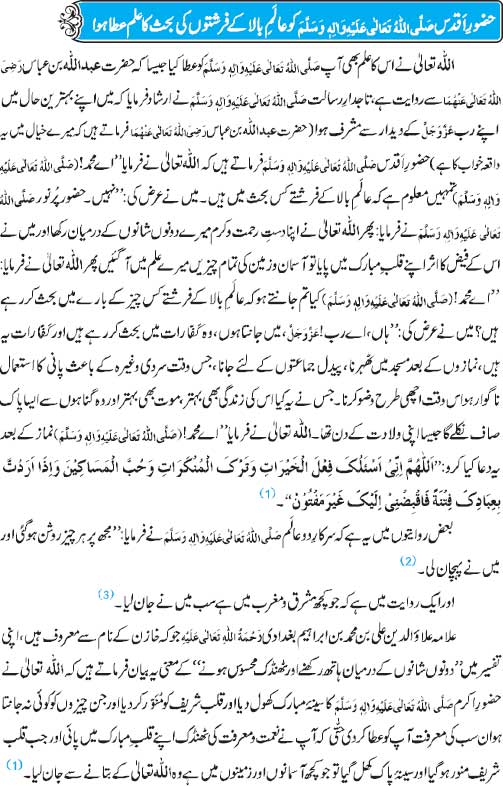
Huzoor-e-Aqdas Ka Ilm
Man Without His Front Two Teeth
His name was Abu Ubaida ibn al-Jarrah and he was the ninth person to accept Islam. Participating in all of the battles led by Prophet Muhammad, during the first two caliphates he was the commander of an army in Syria and Iraq.
An incident occurred at the battle of Uhud which explains the title of this article.
Abu Bakr said, “The Prophet was injured in the battle of Uhud. A couple of links from his own helmet had pierced through his forehead, which was bleeding. I ran towards him, and then suddenly, what I should see but a friend
running towards him from the east. He raced him before me and I saw that it was the self-sacrificing Abu `Ubaidah bin Al-Jarrah.
He requested that I should give him the honor of removing the links from the helmet. With great care and at the same time with great force, he lost a tooth in the process. Then without bothering about the pain, he must be suffering, again he held on to the other link with his teeth and exerted force. As the other link came out, he lost another tooth as well. Thus two of his teeth were sacrificed, but his beloved Prophet was found relieved and comfortable.
It seemed as if he looked even more handsome and graceful than before with the loss of his two teeth because it was done for the love of the Prophet. All the other companions used to look at him with envious eyes. There the only criterion for judging the worth of a person was the extent to which he was willing to sacrifice himself for the Prophet.”
[Ref: Ghandanfar, Commanders of the Muslim Army]
NB. One of the customs of the Arabs in that era was to have a gap between their front two teeth. It was considered a sign of beauty. The comment in the quote about him looking more beautiful doesn’t relate to this custom of having a gap between one’s front teeth, but more because of the reason, it was done i.e. to help remove the links from the helmet.
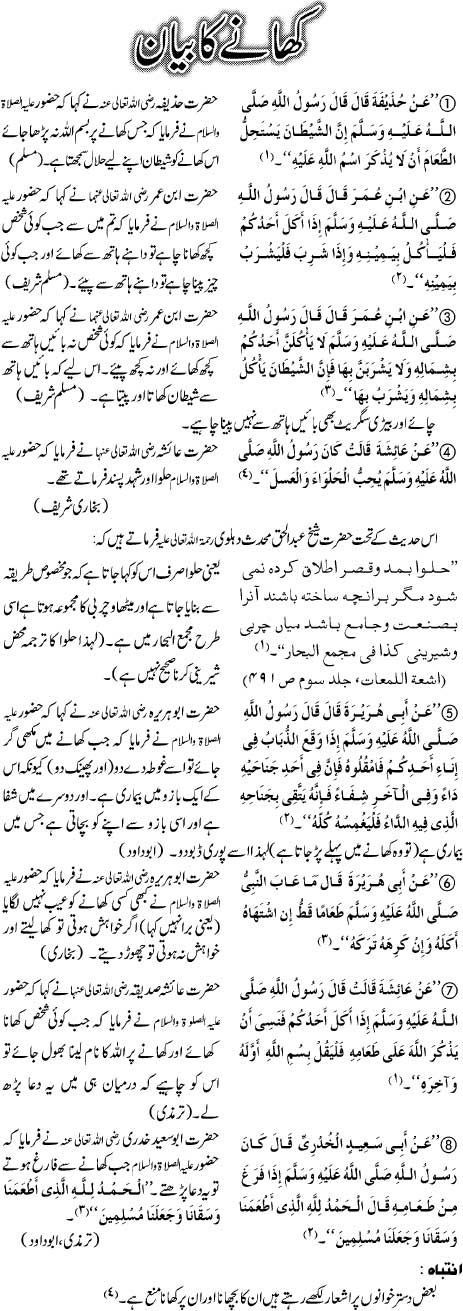
Khane Ka Bayan
Al’Aleem- The All-Knowing
Both East and West belong to Allah, so wherever you turn, the Face of Allah is there. Allah is All-Encompassing, All-Knowing. (Surat al-Baqara, 2:115)
After people begin to think, they start to learn and, over time, accumulate more and more knowledge. Some specialize in certain fields, such as physics, philosophy, or history. All of this knowledge relates to the verb “to know,” as we understand it. However, this verb also has a dimension that is far beyond humanity’s grasp: how Allah knows things.
Allah, being the Creator, holds the knowledge of the heavens, Earth, and every being in between, as well as of all the laws regulating the universe and anything that happens, regardless of time or place. Moreover, His knowledge is boundless, for He knows the names of all new-born babies at any moment, every leaf falling from every tree, what will happen to each star in each galaxy, whatever happens in space at any moment, what is hidden in every living thing’s DNA, and an infinite number of other things.
We must always keep the following fact in mind: In addition to what has been mentioned above, Allah knows all of our thoughts and our most secret acts. We assume that we alone are aware of our feelings, thoughts, or distress. But this is a delusion, for Allah, Who holds complete control over every point of the universe, knows what is in each person’s mind and everything else. Indeed, the Qur’an informs us about Allah’s infinite knowledge:
You will not attain true goodness until you give of what you love. Whatever you give away, Allah knows it. (Surah `Al Imran, 3:92)
Do you not see that everyone in the heavens and Earth glorifies Allah, as do the birds with their outspread wings? Each one knows its prayer and glorification. Allah knows what they do. (Surat an-Nur, 24:41)
And the sun runs to its resting place. That is the decree of the Almighty, the All-Knowing. (Surah Ya Sin, 36:38)
See how they wrap themselves round, trying to conceal their feelings from Him! No, indeed! When they wrap their garments round themselves, He knows what they keep secret and what they make public. He knows what their hearts contain. (Surah Hud, 11:5)
But they will never ever long for it, because of what they have done. Allah knows the wrongdoers. (Surat al-Baqara, 2:95)
You did not kill them; it was Allah Who killed them. You did not throw when you threw; it was Allah Who threw: so He might test the believers with this excellent trial from Him. Allah is All-Hearing, All-Knowing. (Surat al-Anfal, 8:17)
Infaq Fi Sabilillah

What Do Muslims Believe About Jesus?
Muslims respect Jesus (peace be upon him) and await his second coming. They consider him one of the greatest of God’s messengers to mankind…
A Muslim never refers to him simply as ‘Jesus’, but always adds the phrase “peace be upon him.” The Qur’an confirms his virgin birth (a chapter of the Qur’an is entitled ‘Mary’) in her time, and Mary is considered the purest woman in all creation. The Qur’an describes the creation of Jesus as follows:
“Behold! the angels said, `God has chosen you, and purified you, and chosen you above the women of all nations. O Mary, God gives you glad tidings of a word from Him, whose name shall be the Messiah, Jesus son of Mary, honored in this world and the Hereafter, and one that shall speak to the people from his cradle and in maturity, and shall be of the righteous.’ She said: ‘O my Lord! How shall I have a son when no man has touched me?’ He said: `Even so; God creates what He wills. When He decrees a thing, He but says to it, “Be!” and it is.” (Qur’an 3:42-47)
Jesus (peace be upon him) was born miraculously through the same power which had brought Adam (peace be upon him) into being without a father:
“Truly, the likeness of Jesus unto Allah is as the likeness of Adam. He created him of dust, and then said to him, ‘Be!’ and he was.” (Qur’an 3:59)
During his prophetic mission, Jesus (peace be upon him) was granted and performed many miracles. The Qur’an tells us that he said:
“I have come to you with a sign from your Lord: I make for you out of the clay, as it were, the figure of a bird, and breathe into it and it becomes a bird by Allah’s leave. And I heal the blind and the lepers, and I raise the dead by Allah’s leave.” [Qur’an 3:49]
Other miracles include speaking soon after birth in defense of his mother’s piety. God’s other gifts to him included healing the ones born blind and the sick, reviving the dead, and, most importantly, the message he was carrying. These miracles were granted to him by God to establish him as a prophet. According to the Qur’an, he was not crucified, but only appeared so; instead, Allah took him up to Himself; (Qur’an, Chapter Al-Nisa)
Neither Muhammad (peace be upon him), nor Jesus (peace be upon him), came to change the basic doctrine of the belief in one God, brought by earlier prophets, but to confirm and renew it. In the Quran Jesus (peace be upon him), is reported as saying: that he came
“To attest the law which was before me.
And to make lawful to you part of what was forbidden you; I have come to you with a sign form your Lord, so fear God and obey me.” (Qur’an 3:50)