

A Chance That Must Not Be Missed
Allah forgives all sins. Therefore, people should make haste and repent of their sins so that they could earn His forgiveness. It calls on them to heed its call: come on all of you, then! Come on “before the suffering comes upon you, for then you cannot be helped.”
Should the chance be missed, there can be no help. The chance is open now, but its duration cannot be guaranteed. In fact, it can terminate at any moment of the night and day. Therefore, come on and “Follow the best that has been revealed to you by your Lord,” which is this Qur’an that you now have at your fingertips, “before the suffering comes upon you of a sudden, without your being aware of it.”
Come on now before it is too late. Otherwise, you will regret missing the chance and ridiculing God’s promise: “lest anyone should say: Woe is me for having neglected what is due to God, and for having been one of those who scoffed (at the truth).”
Alternatively, someone may say that God condemned him to be in error: had He decreed that he would follow divine guidance, he would have been a God-fearing person: “or lest he should say: ‘If God had but guided me, I would surely have been among the God-fearing.”
This is a baseless excuse: the chance is offered to everyone, the means are available to all, and the gates are wide open. Yet people deliberately miss out: “Or lest he should say when faced by the suffering (that awaits him): If only I could have a second chance in life, I will be among those who do good.” This is something that will never be given. Once this life is over, no return is allowed. All people are now at the stage when they can do what they want. If they miss this chance, all is lost. They will be held to account, and they will be rebuked: “Yes, indeed! My revelations did come to you, but you rejected them. You were filled with false pride and had no faith at all.”
At this point, when the surah has brought our feelings and hearts to the Day of Judgment, it shows us the two contrasting images of the unbelievers and the God-fearing on that momentous day: “On the Day of Resurrection you will see those who invented lies about God with their faces darkened. Is not there in hell a proper abode for the arrogant?
But God will deliver those who are God-fearing to their place of safety: no harm shall afflict them, nor shall they grieve.”
This is the final end: one group has faces darkened by humiliation, sorrow, and the scorches of hell. These are arrogant who, during their lives in this world, were called to turn to God and believe in Him, and the chance was kept open for them even after they went far into sin, but they refused to pay heed.
Now, on the Day of Judgment, they are left in utter humiliation that shows in their faces. The other group is the winner who will not be touched by grief or affliction. These are the God-fearing who, during their lives on earth, paid heed to God’s warnings and hoped for His mercy. They are the ones who will be safe: “No harm shall afflict them, nor shall they grieve.”
With all issues made abundantly clear, let everyone choose what they want. They can either respond to the call and enjoy God’s grace they are certain to find just behind the open gate of repentance, or they can persist in disobedience until the suffering takes them unawares.
God’s oneness, from the angle of the oneness of the Creator who created and controls everything. This serves to show how singular the unbelievers’ offer to the Prophet was that he should join them in worshipping their idols in return for them joining him in worshipping God.
Since God is the Creator and Controller of all, how could anyone be worshipped alongside Him? “No true understanding of God have they,” when they associate partners with Him when He has sway over all and everything, subjecting them all to His will: “on the Day of Resurrection, the whole earth will be a mere handful to Him, and the heavens will be rolled up in His right hand.”
As this image of the Day of Judgment is shown here, the surah presents a unique scene of that day, culminating with the angels surrounding God’s throne, extolling their Lord’s glory and praise. The entire universe joins them in their praises: “All praise is due to God, the Lord of all the worlds.” This is, then, the decisive word on the issue of God’s oneness.
by Adil Salahi
Permission is granted to circulate among private individuals and groups, to post on Internet sites and to publish in full text and subject title in not-for-profit publications.
Reply
Reply to this message…
See
Hijrat-e-Habsha

What Lesson We Learn From This Hadith Qudsi
What lesson do we learn from this hadith Qudsi?[1:1] In the name of GOD, Most Gracious, Most Merciful
[31:6] Among the people, there are those who uphold baseless Hadith, and thus divert others from the path of GOD without knowledge, and take it in vain. These have incurred shameful retribution.
According to our scholars (ulama), “Hadith Qudsi” are the sayings of the Prophet Muhammad as revealed to him by God Almighty. Hadith Qudsi (or Sacred Hadith) are so named by them because, unlike the majority of Hadith which are “Prophetic” Hadith, their authority (Sanad) is traced back not to the Prophet but to God. In other words, like the Quran, Hadith Qudsi is the revelation from God but not included in the Quran!
The following is one such ” sacred” hadith posted by the attached article:
Narrated Abu Said Al-Khudri (r.a.). He quoted Prophet Muhammad (s.a.w.s.) as saying to his Companions that: a man from among the early people or from those before you had said a word, i.e. Allah had blessed him with wealth and sons. When death approached him, he asked his sons: How was I being as a father? They replied: You were the best father. He said: I didn’t save or perform any good deeds for Allah. If Allah takes possession of me, He will punish me. So, look! When I am dead, burn me until I become coal then crush me well and scatter (my ashes in the air) on a stormy day. The Prophet (s.a.w.s.) said: He took a covenant from his sons (and died). They did according to his will and spread his ashes in the air on a stormy day. Allah asswajal said: Be and there he was embodied before Him. Allah, the Exalted, asked him: O my slave! What induced you to do what you did? He replied: It was Your fear (so that I may not appear before You). The Prophet (s.a.w.s.) added:
Allah, the Exalted rewarded him with His mercy; the Prophet (s.a.w.s.) said a second time: Allah did not punish him.
(This Hadith is sound and reported by Bukhari and Muslim).
This man was a believer in the Power of Allah assawajal to resurrect and punish. His belief and fear caused him to make that will which led him to Allah’s forgiveness.
So, according to the above Hadith Qudsi, we can understand the following:
- Allah blessed a man with money and children
- He was the best father to his children
- He did not perform any good deeds for Allah
- As death approached, he realized that he will be punished by Allah
- He was scared and asked his sons to destroy his body after his death to avoid Allah’s punishment
- Allah forgave him because he was afraid to face Allah.
According to the above understanding of the Hadith Qudsi, we can draw the following conclusions:
- Money and children may not be a test
- You may not have to do good deeds even you are capable of doing so
- It is acceptable if you fear Allah at the approaching death
- It is acceptable if you think Allah cannot resurrect you if your body is destroyed
Now, please read and reflect on the following verses of the Quran!
[64:15] Your money and children are a test, and GOD possesses a great recompense.
[63:10] You shall give from our provisions to you before death comes to you, then you say, “My Lord if only You could delay this for a short while! I would then be charitable and join the righteous!”
[2:254] O you who believe, you shall give to charity from the provisions we have given to you before a day comes where there is no trade, no nepotism, and no intercession. The disbelievers are unjust.
[4:18] Not acceptable is the repentance of those who commit sins until death comes to them, then say, “Now I repent.” Nor is it acceptable from those who die as disbelievers. For these, we have prepared a painful retribution.
[17:49] They said, “After we turn into bones and fragments, we get resurrected anew?!”
[17:50] Say, “Even if you turn into rocks or iron.
[17:51] “Even if you turn into any kind of creation that you deem impossible.” They will then say, “Who will bring us back?” Say, “The One who created you in the first place.” They will then shake their heads and say, “When will that be?” Say, “It may be closer than you think.”
So, what is the lesson we learn after reviewing a Qudsi Hadith in the light of the Quran?!
[31:6] Among the people, there are those who uphold baseless Hadith, and thus divert others from the path of GOD without knowledge, and take it in vain. These have incurred shameful retribution.
[45:6] These are God’s revelations that we recite to you truthfully. In which Hadith other than GOD and His revelations do they believe?
Thank you and may God guide us.
Padh Musalman Padh
Prophet Yunus (Alaih Assalaam)
Prophet Yunus(Alaih Assalaam) was sent by Allah to a big town where the people had forgotten Allah’s orders and did many things which Allah had forbidden. You should believe only in Allah and obey only Him, Yunus told them. You should worship Him alone and do good, otherwise, a severe punishment will come upon you!
But Yunus(Alaih Assalaam) soon discovered that the people did not want to listen to him. He left the tow. Afterward, Yunus decided to go across the sea and boarded a ship for the voyage. But when the ship was in the middle of the ocean, Yunus (Alaih Assalaam) suffered a great misfortune. He was thrown overboard and swallowed up by an enormous fish. Fortunately, though, the fish had swallowed Yunus (Alaih Assalaam) in one big gulp, so he landed in its stomach unhurt.
It was very dark inside the fish’s stomach, and Yunus (Alaih Assalaam) grew very fearful. In his loneliness, he started to think over what had happened in the town and came to realize that he should not have acted so hastily and in such a quick-tempered manner. Instead, he should have stayed and kept on speaking to the people and ask them to return to Allah.
In this despair, Yunus (Alaih Assalaam) started to pray with all his heart to Allah. He said “O Allah, there is no God apart from You. You alone do I praise and honor. I have done wrong; if You do not help me, I shall be lost forever.”
Allah hears the prayers of those who pray to Him and those who believe in Him. Allah heard Yunus’s prayer, and he caused Yunus (Alaih Assalaam) to come out of the fish’s stomach, and to be swept by the waves of the sea onto the shore. Poor Yunus (Alaih Assalaam) was in a terrible state and lay on the shore, weak, ill and helpless. He felt dreadfully miserable, but Allah caused a tree to grow and this tree provided Yunus (Alaih Assalaam) with shade and nourishing fruits. Before long, Yunus (Alaih Assalaam) had recovered his health and strength.
When he was better, Allah sent Yunus (Alaih Assalaam) back to the town. This time, though, the people there listened to Yunus (Alaih Assalaam) when he told them: You should believe in Allah and worship Him alone. You must do good.
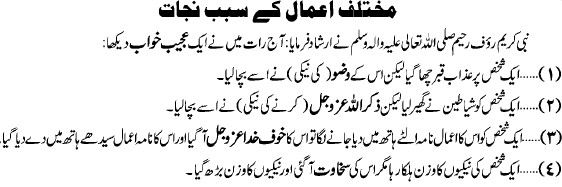
Mukhtalif Aamaal Kay Sabab Nijaat
Du’a And Humbleness Before Allah, The Almighty
Du’a has a grand status in Islam. It is the foundation for all worship. It is the greatest obedience and most beneficial way to draw close to Allah.
The Qur’an begins and ends with a Du’a. Allah says in the Qur’an: ((And your Lord says, “Call upon Me; I will respond to you.” Indeed, those who disdain My worship will enter Hell [rendered] contemptible.)) (40:60). There is also a well-known Hadith that “Du’a is (a form) of worship.” (Jama’i Tirmidhi)
My dear brothers and sisters in Islam, Du’a is an act of humility and a great need of the Son of Adam from cradle to grave.
When one’s Iman in the Names and Attributes of Allah increases, his need of Him increases and he calls on to Him in all circumstances. Du’a is the greatest blessing and most exceptional guidance.
Allah says in the Qur’an: ((So We responded to him, and We gave to him (Yahya), and amended for him his wife.
Indeed, they used to hasten to good deeds and supplicate Us in hope and fear, and they were to Us humbly submissive.)) (21:90)
Allah loves those who call on Him. He loves to see them expressing their wants, even though He is not in need of their worship and obedience.
The reality of Du’a and Qadr (Pre-decree)
Allah, the Almighty averts pre-decree through Du’a. There is a deep connection between faith in Allah and faith in Pre-decree, good and evil.
The first and the last beliefs work like a thermometer. What is meant by this analogy is that the greater the body temperature the greater the rise in mercury. Greater the heart’s understanding of the Names and Attributes of Allah, greater will be the acceptance of Qadr which will eventually lead to the contentment of the heart and dependence on Allah only.
Allah’s Messenger (peace be upon him) said: “Nothing averts the decree except supplication and nothing but piety prolongs life.” (Tirmidhi) In another Hadith, it is mentioned “Caution will not benefit against predestination, but Du’a benefits (matters) that have occurred and those that are (yet) to occur, And indeed, Du’a meets with a calamity, and fights it until the day of Judgment.” (Narrated by Hakim).
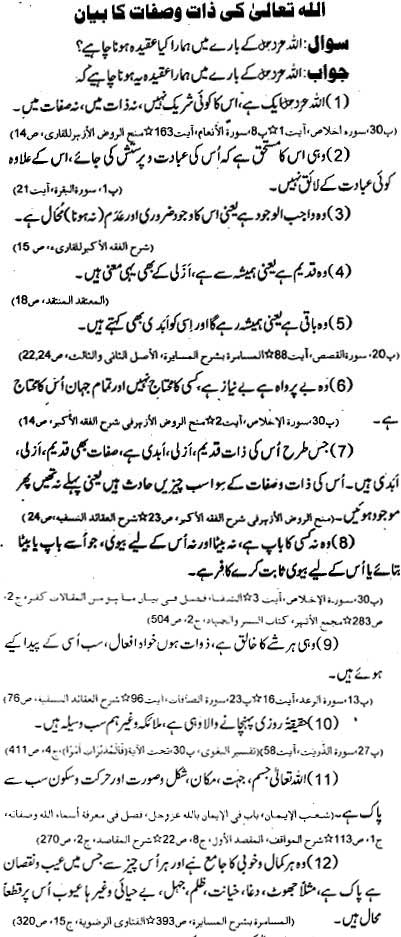
Allah Tala Ki Zaat Aur Sifaat
Does Allah Accept A Person’s Repentance
Does Allah accept a person’s repentance every time he sins and repents, even if he does that many times?
Allah says (interpretation of the meaning): And those who, when they have committed Faahishah (illegal sexual intercourse) or wronged themselves with evil, remember Allah and ask forgiveness for their sins; and none can forgive sins but Allah, and do not persist in what (wrong) they have done, while they know.
136. For such, the reward is forgiveness from their Lord, and Gardens with rivers flowing underneath (Paradise), wherein they shall abide forever. How excellent is this reward for the doers (who do righteous deeds according to Allah’s Orders)
[Aal Imraan 3:135-136]
Ibn Katheer said: The words ‘and do not persist in what (wrong) they have done’ mean: they repent from their sins and quickly turn to Allah, and they do not persist in their sin, rather they give it up, and if they do that again they repent to Him.
Tafseer Ibn Katheer, 1/408.
It was narrated that Abu Hurayrah said: I heard the Prophet (peace and blessings of Allah be upon him) say: ‘A person committed a sin and said: ‘My Lord, I have sinned; forgive me.’ His Lord said: ‘Is My slave acknowledging that he has a Lord Who forgives sins and punishes for them, I have forgiven My slave.’ Then as much time passed as Allah willed, then he committed a sin and said, ‘My Lord, I have sinned; forgive me.’ His Lord said: ‘Is My slave acknowledging that he has a Lord Who forgives sins and punishes for them, I have forgiven My slave.’ Then as much time passed as Allah willed, then he committed a sin and said, ‘My Lord, I have sinned; forgive me.’ His Lord said: ‘Is My slave acknowledging that he has a Lord Who forgives sins and punishes for them, I have forgiven My slave,’ “three times”.
Narrated by al-Bukhaari, 7507; Muslim, 2758.
Al-Nawawi (may Allah have mercy on him) included this hadeeth under the heading: ‘Acceptance of repentance from sins even if the sins and repentance happen repeatedly.’
He said in his Sharh: We have already discussed this issue at the beginning of the Book of Repentance. These ahaadeeth clearly point to that, and even if the sin is repeated a hundred times or a thousand times or more, and he repents each time, his repentance will be accepted and his sin will be erased. And if he repents once from them all, his repentance will be valid.
Sharh Muslim, 17.75.
Ibn Rajab al-Hanbali said: ?Umar ibn ‘Abd al-‘Azeez said: O people, whoever commits a sin, let him seek the forgiveness of Allah and repent, and if he repeats it, let him seek the forgiveness of Allah and repent, and if he repeats it, let him seek the forgiveness of Allah and repent, for it is like chains around the neck of man, and doom lies in persisting in it.
What this means is that a person will inevitably commit the sins that it is decreed he will commit, as the Prophet (peace and blessings of Allah be upon him) said: ‘The son of Adam’s share of zina is decreed for him, and he will inevitably come to that, But Allah has given him a way out from the sins that he falls into and He erases them by means of repentance and seeking forgiveness. If he does that then he will escape from the evil of sin, but if he persists in his sin he will be doomed.
Jaami’ al-‘Uloom al-Hakam, 1/165.
Although Allah hates sin and warns of punishment for it, He does not want His slaves to despair of His mercy. He likes the sinner to seek His forgiveness and repent to Him, but the Shaytaan likes it when despair fills a person’s heart and prevents him from repenting and turning to Allah.
It was said to al-Hasan al-Basri: Would not any one of us feel ashamed before his Lord to seek forgiveness from his sin then go back to it, then seek forgiveness then go back to it. He said: The Shaytaan would like you to feel that way; never give up seeking forgiveness.