

The Most Exclusive Blessings Is Ramadan From Allah
Sahl Ibn Sa’d radi Allahu anhu narrates that RasulAllah sal Allaahu alayhi wa sallam said: “In Jannah, there is a gate called Ar-Rayyan: a door which the Saa’imoon will enter from, no one else except them. It will be announced, ‘Where are the Saa’imoon?’ and the Saa’imoon will stand. No one except them will enter from the gate called Rayyan.”
Have you ever heard of a weekend warrior? They are employees who sit in cubicles and relax at a coffee station, weighed down with donuts all week long. Then on the weekend, they rip off their suits bearing their Reebok gear underneath and spend the entire weekend playing basketball, hang gliding, and mountain climbing. What happens? They break their knees, pull a dozen muscles, and are hospitalized on Monday.
This is in relation to the physical body. But there are people that should be known as Ramadan warriors. They are those that haven’t fasted all year long and then shock their bodies with a whole month. Or haven’t prayed in the masjid or haven’t woken up to pray in the night all year long. What happens to them? As one Muslim doctor said, “In normal days, we have about 5 to 7 patients a day. On the first day of Ramadan, the patients increase to over 50!”
Ramadan warriors were rare in our Islamic history. To illustrate, let’s all remember where we were at the beginning of Safar. We were probably praying for work to end, or just finished up with exams, or looking through brochures for a holiday getaway.
Interestingly, if we were sitting beside a Tabi’oon over a thousand years ago in a simple masjid, we would have heard him raising his hands asking Allah to grant him the blessing of being around when a guest comes, a guest called Ramadan!
There are different ways that we can ‘warm up’ for Ramadan. One of those ways is by increasing the frequency of our du’a. Allah subhaanahu wa ta’aala says in the Qur’an, with the verse before it talking about Ramadan and the verse after it speaking about Ramadan, and right in the middle we read:
And when My servants ask you, (O Muhammad), concerning Me – indeed I am near. I respond to the invocation of the supplicant when he calls upon Me. So let them respond to Me (by obedience) and believe in Me that they may be guided (Al-Baqarah 2/186).
Every goodness on earth is from Allah. And one of the most exclusive blessings is Ramadan. So let us ask the Lord of Ramadan to help us find His mercy in the coming days.
The early generations of the ummah used to make du’a 6 months after Ramadan that Allah accept their deeds in Ramadan. And for the next 6 months, they would make du’a to Allah to grant them the blessing of being alive in the coming Ramadan.
Cleanliness – Whenever a guest comes, we prepare in advance for his arrival by vacuuming the carpet, dusting the shelves, and scrubbing the sinks. We should do this for our guest called Ramadan. But the scrubbing should not just be of our physical surroundings; it should include the scrubbing of our sins.
Listen to the words of RasulAllah sal Allaahu alayhi wa sallam speaking about those people that don’t want to clean up for Ramadan:
“Whoever doesn’t desist from speaking falsehood and acting upon it, Allah has no need that he desist from his food and drink” (Bukhari).
Fasting in Sha’baan (the month before Ramadan) – The biggest downfall of the weekend warriors was that they were not properly warmed up for the exercise, which caused the injuries. Similarly, when fasting, some people only do it once a year, making their bodies very foreign to going without food and drink.
From here we see the following Sunnah: Umm Al-Mu’mineen Aisha radi Allahu anha observes, “Allah’s Messenger never fasted an entire month other than Ramadan and I haven’t seen him fast more than he did in Sha’baan.”
When we look at the celebrations of ‘the holy days’, we see that they put all their time and effort, and spirit into preparation. I tell you, go to any store outside this masjid and you will see preparations of candy canes, red and green bouquets, even eggnog all in the wait for the annual celebration of the birth – as they falsely claim- of Prophet ‘Eesa alayhis salaam. They are preparing for their falsehood almost 2 months in advance! One of the ways to prepare for Ramadan is to educate ourselves in the Fiqh of Ramadan. Alhamdulillah, sitting in this masjid today are many brothers and sisters for whom this will be their first Ramadan. Allahu Akbar! May Allah accept it from them and allow them and us to share in the blessing of Ramadan for many years to come.
Let us briefly review what fasting is:
Fasting in Ramadan is not optional – it is a must. The evidence for this is found in the Qur’an and Sunnah. Allah says:
O you who believe! Observing as-sawn (the fasting) is prescribed for you as it was prescribed for those before you, that you may become al-muttaqoon (the righteous) (Al-Baqarah 2/183).
The Prophet said: “Islam is built on five (pillars)…” among which he mentioned fasting in Ramadan (Bukhari).
The Arabic word for fasting is sawm. In Arabic, it literally means to abstain from something. And in Islamic Law, it is to abstain from those things that break the fast starting from dawn (Fajr prayer) and ending with sunset (Maghrib prayer) having first made the intention to do so.
The things which break one’s fast, the things which he or she must abstain from, from dawn to sunset, are as follows: eating and drinking, and marital relations.
These apply if 3 conditions are met: that the person is not ignorant that this thing breaks one’s fast, that he is aware that he is doing something that breaks his fast (meaning he did not do so in forgetfulness), and he does so out of his free will and no one forced him to break his fast.
In conclusion, as the month of Ramadan draws nearer, we should prepare for this special guest by preparing a Ramadan program (‘Operation: Valuable Time’) in our homes and at our masajid. The program should include:
1. Locked times of the day when we will consistently recite the Qur’an, learning its meanings and memorizing new surahs.
2. Something useful for the time before Taraweeh prayers and the time after Taraweeh. And how to increase our worship in the last ten nights – i.e. what will we do extra.
3. We should make sure that there are days of this month when we feed people. Bring dates or milk to the masjid for Maghrib. Invite people over to have dinner with your family. Organize a dinner in the masjid and invite people that don’t normally get invited because they are new. Take care of the new Muslims in your community and for the sake of Allah ta’aala make their Ramadan special.
4. Make the intention to double and triple the amount of sadaqah we give, the worship we normally do, the dhikr we do, and the deeds that’ll help us purify our souls.
5. And finally, for those that can afford it, plan an Umrah to the Ka’bah in Ramadan!
After returning from the Farewell Hajj, RasulAllah sal Allaahu alayhi wa sallam saw an Ansari woman who had not made the Hajj. He asked her, “What kept you back from joining in the Hajj?”
She said, “We had a camel that we used to ride which Abu Fulan and his son went on, and another we used for farming.”
So, RasulAllah sal Allaahu alayhi wa sallam said, “Verily, Umrah in Ramadan is the same (reward) as performing Hajj with me” (Bukhari and Muslim)!
khushkhabri Do Nafratein Na Phelao
The Demise Of Fatimah Radhiyallahu Anha
Fatimah was the youngest daughter of the Prophet, peace, and blessings be upon him, and her mother was Khadijah Bint Khuwailid. Fatimah was born five years before prophethood, i.e. before Muhammad, peace, and blessings are upon him, was sent as Allah’s Prophet.
She was engaged to `Ali Ibn Abu Talib, may Allah be pleased with him, in the second year after Hijrah (the Prophet’s Migration to Madinah) in Ramadan, then they got married in Dhul Hijja. She gave birth to Al-Hasan, Al-Husain, Zainab, Umm Kulthum, and Muhsin who died when he was a child.
She was very dear to the Prophet, peace, and blessings be upon him. `A’ishah, may Allah be pleased with her, narrated: “Fatimah, may Allah be pleased with her, was coming towards our home, walking exactly like the Prophet, peace, and blessings be upon him. The Prophet said: ‘Welcome, my daughter!’ He seated her to his right or left. Then he told her something in secret, and she cried. I (`A’ishah) said to her: ‘The Prophet discloses his secrets to you and you cry, how come? Then the Prophet, peace, and blessings be upon him, told her another thing in secret and she laughed. Hence I (`A’ishah) said: ‘I’ve never seen a sad mood turning in a moment to happiness as I see today’. I asked her about what the Prophet told her, but she said: ‘I am not to reveal the secrets of Allah’s Messenger, peace and blessings be upon him.’
Later on, when the Prophet, peace, and blessings be upon him, passed away, I asked her again. She answered: He (the Prophet) told me: ‘Gabriel used to reveal the Qur’an to me once a year. Yet he did it twice this year. So I think it is a sign that my days are numbered, and you will be the first one of my folk who will die after me. What a good predecessor I am to you!’ Hence, I cried. Then he told me: ‘Doesn’t it gladden you to be the master of believing women in Paradise?’ Hence, I laughed.” This incident is agreed upon.
It is said that she never laughed after the Prophet’s demise out of overwhelming sadness and eagerness to follow her father, peace, and blessings be upon him.
Fatimah, may Allah be pleased with her, died on the third of Ramadan, the night of Tuesday, 11 A.H. May Allah be pleased with her.
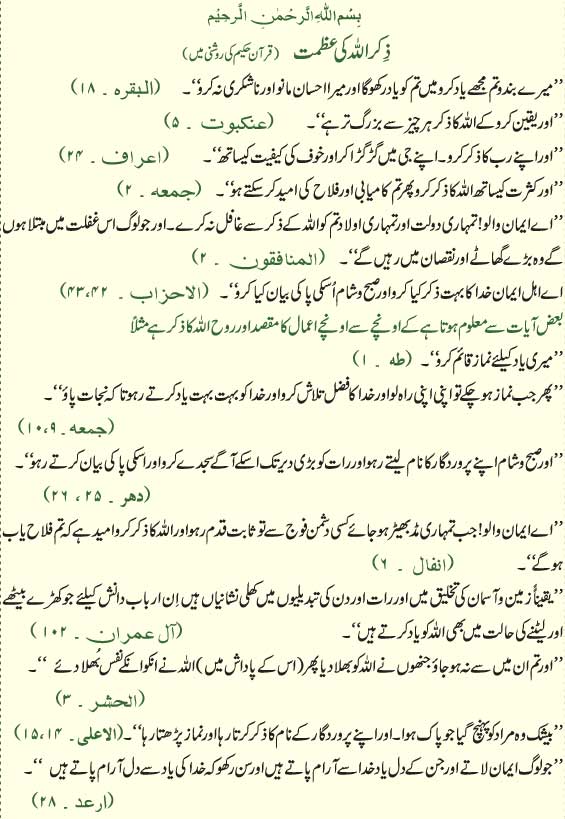
Zikr Allah Ki Azmat
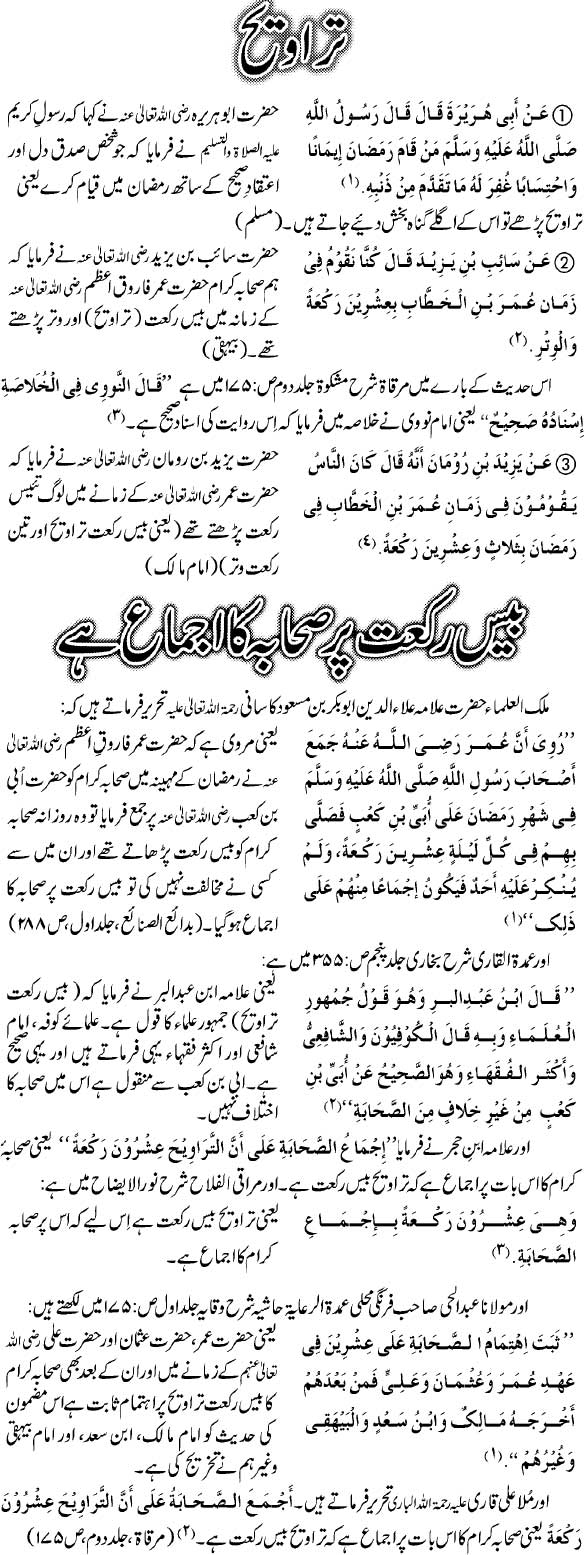
Namaz-e-Taraweeh Aur Rakat
Preparation Of Ramadan
Every Muslim should prepare himself/herself to welcome the blessed month of Ramadan by strengthening his relationship with the Qur’an, busing himself with the spirit of fasting, and recharging his spiritual battery to prepare himself to make the whole blessed month of Ramadan a real occasion of sincere obedience.
Ramadan is an event that occurs in the life of the faithful, as individuals and as an ummah, once a year. It is intended by Allah to help us to recharge our spiritual batteries and thus prepare us for the great mission of realizing his will on earth. Therefore, in order to benefit from Ramadan, we may do well to prepare for it by opening our hearts and minds to embrace it. let me offer a few tips:
1… We should empower ourselves by learning as much as we can about the precise laws as well as the benefits of fasting.
2… We should ensure that we gain true benefits from our fasting, let us make sure to realize the spirit of fasting: this can only be done by abstaining, not only from food, drink, and sex, but also by strictly restraining our minds, hearts as well as our eyes, ears, hands, tongue, and so on.
3… We must embrace the spirit of fasting as stressed in hadith: to be charitable and compassionate as much as we can.
4… We should strengthen our relationship with the Qur’an; for Ramadan is the month of the Qur’an.
5… We should engage in dhikr and condition ourselves to make it second nature.
6… Last but not least, we should build up our community through acts of charity and compassion and extending help to those in need as much as we can.
Let us pray that we come out of Ramadan with our faith recharged, gaining strength in our faith and commitment and relationship with Allah.
Ya Allah!
Surely we have heard a preacher calling to the faith,
Saying: believe in your Allah, so we did believe;
Ya Allah!
Forgive us therefore our faults,
And cover our evil deeds and make us die with the righteous.
Ya Allah!
Grant us good in this world and good in the hereafter,
And save us from the chastisement of the fire.
Ya Allah!
Accept from us;
Surely thou art the Hearing, the Knowing
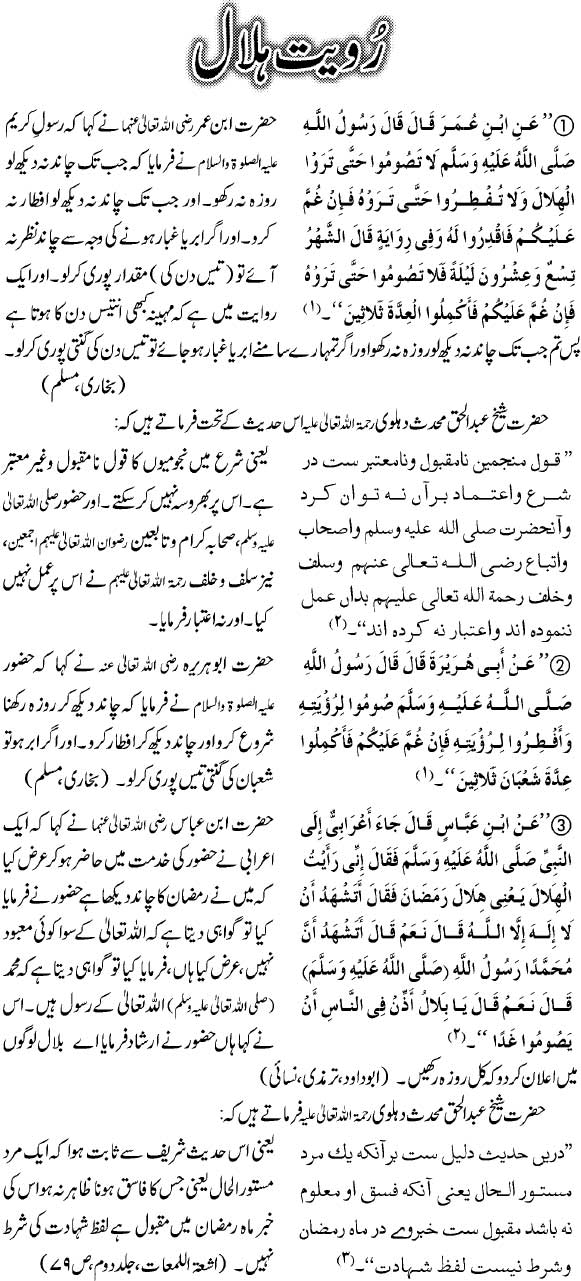
Ramadan: Ruet-e-Hilal
10 Goals To Set For This Ramadan
1. Eat, drink, and be moderate
Almost all of us do it – once Iftar time hits, we just keep plowing food and drink into our mouths till it’s hard to move afterward. And those of us who do it know this is totally contrary to the spirit of Ramadan, through which we’re supposed to learn self-control, not self-indulgence. Let’s try to stick to the Prophetic rule on eating: fill our stomachs with one-third of food, one-third water, and one-third breathing space, even in Ramadan.
2. Give a dollar a day in charity…or five or ten
The Prophet Muhammad, peace and blessings be upon him, was always generous but even more so in Ramadan. Let’s open our hearts and dig a little deeper in our wallets this year. Even less than a dollar a day adds up. Whatever you can give, it’s the intention that counts.
3. Memorize 4 new Surahs
Memorizing the Quran often seems like a daunting task. But the key is doing it in small bites. Since there are four weeks in Ramadan, try to memorize one new Surah a week. Start off with a short, easy one. Once you’ve started, you’ll build momentum and may even want to memorize a longer one the following week.
4. Go to Tarawih prayers
Post-Iftar, the first urge is to sleep after an exhausting day. But try your best to head out to the mosque for Tarawih prayers. Praying alone is wonderful, but doing it in the congregation is fantastic. The community spirit is part of Ramadan’s blessings. Don’t miss it this year. If going every day is not possible, try going at least one week.
5. Attend the Tarawih prayer in which the recitation of the Quran will be finished
Call the local mosque and find out which day the Imam will be finishing the recitation of the Quran in prayer. Attend to not only hear part of the Quran’s recitation in prayer but also participate in the heart-rending Duas that follow it.
6. Stop swearing and/or backbiting with a special box
It’s hard not to shoot our mouths off when someone’s upset us. Whether we utter those four-letter words or backbite about someone to our family and friends, we know this isn’t the God-approved way of letting off steam. In Ramadan, when we want to build our spirituality, we’ve got to wage Jihad against our bad habits.
Try this: get a box and every time you catch yourself swearing or backbiting put some money in it. It could be a buck or less. The point is to choose an amount that makes it feel like punishment.
At the end of the month send the money to a charity or buy a gift for the person whom you’ve backbitten the most against.
7. Call/email your relatives
You’d think that given the easy access to email, competitive long-distance calling rates, phone cards, etc. these days, we’d keep in touch with family and friends more often. But the opposite seems to be the case, as we get caught up in life’s “busyness.”
Strengthening ties with family members and keeping in touch with friends is part of our way of life and an act Allah is very pleased with. This Ramadan, call family and friends or at least email them a Ramadan card and ask them how their fasting is going.
8. Go on a technology diet
Even if you work in the IT industry, you can do this. Avoid checking personal email and surfing the web during your fast. After Iftar, instead of plopping yourself in front of the screen, go to Tarawih. The same goes for the television. The point is to try to give our full attention to spiritual elevation this month.
9. Read 5 minutes of the Quran a day…just five, not more, not less
Even if you feel you’ve got absolutely no time, set a timer or the alarm on your cell phone and find a relatively quiet place. You can read the first page of the Quran you open or follow a sequence. The choice is yours. The point is simply to connect with God through His revelation in the month of the Quran.
10. Forgive everyone who has hurt you
Still, got a festering wound from the fight with your friend last year? Still upset about something your spouse said during a heated argument? Or are you still bitter about the way your parents sometimes treated you as a kid? Let go of the anger and pain this Ramadan and forgive those who have hurt you. Forgiving someone is not only good for the body, but it’s also great for the soul. And in Ramadan, ten days of which are devoted to Allah’s forgiveness, shouldn’t we lesser beings forgive too?
If you find it very difficult to forgive everyone, forgive at least three people.