

Marriage Between Muslims And Non-Muslims Clearly Prohibited In The Quran and Sunnah
Marriage between Muslims and non-Muslims is something that has been clearly prohibited in the Quran and Sunnah, thus not permissible in any way. The only exception to this general rule is the marriage of Muslim men with Christian and Jewish girls, and that also with certain conditions.
Allah Most High says:
“Do not marry unbelieving women until they believe. A slave woman who believes is better than an unbelieving woman, even though if she attracts you. And not marry (your girls) to unbelievers until they believe. A man slave who believes is better than an unbeliever, even though if he attracts you. Unbelievers do (but) beckon you to the fire but Allah beckons by His grace to the garden (of bliss) and forgiveness, and makes His signs clear to mankind; that they may receive admonition”. (al-Baqarah, 221).
The above verse of the Holy Quran along with many other statements of the Quran and Sunnah clearly mention the impressibility of Muslims marrying non-Muslims. Therefore, a marriage between a Muslim and someone from another religion will not be lawful or even valid according to Islam. The exception, however, is mentioned in the following verse:
“Lawful unto you in marriage are chaste women who are believers and chaste women among the people of the book”. (al-Maidah, 5).
Thus, it would be permissible, in principle, for Muslim men to marry women from the people of the book (ahl al-Kitab) namely Christian and Jewish girls. However, this is also subjected to certain conditions.
The reason behind this is that, marital relationships demand mutual love, affection and intimacy and without this, the purpose of marriage is left unfulfilled. If such close relationship of love and intimacy is established with a non-Muslim, it may emotionally incline a Muslim towards disbelief (kufr) or, at least, the abhorrence of Kufr and Shirk may not remain in the heart. Consequently, it may lead one to disbelief and eventually the fire of Hell. This is why Allah Almighty said towards the end of the verse of Surah al-Baqarah quoted above:
“Unbelievers do (but) beckon you to the fire but Allah beckons by His grace to the garden (of bliss) and forgiveness, and makes His signs clear to mankind; that they may receive admonition”. ( 221). (See: Maarif al-Quran, 1/ 540).
Therefore, the fear that a Muslim man or woman may well be affected with his/her partner’s religion, thus go on to a path that leads to the fire of hell, is the main cause for this prohibition. Hence, a Muslim woman will not be allowed whatsoever to marry anyone besides a Muslim man, and even if she did, the marriage will not be valid in Islam. Similarly, a Muslim man will not be allowed to marry any non-Muslim girl, such as a Hindu, Sikh, Buddhist, or any other non-Muslim woman. However, it will be permissible for him to marry a Christian or a Jewish girl. This is explained in the following section.
Marrying Christian and Jewish girls
Islam has allowed Muslim men to marry women from the people of the book (ahl al-Kitab). This permission is explicitly mentioned in the verse of the Quran already quoted:
“Lawful unto you in marriage are chaste women who are believers and chaste women among the people of the book”. (al-Maidah, 5).
However, there are certain points that need to be taken into consideration here:
Firstly, the exception of Christian and Jewish girls is because the difference in belief between the people of the book and Muslims is relatively lesser and lighter as compared with other non-Muslims. They are all monotheistic religions and known as the Abrahamic faiths. The basic difference between Islam and the other two religions is the belief in the last Messenger of Allah (Allah bless him & give him peace). Therefore, the fear and danger of corruptibility is less as compared to marrying with women from other faiths, thus Islam gave this permission for Muslim men to marry Christian and Jewish girls.
A question may arise here, that if the difference between Muslims and people of the book is considered to be lighter as compared to other faiths, then why is it unlawful for Muslim girls to marry Christian and Jewish men?
The answer to this question is that, women are somewhat weak and emotional by nature. Then the husband has been given a care taking and controlling role over the wife. As such, it is very likely that the Muslim wife may fall prey and become impressed with her husband’s faith. The chances of the husband becoming affected by his wife’s faith are remote, thus the difference between the two situations is clear.
Moreover, by marrying a Christian or a Jewish man, the status of the Muslim wife would be affected, for the wife normally takes the nationality and status given by her husband’s law. A Christian or a Jewish woman marrying a Muslim man would be expected eventually to accept Islam, while the possibility of a Muslim woman changing her faith to that of her husband is very likely. Therefore, only Muslim men were given this permission of marrying with women from the people of the book.
Secondly, women who are Christians and Jews merely by name, and do not really believe in any religion, like a large number of people in the west, cannot be termed as people of the book (ahl al-Kitab). They are atheist in reality and it will not be permissible for Muslim men to marry them.
Therefore, one must first make sure that the woman is truly a believing Christian or Jew, and then consider contracting marriage with them.
Thirdly, it should be remembered that the meaning of the permission of marrying Christian and Jewish women is simply that, if a marriage contract was performed with them, it would be valid according to Islam and the children born out of this wedlock will be considered legitimate.
However, there are various narrations that establish its undesirability. A Muslim man is advised in the Hadith to select a life partner who fully observes the injunctions of Islam, so that she becomes a means of attaining piety. If that is the case, then marrying Christian and Jewish girls would be disliked.
This is the reason why Sayyiduna Umar ibn al-Khattab (Allah be pleased with him) prevented many such marriages in his lifetime because of what he had seen of the corruption that resulted in Iraq and Syria. (See: Muhammad ibn al-Hasan, Kitab al-Athar).
Finally, this permission is only when one is confident that he himself or his children will not be affected by this marriage. In the early days, Muslims were duly equipped with adequate Islamic knowledge and an unshaken commitment towards their religion. As such, there was no risk of the husband being affected by his wife’s religion. Rather, the wife would see the glory of Islam, thus enter into the fold of Islam.
Therefore, if a Muslim male is confident that marriage with a Christian or Jewish girl will have no affect on his and his children’s Islamic identity and commitment, then there is no bar against such marriages. However, if he is not so confident, he must avoid entering into such marriages.
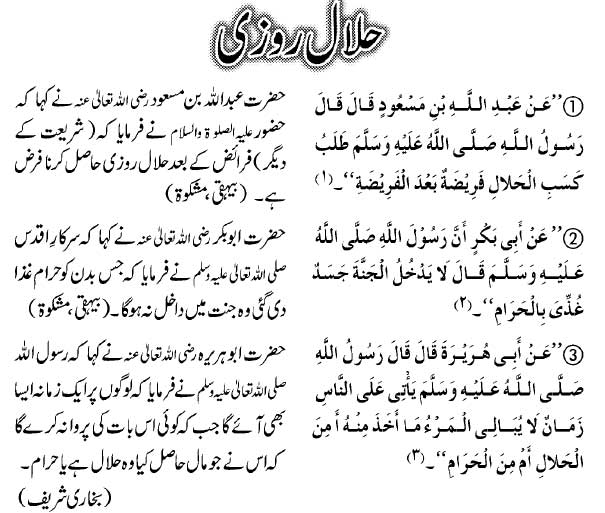
Halal Rizq
Islamic Faith & Practice: Moral Virtues
Morality, like worship, forms an important branch of religion. In a way, it is more important than the other branches because it is here that man has within his grasp the opportunity of functioning as God’s deputy and vicegerent. Good morals are Devine attributes and it is demanded of us to produce them in ourselves as far as our humanity allows. A Tradition of the Prophet (Peace be upon him) says, “Let the virtues of God be your virtues.”
To appreciate fully the distinctive merit of good morals it is of advantage first to know as a basic principle that human deeds that are capable of caning God’s pleasure and on which there is a reward from him are divided into four groups.
The first group includes acts a man performs to express and affirm while paying his tribute to the Glory and Worship fullness of God, his own utter helplessness before and complete submission to him. The acts of worship fall within this category.
The second includes acts a man is compelled to perform by the very nature of his being and the material wants of his earthly existence, but if they are performed according to the wishes and dictates of the Lord, they become worthy of his approbation and reward. For instance, a man engages himself in an occupation for the purpose of earning his daily sustenance or he gets married because their is a natural urge to be fulfilled, but God has laid down certain rules in respect of these activities; now, if he pays due regard to the Divine ordinances while pursuing his profession or in the conduct of his married life, everything that he does in these spheres becomes an act of religion and entitles him to a reward from God. This aspect is characteristic of acts we sun up under the two headings of Muamalat (monetary affairs) and Muasharat (social conduct).
The third includes functions like the propagation of the faith, religious preaching and instruction, the rendering of assistance to the sacred cause, the acceptance of trial and suffering in its path, the making of sacrifices for its victory and the forbidding of evil and the ordering of good deeds, which are in reality the province of the prophets, and when men other then them make these duties their own they get elevated to the status of the deputies and agent of the Divine Apostles. They then operate as successors to the Holy mission of those closen servants of God. These deeds are very pleasing to the Almighty and there can be no doubt about the great reward that is on them. What is more, they engender in the doer of them a resemblance with the Prophets (Peace be upon him) which cannot be acquired in any other way.
The fourth includes deeds that are associated with the vice gerencey of God. This is the grand distinguishing feature of moral virtues. For example, mercy is a virtue that is essentially a Divine attribute. It is because of this attribute that he is glorified as the most benevolent, the most compassionate, and his wish is that his servants should also cultivate the noble quality and behave with mercy and compassion towards his deserving creatures. Similarly, forgiveness and the hiding of the faults and sins of others are Divine virtues and we men are required to produce them in ourselves as well. The same is the case with the other excellent moral qualities like modesty. temperateness, beneficence, charity, generosity, justice and fair-mindedness, and the capacity to admire what is good and to despise what is wicked. All these are Divine qualities that we are called upon to furnish ourselves with.
In brief, in the field of morality alone, among all the fields of human endeavor, does man operate as the vicegerent of God in its domain he does what God himself doth do. This destination is shared by no other department of man’s existence. Hence, the intrinsic superiority of morals over the rest of the aspects of human conduct.
We will now see what great importance has the Prophet (Peace be upon him) attached to moral virtues. He says:
“The Lord has sent me down as his Apostle that I may evolve moral virtues to the highest perfection.” ( Mishkat)
“Muslims who possess better morals are the most perfect in faith .” ( Mishkat)
“On the day of judgment, the moral virtues of a Muslim will (prove to be) the heaviest item in the scales of Deeds.” (Ibid)
Yet, inspite of these clear pronouncements, a majority of even those among us who may be said to be men of religion present a most disappointing picture : they do show some awareness of the importance of worship, but where the Divine commands governing social and moral behaviour and the conduct of monetary affairs are concerned, they pay little head to them. Many of them, indeed, seem to labor under the impression that these commands are meant for those who expire for exceptional spiritual advancement while for salvation only the Namaz and Roza are enough, although moral rectitude is as much necessary for deliverance in the Hereafter as worship.
In the Quran and the Traditions, the same stress is laid on good morals as on worship, and moral transgressors have been given the warning of chastisement as equally severs as that promised to the defaulters in the matter of prayer, fasting etc., For instance, stinginess is a moral fault. Now, see how strongly has it been condemned by the Quran :
“And let not those who covetously withhold of the gifts which God hath given of his grace think that it is good for them : soon the things which they covetously withheld be tied to their necks like a twisted collar, on the Day of Judgement.”
(Quran : Aal-i-Imran, 18)
In like manner, in Sura-i-Humaza, the Quran gives the tidings of hell for moral diseases like excessive love of wealth, contemptuous upbraiding, double-dealing, scandal-mongering, and malicious back-biting.
“Woe to every (kind of ) scandal-monger and backbiter who pileth up wealth and layeth it by thinking that his wealth could make him last forever! By no means! He will be sure to be thrown into that which breaks to pieces.”
(Quran : Humaza, 1)
So, also, does the Prophet (Peace be upon him) of a number of moral vices he has emphatically stated that they are sure to plunge one into the all-consuming fire of the hell. Take vanity. About it he says :
” He who harbors vanity in his heart even by an atom shall not enter Heaven.” (Muslim)
Or, read these Traditions of his :
” Anyone who engages in malicious fault-finding or pries into the secrets of others and gives publicity to them shall not be admitted into the Paradise.” (Bukhari)
” On the last day the biggest loser will be the hypocrite, who, when he goes to one party talks in one voice and, when to the other party. Talks in another voice. (Muslim)
” God will show no compassion to him who shows no compassion to his fellow-beings.” (Bukhari)
” A woman will find her way into the Hell simply for the reason of her cruelty to a cat which she had lead in captivity and gave it not a morsel of food till it died of starvation.” (Muslim)
In contrast to the above two Traditions, those who are kind and merciful have been given by the Prophet (Peace be upon him) the assurance of a rich reward :
” God will have mercy upon them that are merciful. Show compassion to those who dwell on the earth: He who dwells in the Heavens will show compassion to you.” (Abu Dawood)
In another Tradition, we are informed that “A woman was granted remission of her sins because her heart melted at the sight of a dog who was dying of thirst, and, she saved its life by drawing water from the well, at great pains to herself, and giving it to drink.”
Apart from the Traditions giving the warning of dradful chastisement in the Hereafter to those who cherish wrong moral ideals and behave accordingly, there are in which it is plainly stead about certain moral vices that their presence in a man is enough to disqualify him from a being a Muslim. Thus, it is related that once the Prophet (Peace be upon him) declared with great feeling that “I swear by God in whose power lies my life that no one can be a believer unless he attains the state of desiring for his brother what he desires for himself.”
On another occasion, it is reported that the Prophet (Peace be upon him) spoke out the following words: “By God, he is not a Muslim, by God, he is not a believer, by God, he is devoid of the wealth of faith.”
“Who?” the Companions inquired. “The III-fated man”, the Prophet ( Peace be upon him) replied, “from whose mischief his neighbors are not secure.”
There also occurs a Tradition to the effect that, ” That callous, unfeeling person is not a Muslim who eats to hissatisfaction while his neighbor, by his side, goes without a meal.”
Now, in these Traditions the vices for which the chastisement of Hell has been promised or which have been described as destructive of faith or inimical to salvation all belong to the realm of morality. This will show in what great value does Islam hold good ethical conduct……..To quote from Ibn-i-Taimiyah in Kitab-i-Imam : “The position of things about which it is said in the Traditions that whoever is guilty of them will not be admitted into the Heaven or that he is devoid of faith is, at the minimum, that they are prohibited in the Shariat and it is the duty (of a Muslim) to abstain from them.”
Be that as it may, normal virtues are not the ultimate objectives one may strive after only if the aim should be to become a saint or a spiritual luminary. They are essential to the condition of faith, it being as much indispensable for the saving of the soul to develop good moral qualities and avoide moral evils as are the offering up of prayer and the observance of fasts. Particularly unnecessary is the acquirement of virtues on which special stress has been laid in the Quran and the Traditions, like fortitude, the reposing of trust in the will of God, truthfulness, honesty, and integrity, the keeping of promises, sincerity, genuine and wholehearted love of God and the Prophet (Peace be upon him) wishing well and thinking nobly of others, and maintenance of secrecy over their faults and misdeeds, compassion, forgiveness, suppression of anger, generosity, justice, and fair-mindedness, humility and meekness and love and hatred not for self-satisfaction but for the sake of God. In the same way, it is of utmost importance to purge oneself clean of the reverse qualities, known, in common parlance, as vices.
By Maulana Manzoor Numani
Ghar Mein Sakoon Kesay
Ta’leem Mut’allim – Etiquettes Of A Student
There is no one worthy to be worshipped but Allah, Muhammad is His (last) Messenger.
First, a little introduction about Knowledge – religious knowledge is like light passed from Rasulullah (SalLalLahu Alehe WaAlehe WaSabehe WaSalLam) down through the Sahabah and further down until it reaches the students of knowledge. It is up to us to ascertain how we can gain maximum benefit from this light, but if we don’t respect it, Allah (Subhanahu Wa Tala’a) can and will take it away from us.
1. There are some areas of knowledge that are fard (obligatory) for every Muslim to know. It is important for us to first understand our religious obligations e.g. how to pray, fast, make wudu, etc. Essentially, every student should have a thorough knowledge of the basic fara’id – the fard `ayn.
2. Every student should make sure that their intention is only to please Allah (Subhanahu Wa Tala’a) and NOT to gain fame, wealth, or become well-known. If we have incorrect intentions then whatever we gain and benefit would be for that purpose and not for Allah (Subhanahu Wa Tala).
3. You should choose the most learned, pious, and the most advanced person in age as your teacher. The most elderly person should be selected because of the experience they possess. If this is not possible then at least the most learned and pious. Once that teacher is selected their opinion should be taken on what you should study and their opinion should be respected. This means that you shouldn’t go to your teacher and say, “I think I’m ready to study Sahih Bukhari” when he/she wants you to learn Arabic first. You can say that you feel weak in a certain area and would like to study that asking for suggestions on what books you should study.
4. All students should have complete respect for the knowledge they are studying andof their teachers. In regards to teachers, they should not be questioned too much. In regards to knowledge, we shouldn’t place our books on the floor, and in fact, we shouldn’t put our pens on top of our notes or doodle in the margins! Furthermore, no matter how many items you are learning something you should have the same reverence for it.
5. Students should be regular and consistent. They should not miss their classes and be there on time. If a student is continuously missing classes it means that other things are more valuable to them.
6. Reliance on Allah (Subhanahu Wa Tala’a) is key. We should develop ourselves so that we have trust in Allah (Subhanahu Wa Tala’a) that all of our worries will be taken care of. We should look for a means and then rely on Allah (Subhanahu Wa Tala’a) that He will sustain us through those means. Also, we should not underestimate the power of du’a, the more you ask the more likely your prayers will be answered. Du’a should not be restricted to the hereafter, it is said that even if you need new shoes you should ask Allah (Subhanahu Wa Tala’a) for the means. Whatever we need we should ask Allah (Subhanahu Wa Tala’a) for it, we don’t know what obstacles lie in our path which Allah (Subhanahu Wa Tala’a) will remove.
7. Take advantage of your time. Learn during your youth, study after fajr and between Maghrib and `Isha. As a student of knowledge, time should not be wasted, use the night and tahajjud time to revise unless you are really tired.
8. A student should be a kind and compassionate person, not jealous, harsh, or mean. These are not characteristics of the Prophets (Alehe Salam) or our pious predecessors. You must have a clean heart to take on this knowledge.
9. Seek benefit from scholars and learned people. Also, don’t try to memorize the knowledge your gaining, take good notes.
10. Abstain from sins and haraam. Stay away from doubtful food. The students of the past would not go out and eat in the market place for fear of the doubt in the food and what effect it would have on their hearts. The very least we can do is make sure everything we eat is halal; how do we expect this noor to penetrate the haraam? Also do not neglect the Sunnah of RasulAllah (SalLalLahu Alehe WaAlehe WaSabehe WaSalLam), if you neglect it you are deprived of his (SalLalLahu Alehe WaAlehe WaSabehe WaSalLam) practices. Think of the fara’id as a house, the sunnah as the fence surrounding that house, and the etiquettes are the gate surrounding the community that you live in. If the gate isn’t there, Shaytan can penetrate your fence, if the fence isn’t there he can penetrate the fara’id.
Furthermore, we have to realize that there is knowledge, and then there is the acceptance and application of that knowledge. If you have no application, no one will benefit from your knowledge. Always ask Allah (Subhanahu Wa Tala’a) to accept the knowledge you are seeking. He doesn’t need us to spread His deen. He can always replace us. We must act upon and teach the knowledge we are gaining, it is not meant to be hidden.
Rasool e Kareem (s.a.w) Ki Malkiyat
Hereafter: Life After Death
Many people wonder as to how a person with a scientific and logical temperament, can lend any credence to the belief in life after death. People assume that anyone believing in the hereafter is doing so on the basis of blind belief.
There are more than a thousand verses in the Glorious Qur’an containing scientific facts. Some have been discovered by science and others will be discovered as science advances.
The concept of peace and human values or good or bad is useless without the concept of hereafter. One thing or act can be bad in the eyes of a person but could be good or beneficial for another one.
Every human being wants justice: Do human law provide justice to all humankind?
The people who do injustice should be punished: Can we punish a murderer of 100 people as compared to a murderer of a single person?
This life is a test for the hereafter: If it is not, then why few people are wealthy and enjoying luxuries of life and why few are poor and don’t even have enough food to eat. Life is a test for both of them.
Final justice on the day of judgment. No human law can provide 100% justice to all humankind. There will be definitely a day of judgment for final justice.
When it is dead sure that there will be a day of judgment and life after death, one should follow the religion instead of passing life in his/her own style.
All religions basically exhort mankind to be righteous and eschew evil. But Islam goes beyond that. It guides us towards practical ways of achieving righteousness and eliminating evil from our individual and collective lives. Islam takes into account human nature and the complexities of human society. Islam is guidance from the creator himself. therefore, Islam is also called the “deen-ul-fitrah” (the natural religion).
we should hurry to ask Allah (SWT) for forgiveness and start following true religion before the last day of our life (who knows tomorrow we will get up from sleep or not!)
May ALLAH (SWT) show us the right path. Aameen
Abuabas
Alnaas Ma’aden
by Mufti Muneeb-ur-Rehman
Qur’an On The Creation Of Man
The Qur’an is the Book that brought humanity from the pre-scientific age to the age of rationality. The very first Book, which invited mankind to observe and contemplate the phenomena of nature, which we experience in ourselves and in the continuum surrounding us with our five senses of perception. The Qur’an said, “Verily in the creation of the heavens and the earth, and in the alteration of night and day, and the ships which sail through the sea with that which is of use to mankind, and the water (rain) which Allah sends down from the sky and makes the earth alive therewith after its death and the moving (living) creatures of all kinds that he has scattered therein, and in the veering of the winds and the clouds which are held between sky and the earth are indeed signs for people of understanding.” (Qur’an, 2:164)
All these phenomena of nature contain the signs of God the Unique for the people to believe in His divine Omnipotence.
But the revelation of the Qur’an dates back to the 7th century of the Christian Era. This age is known as the age of ignorance. God intended to take out the benighted humanity to enlightenment, from ignorance to knowledge, from unawareness to intelligence. He sent the Prophet Muhammad (peace be upon him) as a great blessing for humanity. The teachings of the Messengers before him were lost. The divine books, Torah, Psalms of David, and the Gospel were irretrievably lost. They were written four to five hundred years after their revelation. These Books contained only hearsay evidence of past events.
The very first revelation to the Prophet (peace be upon him) was to invite humanity to knowledge. “He Who taught man that which he knew not.”(Qur’an, 96:5). Literal translation. Arabic ‘Allama’ is in past tense meaning taught. Some have translated it into present perfect that, in many views, is not correct.
In that very revelation, the Qur’an disclosed a scientific fact as to the creation of man and said: “Read in the name of your Lord Who created, Who created man from something that clings.” (Qur’an, 96:1,2). Literal translation. Arabic word ‘Khalaq’ past tense meaning created, the word ‘Alaq’ means that clings. (Arabic-English, Lanes Lexicon). There are other verses that explain the stages of the embryo, I quote here a few of them:
“We created man from drops of mixed semen (sexual discharge of man and woman), in order to try him: so we made him hearer and seer.” (Qur’an, 76:2) “Then He made his offspring from semen of despised water (male and female sexual discharge).” (Qur’an, 32:8)
The beauty of the description in the Quranic verses is that modern science could not add any such fact relating to the processing of embryos in the womb which the Qur’an does not mention.
Before we discuss the science of the formation and development of the embryo, it may be noted that the views of Aristotle (384-322 BC) were predominant before the revelation of the Qur’an. He was of the view that the actual creation and formation of the embryo was from the menstrual blood. To him, the process resembled the curdling of milk into cheese.
In the first quarter of the 7th century (C.E.) the Qur’an brushed off the views of Aristotle telling that Allah created man from drops of mingled liquids of both male and female as referred to above. Ibn Kathir, while discussing the Arabic word ‘Amshaj (mingled liquids) said, “The root word is ‘Mashaja’ which means to mix and ‘Masheej’ means something mixed with another. Elias Modern Dictionary Arabic-English gave the meaning of ‘Masheej’ as gamete. Ibn Abbas explaining the verse said, “It means the semen of man and woman intermingled and then it passes through various stages. Allah said, “He created you in different stages.” (Qur’an, 71:14)
However, Europe remained stuck to the baseless notions of Aristotle until Redi in 1668 dealt a blow to his theory, and Pasteur in 1864 wrote the final obituary to the doctrine of spontaneous creation. Later, Van Banden in 1883 proved that both male and female participate equally in the formation of human zygote.
Thus what was said by the Prophet (peace be upon him) disclosing the Qur’anic fact was finally upheld by the scientists after about 1300 years of the ignorance of science regarding the creation of man. The Qur’an said, “Was he not a Nutfah (drops of sperm) which gushed forth.” Al-Mawrid Arabic-English, A. Yusuf Ali; (Qur’an, 75:37)
It is also now proved that the total semen ejaculated contains an average of 200 to 300 million spermatozoa, only one out of these huge numbers fertilizes the ovum to form the zygote, which grows into a fetus.
The Arabic word Nutfah translated as sperm is singular, thus we can safely say that Nutfah is that spermatozoa that cause fertilization. Arabic words ‘Nutfah Amshaj’ further establish the meaning that male spermatozoa with female cells cause fertilization to form zygote. This fertilization stage is described in the word ‘Alaq’ as something that clings in the uterus (womb).
The Qur’an describes the next stage as ‘Mudgha’ in the verse 23:14. It literally means chewed lump (Al-Mawrid Arabic-English). That is a mass of flesh having teeth marks on it. In the early 7th century, no one in the world could know this stage of embryos’ development. Only in the 20th century, gynecologists could observe it, and they call it a somite stage. After this stage there comes another stage as told by the Qur’an. “Then We made out of that lump bones and clothed the bones with flesh.” Literal translation (Qur’an, 32:14)
It was impossible for a man living in the early 7th century to have come up with such facts, so it is foolish to say that Muhammad (peace be upon him) wrote the Qur’an. One has to admit that this is the Book of God the Unique (Allah). He in His very first revelation to His Prophet (peace be upon him) described the creation of man by fertilization ‘Alaq,’ i.e. by clinging of the male and female cells to each other.
Certainly, the Qur’an taught the man things which he doesn’t know.
– By Ahmad Wahaj Al-Siddiqui