
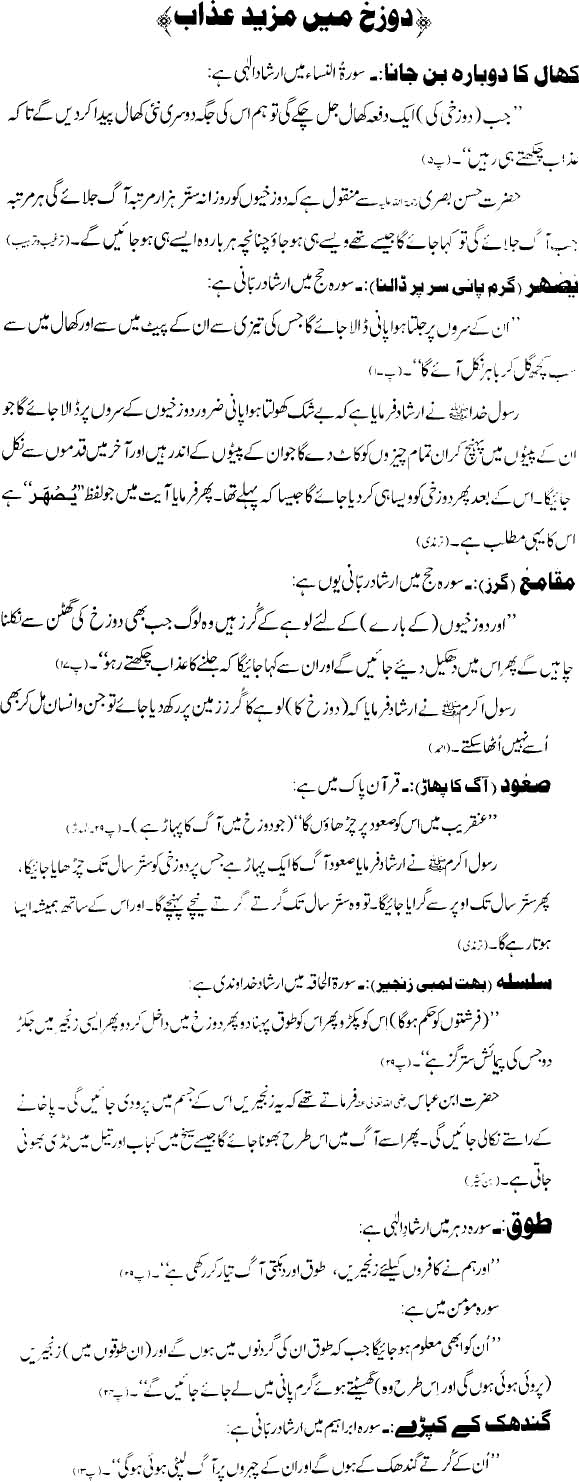
Dozakh Mein Azabat
In Tests And Trials There Are Lessons
Praise be to Allah, we seek His help and His forgiveness. We seek refuge with Allah from the evil of our own souls and our bad deeds. Whomsoever Allah guides will never be led astray, and whomsoever Allah leaves astray, no one can guide. I bear witness that there is no god but Allah, and I bear witness that Muhammad is His slave and Messenger.
The First Lesson
From the benefit of tests and trials is the influence it has on one’s Tawhid (worship of Allah), Iman (faith), and Tawakkul – reliance upon Allah. It makes you examine the reality that man is a weak creation without any power or strength, except in your Lord. Therefore, you resort to Him and depend on Him. Thereupon arrogance, false pride, and negligence will be removed, and you will come to know that you are really poor and in need of your Creator, the Almighty, the Most Perfect, and so you resort to Him.
The Second Lesson
Tests unravel the reality of this life. It is clarified to be a temporary stay for enjoyment, and the perfect life is the one that follows, wherein there is no toil, worry, fatigue, or disease.
And this life of the world is only amusement and play! Verily, the home of the Hereafter – that is the life indeed (i.e., the eternal life that will never end), if they but knew. [Noble Quran 29:64]
Even with this amusement and play, there is also toil and fatigue. This is the reality of this life – one day life is smiling at you, and the other day it is turning its back on you. This is the nature of life, but man forgets that. The trials and tests come, and they serve to remind man of the nature of this life and that he should not become attached to it.
The Third Lesson
The tests and trials remind the person of the favors bestowed upon him by Allah. It is also a reminder that this life is transitional.
The Fourth Lesson
We are reminded to avoid being in a state of joy such that we feel arrogance, and likewise to prevent a state of sadness and grief such that one feels despair.
No calamity befalls on the earth or in yourselves, but it is inscribed in the Book of Decrees (Al-Lauh Al-Mahfouz) before We bring it into existence. Verily, that is easy for Allah. In order that you may not grieve at the things over that you fail to get, nor rejoice over that which has been given to you. And Allah likes not every prideful boaster. [Noble Quran 57:22-23]
The Fifth Lesson
Trials and tests remind the person of his shortcomings and diseases (of the heart and actions) so that he can take preventive measures against them.
Whatever of good reaches you, is from Allah, but whatever of evil befalls you, is from yourself. And We have sent you (O Muhammad, peace and blessings be upon him) as a Messenger to mankind, and Allah is Sufficient as a Witness. [Noble Quran 4:79]
And whatever of misfortune befalls you, it is because of what your hands have earned. And He pardons much. [Noble Quran 42:30]
And verily, We will make them taste of the near torment (i.e., the torment in the life of this world, i.e., disasters, calamities) prior to the supreme torment (in the Hereafter), in order that they may (repent and) return (i.e., accept Islam). [Noble Quran 32:21]
This lesser torment is in this life, which is full of calamities, disasters, and hardships.
The Sixth Lesson
Tests and trials serve as great teaching processes through which one learns patience. We cannot be firm upon truth and obedience except with patience, and we cannot stay away from falsehood and disobedience except with patience and perseverance. We cannot walk the paths of this life except with patience regarding the pre-ordinance of Allah. The outcome is Jannat al-Qulb war-Ridwan – the endless bliss in Paradise and the Pleasure of Allah.
But none is granted it except those who are patient, and none is granted it except the owner of the great portion (of happiness in the Hereafter, i.e., Paradise, and of a high moral character) in this world. [Noble Quran 41:35]
By Dr. Saleh as-Saleh
Logon Say Mail Mulaqat Ki Sunnatien

Logon Say Mail Mulaqat Ki Sunnatien Aur Adaab: Salam Kerna, Musafiha Kerna, Aur Achi Baat Kerna
Virtues Of Congregational Prayers
Performing the (obligatory) prayers in congregation is mandatory and required of every believing adult male who has no excuse for not doing so.
{And those who remain patient, seeking their Lord’s Countenance, perform As-Salat (Iqamat-as-Salat), and spend out of that which We have bestowed on them, secretly and openly, and defend evil with good, for such there is a good end} [Surah Al-Rad: 22]
The Prophet (peace and blessings of Allah be upon him) said, “Offering the prayer in congregation carries 27 times greater reward than offering it alone individually.” [Bukhari, Muslim]
Ibn Masud (May Allâh be pleased with him) reported: He who likes to meet Allah tomorrow (i.e., on the Day of Requital) as a Muslim, should take care and observe the Salat when the Adhan is announced for them. Allah has expounded to your Prophet (peace and blessings of Allah be upon him) the ways of right guidance, and these (the prayers) are part of the right guidance. If you have to perform Salat in your houses, as this man who stays away (from the mosque) and performs Salat in his house, you will abandon the Sunnah (practice) of your Prophet (peace and blessings of Allah be upon him), and the departure from the Sunnah of your Prophet (peace and blessings of Allah be upon him)will lead you astray. I have seen the time when no one stayed behind except a well-known hypocrite. I also saw that a man was brought swaying (on account of weakness) between two men till he was set up in a row (in the masjid).
Muslim (Book 04, chapter 85, # 1376)
This Hadith makes the following four points:
1. Emphasis on performing Salat in congregation.
2. The passion of the Companions of the Prophet (peace and blessings of Allah be upon him) for Salat.
3. Evasion(avoidance) from Salat with congregation is a practice of hypocrites.
4. Inducement for following the Sunnah of the Prophet (peace and blessings of Allah be upon him) because evasion from it is bound to lead one astray.
Sila Rehmi Ki Waja Say Buri Moat Say Hifazat
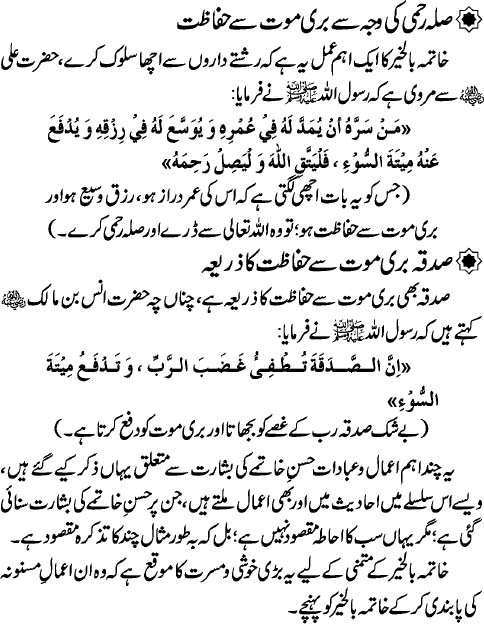
Khatma Bil Khair, Husn e Khatma: Sila Rehmi Ki Waja Say Buri Moat Say Hifazat
Being Sad Is Not Encouraged In Our Religion
So do not become weak [against] your enemy, nor be sad… (Quran 3: 139)
And grieve not over them, and be not distressed because of what they plot. (Quran 16: 127)
Be not sad, surely Allah is with us. (Quran 9: 40)
Referring to true believers, Allah informs us that: Upon such shall come no fear, nor shall they grieve. (Quran 2: 38)
Sadness enervates the souls will to act and paralyzes the body into inactivity. Sadness prevents one from action instead of compelling one towards it. The heart benefits nothing through grief; the most beloved thing to the Devil is to make the worshiper sad in order to prevent him from continuing on his path. Allah, the Exalted, says: *Secret counsels [conspiracies] are only from Shaitan [Satan], in order that he may cause grief to the believers. (Quran 58: 10)
In the following hadith, the Prophet (PBUH) said: “In a company of three, it is forbidden for two to hold secret counsel to the exclusion of the third, since doing so will be a cause of sadness for him.”
Contrary to what some believe (those who have an extreme ascetic bent), the believer should not seek out sadness, because sadness is a harmful condition that afflicts the soul. The Muslim must repel sadness and fight it in any way that is permissible in our Religion.
There is no real benefit to sadness; the Prophet (PBUH) sought refuge from it in the following supplication: “O Allah, I seek refuge in you from anxiety and grief.”
Grief is coupled with anxiety in this hadith. The difference between the two is that if a bad feeling is related to what is going to happen in the future. Then one is feeling anxiety. And if the cause of this feeling concerns the past, then one is feeling grief both weakens the heart, causing inactivity and a decrease in will power.
Despite what has been mentioned above, grief may sometimes be both inevitable and necessary. When they enter Paradise, its dwellers will say: All the praises and thanks be to Allah, Who has removed from us [all] grief. (Quran 35: 34)
This verse implies that they were afflicted with grief in this life, just as they were afflicted with other forms of hardship, both of which were out of their control. So whenever one is overcome by grief and there is no way to avoid it, one is rewarded, because grief is a form of hardship, and the believer is rewarded for going through hardship. Nonetheless, the believer must ward off grief with supplication and other practical means.
“Whatever befalls the believer in terms of anxiety, hardship, or grief, Allah will remove his sin.”
It indicates that grief is a trial with which the believer is afflicted, and through which some of his sins are atoned for. However, it does not indicate that grief is something to be sought after; the believer should not seek out means of finding grief, thinking that he is performing an act of worship.
And as for the alleged hadith, “Verily, Allah loves all sad hearts,” the chain of its narrators is unknown, so it is not an authentic hadith, especially in view of the fact that the basic principles of our religion are contrary to it.
In this verse, Allah says of his Prophet Israaeel (Israel): And he lost his sight because of the sorrow that he was suppressing. (Quran 12: 84)
Here we are informed of his grief over losing his beloved son. Simply informing about something does not in itself signify either approval or disapproval of that thing. The fact is that we have been ordered to seek refuge from sadness, as it is a heavy cloud that hangs above its victim, and is a barrier that prevents one from advancing to higher aims.
There is no doubt that sadness is a trial and a hardship, and is in some ways similar to sickness. However, it is not a stage, level, or condition that the pious should actively seek out.
Hazrat Umm Amarah RA Ka Islam Aur Jang Mein Shirkat
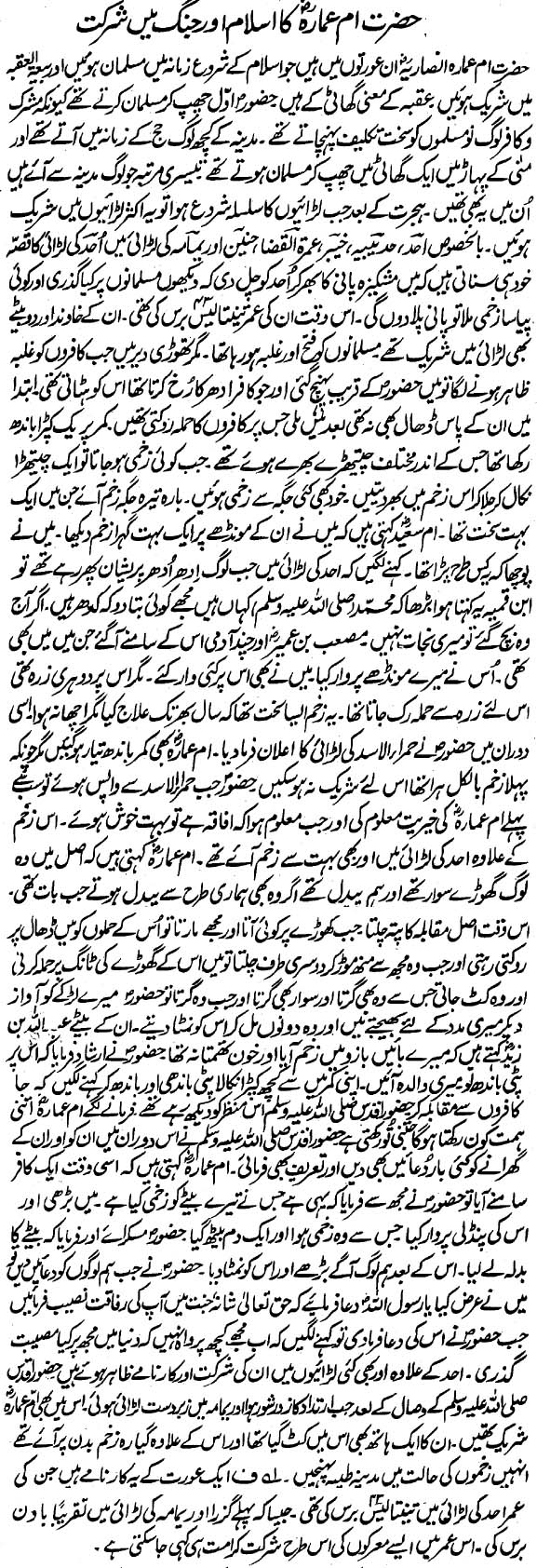
Hazrat Umm Amarah RA Ka Islam Aur Jang Mein Shirkat
The Seven Stages In The Life Of A Muslim
Abu Saeed Khudri (RA) narrates that Prophet Muhammad (peace be upon him) was asked, “Who is superior in the sight of Allah on the Day of Resurrection? He said, “The men and women who remember Allah greatly.”
Islam = submission to the Will of Allah (GOD).
Islam has a beginning and an end. Those who embrace Islam are called Muslims. The word Muslim is derived from the word Peace. The traditional muslim greeting is peace be unto you.
Who is Allah? Allah is the One and the Only God who created the worlds, Angels (created by light), Jinn (created by Fire), Satan (devil) is an outcast Jinn, man (created from sounding clay), animals, and the contents of the universes. Allah is One, there is no God other than Him, without any partners. He is eternal without a beginning and enduring without end, Absolute, Self-Sufficient, Self-Existing, never dies, not borne nor gives birth, has no companion, and nothing is comparable to Him. He never sleeps nor slumbers. All-Knowing, All-Hearing, All-Seeing. Nothing happens except what He wills. He gives life and death. He is The Most Gracious and The Most Merciful. He is intensely and continuously merciful to his creatures, even though Non Muslims do not believe in him. He is far above any created being. He is the Creator of everything in the universe, heaven, and earth, and its content. He will never perish or come to an end. When Allah wants anything to happen, he says “Be” and it is. Muslims do not believe that Allah assumed Human form and came down to this earth. The human body form has animal properties, and animal characteristics are created by Allah. Allah is high above all the creations.
Creation of Mankind
The first Man’s (Adam ) body was created from sounding clay. His companion woman, “Hava,” was created from Adam’s rib. All his descendants’ bodies are created by the sperm of men and the ovum of women. Jesus (Prophet ISA), son of Mariam (Mary), was created by Allah’s word (Be and it is) like Adam, but in Mariam’s womb. Jesus was a human prophet and not the Son of God. He was not crucified but taken up alive (Holy Quran).
Allah breathed into the body of man part of His spirit called (Ruh) Soul. When the soul enters the body, it becomes alive. When this soul is withdrawn from the body, it dies, and the body decays, putrefies, and is eaten by microorganisms. Every day, man experiences temporary death at night when he sleeps and resurrects when he wakes up. Allah keeps his soul in a safe place during his sleep. Allah has appointed angels as guardians to the right and left side and allowed satan to disturb humans. All these facts are described in the Holy Quran.
Surah Takasur Kay Fazail
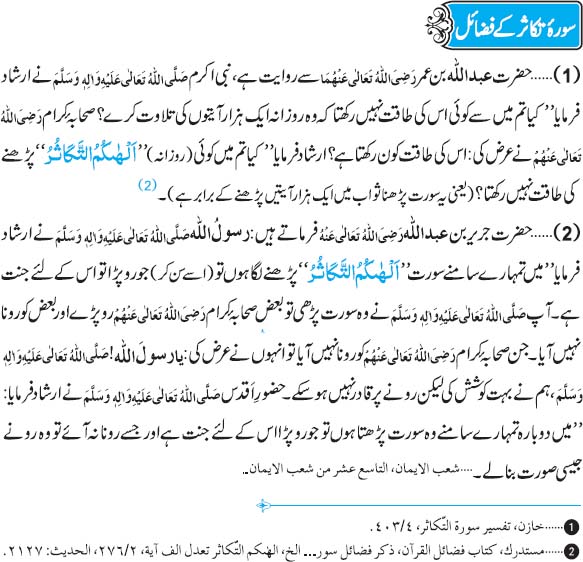
Surah Takasur Kay Fazail
People Are Upon 4 Levels Regarding The Circumstances Of Affliction
Knowledge is not measured by how much is memorized, but rather by how much it is acted on.
The First Level: Being Angry
This is in various ways:
The first type: That the anger is in the heart, as if he is angry at his Lord. So he becomes angry with what Allah has decreed for him, and this (level) is Haram. And it is possible that this could lead to Kufr (disbelief). Allah said:
“And among mankind is he who worships Allah as it were, upon the very edge (i.e. in doubt); if good befalls him, he is content therewith; but if a trial befalls him, he turns back on his face (i.e., reverts to disbelief after embracing Islam). He loses both this world and the Hereafter.” [Noble Quran 22:11]
The second type: That the anger is by the tongue, like making Du’a for destruction or ruin, and what is similar to that, and this is Haram.
The third type: That the anger is by the limbs like slapping the cheeks, ripping the clothes, pulling out hair, and similar to that, and all of this is Haram in contradiction to patience, which is Wajib (obligatory).
The Second Level: Being Patient
Just as the poet said: “Patience is like its name – bitter in taste, yet its outcomes are sweeter than honey.”
So the person sees this thing (the affliction) weighs very heavy upon him, yet he bears it although he dislikes that it happened. Rather, his Iman bears it and restrains him from being angry.
So the time of affliction and the time of no affliction are not the same to him, and this (level) is Wajib, because Allah
commanded the people to be patient, saying: “…and be patient. Surely, Allah is with those who are As-Sabirin (the patient ones).” [Noble Quran 8:46]
The Third Level: Being Pleased With The Affliction
Is when the person is pleased with the affliction, and whether it happened or not, it is the same to him, so it is not
difficult for him. He does not bear it as if it is something weighing heavily on him, and this (level) is Mustahabb (preferred – between Haram and Wajib), and it is not Wajib according to the most correct opinion. The difference between this level and the one before it is apparent because the affliction, happening or not happening, is the same due to the pleasure of the one on this level. As for the level before it, the affliction is hard upon him, yet he remains patient over it.
The Fourth Level: Thanking – Being Grateful
This is the highest level. This is that the person thanks Allah for the affliction, which has struck him, in that he knows that this affliction is an expiation for his sins and perhaps a cause for an increase in his good deeds. The Prophet
(Peace and blessings be upon him) said: “There is no affliction which strikes the Muslim except that Allah expiates with it (sins), even with a thorn that may poke him.” [Bukhari & Muslim]
By Sheikh Muhammad Ibn Salih Al-Uthaymeen
Taken from: Fatawa Arkan
Al-Islam