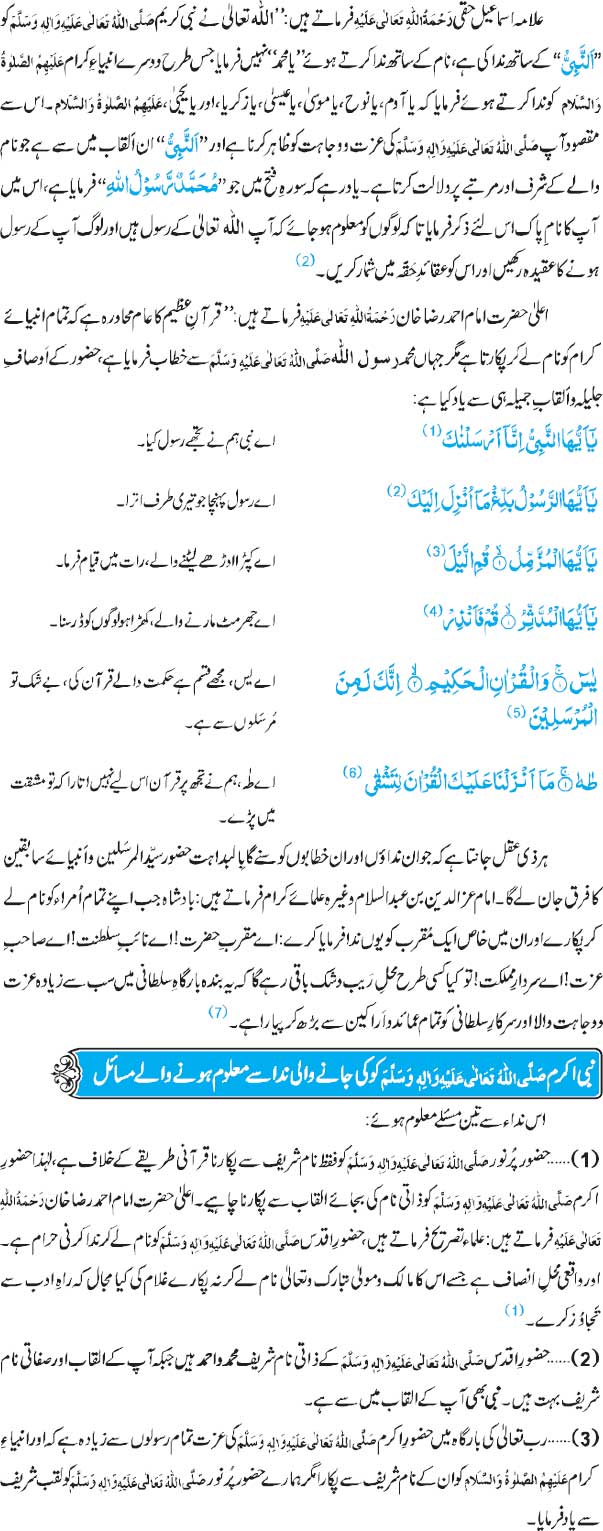
Nabi e Akram Ko Ki Janey Wali Nida


The attention to hygiene is another aspect of a Civilized Manner (Suluk Al-Hadari) which is an unknown concern in any other religion or philosophy before Islam. Cleanliness became an essential part of the rites and worship to such an extent that it is an inseparable part of the Muslim’s life.
Wudhu :
The five daily Prayers are obligatory upon every Muslim, man, and woman. This Prayer is actually a pledge to meet Allah, the Exalted, from the rising of the dawn until the disappearance of the twilight in the evening.
It is, in fact, a spiritual shower washing away sins five times a day. In this respect, Allah says: “And establish regular Prayers at the two ends of the day and when the night approaches, surely the good deeds blot out the evil deeds.” (11:114)
This Islamic Prayer has a uniqueness unlike the Prayer in other religions in that physical purification is a necessary condition. If Prayer is the key to Paradise then, likewise purification is the key to Prayer.
The Prophet (Peace be upon him) said: “Allah does not accept Prayers without purification. ”
[Note: Reported by Muslim and Ibn Majah on the authority of Ibn `Umar, also by Ibn Majah on the authority of Anas and Abi Bakrah and also Abu Dawud, Al-Nasa’i and Ibn Majah on the authority of the father of Abi Al Malih, Sahih Al- Jami’ Al-Saghir, No.7746]
This purification and cleanliness are of two kinds: purification from impurities and purification from the excretions from the private parts.
Purification from impurities purifies the body, the clothes, and the place in which one prays from any impurities such as the stains of the blood, dead animals and pigs, and the vomiting, urine, or excrement of human beings and animals.
The other kind of purification does not mean cleanliness from something palpable. But rather purifying the inner of oneself because it is an order from Allah.
A Muslim is obliged to make ablution if exposed to minor impurities. This means he must wash the areas of the body which are ordinarily exposed to dust and dirt and he should have a body-washing (Ghusl) after menstruation and sexual intercourse. Moreover, these acts of purification are connected to recurrent natural stimuli which one must blot out through purification. It is also preferable, in Islam, for the Muslim to be eager to clean his body regularly, particularly when he meets his fellow Muslims in the congregational Prayers.
Bath:
Ghusl is also an act in which it is preferable to be performed before the Friday congregational Prayer as stated in the noble hadith.
In other versions, the hadith goes to the extent of ordering one to perform (Ghusl) as part of the overall cleanliness and hygiene of the Muslim Society: “Ghusl on Friday is obligatory (Wajib) on every adult!”
[Note: Reported by Malik, Ahmad, Abu Dawud, Al-Nasa’i, and Ibn Majah on the authority of Sa’id, Sahih Al-Jami’ Al-Saghir, (3690)]
Another hadith obliges the Muslim to perform (Ghusl) at least once a week saying: “Every Muslim should bathe once every seven days where he should wash his head and all of his body.”
[Note: Agreed upon on the authority of Abu Hurairan, Al-Lu `Lu’ Wal Marjan, (No.442)]
Mouth:
The Sunnah has directed attention in taking care of certain parts of the human body such as the mouth. The means of cleaning it was the Swak which is easily found and used in the Arab Peninsula.
In this respect, the Prophet (Peace be upon him) said: “The Swak is a purifying agent for the mouth and it is a way of seeking Allah’s Pleasure.”
[Note: Reported by Ahmad on the authority Abi Bakr; also by Al-Shafi’i, Ahmad, Nasa’i, Ibn Khaizamah, Ibn Hibban, Al-hakim and Al-Baihaqi on the authority of `Aishah, and by Ibn Majah on the authority of Abi Umaman, Sahih Al-Jami Al-Saghir, (3695)]
Hair:
Concerning the hair, Abu Hurairah reported that the Prophet (Peace be upon him) said: “Whoever has hair should care about it.”
[Note: Reported by Abu Dawud on the authority of Abu Rurairah, (No. 4163), Sahih Al-Jami’ Al-Saghir, (No.6497)]
Ata Ibn Yasser reported that: “A man came to the Prophet (Peace be upon him): When he was in the mosque with uncombed hair and an untidy beard. The Prophet pointed to him as if ordering him to fix his hair and beard. He did so and returned. Thereupon the Prophet (Peace be upon him): When he was in the mosque observed, “Isn’t this better than one of you coming with his hair uncombed, as if he was a devil ?”
[Note: Reported by Malik, Al-Mawatta’, vol.2, p.949]
Thus the Prophet as the instructor taught the Muslims the importance of having a pleasant appearance which comes second in importance after the excellence of the inner self.
Furthermore, he taught Muslims to wash their hands thrice on waking up before putting them in the water, saying, “For no one knows where his bands were during sleep.”
[Note: Reported by Al-Bukhari, Muslim, Ibn Majab, Al-Nasa’i, Abu Dawud, and Al-Tirmidhi on the authority of Abu Hurairah, Sahih Al-Jam’i Al Saghir, No.332]
Arabs used to clean their private parts with stones due to scarcity of water and many of them weren’t in the habit of wearing pants, so perhaps they might have touched their private parts (where the impurity was) while they were asleep.
He also taught them to wash their hands after eating and particularly after eating meat. He went so far as to warn them against neglecting to wash their hands before sleep saying: “Whoever goes to sleep without washing his hands from the traces of fatty foods, exposes himself to illness and should blame no one but himself.”
[Note: Reported by Abu Dawud (No.3852), Al-Tirmidhi (No.1861), Ibn Majah (No.3267), and Ibn Hibban as mentioned in Al-Mawarid (No. 1354), all of them reported it on the authority of Abu Hurairah except Ibn Majah who reported it after Fatimah, (May Allah be pleased with both of them), No.3296]
Home:
The Sunnah stressed the importance of cleanliness in the house saying: “You must clean your houses and do not follow in the footsteps of Jews”.
[Note: Reported by Al-Tirmidhi]
Road:
Moreover, the Sunnah instructed Muslims to maintain the cleanliness of the roads by lifting any harmful objects found on it. This is considered a Sadaqa and as a means to ridding the streets of impurities and filth.
Some Bedouin Arabs used to urinate on the roads or in the shade.
The Prophet (Peace be upon him) strictly warned them against it and considered it one of the reasons to provoke Allah’s curse and the people’s curse saying:
“Beware of those acts which cause others to curse. They asked, “What are those acts?” The Prophet (Peace be upon him) said: “Relieving oneself in the people’s walkways or in their shade”.
[Note: Reported by Ahmad, Muslim and Abu Dawud on the authority of Abu Hurairah, the previous reference (no. 110)]
“Beware of the three acts that cause others to curse you: relieving yourselves in a watering-place, on footpaths or shaded places.”
[Note: Reported by Abu Dawud, Ibn Majah, Al-Hakim and Al-Baihaqi on the authority of Mu’adh, Sahij’ Al- Jaini’ Al-Saghir (no. 112)]
This instruction in conjunction with the others were the first attempts, known in the history of mankind, to link human beings with the protection of the environment from harm in the name of religion.

The Delights of the People of Paradise:
(i) The Wife Of The Believer In This World Will Be His Wife In The Hereafter If She Is Righteous
“Gardens of ‘Adn, which they shall enter, and [also] those who act righteously from among their fathers, and their wives and their offspring…” [13:23]
“They and their wives will be in pleasant shade, reclining on thrones.” [36:56]
“Enter Paradise, you and your wives, in happiness” [43:70]
(ii) A Woman [Who Was Married More Than Once] Will Be With The Last of Her Husbands
In Taareekh ar-Raqqah, Abu ‘Ali al-Hurani reported from Maymun ibn Mahran that “Mu’aawiyah ibn Abi Sufyan (ra) proposed to Umm ad-Darda’ but she refused to marry him, saying, “I heard Abud-Dardaa’ say that the Messenger of Allah (saw) said, “A woman will be with the last of her husbands.” The men in its isnaad are trustworthy apart from al-‘Abbaas ibn Saalih, whose biography is unknown. Abul-Shaykh reported it in at-Taareek with a Saheeh isnaad only quoting the marfoo’ version of it. at-Tabaraani reported it with a da’eef isnaad in al-Mu’jam al-Awsat but taking both isnaads into account strengthens it. The marfoo’ version is Saheeh, and it also has two corroborating reports that are mawqoof.
The first of these was reported by Ibn ‘Asaakir from ‘Ikrimah:
“Asmaa bint Abi Bakr was married to az-Zubayr ibn al-‘Awwaam who was harsh towards her. She came to her father and complained to him, and he said, “O my daughter, have patience, for if a woman has a righteous husband, and he dies and she does not remarry after his death, they will be reunited in Paradise.” [The men of its isnaad are thiqaat [trustworthy] but is it mursaal because ‘Ikrimah never met Abu Bakr; he only heard it from Asmaa]
The second report was narrated by al-Bayhaqee in as-Sunan, where he says that Hudhayfah said to his wife, “If you want to be my wife in Paradise, do not remarry after I die, for the woman in Paradise will be with the last of her husbands on earth.”
For this reason, Allah forbade the wives of the Prophet (saw) to remarry after his death, because they will be his wives in the Hereafter.
(iii) al-Hoor al-‘Eeyn
Allah (swt) will marry the believers in Paradise to beautiful women who were not their wives in this world, as Allah (swt) says:
“So [it will be] and We shall marry them to Houris with wide lovely eyes.” [44:54]
al-Hoor is the plural of Hooraa’, which is a woman, the white parts of her eyes intensely white, and the black is intensely black. al-‘Eeyn is the plural fo ‘Aynaa, which is the woman whose eyes are wide.
The Qur’an describes al-Hoor al-‘Eeyn as being firm and full-breasted:
“Verily, for al-Muttaqoon, there will be a success; gardens and grape yards and young full-breasted [mature] maidens of equal age.” [78:31-33]
Al-Hoor al-‘Eeyn are creatures that Allah (swt) has made especially for Paradise, and has made them virgins:
“Verily, We have created [their companions] of special creation, and made them virgin-pure [and undefiled], beloved [by nature], equal in age.” [56:35-37]
The fact that they are virgins means that no-one has ever married them before:
“…whom no man or jinn has touched before them.” [55:56]
This refutes the idea that the wives that Allah (swt) will create for them in Paradise will be their wives from this life, made young again after old age had overtaken them. That idea if correct in that Allah (swt) will admit the believing women to Paradise with their youth restored but they are not al-Hoor al-‘Eeyn whom Allah created in Paradise.
The Qur’an also speaks of the beauty of the women of al-Jannah:
“And [there will be] Houris with wide lovely eyes [as wives for the pious], Like unto preserved pearls.” [56:22-23]
Maknoon [“preserved”] means hidden or protected, something whose colour is not changed by exposure to sunlight or by being tampered with. Elsewhere, Allah likens them to rubies and coral, two beautiful precious stones:
“In them will be [maidens] restraining their glances, whom no man or jinn has touched before them, Then which of the favours of your Rabb will you deny? Like unto rubies and coral.” [55:56-58]
al-Hoor are also described as restraining their gaze upon their husbands i.e. they restrict their gaze and don’t let their eyes wander to others. Allah (swt) has stated that they are very beautiful, and it is sufficient to know that Allah (swt) said:
“In them will be fair [companions] good and beautiful; then which of the favours of your Rabb will you deny? Companions restrained [as to their glances] in [goodly] pavilions” [55:70-72]
The women are not like the women of this world. They are free of al-Hayd [menstruation], an-Nifaas [post-natal bleeding], spittle, mucus, urine and stools. This is what is referred to in the aayah:
“..And they shall have therein Azwaajun Mutahharatun [purified mates]” [2:25]
The Prophet (saw) told us about the beauty of the wives of the People of Paradise. al-Bukhaari and Muslim reported from Abu Hurayrah that the Messenger (saw) said, “…the marrow of whose leg-bones will be visible through the flesh because of their extreme beauty.” [as-Saheeh, Kitaab al-Khalq, Baab Maa Jaa’a fi Sifaat al-Jannah, Fath al-Baari, 6/318 and Muslim in Kitaab al-Jannah wa Sifaat Na’eem ahlilhaa, Baab awwal zumrah tadkhul al-Jannah, 4/2178, no. 2834]
Look at this beauty that the Prophet (saw) described! Can you find any comparison to it in the world that you know?! :
“If one of the women of Paradise were to look at the people of this world, everything in between them would be lit up and filled with her fragrance. The veil on her head is better than this world and everything in it.” [al-Bukhaari, in as-Saheeh, Kitaab al-Jihaad, Baab wa Zawwajnahum bi Hoor-‘Eeyn. Fath al-Baari, 6/15]
The smallest number of wives that any one man will have in Paradise is seventy-two. It was reported that the Shaheed will have seventy-two wives from amongst al-Hoor a–‘Eeyn [Mishkaat al-Masaabeeh, 3/357, no. 3834, at-Tirmidhi, Ibn Maajah from al-Miqdaam ibn Ma’d Yakrib]
The Song of al-Hoor al-‘Eeyn
The Messenger (saw) told us that al-Hoor in Jannah sing with sweet, beautiful voices. In al-Mu’jam al-Awsat, at-Tabaraani reports with a saheeh isnaad from Ibn ‘Umar that the Prophet (saw) said,
“The wives of the people of Paradise will sing to their husband in the most beautiful voices that anyone has ever heard. What they will sing is: “We are good and beautiful, the wives of a noble people, who look at their husbands content and happy.” And they will sing, “We are eternal, and will never die, we are safe and will never fear, we are remaining here and will never go away.” [Saheeh al-Jaami as-Sagheer, 2/48, no. 1557; also Abu Na’eem, ad-Diyaa in Sifaat al-Jannah]
Samawayh reported in al-Fawaa’id from Anas that the Messenger of Allah (saw) said, “al-Hoor al-‘Eeyn are singing in Paradise saying, “We are the beautiful houris, we are being kept for noble husbands.” [Saheeh al-Jaami’, 2/58, no. 1598]
The Jealousy of al-Hoor al-Eeyn over their Husbands in this World
The Prophet (saw) told us that al-Hoor feel jealous over their husbands in this world if the wife of one of them upsets him. Ahmad and at-Tirmidhi report with a Saheeh isnaad from Mu’aadh that the Messenger of Allah (saw) said,
“No woman in this world upsets her husband but his wife from among al-Hoor al-‘Eeyn will say, “Do not upset him, may Allah kill you! For he is with you only temporarily, and soon he will leave you and come to us.” [Saheeh al-Jaami’ as-Sagheer, 6/125, no. 7069]
(iv) The believer in Paradise will be given the Strength of One Hundred Men
Anas reported that the Prophet (saw) said, “The believer in Paradise will be given such and such strength.” He was asked, “O Messenger of Allah, will he really be able to do that?” He said, “He will be given the strength of one hundred men.” [it was reported by at-Tirmidhi, Mishkaat al-Masaabeeh, 3/90, no. 5636, at-Tirmidhi said: “ghareeb saheeh.”]

Some verses of the Quran about “Life of this world and of the hereafter” are posted here with the hope that you will like to brainstorm and analyze that what type of life we MUSLIMS want to achieve?
What Package of life we are interested in?
(a) The life of the present and its glitter (The basic requirement for this type of life is knowledge of professional skill)
(b) The tilth of the Hereafter (The basic requirement for this type of life is knowledge of spiritual wisdom)
(c) Both for the life of the present with its glitter and for the tilth of the Hereafter (The basic requirement for this type of life is knowledge of professional skill with knowledge of spiritual wisdom or knowledge of spiritual wisdom along with professional skill)
(d) Neither intended for the life of the present with its glitter nor the tilth of the Hereafter (The basic requirement for this type of life is ignorance to the knowledge of professional skill and unawareness with the knowledge of spiritual wisdom)
In the name of Allah, Most Gracious, Most Merciful.
O humanity! Be mindful of your Lord, and beware of a Day when no parent will be of any benefit to their child, nor will a child be of any benefit to their parent. Surely Allah’s promise is true. So do not let the life of this world deceive you, nor let the Chief Deceiver deceive you about Allah.. [31:33]
This worldly life is no more than play and amusement, but far better is the ˹eternal˺ Home of the Hereafter for those mindful ˹of Allah˺. Will you not then understand? [6:32]
And this worldly life is not but diversion and amusement. And indeed, the home of the Hereafter – that is the [eternal] life, if only they knew. [29:64]
Know that the life of this world is but amusement and diversion and adornment and boasting to one another and competition in increase of wealth and children – like the example of a rain whose [resulting] plant growth pleases the tillers; then it dries and you see it turned yellow; then it becomes [scattered] debris. And in the Hereafter is severe punishment and forgiveness from Allah and approval. And what is the worldly life except the enjoyment of delusion. [57:20]
Beautified for men is the love of things they covet; women, children, much of gold and silver (wealth), branded beautiful horses, cattle and well-tilled land. This is the pleasure of the present world’s life; but Allah has the excellent return (Paradise with flowing rivers, etc.) with Him. [3:14]
Wealth and children are the attractions of this worldly life, but lasting good works have a better reward with your Lord and give better grounds for hope. [18:46]
And it is not [possible] for one to die except by permission of Allah at a decree determined. And whoever desires the reward of this world – We will give him thereof; and whoever desires the reward of the Hereafter – We will give him thereof. And We will reward the grateful. [3:145]
Whoever seeks the harvest of the Hereafter, We shall increase for him his harvest, and whoever seeks the harvest of this world, We shall give him thereof; but he will have no share in the Hereafter. [42:20]
Whoever desires the life of this world and its adornments – We fully repay them for their deeds therein, and they therein will not be deprived. [11:15]
Indeed, those who do not expect the meeting with Us and are satisfied with the life of this world and feel secure therein and those who are heedless of Our signs – [10:7]
The ones who prefer the worldly life over the Hereafter and avert [people] from the way of Allah, seeking to make it [seem] deviant. Those are in extreme error. [14:3]
They know what is apparent of the worldly life, but they, of the Hereafter, are unaware. [30:7]
So let not their wealth or their children impress you. Allah only intends to punish them through them in worldly life and that their souls should depart [at death] while they are disbelievers. [9:55]
Those are the ones who have bought the life of this world [in exchange] for the Hereafter, so the punishment will not be lightened for them, nor will they be aided. [2:86]
For them will be punishment in the life of [this] world, and the punishment of the Hereafter is more severe. And they will not have from Allah any protector. [13:34]
That is because they preferred the worldly life over the Hereafter and that Allah does not guide the disbelieving people. [16:107]
So turn away from whoever turns his back on Our message and desires not except the worldly life. [53:29]
[They are] those whose effort is lost in worldly life, while they think that they are doing well in work.[18:104]
And do not extend your eyes toward that by which We have given enjoyment to [some] categories of them, [its being but] the splendor of worldly life by which We test them. And the provision of your Lord is better and more enduring. [20:131]
Indeed, We will support Our messengers and those who believe during the life of this world and on the Day when the witnesses will stand – [40:51]
Whoever desires the reward of this world – then with Allah is the reward of this world and the Hereafter. And ever is Allah Hearing and Seeing. [4:134]
Allah extends provision for whom He wills and restricts [it]. And they rejoice in the worldly life, while the worldly life is not, compared to the Hereafter, except [brief] enjoyment. [13:26]
And keep yourself patient [by being] with those who call upon their Lord in the morning and the evening, seeking His countenance. And let not your eyes pass beyond them, desiring adornments of the worldly life, and do not obey one whose heart We have made heedless of Our remembrance and who follows his desire and whose affair is ever [in] neglect. [18:28]
O you who have believed, what is [the matter] with you that, when you are told to go forth in the cause of Allah , you adhere heavily to the earth? Are you satisfied with the life of this world rather than the Hereafter? But what is the enjoyment of worldly life compared to the Hereafter except a [very] little. [9:38]
Every soul will taste death. And We test you with evil and with good as trial; and to Us you will be returned. [21:35]
And it is He who has made you successors upon the earth and has raised some of you above others in degrees [of rank] that He may try you through what He has given you. Indeed, your Lord is swift in penalty; but indeed, He is Forgiving and Merciful. [6:165]
And We have revealed to you, [O Muhammad], the Book in truth, confirming that which preceded it of the Scripture and as a criterion over it. So judge between them by what Allah has revealed and do not follow their inclinations away from what has come to you of the truth. To each of you We prescribed a law and a method. Had Allah willed, He would have made you one nation [united in religion], but [He intended] to test you in what He has given you; so race to [all that is] good. To Allah is your return all together, and He will [then] inform you concerning that over which you used to differ. [5:48]
Until, when they arrive [at the place of Judgement], He will say, “Did you deny My signs while you encompassed them not in knowledge, or what [was it that] you were doing?” [27:84]
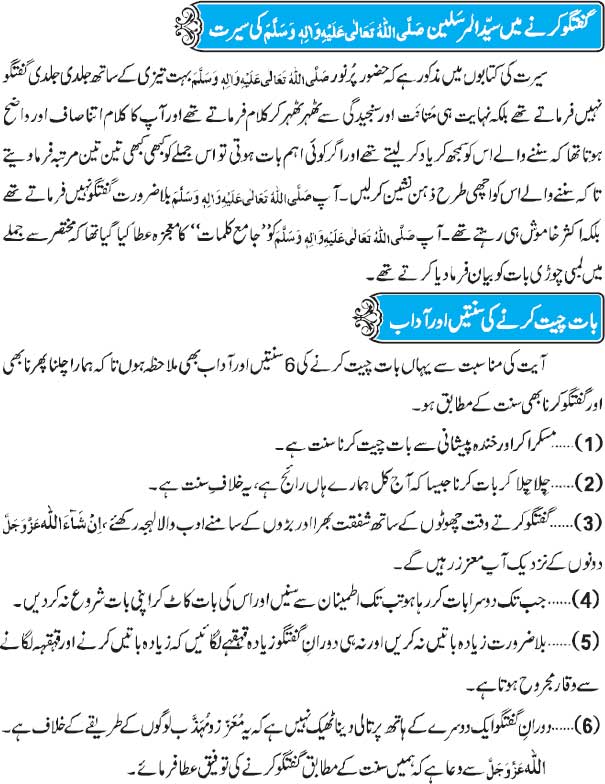
The Hadith of intention is usually the first in most books of Hadith. Ibn Daqiq Al-Id expounds on it in his explanation of Imam Nawawi’s 40 Hadith.
Umar Bin Al-Khattab (may Allah be pleased with him) said: I heard the Messenger of Allah (peace be upon him) say: “Actions are but by intention and every man shall have but that which he intended.
Thus he whose migration was for Allah and His messenger, his migration was for Allah and His messenger, and he whose migration was to achieve some worldly benefit or to take some woman in marriage, his migration was for that for which he migrated.” (Al-Bukhari and Muslim)
This Hadith is great in its benefit and importance. It has been said that Islam revolves around it. Some scholars said it is one-third of knowledge because actions involve the heart, tongue, and limbs. So the intention of the heart is one-third of that.
Other scholars said Islam is encompassed in three Ahadith: This one, the Hadith “The Halaal is clear, the Haraam is clear and between them are doubtful matters…,” and the Hadith “Whoever innovates in this religion that which is not from it will have his actions rejected (by Allah).”
The word “by” (in the sentence “actions are but by intention”) means that the acceptance and correctness of any action depend upon the intention behind it.
An action which is apparently good, such as giving money to charity, will be rejected if the intention behind it is wrong. Giving charity to show off is one such example. The Prophet (peace be upon him) narrated from Allah that if a person performs an act for Allah’s sake and also for the sake of someone else, then Allah will reject the deed entirely and leave the whole of that deed for the partner the person made (with Allah). This shows us how grave the sin of Shirk is – it is the only sin that Allah will never forgive.
In the Hadith, the words “shall have” means that the person will be rewarded only for what he intended. If a person did the Hijrah with a wrong intention, then he would not be rewarded with Hijrah (for Allah’s sake).
The word “actions” refers to those actions which are part of the Shariah of Islam.
Thus, any action of the Shariah – such as Wudhu, Ghusl, Tayammum, Salah, Zakat, Fasting, Haj, I’tikaf, or any other act of worship – will not be accepted and rewarded unless it is performed with the correct intention.

The meaning of a Hadith is:
The Messenger pbuh of Allah s.w.t said: “Nobody will go to Jannah on account of his good deeds/behavior but only those will be permitted to enter JANNAH whom Allah s.w.t may (WILL) cover with His mercy. The Sahabahs r.a. asked Hazoor (pbuh) you too he said yes I too.
However, Allah is very Merciful that can be inferred from following Ahadith copied from
Riadh-us-Saleheen:
20. Abu Sa`id Al-Khudri (May Allah be pleased with him) reported: Prophet of Allah (PBUH) said: “There was a man from among a nation before you who killed ninety-nine people and then made an inquiry about the most learned person on the earth. He was directed to a monk. He came to him and told him that he had killed ninety-nine people and asked him if there was any chance for his repentance to be accepted. He replied in the negative and the man killed him also completing one hundred. He then asked about the most learned man on earth. He was directed to a scholar. He told him that he had killed one hundred people and asked him if there was any chance for his repentance to be accepted. He replied in the affirmative and asked, `Who stands between you and repentance? Go to such and such land; there (you will find) people devoted to prayer and worship of Allah, join them in worship, and do not come back to your land because it is an evil place.’ So he went away and hardly had he covered half the distance when death overtook him; and there was a dispute between the angels of mercy and the angels of torment. The angels of mercy pleaded, ‘This man has come with a repenting heart to Allah,’ and the angels of punishment argued, ‘He never did a virtuous deed in his life.’ Then there appeared another angel in the form of a human being and the contending angels agreed to make him arbiter between them. He said, `Measure the distance between the two lands. He will be considered belonging to the land to which he is nearer.’ They measured and found him closer to the land (land of piety) where he intended to go, and so the angels of mercy collected his soul”.
[Al-Bukhari and Muslim].
In another version: “He was found to be nearer to the locality of the pious by a cubit and was thus included among them”. Another version says: “Allah commanded (the land which he wanted to leave) to move away and commanded the other land (his destination) to draw nearer and then He said: “Now measure the distance between them.’ It was found that he was nearer to his goal by a hand’s span and was thus forgiven”. It is also narrated that he drew closer by a slight movement on his chest.
Commentary:
1. One comes to know from this Hadith that the gate of Taubah is open even for the worst of the sinners; and Allah forgives everyone provided he repents sincerely, the conditions for such repentance have already been discussed.
2. It is the duty of a religious scholar that while discussing a problem, he should keep in mind the psychological aspects of the questioner and adopt a policy which neither causes a change in the Injunction of Allah nor make the sinner reckless in his sins out of frustration.
3. When a situation warrants, angels appear in the form of men on Orders of Allah.
126. Abu Hurairah (May Allah be pleased with him) reported: Messenger of Allah (PBUH) said, “While a man was walking on his way he became extremely thirsty. He found a well, he went down into it to drink water. Upon leaving it, he saw a dog that was panting out of thirst. His tongue was lolling out and he was eating moist earth from extreme thirst. The man thought to himself: `This dog is extremely thirsty as I was.’ So he descended into the well, filled up his leather sock with water, and holding it in his teeth, climbed up, and quenched the thirst of the dog. Allah appreciated his action and forgave his sins”. The Companions asked: “Shall we be rewarded for showing kindness to the animals also?” He (PBUH) said, “A reward is given in connection with every living creature”.
[Al-Bukhari and Muslim].
In the narration of Al-Bukhari, the Prophet (PBUH) is reported to have said: “Allah forgave him in appreciation of this act and admitted him to Jannah”.
Another narration says: “Once a dog was going round the well and was about to die out of thirst. A prostitute of Banu Israel happened to see it. So she took off her leather sock and lowered it into the well. She drew out some water and gave the dog to drink. She was forgiven on account of her action”.
Commentary:
1. This Hadith emphasizes the importance of kindness to every creature, even animals because Allah is pleased with such kindness.
2. Allah’s Quality of mercy and forgiveness is immensely vast. If He wants He may forgive a person even for a minor good action done by him.
127. Abu Hurairah (May Allah be pleased with him) reported: The Prophet (PBUH) said, “I saw a man going about in Jannah (and enjoying himself) as a reward for cutting from the middle of the road, a tree which was causing inconvenience to the Muslims”.
[Muslim].
Another narration says: “A man who passed by a branch of a tree leaning over a road and decided to remove it, saying to himself, `By Allah! I will remove from the way of Muslims so that it would not harm them.’ On account of this, he was admitted to Jannah”.|
According to the narration in Al-Bukhari and Muslim: Messenger of Allah (PBUH) said, “While a man was walking, he saw a thorny branch on the road, so he removed it and Allah appreciated his action and forgave him”.
Commentary: The act of saving people from harm and loss is greatly liked by Allah, no matter how small it is. Allah is greatly pleased if a person removes from the passage something that causes harm to people. On the contrary, persons who restrict or obstruct passages and thereby create inconvenience for the passers-by, as is usually done with great audacity on marriage parties, or create trouble for people by encroachment, do in fact incur Allah’s displeasure. But our moral sense has been so blunted that rather than feeling any compunction, we do such things boastfully forgetting that `Truly, to Allah, we belong and truly, to Him we shall return.’ We have now become so low that we take pride in going against our religious teachings and practices thus incurring Allah’s displeasure. Is there any further stage of moral turpitude and revolt against Him?.
BUT we must note that Allah s.w.t has sent The Book: “al-Qur’an” and the Mighty Messenger pbuh as an example to show us how to act on this book.