
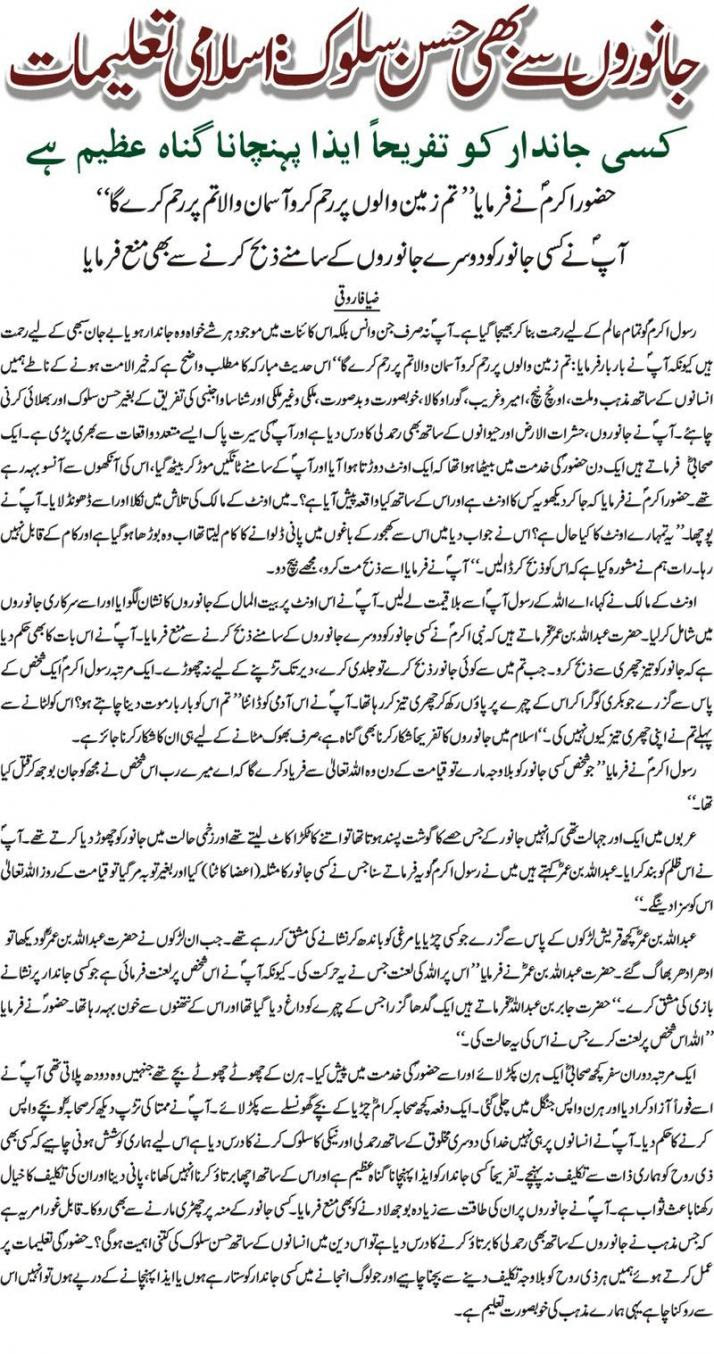
Janwaron Say Acha Salook
How To Receive Hajjis ?
In the name of Allah, the Most Merciful, the All-Compassionate. “May the Peace and Blessings of Allah be Upon You”
Praise be to Allah, we seek His help and His forgiveness. We seek refuge with Allah from the evil of our own souls and our bad deeds.
Whomsoever Allah guides will never be led astray, and whomsoever Allah leaves astray, no one can guide. I bear witness that there is no god but Allah, and I bear witness that Muhammad is His slave and Messenger.
How To Receive Hajjis?
On welcoming hajjis home, it is mustahab (commendable) to congratulate them and make a banquet for them. But
decorating with lights, firing gunshots, and hanging welcoming banners on walls are all forms of extravagance and showing off that should be avoided. Basically, there is nothing wrong with showing happiness for the safe arrival of hajjis when receiving them, yet it should be done without wasting money because this was not the practice of the Prophet (peace and blessings be upon him).
Allah accepts acts of worship when done with sincerity, which is achieved by avoiding all aspects of showing off. My concern is that acts such as putting up banners, colored lights, and firing gunshots as a welcoming gesture might be counted as a form of extravagance and showing off; that is why I suggest that they should be avoided.
In this regard, Allah says: (O ye who believe! Render not vain your almsgiving by reproach and injury, like him who spendeth his wealth only to be seen of men and believeth not in Allah and the Last Day. His likeness is as the
likeness of a rock whereon is dust of earth; a rainstorm smiteth it, leaving it smooth and bare.) (Al-Baqarah 2: 264)
The Prophet (peace and blessings be upon him) said: “He who lets the people hear of his good deeds intentionally, to win their praise, Allah will let the people know his real intention (on the Day of Resurrection), and he who shows off, Allah will disgrace.” (Al-Bukhari and Muslim).
Receiving people coming from Hajj should be done without exaggeration. There is nothing wrong with using phrases like “May Allah accept your Hajj, grant you forgiveness, and reward you for your efforts.”
In another hadith, the Prophet (peace and blessings be upon him) said, “O Allah! Forgive pilgrims and those for whom pilgrims have sought forgiveness from You.”
There is nothing wrong with relatives of hajjis preparing a banquet for them and those who come to congratulate them.
Generally speaking, it is preferable to congratulate a pilgrim on his safe arrival and on performing Hajj, for this is an act of supplication of a Muslim to his Muslim brother. Besides, it is a token of affection and shows mercy and sympathy to one another.
In the Quran, we read a verse congratulating the believers on the blessings they have in Paradise. Almighty Allah says: ((And it is said unto them): Eat and drink in health (as a reward) for what ye used to do.) (At-Tur 52: 19).
On congratulating one another, people should use phrases and actions that create happiness and conform to the commands of Allah and the teachings of His Prophet (peace and blessings be upon him). Occasions like marriage, birth of a child, Eid, return from a journey, Hajj, or Umrah, getting rid of distress are all occasions that need congratulations.
Namaz-e-Istisqa
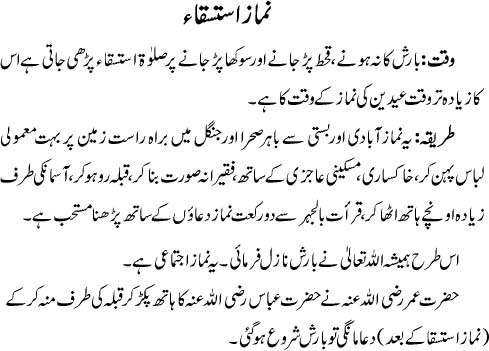
Namaz-e-Istisqa (Barish Ki Namaz) Ka Tariqa
Suspicion In Islam: Try To Avoid It
O Allah, save me from all those things that will lead to my destruction in this world and the next, and guide me towards those which will benefit me in both worlds. Ameen.
Misunderstandings crop up because of waswasa (repeated, unfounded doubts or fears). Sometimes Satan gains control of a person’s mind, rendering him worse than a hypocrite or a show-off. In other words, he becomes Satan in the garb of a human being! Satan enslaves his thought process, and the person does whatever Satan wants him to do
Sometimes Satan is also able to dominate the hearts of certain people.
The worst effect of waswasa of thought is that the person becomes suspicious. First, he is plagued with bad thoughts. Suspicion is from Shaitan. Shaitan makes a small beginning, but as soon as man gives him an opportunity, he takes man to the seventh level of Hell. He will not settle for anything less. In addition, Shaitan even ridicules man and says, “You have reached the depths of Hell yourself, what do I have to do with you?” Suspicion, driven by waswasa of thought, starts on a low scale, but soon escalates.
The biggest danger of suspicion is that it may lead one to sin. Because of waswasa of thought and suspicion, the affected person views others as sinners and bad characters.
The kind of suspicion which is a sin is the ascribing of evil motives, and it is not permissible for a Muslim to impute such motives to his brother Muslim without justification and clear evidence. Because the basic assumption concerning people is that they are innocent, a mere suspicion should not be allowed to result in the accusation of an innocent person.
For example, a man suspects his wife. This is a great sin. Or, for example, when a man enters their path, the husband tells his wife, “He is making passes at you.” This man talks like an insane person. Sometimes the wife suspects her husband, although he has become so old, he is devoid of carnal desires. But the moment he steps into the house, she creates a hue and cry, accusing him of maintaining a secret second wife. “Where else could you have gone all this time?” she asks him.
Like the silkworm, a person who remains trapped in the cocoon of his doubts and wrong thoughts will suffocate to death. O men! Do not talk about matters without knowledge. Don’t assume things. Don’t suspect others. Your eyes, your ears, and even your hearts will be questioned on the Day of Reckoning about these suspicions and these wrong thoughts! On that day, the organs of your body will bear witness against you
Islam aims at establishing its society on the clearness of conscience and mutual trust, not on doubts, suspicions, accusations, and mistrust.
Allah Almighty states: O you who believe, avoid (indulging in) much suspicion; truly, some suspicion is a sin. (S:49 V:12)
The Holy Prophet (peace be on him) said, “Avoid suspicion, for airing suspicion is the most lying form of speech.”(Reported by al-Bukhari and others.)
Human weakness is such that no one is free of suspicion and wrong thoughts, especially concerning those with whom relationships are not good. However, one must not give in to such thoughts nor go beyond thoughts to action, as stated in the hadith, “If you have a suspicion, do not pursue it.”(Reported by al-Tabarani.)
Suspicion could ruin relations between people, particularly when it is based on flimsy evidence or hearsay. The Prophet (Peace be upon him) has spoken in very clear terms about misplaced suspicion, giving clear orders to refrain from it. One clearly authentic hadith that groups together some of the actions that cause discord within the community and make people dislike one another is reported by Abu Hurairah. He quotes the Holy Prophet (peace be upon him) as saying: “Beware of suspicion, for it is the most untrue of what people say. Do not spy on one another, or compete with one another. Do not boycott, envy, or hate one another, but remain — you servants of God — brothers and sisters.”(Related by Al-Bukhari, Muslim, Abu Dawood and Al-Tirmidhi).
Quran Kareem Mein Jahannam Kay Azabon Ka Zikr
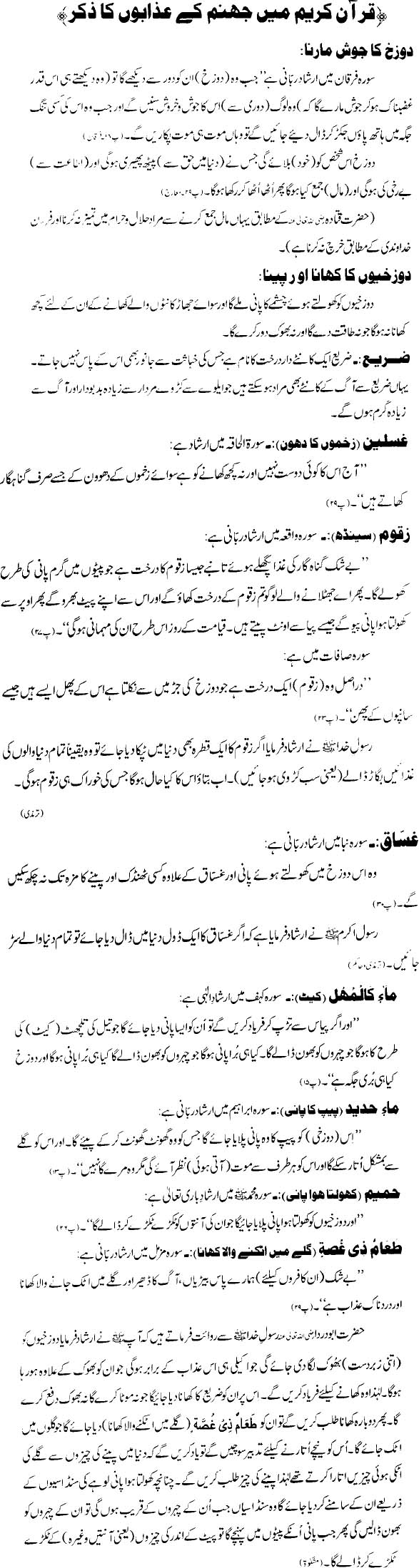
Quran Kareem Mein Jahannam Kay Azabon Ka Zikr
Hadith Khumm
Yazid Bin Haiyan reported: I went along with Husain Bin Sabrah and Amr Bin Muslim to Zaid Bin Arqam (May Allah be pleased with them) and, as we sat by his side, Husain said to him, “Zaid, you acquired great merits, you saw Messenger Of Allah (PBUH), listened to him talking, fought by his side in (different) battles, and offered Salat (prayer) behind him.
Zaid, you have indeed earned great merits. Could you narrate to us what you heard from the Messenger of Allah (PBUH)? ”
Zaid said, “By Allah! I have grown old and have almost spent up my age, and I have forgotten some of the things which I remembered in connection with Messenger of Allah (PBUH), so accept what I narrate to you, do not compel me to narrate what I fail to narrate”.
He then said,” One day Messenger of Allah (PBUH) stood up to deliver a Khutbah at a watering place known as Khumm between Makkah and Al-Madinah. He praised Allah, extolled Him, and exhorted (US), And said, Amma Badu. O People, I am a human being. I am about to receive a Messenger (The Angel of Death) from my Rubb, and I will respond to Allah’s call, but I am leaving with you two weighty things :
The first is The Book of Allah, in which there is right guidance and light, so hold fast to the Book of Allah and adhere to it.’ he exhorted (us to hold fast) to the book of Allah and then said, the second is the members of my household, I remind you (to be kind) to the members of my family. I remind you (to be kind) to the members of my family.
Husain said to Zaid, “Who are the members of his household?” O Zaid, aren’t his wives the members of his family?
Thereupon, Zaid said, “his wives are the members of his family. (but here) the members of his family are those for whom Zakat is forbidden”.
He asked, “Who are they?”
Zaid said, “Ali and the offspring of Ali, Aqil and the offspring of Aqil and the offspring of Jafar and the offspring of Abbas.”
Husain asked, “For all of them, the acceptance of Zakat is forbidden? “Zaid (may Allah be pleased with him) said, “Yes”. [ Muslim ].
Another narration is: Messenger of Allah (PBUH) said, “I am leaving behind me two weighty things. One of them is the book of Allah; that is the strong rope of Allah. Whosoever holds firmly to it, will be the guided, and whosoever leaves it goes astray”.
Commentary: This Hadith brings out the following points:
Messenger of Allah (PBUH) was a human being. He, too, was subject to the inevitable law of death.
It stresses the establishment of a firm bond with the Book of Allah (the Qur’an) and emphasizes showing respect and honor to the members of the Prophet’s family.
The members of the Prophet’s family are classified into two categories:
Firstly, the wives of the Messenger of Allah (PBUH) or the Mothers of the Believers. This is established from the categorical Verses of the Noble Qur’an.
Secondly, persons who have a close relationship with Messenger of Allah (PBUH). They are Banu Hashim and Banu Abdul-Muttalib, and include descendants of Ali, Aqil, Jafar, Abbas, and Harith (May Allah be pleased with them). Sadaqah is unlawful for the latter category.
Awabeen Kay Fazail
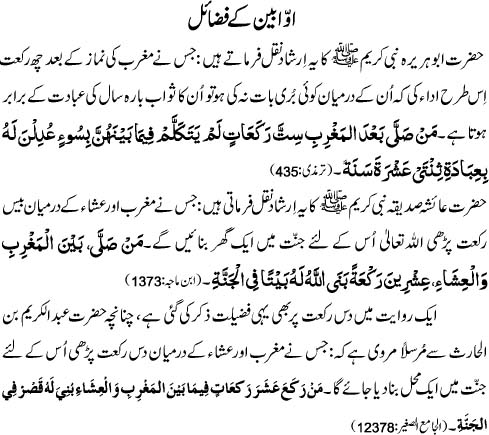
Awabeen Ki Namaz Kay Fazail
The First Muezzin: Bilal Ibn Rabah, An Ethiopian
The Prophet (P.B.U.H.) Death
Clearly, the Prophet (P.B.U.H.) final moments in this world revealed Bilal’s finest characteristics, as he was so emotional and seemed to be the person who suffered the most.
The Prophet (P.B.U.H.) died on a Monday. Madinah has never witnessed such tears and unhappiness as that day. He died on Aisha’s chest; see the tenderness of his wife? She left her home, not knowing what to say to the people. She opened the doors to the mosque and said, “Allah messenger has died, Allah messenger has died.”?
The people in the mosque burst into tears. Anas Ibn Malak said, “The Prophet (P.B.U.H.) first came to Madinah on a Monday, and everything on that day was filled with light. Now he died in Madinah on a Monday, and everything on this day was filled with darkness.”
One of the Companions who were away from Madinah said, “When I returned, I found all the doors closed, and heard weeping from inside the houses.”
The first prayer after his death came, and Bilal ascended to call for the prayer, saying, “Allah is the Greatest, Allah is the Greatest”, “There is no God but Allah, there is no God but Allah”. When he reached “witness that Muhammad is the Messenger of Allah”, the people in the mosque burst into tears and Bilal’s voice broke down, tears overcoming him. He couldn’t continue the call for prayer and descended from the pulpit. When the next prayer came, Bilal ascended to call for the prayer, and the same thing happened again.
O people, how can you latch onto other things and forget the Prophet (P.B.U.H.)?
Bilal stayed in this state for three days, wanting to call for the prayer but could not bring himself to do so.
He went to Abu Bakr and said, “Abu Bakr, discharge me from being the caller for prayer.”
He requested this after ten years of calling for prayers.
Abu Bakr wondered, “Why”?
Bilal replied, “I can’t call anyone for the prayer after Allah’s messenger. Every time I tried, I failed”.
Abu Bakr again wondered, “Why”?
Bilal said, “I can’t stay in Madinah after the Prophet’s death.”
Abu Bakr said, “No, I want you to stay with me”.
Bilal said, “If you released me from slavery under Umaya for yourself, then lock me up, and if you released me for Allah, then leave me to whom you released me for.”
Imagine how lovely and kind this former slave was.
Abu Bakr said, “I swear I didn’t buy you except for Allah’s sake, or spend my wealth except for Allah, or release you except for Allah, go, Bilal, do what you wish.”
Where do you think he went? He’s a soldier of Islam. Does it mean that as a result of the Prophet’s (P.B.U.H.) death, Bilal will stop everything and stay at home? No! He just can’t stand to stay in Madinah, because of the memories and the emotional ties.
Life After the Prophet (P.B.U.H.)
Bilal went to Palestine, where he joined the army, which struggled to take back Palestine and Al Quds. Omar Ibn Al-Khattab sent out the armies, and they defeated the enemies and won. Bilal prayed with the Companions in Al-Aqsa Mosque.
O Allah! Reward us with a prayer in Al-Aqsa Mosque!
The Muslims sent for Omar Ibn Al-Khattab to receive Palestine keys. He didn’t go in person to receive Egypt’s keys or Iraq’s keys, but he went to Palestine; see the significance of the country!
Omar met the armies and told them to gather in a wide open space, so they met on the Golan Heights. Omar asked, “Where’s Bilal?” It had been years since they had last met, and the happiness of meeting each other was immense. “Bilal, call for the prayer,” Bilal said, “Ruler of the Believers, I don’t call anyone for the prayers after the Prophet (P.B.U.H.).” Omar said, “Bilal, this is a victorious day, this is a day of dignity, a day which would make the Prophet (P.B.U.H.) pleased.” So Bilal ascended the Golan Heights and called: “Allah is the Greatest, Allah is the Greatest”, “there is no God but Allah, there is no God but Allah” until Muhammad is the Messenger of Allah” was stated, and the whole army burst into tears. They even heard Omar’s weeping voice!
The rest of Bilal’s story can be narrated in a few lines. Bilal settled in Damascus in Syria. A few months before he died, he saw a vision; he saw the Prophet (P.B.U.H.) telling him, “O Bilal! What’s this unfriendliness? Didn’t you miss visiting me, Bilal? As soon as he woke up, he hurried to Madinah. He stood in front of the Prophet’s grave (P.B.U.H.) and greeted him: “Peace be upon you, Allah’s messenger, peace be upon you, Allah’s beloved.”
Let me tell you a really pleasant thing: no one salutes the Prophet (P.B.U.H.), without an Angel going to the Prophet (P.B.U.H.) and informing him of this greeting, and so the Prophet would reply to your greeting! The Prophet (P.B.U.H) said, “Allah has angels walking on earth, if they find someone who is praying and greeting me, they carry the greeting to me, so I reply to your greeting.”
Hassan and Hussain, the Prophet’s (P.B.U.H.) grandchildren, came to Bilal, and he hugged them and cried. They said, We have missed your call for the prayer, Bilal. So he ascended to call for the prayer. Seven years had passed since he last did this. The whole of Madinah was captivated as they remembered this precious sound as they listened to the call for prayer.
The call to prayer has such sweetness.
People came out of their homes when they heard the call to prayer, moving towards the voice. Madinah cried like it hadn’t since the death of the Prophet (P.B.U.H.).
Bilal died in Damascus in Syria, where his grave lies. He died at the age of sixty. While dying, his wife felt sad and cried out, O disaster, O disaster. Bilal replied, “Don’t say O! Disaster, say O! Joy, O! Joy, for tomorrow I meet the beloved Muhammad and his Companions.”
Conclusion
Let’s remember the details of Bilal’s life:
He is the first caller of the prayers for the Prophet (P.B.U.H.).
He embraced Islam at the age of 30.
He was among the first Muslims.
Abu Bakr released him from slavery.
He continued calling the prayers for the Prophet (P.B.U.H.) for ten years.
He was the only one who prayed in the Kaaba with the Prophet (P.B.U.H.).
He died in Damascus, 17 A.H *. At the age of 60.
He said the well-known quote on his deathbed, “O! Joy, tomorrow I meet the beloved Muhammad and his Companions.”
Endnotes
* Radeeya Allah Anho, R.A. is the abbreviation, literally means “May Allah be pleased with him”.
* P.B.U.H. is the abbreviation of “Peace be upon him”, referring to the Prophet.
* Umrah is the lesser pilgrimage, which is optional and can be performed at any time.
* A.H. is the abbreviation of “After Hijraha”.
Kamil Wudu Aur Khushu Khudhu Say Namaz Parhne Par Maghfirat
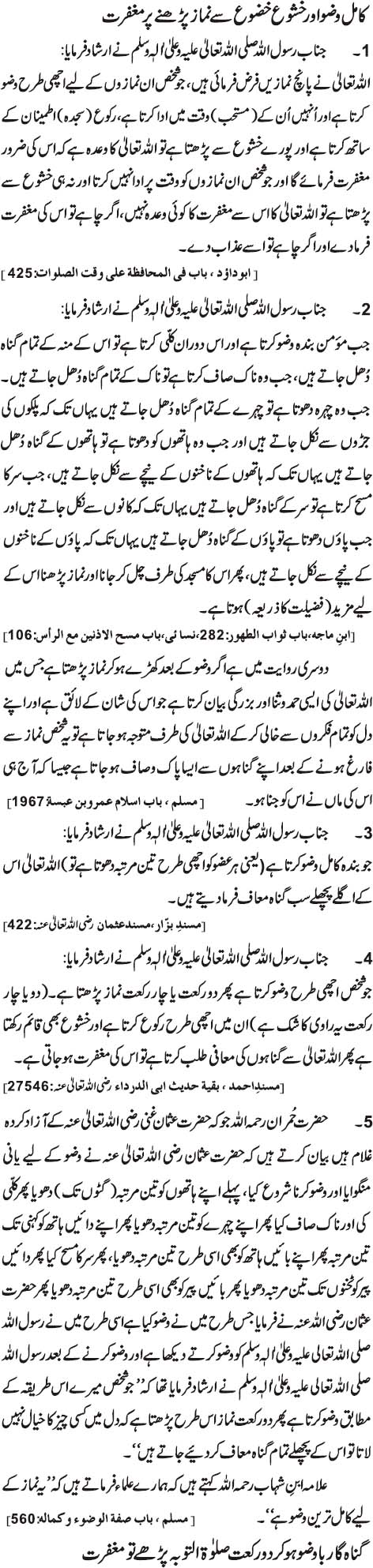
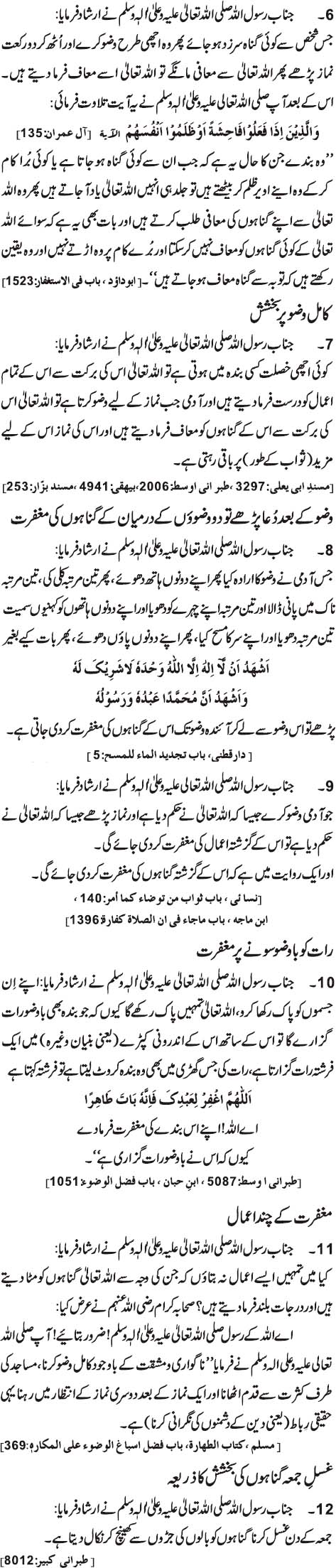
Kamil Wudu Aur Khushu Khudhu Say Namaz Parhne Par Maghfirat
Bilal Becomes A Muslim
Bilal (Radeeya Allah Anho) embraced Islam in the first year of Muhammad’s prophecy at the age of 30. There was an age difference of ten years between him and the Prophet (P.B.U.H), as the Prophet received the message of Islam at the age of forty. Bilal was one of the first people in Makkah to embrace Islam.
Bilal had something valuable; he was the third person who became a Muslim in Makkah. This is a very important point, because he was a slave to a very cruel, disbelieving man from Quraish, Umaya Ibn Khalaf. This man lived and died a disbeliever, and Bilal wished to declare his religion openly, although he was forbidden to do so. Even though he had to hide his beliefs from his cruel master, his declaration of faith was accepted. Bear in mind that during the period of severe suffering in Makkah, no one openly declared their faith in Islam except seven people.
Firstly, the Prophet (P.B.U.H.), secondly Abu Bakr (R.A.), and thirdly person was Bilal Ibn Rabah (R.A.). Because he loved his religion so much, he couldn’t hide it, and so he forsook his life for the sake of Allah.
Bilal stood in the middle of Makkah and testified, “There is no God but Allah and Muhammad is the Messenger of Allah”. He was among the Companions who were greatly harmed by the disbelievers because of his faith in Islam.
Umaya Ibn Khalaf used to take him to the desert and wait until the temperature reached forty or fifty degrees. He ordered his servants to undress Bilal, then cover him in an iron material, and place a heavy stone on his chest, which was so heavy that ten men couldn’t lift it. They would leave him like that for hours.
They would then return to him, and by then Bilal would literally be melting. They would demand Bilal to reject his faith in Allah and Muhammad (P.B.U.H.); but Bilal endless response would be: “Only one, only one” (meaning only One God). He stayed in this situation for endless days and months.
However, Bilal remained patient until Abu Bakr went to Umaya Ibn Khalaf and told him, “Why don’t you have mercy on this poor man?”
Umaya replied, “You give mercy to him”.
Abu Bakr said, “Yes, I will buy him. How much will you sell him for?”
A slave at that time was worth Dinars of silver. Since Bilal was in poor health and was beaten excessively, he was worth only one silver Dinar. The spiteful Umaya Ibn Khalaf said, “I will sell him for nine silver Dinars.” Abu Bakr replied, “And I will buy him for that price.”
Umaya laughed and said, “You know Abu Bakr, if you had argued the price with me, I would have sold Bilal to you for one Dinar”.
So Abu Bakr replied, “Umaya, if you had demanded one hundred Dinars, I would still have bought him!”
Brothers and sisters, spend wealth on people around you who are in need, be devoted and ready to sacrifice yourself. When you live solely for yourself and your children, you will live small and die small. But when you live for others, Allah will extend your life with each person you have helped.
If I asked women here, what is the state of your wardrobes? Filled with clothes? Do you wear them all? You’ll find that you don’t wear half of them. Why? Because fashion changes, and because you’re going to lose weight next year, etc. This is a selfish and greedy act. Give to those who need; those who can benefit from your unwanted goods.
The Migration to Madinah
Bilal stayed with the Prophet (P.B.U.H.) until the migration to Madinah (Al Hijrah), where they left Makkah for Madinah.
Something strange occurred in Madinah. The Prophet’s Mosque had been built, but people found it difficult to know the prayer times. How would they know when it is time for prayer? One of the Muslims suggested ringing a bell to signal that it is time for prayer. This idea was rejected, since the Christians use a bell to call members to church. Another Muslim suggested that they could raise a flag and walk with it to signal it was time to pray. But this idea was also rejected.
A companion called Abdullah Ibn Zayd (R.A.) came and said, “O Allah’s Prophet! That night, I dreamt I saw a man selling bells, so I asked him if I could buy one. He replied, Why do you need it? I said, so that people would know it was time to pray. The man replied, I can tell you something better than that. I asked him what it was. He said: Call for the prayer.”
O brothers and sisters! His dream was about religion! Some of the youths’ dreams are to get a particular car, and that’s all they dream of!
While Abdullah Ibn Zayd told them of his dream, Omar Ibn Al-Khattab said, “I swear by Allah’s messenger, I saw exactly what he saw too!” Upon this, the Prophet (P.B.U.H.) said, “Thanks be to Allah for this blessed vision. Tell Bilal to call for the prayer. He has a more beautiful voice than yours.”
Does Islam care about beauty, and how to make things look and sound beautiful? Is that our religion? Yes, that’s our religion! This is Islam.
So the call for the prayer was heard, and Bilal became the first caller for the prayers in Islam, and the first caller for the prayer for the Prophet (P.B.U.H.).
Battles and the Return to Makkah
Bilal stayed with the Prophet (P.B.U.H.) and never missed a single battle with him. When he was going to the battle of Badr to face the disbelievers, imagine who was among them? Umaya Ibn Khalaf! Bilal had come face to face with him! What would you do to the one who had tortured you? When Bilal saw him, he said, “Umaya Ibn Khalaf, the head of the disbelievers, I won’t survive if he survives.” During the battle, Umaya Ibn Khalaf was killed.
When the Muslims returned to Makkah, the Prophet (P.B.U.H.) returned the favor to Bilal. The Prophet (P.B.U.H.) said, “Bilal, climb on the Kabah back and call out for the prayer”. It doesn’t end there. The Prophet (P.B.U.H.) asked, “Where is the Kabah key?” There were 10,000 people standing in front of the Kabah, and the space inside the Ka‘bah would not allow more than one person to pray next to the Prophet (P.B.U.H.). Who will enter with Allah’s Prophet?! Surely Abu Bakr or Omar or Othman? No, it’s a pious and loyal day, “Where’s Bilal, come Bilal, pray with me inside the Kabah”. No one had prayed in the Kabah with the Prophet (P.B.U.H.), except one person, Bilal Ibn Rabah. From then on, when Omar met Bilal, he used to say, “Bilal, Abu Bakr is your master, and you are our master.” ‘Omar used to say this to Bilal! Look at what he learnt from the Prophet (P.B.U.H.).
Once the Prophet asked Bilal, “Bilal, tell me the best deed you have done, as I heard your footsteps in Paradise.”
“I swear the most I’ve done is that whenever my ablution was nullified, I would perform ablution immediately, and I would always pray two Raka‘s after ablution,” Bilal replied.
“That’s it Bilal!” The Prophet (P.B.U.H.) exclaimed.
Brothers and sisters, do you want to hear your feet walking in Paradise? Don’t move except when you are pure and on ablution. How can you leave your house in the morning when you are not?
Adil Khan