

Deeds That Are Like Ashes
“The parable of those who disbelieve in their Lord is that their works are as ashes, on which the wind blows furiously on a stormy day, they shall not be able to get aught of what they have earned. That is the straying, far away (from the Right Path).” (Qur’an, 14:18)
Allah has resembled the deeds of the disbelievers to ashes on which a severe wind blows during a stormy day, showing the futility and lack of benefit of those deeds.
So He compared their nullified actions with scattered dust because the actions were not based on the foundation of Imaan (faith) and Ihsaan. They were neither for Allah’s sake nor upon His command.
So such a person will not be able to benefit from his deeds at a time when he would need it the most (i.e. on the Day of Judgement). For this reason, Allah said, “they shall not be able to get aught of what they have earned.”
Hence, they will not be able to earn any reward or benefit from their deeds on the Day of Judgment. This is because Allah does not accept any deed unless it is done sincerely for His sake and in accordance with what He has legislated.
Actions are of four types. Only one type is accepted and the rest three are rejected. Only when the action is Al-Khaalis As-Sawaab (pure and correct), is it accepted. Al-Khaalis is sincerity for Allah’s sake alone and for none other than Him. As-Sawaab means the deed must be done according to how Allah legislated it upon the tongue of His Messenger (i.e. upon the Sunnah).
(The other three types are:
1. Deeds that are neither for Allah’s sake nor upon the Sunnah;
2. Deeds that are for Allah’s sake, but not upon the Sunnah;
3. Deeds that are upon the Sunnah but not done sincerely for Allah’s sake. These three types of deeds are rejected, while only the first type of deed – Al-Khaalis As-Sawaab – is accepted by Allah.)
There is a profound secret in (Allah’s) resembling of these (rejected types of deeds) with the ashes. Ashes come after the fueling and igniting of fire. Hence, such actions are the food of the fire (that will be destroyed). And it will also be the fuel of the Fire that will roast its inhabitants.
Allah will bring about (more) fire and punishment from their false actions, just as He brings about bliss and pleasure for the people whose deeds are purely for His sake alone and are in accordance with His command.
The Fire will affect the (rejected type of) actions until it turns them to ashes. Hence, such people, their actions, and what they worship besides Allah, are the fuel of the Fire.
– By Ibn Al-Qayyim Al-Jawziyyah
– Tafseer Al-Qayyim pg. 326-327
Maut Ko Kasrat Se Yaad Karo

Celebrating Eid, The Sunnah Way
The time for celebration is here. The Prophet (peace be upon him) said, “There is an Eid for every nation and this is our Eid.” (Al-Bukhari)
Here are some of the Sunnah acts of Eid:
Doing Ghusl before going out to the prayer
It was narrated in a Saheeh Hadeeth in Al-Muwatta’ and elsewhere that Abdullah Bin Umar used to do Ghusl on the day of Al-Fitr before going out to the prayer-place in the morning. (Al-Muwatta’ 428)
Al-Nawawi said Muslims were unanimously agreed that it is Mustahabb (recommended) to do Ghusl for Eid prayer.
Eating after the prayer on Eid Al-Adha
On Eid Al-Adha it is recommended not to eat anything until one comes back from the prayer, so as to eat from the sacrifice if he has offered one. If he is not offering a sacrifice then there is nothing wrong with eating before the prayer.
As for Eid Al-Fitr, it is recommended to eat some dates before going to the prayer.
Takbeer on the day of Eid
This is one of the greatest Sunnahs on the day of Eid.
Al-Daraqutni and others narrated that on the morning of Eid Al-Fitr and Eid Al-Adha, Ibn Umar would be excessively engaged in reciting Takbeer until he came to the prayer place, then he would recite Takbeer until the Imam came out.
Saying Takbeer when coming out of one’s house to the prayer place and until the Imam came out was something that was well known among the early generations. This has been narrated by a number of scholars.
In the case of Eid Al-Adha, the Takbeer begins on the first day of Dhul-Hijjah and lasts until sunset on the last of the days of Tashreeq.
Description of Takbeer
It was narrated in the Musannaf of Ibn Abi Shaybah with an authentic chain from Ibn Mas’ood (may Allah be pleased with him) that he used to recite the following Takbeer during the days of Tashreeq:
Allahu Akbar, Allahu Akbar, Laa ilaha illAllah, wa Allahu Akbar, Allahu Akbar, Wa Lillaahil-Hamd
Meaning: Allah is Most Great, Allah is Most Great, there is no god but Allah, Allah is Most Great, Allah is Most Great, and to Allah be praise.
Al-Mahamili also narrated the following with an authentic chain from Ibn Mas’ood:
“Allahu Akbar Kabeera, Allahu Akbar Kabeera, Allahu Akbar Wa Ajall, Allahu Akbar Wa Lillaahil-Hamd.” (Al-Irwa’, 3/126)
Greeting each other
The etiquette of Eid also includes congratulating and exchanging good wishes by people, with any permissible expressions of congratulations.
Jubayr Ibn Nufayr said when the companions of the Prophet (peace be upon him) met one another on the day of Eid, they would say to one another, “Taqabbal Allah Minna Wa Minkum,” which means, “May Allah accept (good deeds) from us and from you.” (Al-Fath, 2/446)
Adorning oneself on Eid
Jabir (may Allah be pleased with him) narrated that the Prophet (peace be upon him) had a cloak which he would wear on the two Eids and on Fridays. (Saheeh Ibn Khuzaymah, 1756) Al-Bayhaqi narrated with an authentic chain that Ibn Umar used to wear his best clothes on Eid.
Choosing different routes
Jabir Ibn Abdullah narrated that on the day of Eid, the Prophet (peace be upon him) used to vary his route. (Al-Bukhari, 986)
This was done so that the two routes would bear witness for him on the Day of Resurrection, as the earth will speak on the Day of Resurrection and say what was done on it, both good and bad.
And also to manifest the symbols of Islam on both routes, or to manifest the remembrance of Allah (Dhikr), or to cast fear in the hearts of the hypocrites and Jews, and to overwhelm them with a large number of people with him. Another reason was so that he could attend to people’s needs, answer their questions, set an example, give charity, or visit his relatives.
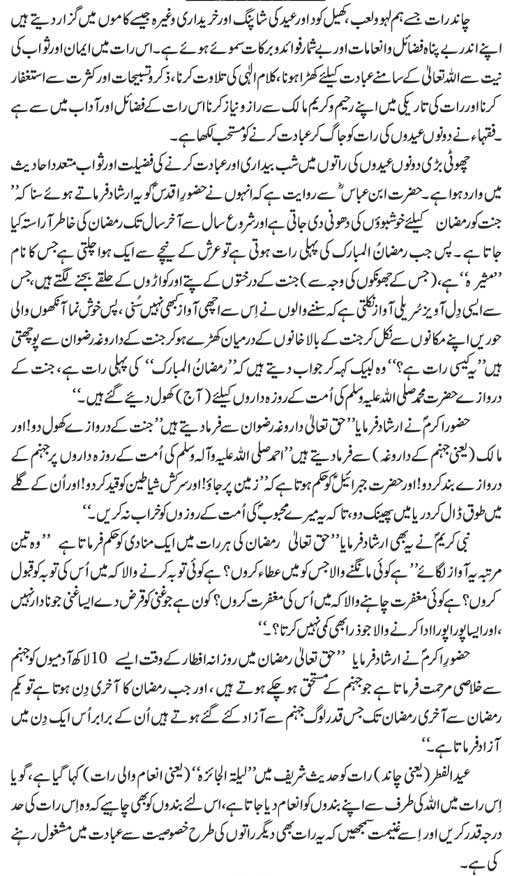
Chand Raat Mein Ibadat Ka Sawab
Excessive Display Of Charm
Praise be to Allah. Allah has prescribed fasting for great reasons. One of the most important of these reasons and one of the greatest purposes achieved by the fast is so that we may attain piety (taqwa), as Allah says: O you who believe! Observing As-Saum (the fasting) is prescribed for you as it was prescribed for those before you, that you may become Al-Muttaqoon (the pious). (Qur’an 2:183)
Taqwa or piety means obeying that which Allah has commanded and avoiding that which He has forbidden.
The person who is fasting is commanded to do acts of worship and obedience, and he is forbidden to do haraam things. Sins are bad enough when committed by anyone, but they are even worse when committed by one who is fasting. Hence the Prophet (peace be upon him) said: “Whoever does not give up false speech and acting in accordance with it, and ignorant conduct, Allah has no need of him giving up his food and drink. (Al-Bukhari)
Ibn Khuzaymah, Ibn Hibban and Al-Hakim narrated that Abu Hurayrah (may Allah be pleased with him) said: The Messenger of Allah (peace be upon him) said: “Fasting does not just mean giving up food and drink, rather fasting also means giving up idle and obscene talk. (Sahih Al-Targheeb)
Secondly, a woman’s making a wanton display (tabarruj) of her beauty and charms to non-mahram men detracts from the reward of fasting. The more sins are committed and the more serious they are, the more that detracts from the reward of fasting, and it may cancel out the reward altogether, so that a person may have denied himself food, drink and all the things that invalidate the fast, yet still is deprived of the reward for that by disobeying Allah.
Hence the Prophet (peace be upon him) said: “The one who fasts may get nothing from his fast but hunger, and the one who performs qiyaam (salah) may get nothing from his qiyaam but a sleepless night.” – Narrated by Ibn Maajah.
Thirdly, with regard to fasting that is accompanied by sins – including tabarruj on the part of a woman – the fast is not invalidated by that, rather it is valid and the fasting person has fulfilled his obligation and does not have to make up for the fast. But the reward for fasting gets decreased owing to that sin and it may be cancelled out altogether as stated above.
Al-Nawawi said in Al-Majmou: The fasting person should protect his fast from backbiting and slander. What this means is that it is more important for the fasting person to avoid these sins than others, although those who are not fasting should avoid these sins too, as that is the command for all situations. If a person backbites while fasting, he has committed a sin but that does not invalidate his fast in our view.
This is the view of Malik, Abu Hanifah, Ahmad and all the scholars except Al-Awzai‚ who said that the fast is invalidated by backbiting, and must therefore be made up.
Based on this, the fasting person has to avoid haraam words and actions, so he should not backbite people, or tell lies, or spread malicious gossip amongst them, he should not engage in haraam transactions, and he should avoid all haraam things.
If a person avoids that for a whole month then he should be able to adhere to that straight path for the rest of the year. But unfortunately many of those who fast do not differentiate between the days when they fast and the days when they do not fast, so they carry on as usual with haraam speech such as lying, cheating and so on. You do not feel that they are observing the sanctity of fasting. These actions do not invalidate the fast but they do detract from its reward, and may cancel out the reward of fasting altogether.
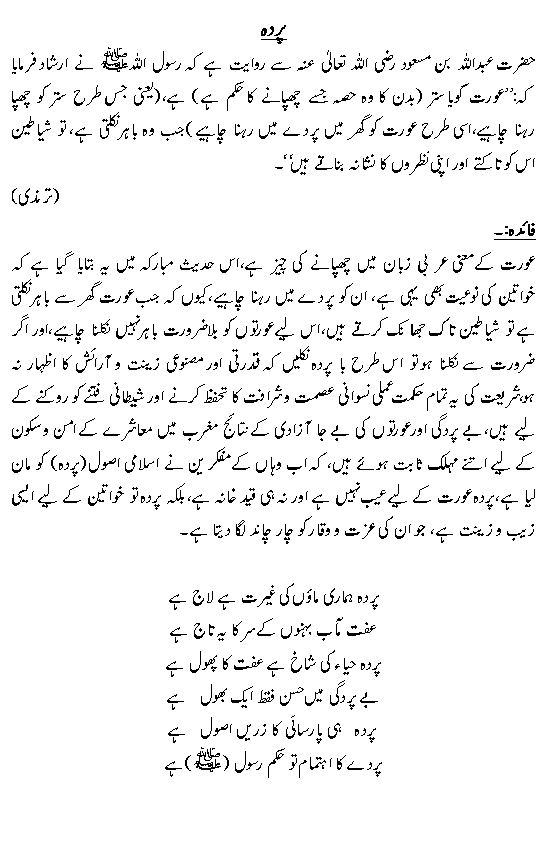
Parde Ka Hukam
Thoughts On Modesty
EVERY religion has its characteristic, and the characteristic of Islam is modesty.
This statement made some 1400 years ago by Prophet Muhammad (peace be upon him) is just as relevant today as it was then. The Prophet (peace be upon him) lived in turbulent times when slavery, debauchery, drunkenness and sexual abuse was rife; when poor women could be maltreated without redress and wealthy women could live totally without morals if they wished, without much criticism.
When the Prophet (peace be upon him) was a teenage boy he was one of the founder members of a society of “Knights of Justice” created by his uncle, determined to bring protection and fair dealing to the weak and insecure. He, and those of like mind, were loved and admired for their nobility, years before the revelation of Islam. The revelations, when they came, encouraged and exhorted them to show others that compassion, generosity, courage, modesty and patient faith were the right way to live.
Modesty is such a ‘quiet’ characteristic, that perhaps nobody thinks about it very much. What are modest people like? They are self-effacing and humble; they do not wish to draw too much attention to themselves. They feel embarrassed when they are given praise, and genuinely do not really feel they have done all that much to deserve it, for everything they do is no more than their duty and their delight, in serving Allah. They would hate to be picked out for praise above their fellows, or pushed forward into the limelight, shown off, or made to perform ‘party pieces’ to the applause of others.
Modesty also implies a personal and physical shyness and reticence, as opposed to a wish to flaunt themselves for their physical charms. In this day and age, when it seems to be taken for granted that young women wish to walk down the streets of town wearing garments that cover little more than their underwear does, and when everything seems geared up to a lifestyle that encourages females to make themselves as sexually attractive as possible and to feel failures if they are not turning heads, women who are not like that, and do not wish to be, are regarded by some as being rather odd.
It is an unfortunate sort of discrimination, for in actual fact very large numbers of girls and women are naturally modest, and do not wish to flaunt themselves at all, and feel no sense of distress or loss if they are not arousing male desires or interested glances. Wearing hijab, or becoming a ‘covered lady’, is one of the odd problems facing girls and women who convert to Islam and who then decide to alter their style of clothing, and/or wear a head-veil.
Ironically, genuinely shy and modest women can feel really uneasy and ‘forced into the arena of public scrutiny’ when they change old habits; putting on hijab can cause people who know you to stare, or wonder why you suddenly think yourself to be ‘better’ or ‘more holy’ than them, or to bring out remarks about how well they know what you are really like, or to wonder why you are seeking to ‘dress up in fancy dress’, or pretending to be an Arab or a Pakistani or whatever. Muslim women who take the further step of covering their faces often face a similar reaction from Muslim women who don’t.
This is not something that male Muslims know very much about. There is no equivalent requirement for a man as regards his clothing, or head covering, or face covering. I suppose something similar would be for a converted man to feel it was a good thing required by Allah to turn up at the office or go to the garage or factory in an Arab long white dress and put a bag over his head.
There is no false modesty intended. But they are giving certain specific messages: firstly, that their faith is Islam and they have chosen to submit to the will of God in every aspect of their lives; and secondly, that they wish to be appreciated for their characters and good deeds, and not for whether or not they happen to be pretty or slim or sexy.
Modesty also implies simplicity and lack of desire for ostentation. A woman could be completely covered, but in some gaudy material, shrieking color, and also dripping with jewelry, gold, and pearls. That’s one sort of ostentation. Or she might be the only woman in her community who chooses to be head to toe in black-that might well be genuine piety, but it could also be a form of ostentation too. Allah will judge the lady not by her clothes at all, but by her motives, her niyyah, and the quality of her life and what she does with it.
There is always a lot of controversy about the extent of a woman’s hijab in Islam. Some women cover absolutely everything, others interpret it to mean ‘modest dress according to the society in which one lives’ and even dispense with the head-veil. Hijab certainly means that a woman should not be showing her cleavage, or wearing a garment that is transparent and reveals her underwear, or one that is tight and clinging.
The compulsory aspect of hijab to a Muslim woman is modesty-how this is interpreted in clothing styles is not compulsory at all, and is left to the piety and taste of the individual. Modesty and simplicity, and trust in Allah go hand in hand.
May Allah bless us, and fill our hearts with love and compassion, and direct our lives along a path that will enable us to bring help, hope, serenity, shelter and peace to others, and a means of rescue and healing to those already hurt and damaged by callousness, cruelty and abuse,
Ameen.
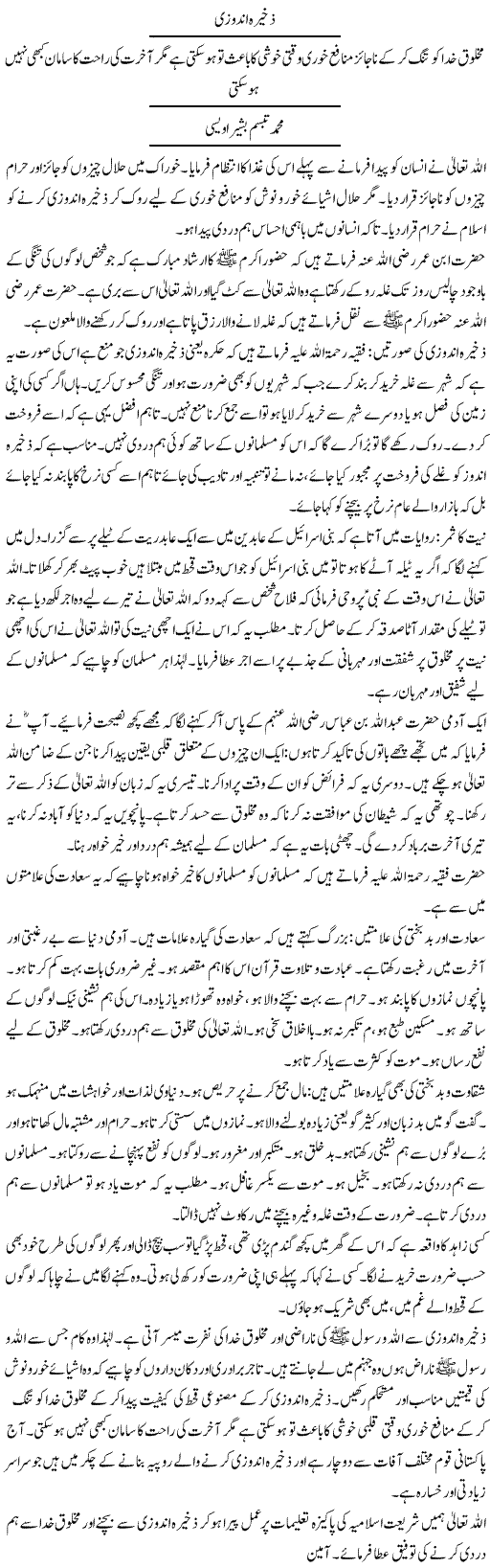
Zakheera Andozi
Seek The Greatest Night Of The Year
Itikaf
Itikaf means seclusion and staying in the mosque with the intention of worshipping and becoming closer to Allah. Every Ramadan, the Prophet (peace be upon him) would retreat himself in Itikaf for the last 10 days. The year he died, he observed Itikaf for twenty days. (Bukhari)
As the month of blessings and mercy is coming to the end, similarly, the recitation of the complete Qur’an is also coming to the Khatam which would be on the 27th night of Ramadan. The last ten nights are very important nights. Ayesha (may Allah be pleased with her) said that the Prophet (peace be upon him) used to exert himself in night prayer especially during the last 10 days of Ramadan.
Lailat-ul-Qadr
Ayesha (may Allah be pleased with her) said, “Allah’s Messenger used to practice Itikaf in the last ten nights and say: ‘Seek out Lailat-ul-Qadr in the (odd nights) of the last ten days of Ramadan.” (Bukhari and Muslim).
Lailat-ul-Qadr (Night of Decree) is the greatest night of the year. It is a night about which Allah revealed a full Surah, Surah Al-Qadr, and verses 3-6 of Surah Al-Dukhan. Allah the Almighty said in the Qur’an, “Verily, We have sent it (his Qur’an) down in the night of Al-Qadr (Decree). And what will make you know what the night of Al-Qadr (Decree)is? The night of Al-Qadr (Decree) is better than a thousand months (i.e. worshipping Allah in that night is better than worshipping Him a thousand months, i.e. 83 years and 4 months). Therein descend the angels and the Ruh [Jibril (Gabril)] by Allah’s Permission with all Decrees, (All that night), there is Peace (and Goodness from Allah to His Believing slaves) until the appearance of dawn.” (Qur’an, 97:1-5)
Abu Hurairah reported that the Prophet (peace be upon him) said, “…there is a night (during this month) which is better than a thousand months. Whoever is deprived of its good is really deprived (of something great). (Ahmad, an-Nisai and al-Bayhaqi).
Spend more time with the Qur’an. Read the Qur’an every day. Try to recite the whole Qur’an at least once during this month. Pray on time. Men should try to observe all the prayers with the congregation at mosques. Do not ignore the Taraweeh. Make more extra and voluntary prayers.
Do as much worship as you can. Do more Dhikr (remembering Allah) and Du’a (supplication) for yourself and for others. Repent and seek forgiveness for yourself and for others as much as you can. This is the best time for devotion and seeking Allah’s forgiveness. Seek the Night of Qadr by special devotion during the last 10 nights of this month.
The month of blessing and forgiveness is passing away very quickly. Do not miss the remaining last ten days and nights. Let us clear our sins. Let us seek the Night of Qadr!