

Inner Revolution
God is the greatest of all powers. No one can escape Hid reckoning. He will deal severely with the wicked. Belief in a God of this awesome nature is no simple matter; faith transforms a person a being when it enters his soul.
Imagine the change that comes over a person who suddenly realizes that a lion is roaming free in front of him. A far greater change occurs when one truly realizes the existence of God. To believe in God is to discover Him, and when one truly discovers God, one becomes more certain of His existence than of anything else, one fears Him above all else.
Faith in God is like an earthquake, which shakes the human soul. The true believe sees the Day of Resurrection before it comes.
Such belief engulfs one’s entire being in the fear of God. This fear is manifested in all one’s dealings with others. One does not humiliate the weak for one sees that they are God’s envoys. One does not cover before the strong, because one sees that all are helpless before God. One accepts the truth when it is proven, for denying it would be like seeing heaven, and hell before one, then leaving the fresh gardens of paradise to plunge into the flames of hell.
Esaar
Preferring A Life Of Poverty
Some prophets, such as David and Solomon, combined kingdom with prophethood. They enjoyed the benefits of kingdom with the great privilege of being the recipients of divine revelations. In the case of David, he was given the Psalms, constituting one of the major divine books. Solomon, on the other hand, was granted what he prayed for: a dominion that would not be granted to anyone else. Hence, God made the wind subservient to his command, and granted him mastery over the jinn. Other prophets were given special privileges.
Prophet Muhammad (peace be upon him) was God’s final messenger. It should be remembered that prophets were of two types: some were only prophets endorsing messages given before their times, and others were given their own messages, making them God’s messengers. Muhammad was of the latter, elite type, but as the last messenger, his message was addressed to all mankind, and guaranteed by God to remain intact for the rest of time.
What effect did this have on his family life? Prophet Muhammad established a state in Madinah, thus combining the two roles of prophethood and head of state. The Muslim community was under siege for the first few years, with the enemies combining their forces to try to crush the Muslim state. However, after the great victory against the allied forces of the Arab unbelievers and the Jews, the situation brightened up for the Muslims and their fortunes vastly improved. The Prophet could lead a life of riches, had he so wished. He, however, preferred a life of poverty. He did not wish to change his life style in any way.
Although jealousy among his wives often surfaced, with two groups emerging among them, they were treated equally by him. No one was ever as fair as the Prophet was in his treatment of his wives. They, however, felt that they should not continue to endure a life of poverty. Therefore, they requested him to give them a better standard of living. They all joined in making this request, feeling that by grouping together they might be able to persuade the Prophet to change his mind.
Again we see here a perfectly ordinary family situation. A woman asks her husband for better provisions after having endured poverty for a length of time. What makes the request more significant, however, is that it was made by several wives at the same time. They all endured the same standard of living. Aishah once said that: “We might go through a month without a fire being lit up for cooking in any of the Prophet’s homes.”
When things were hard, those noble wives of the Prophet endured this type of life with exemplary patience. However, when the situation changed and the Muslim state was no longer poor, they felt that the newly found affluence should be reflected in their standard of living. This was a perfectly understandable request.
Yet the Prophet realized that material affluence counted for little. His mission placed him on a totally different level. Therefore, he was unwilling to change his life style. The request could not be granted.
-by Adil Salahi
Izzat, Zillat Ka Mayar Deen Aur Parhaiz Gari
The Vessels and Cups of the People Of Paradise
The vessels from which the people of Paradise will eat and drink will be of gold and silver. Allah (SWT) says:
“Trays of gold and cups will be passed round them..” [43:71] i.e. cups of gold.
And Allah (SWT) says, “And amongst them, will be passed round vessels of silver and cups of crystal, crystal-clear, made of silver. They will determine the measure thereof according to their wishes.” [76:15] i.e it will combine the purity of crystal with the whiteness of silver.
al-Bukhaari and Muslim reported from Abu Musaa al-Ash’ari that the Messenger of Allah (saw) said, “The believer in Paradise will have a tent made of a hollowed-out pearl.. and two gardens of silver, their vessels and everything in them, and two gardens of gold, their vessels and everything in them.” [Mishkaat al-Masaabeeh, 3/86]
Among the vessels from which they will drink will be cups and jugs and glasses:
“They will be served by immortal boys, with cups, and jugs and a glass from the flowing wine.” [56:17-18]
The “cup” [koob] is something that has no handle or spout, the “jug” [ibreeq] has a handle and a spout and the “glass” [kaa’s] is a cup that is filled with drink.
Surah Kausar
Woman’s Right To Khula
ISLAMIC Shariah provides for Nikah in order to keep the society morally healthy, bring to an end all that is evil and obscene, and let husband and wife live in peace and harmony. If a couple fails to reap these benefits from a Nikah-based wedlock, viz. the matrimonial relations do not remain pleasant and harmonious and in case that situation prevails, there arises the danger of spoiling the very purpose of Nikah, then it is desirable to annul such a Nikah.
Since it is binding upon the husband to pay Mahr to his wife and provide all the basic needs to her, he has the right to pronounce the divorce. If a woman wants separation from her husband, she will have to return her Mahr. In Islamic parlance, this right of a woman is called Khula. Khula means to annul, to free, to rescind. Precisely, it is a typical form of breaking the marriage bond. Scholars of Islamic jurisprudence have defined it differently and at great length. The gist of all this is that a man’s pronouncing divorce after receiving money for the purpose from his wife is called Khula.
The right to divorce rests with the husband. If the wife wants to seek divorce, the way is open for her on the condition of returning her Mahr. If the husband is not ready to divorce her even on the condition of getting the Mahr back, the woman can move the court and the court, in turn, would secure divorce from her husband in lieu of the Mahr.
During the lifetime of Prophet Muhammad (peace be upon him), there arose some cases of Khula which led the Islamic State of Madina to lay down its rules and procedure. The Holy Qur’an says “…Then if you fear that they would not be able to keep the limits ordained by Allah, then there is no sin on either of them if she gives back (the Mahr or a part of it) for her Al-Khul (divorce). These are the limits ordained by Allah, so do not transgresses the limits ordained by Allah, then such are the Zalimun (wrong-doers).” (Qur’an, 2:229)
As divorce without any rhyme or reason is most detrimental, similarly seeking Khula without any solid ground is most detestable in the eyes of Shariah. A tradition of the Noble Prophet (peace be upon him) says: ‘The woman who demands divorce from her husband without having any ground, will be deprived of the fragrance of Heaven.’ (Bukhari)
However, if there is any reasonable ground, securing Khula is permissible and there is no hitch about it. Another Hadith says: “The wife of Thabit Bin Qais went to the Noble Prophet (peace be upon him) and said to him: ‘Messenger of Allah, I dislike Thabit the most. I do not level any charge against his faith or morals, but I fear that living with him may plunge me into Kufr.’ The Noble Prophet (peace be upon him) asked her whether she would return the garden which he (Thabit) had given her as Mahr. To which she replied in the affirmative. Then he (the Prophet) asked Thabit Bin Qais to get the garden back and divorce her.” (Bukhari)
Another case of Khula relating to the same Thabit Bin Qais is reported thus: “Thabit Bin Qais beat his wife Jameelah. She (Jameelah) or, according to another report, her brother complained to the Noble Prophet (peace be upon him) against him. He (the Prophet) sent for Thabit and told him to take the Mahr back and divorce his wife.” (Nasai)
A study of these traditions brings to light certain facts about Khula. One, if a woman dislikes her husband, and as a result fears that the couple might not be able to keep within the bounds set by Allah, opting for Khula is better.
Two, the woman will have to return the Mahr in order to secure divorce. And if the husband does not want to divorce her even on the condition of taking the Mahr back, he will be compelled by the court to accept the money and divorce her. Three, these traditions also indicate that the amount of Mahr should be considered as the maximum for granting Khula. That is, a man should accept the Mahr back from his wife and divorce her on demand. If a man demands more than the amount of Mahr to grant Khula, it is undesirable. However, it is not illegal according to Ibn Abbas, Ibn Umar and Uthman.
The divorce pronounced in the case of Khula, in whatever words it is done, will be final and irrevocable. That is, the man will have no right to revoke the divorce during the woman’s Iddah. Had the man been given the right to revoke the divorce in case of Khula, the very purpose of Khula would not have been served. Khula has been provided for to give the woman the right to separation from her husband if she dislikes him, and for this kind of separation, she returns her Mahr. In spite of this, if a man were to have the right to revoke the divorce, it would mean the woman was not given that right.
Like divorce, Khula also becomes effective without the intervention of the court. It can be demanded and granted in the privacy of the man and wife or in the presence of some relatives and friends. However, if the man is not willing to grant Khula, the case should be referred to a court.
Unlike divorce, Khula can be demanded and granted even while the woman has not completed her menstrual period.
A woman can herself demand Khula or her Wali (guardian) can do so on her behalf. However, if the woman has not attained puberty, her Wali has no right to demand Khula on her behalf.
– Mushtaq A. Tejarwi – an eminent scholar of Fiqh from India.
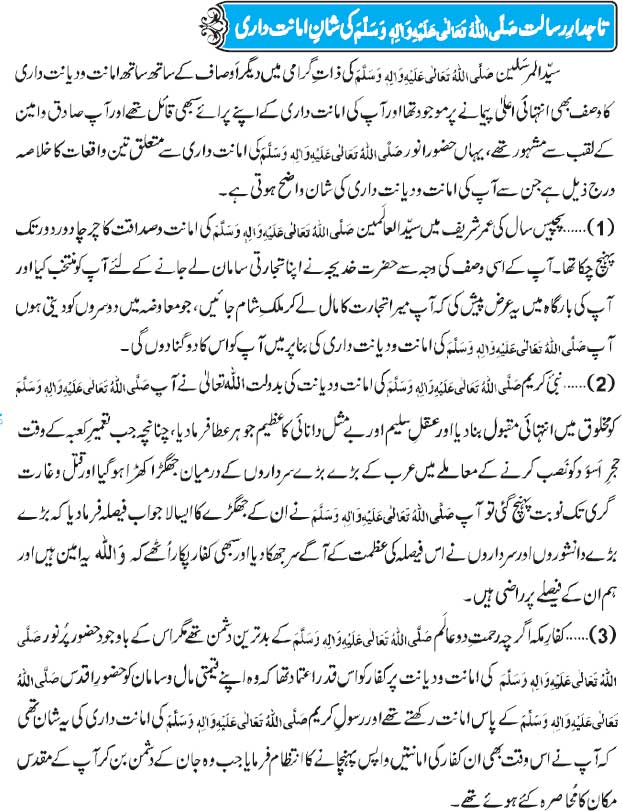
Tajdar-e-Risalat Ki Shan e Amanat Dari
A Message To Those Drowning In Sin
Q: I would like to let you know that I have committed the most major sins and I am not saying this in order to take pride in my sins – I used to feel this before but not any longer. I have defeated Satan in many rounds, but he defeated me in more battles. Is it possible for me to return to Allah once again and how?
A: In the name of Allah, Most Gracious, Most Merciful. All praise be to Allah and prayers and salutations to our Prophet Muhammad and his family and companions.
The Prophet (PBUH) said Allah will forgive whoever repents before the sun rises from the west [reported by Muslim from the Hadith of Abu Hurairah].
Nothing prevents you from repenting, even if your sins reach the sky or fill the whole earth. As long as the human being is in this life, the door of repentance is open. You are in the midst of a battle between the call of faith in your heart, and the call of desire that is guided by Satan in your heart.
The heart is not immunized from Satan except with the Zikr (remembrance) of Allah, the Exalted, and it does not have the strength to want good except by doing good deeds. Satan does not defeat the heart unless it is inattentive of the Zikr of Allah, the Exalted and unless it is weak because of vice and sins committed. Take it and maintain it as its results are guaranteed, Allah willing, if you persevere it honestly:
- Keep up the five prayers in congregation, especially the Fajr prayer and never miss it. Allah, the Exalted says “and the fajr reading of the Qur’an , verily the fajr recitation of Qur’an is witnessed,” i.e. the Fajr prayer is witnessed by angels.
- After the Fajr prayer remain in the mosque to read the Qur’an until sunrise, and then offer two Rakahs (prayer units) 10 minutes after sunrise.
- Say Subhan Allah wa bi Hamdihi (may Allah be glorified and praised) one hundred times a day at any time in the mosque or house, whether walking, sitting, in the car, etc. This Zikr wipes out sins.
- Ask forgiveness of Allah one hundred times each day, saying Astaghfirullah wa atoobu ilayh (I ask forgiveness of Allah and I repent to Him), once again at any time you wish and in whatever condition you are in.
- Say this zikr: la ilaha illa Allahu wahdahu la sharika lah, lahul mulk wa lahul hamd wa howa ala kul shayin qadeer (there is no god but Allah; He has no partner; He is the dominion and praise, and He is capable of everything) one hundred times each day at any time you wish and in whatever condition you are.
- Between Maghrib (sunset prayer) and Isha (evening prayer) remain in the mosque and do not leave it, and recite as much as you can of the Qur’an, with full concentration.
- Continue this program for at least a month: living with the Qur’an, reciting it with consideration, and acting upon what is in it; spending time alone for long hours for the Zikr of Allah, the Exalted.
- If the environment in which you live does not support you in applying this program, then change the environment – abandon bad friends, and avoid places that encourage you to commit sins.
- Donate part of your money as a form of repentance to Allah, the Exalted, as charities given in secret are seen only by Allah, the Exalted.
In an authentic Hadith, “Secret charities extinguish the anger of the Lord.” [Narrated by ibn Hibban from the Hadith of Anas] - Try to perform Umrah with the intention of renewing your faith and cleansing your past with the water of this blessed trip.
11. If you owe anything to others, return that and do not retain anything you will be accounted for, as a form of repentance to Allah.