
Qayamat Kay Din Kay Chand Ausaf

What Are The Different Duties The Angels Undertake?
• They are the keepers of Paradise: “And those who kept their duty to their Lord will be led to Paradise in groups, till, when they reach it, its gates will be opened and its keepers will say: Salaamun ‘Alaikum (peace be upon you!). You have done well, so enter here, to abide therein.” (Qur’an, 39:73)
• They are the keepers of Hell, who are “stern and severe, who flinch not (from executing) the Commands they receive from Allah, but do (precisely) what they are commanded.” (Qur’an, 66:6)
• There are angels that carry the Throne, glorify the praises of their Lord, and ask forgiveness for the believers who repent sincerely. (Qur’an, 40:7)
• An angel is responsible for blowing the Trumpet to signal The Hour (Israfeel).
• Angels drive the clouds and descend with each drop of rain (Mikael and his helpers).
• Angels take a person’s soul at the time of Death (there is no authentic narration to state that the name of the angel of Death is Azra’eel).
• Angels test a person in the grave (Munkar and Nakeer).
• Angels are engaged in various acts of worship tirelessly: some are bowing, some are prostrating, some are standing in rows, some are circumambulating the House of Allah over the seventh heaven (Al-Bayt Al-Ma‘moor), which is the counterpart of the Ka’ba in the Heavens.
• Angels keep record of a person’s deeds, the “honorable scribes” (Kiraman Katibeen) who know all that we say and do. (Qur’an, 6:61; 43:80; 50:17-18)
• Angels protect a person throughout his life. “For each (person), there are angels in succession, before and behind him. They guard him by the command of Allah.” (Qur’an, 13:10-11)
• An angel is responsible for the fetus in the womb, who “breathes the spirit into (the fetus), and is charged with four commands: to write down his provision, his life-span, his actions, and whether he will be wretched or happy.” (Al-Bukhari and Muslim)
• There are angels who travel throughout the world, seeking out and gathering around assemblies of Dhikr (remembrance of Allah).
• Angels witness the recitation of the Qur’an at Fajr (Dawn): “Indeed, the recitation of Fajr is witnessed.” (Qur’an, 17:78)
• Angels are in charge of the stability of mountains, as mentioned in the authentic narration where the Messenger of Allah (peace be upon him) was addressed by the angel of mountains at Taif when he went there to call the people to Islam.
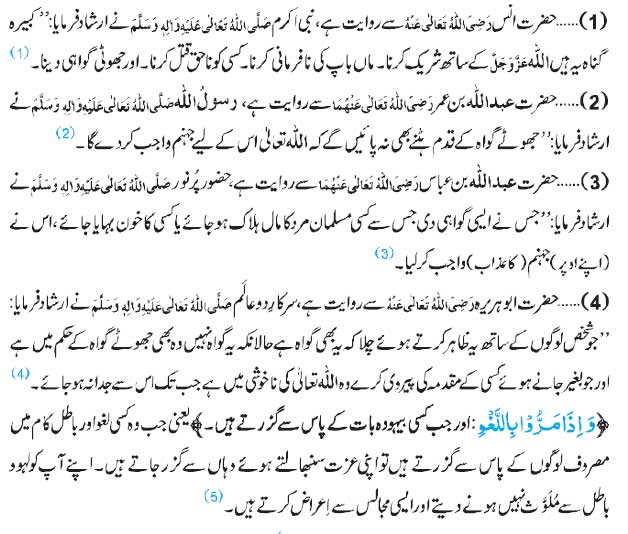
Jhooti Gawahi Ki Muzammat
The Modern Muslim State Of Madina
PROPHET MUHAMMAD (peace be upon him) stayed in Makkah calling the people of his hometown to the message of Allah for 13 years and the number of people who embraced Islam did not exceed 70. The Prophet (peace be upon him) suffered a lot at the hands of his people who rejected the new religion, in spite of its noble and uplifting values. During that initial phase of Islam, Prophet Muhammad (peace be upon him) was fully occupied with instilling the idea of monotheism or the Oneness of God in his people’s minds.
When the Prophet (peace be upon him) migrated to Madina where he (peace be upon him) spent 10 years of his life, that are truly considered the most profitable and fruitful ones in the history of Islam. As soon as he settled in Madina, the Prophet (peace be upon him) started to work for establishing the Muslim state. If we deeply study the foundations upon which Prophet Muhammad (peace be upon him) established this state, we will discover that it was a modern state in the full sense of the word:
• When the Prophet (peace be upon him) arrived in Madina, he started building a mosque first to serve as the parliament for the nascent Muslim state. In other words, it was not only a place of worship but a place for discussing and reviewing all the matters related to the general good of Muslims and Islam.
• The second step taken by Prophet Muhammad (peace be upon him) was to effect a reconciliation between Aws and Khazraj, the two most powerful tribes of Madina. This is what is called nowadays in political circles as establishing social peace and political stability.
• The third step was to sign non-aggression treaties with the Jews which in the present terminology is called establishing and fostering good neighborliness. But, unfortunately, the Jews, as usual, violated the treaty which made Prophet Muhammad (peace be upon him) expel them from Madina to keep their mischief away from the new-born Muslim state and this is what is called today political shrewdness.
• The Prophet (peace be upon him) established the principle of Shoura (Consultation). He (peace be upon him) used to consult his Companions to seek their views on all matters of importance, giving everybody the chance to present his or her point of view. He never hesitated to accept and act on any reasonable point of view, in spite of the fact that it might be contrary to his own view. This is what we call today the democratic spirit and public opinion polls.
• The Noble Prophet (peace be upon him) was deeply concerned about equality. He emphasized on many occasions that all Muslims regardless of their color, race, wealth and social status are equal and this accomplished what we call today as human rights.
• The Prophet (peace be upon him) always emphasized the positive role of women in building the Muslim society and always stressed that her role is as important as that of man, and this is what we have come to call today women’s rights or women’s empowerment.
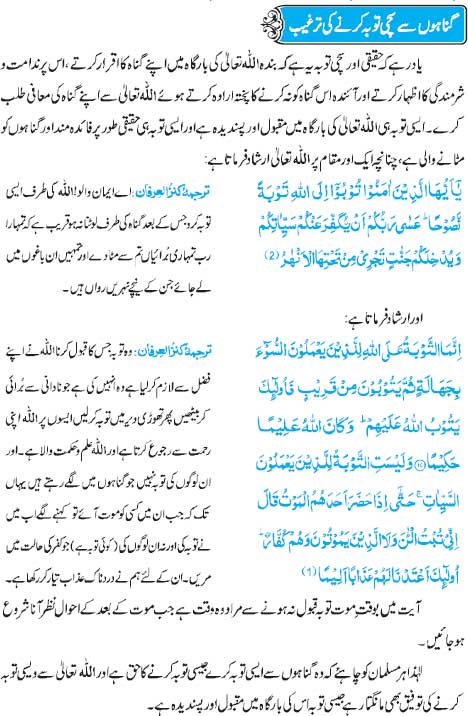
Gunahon Say Sachi Tauba
Feed The Orphan, The Needy, The Wayfarer
[ALLAH’S Quran 107:1-3] “Have you ever considered (the kind of person) who denies the Judgment (to come)? It is (the person) who drives away the orphan with harshness and feels no urge to feed the needy.”
The PROPHET (Peace Be Upon Him) has said:
[Muslim, Book #005, Hadith #2290] “Abu Said al-Khudri reported: The Messenger of Allah (may peace be upon him) was sitting on the pulpit and we were sitting around him, and he said: What I am afraid of in regard to you after my death is that there would be opened for you the adornments of the world and its beauties. A person said: Messenger of Allah, does good produce evil? The Messenger of Allah (may peace be upon him) remained silent. And it was said to him (the man who had asked the question from the Holy Prophet): What Is the matter with you, that you speak with the Messenger of Allah (may peace be upon him) but he does not speak with you? We thought as if the revelation was descending upon him. He regained himself and wiped the sweat from him and said: He was the inquirer (and his style of expression showed as if he praised him and then added): Verily good does not produce evil. Whatever the spring rainfall causes to grow kills or is about to kill, but that (animal) which feeds on vegetation. It eats till its flanks are filled; it faces the sun and dungs and urinates. and then returns to eat. And this Wealth is a sweet vegetation, and it is a good companion for a Muslim who gives out of it to the needy, to the orphan. to the wayfarer or something like that as the Messenger of Allah (may peace be upon him) said: He who takes it without his right is like one who eats but does not feel satisfied, and it would stand witness against him on the Day of judgment.”
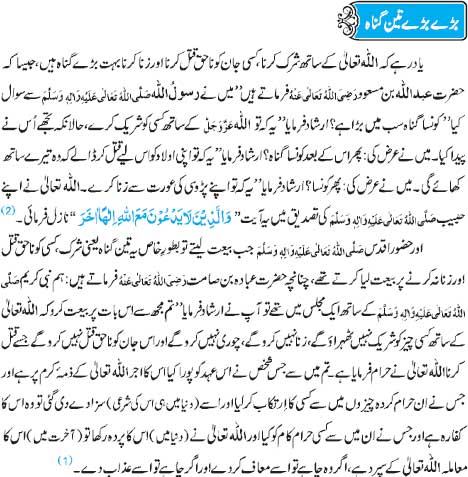
Barey Barey Teen Gunnah
Hadith About Iqama & Prayer
Volume 1, Book 11, Number 600 :
Narrated ‘Abdullah bin Mughaffal:
The prophet said, “There is a prayer between the two Adhans (Adhan and Iqama), there is a prayer between the two Adhans.” And then while saying it the third time he added, “For the one who wants to (pray).”
Volume 1, Book 11, Number 610 :
Narrated ‘Aun bin Abi Juhaifa:
My father said, “I saw Bilal turning his face from side to side while pronouncing the Adhan for the prayer
Volume 1, Book 11, Number 609 :
The Prophet said, “When you hear the Iqama, proceed to offer the prayer with calmness and solemnity and do not make haste. And pray whatever you are able to pray and complete whatever you have missed.
Volume 1, Book 11, Number 610 :
Narrated ‘Abdullah bin Abi Qatada:
My father said. “Allah’s Apostle said, ‘If the Iqama is pronounced then do not stand for the prayer till you see me (in front of you).’ ”
Volume 1, Book 11, Number 615 :
Narrated ‘Anas:
Once the Iqama was pronounced and the Prophet was talking to a man (in a low voice) in a corner of the mosque and he did not lead the prayer till (some of) the people had slept (dozed in a sitting posture).
Volume 1, Book 11, Number 618 :
Narrated ‘Abdullah bin Umar:
Allah’s Apostle said, “The prayer in congregation is twenty-seven times superior to the prayer offered by person alone.”
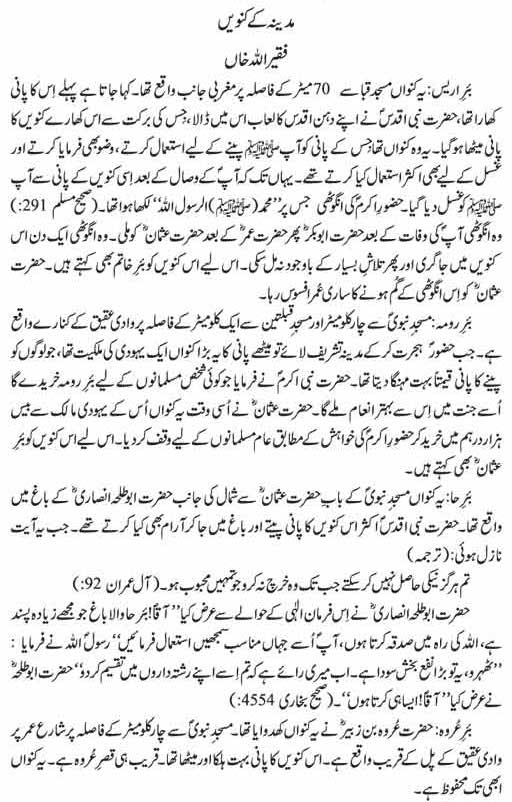
Madina Kay Kuwein