The Principles Of Self-Development
DEVELOPMENT carries the notion of enhancement of one’s capabilities and potentials. It implies a forward movement from a given position to a position of greater achievement, opportunity and benefit.
In order to develop, individually or collectively, it is necessary to define the goals one wishes to achieve, factors that influence development, and the process of achieving the desired goals for development. Each human being is born with some basic faculties. How these faculties are molded depends on inherent capacities, nurturing environment and other external influences.
Islam places a great deal of emphasis on ‘self-development’ where an individual takes the responsibility for understanding the purpose of human life, and for shaping that life in the best possible manner, for one’s own benefit and the benefit of the society at large; Islam also provides comprehensive guidance to achieve this goal.
Human development consists of processes of growth and change that takes place from birth to the end of life. The development process is externally influenced from sensory inputs through the organs, and it is internally self-propelled from things which happen within the human body and mind.
Our focus here is the development of the human mind, which takes place through sensory inputs and internal mental processes. This development includes learning through the senses and cognition that occurs when learning is abstracted into knowledge for subsequent use.
Islam identifies two sources which play the roles of nurturing or corrupting human development. Inspiration from divine guidance nurtures human development. Not paying attention to divine guidance and succumbing to conspiracies, arising from within or external environment, corrupts human development.
Human development may be looked at from different perspectives, both as a basic human interest and as formalized disciplines of studies such as psychology, science, philosophy, sociology, anthropology, and so on.
Purification from corruption
We regularly wash our hands before touching food because our hands come in contact with so many objects that may collect harmful germs from others touching the same objects. We wash our clothes when they collect sweat and dirt from our own body and our surroundings. We bathe and shower to keep our body clean. All these cleanliness chores are intended to keep us in good physical health. What about some chores to keep our minds clean and in good health? So many things that we come in contact with can corrupt our minds.
We may see a person drawing satisfaction from hitting and humiliating another. It leaves an impression on our mind and may later make us do the same impulsively.
We see people achieve success through lying and cheating, and our mind may perceive it as an acceptable behavior particularly if these cheaters and liars are being bandied around as role models.
A child may go through abuse from parents considered respectable in society and on growing up may engage in the same dysfunctional behavior.
Both eyesight and hearing are indispensable for human learning and development. They can propel us to unimagined heights of human excellence. However, we must learn to use them properly. Otherwise what we see and hear can also corrupt our mind and degenerate us into the lowest abyss of human existence.
How do we purify ourselves from the corrupting influences around us? We need to reflect on what we see and hear and to separate them into experiences that are desirable form of behavior and those that are undesirable in the light of some guiding principles. We may call it the exercise of the mind, and similar to other forms of exercise, the exercise of the mind requires regime and regularity.
The process of purification of the mind, variously called purification of the heart and soul, is known in Islam as tazkiyyah.
A prerequisite of engaging in tazkiyyah is to know that the human mind is prone to becoming corrupted. The corruption may be attributed to acquired elements within oneself, or to external influences, or both. However, the responsibility for any undesirable behavior rests with the person who commits it and not the person or the environment that caused it. We all bear direct responsibility for our actions.
Despite the best efforts that one may make at purification of the mind, aberrations are still possible. We may make mistakes or commit sins. What happens then? A properly trained human mind possesses what is called a self-reproaching soul (nafs-e-lawwama). It will react by an admission that something has gone wrong; it will accept the failing with humility, and it will engage the mind to reform itself accordingly.
On the other hand, someone who has a headstrong soul (nafs-e-ammara) such admissions may be seen as undignified, thus becoming prone to more and bigger aberrations in future. A wrongful act if recognized with a thoughtful commitment to avoid repetition is an act of self-purification and proper human development.
On the contrary, a reckless disregard of such actions leads to further corruption of the soul and self-degeneration.
Self-development regime
Understanding the principles is generally within the reach of most people. Putting those principles into practice requires courage, rigor and regularity.
Consider the following excerpt from a Tradition (Hadith) of the Prophet Muhammad (peace be upon him) about one of the things that happened to him during his appearance before God. Prophet said : “… Allah enjoined fifty prayers on my followers. When I returned with this order of Allah, I passed by Moses who asked me, ‘What has Allah enjoined on your followers?’ I replied, ‘He has enjoined fifty prayers on them.’ Moses said, ‘Go back to your Lord (and appeal for reduction) for your followers will not be able to bear it.’ (So I went back to Allah and requested for reduction) and He reduced it to half. When I passed by Moses again and informed him about it, he said, ‘Go back to your Lord as your followers will not be able to bear it.’ So I returned to Allah and requested for further reduction and half of it was reduced. I again passed by Moses and he said to me: ‘Return to your Lord, for your followers will not be able to bear it. So I returned to Allah and He said, ‘These are five prayers and they are all (equal to) fifty (in reward) for My Word does not change’.”
The prayer we offer to God is an act of His remembrance and the guidance that he has revealed for shaping our lives. We engage in this formal exercise five times a day. What about the rest of the time? This requires us to reflect on the moral of the above saying of the Prophet (peace be upon him). Perhaps an ideal number to stand formally before God would have been seventy times a day as the Prophet (peace be upon him) was informed first.
One may ask as whether there are some special words that one can utter for engaging in remembrance of God and reflecting on our thoughts and actions. The Prophets asked the same question. While there are no bounds on what one can say and utter, what we are reminded to say by God is very simple, easy to remember and utter, and direct in meaning. Here are some examples: … There is no God but Allah.
This simple expression provides the pinnacle for human development. Reminding ourselves that there is no god but Allah provides the best possible framework for human development since what God (Allah) tells us to do is for our own good, and there is no need for us to succumb to any power contrary to what God tells us. Ultimately God has power over all things and God arranges our affairs rightly if we reach out to Him.
Examples of expanded expressions for remembrance of God for self-development are: ‘Glory to Allah, and praise to Allah, there is no god except Allah, and Allah is the Greatest’. Also there is ‘there is no god but Allah, He is One and has no partner. His is the dominion, and His is all praise, and he is Powerful over everything’.
Conclusions
There are infinite words and ways of expressing ourselves in remembering Allah, and seeking closeness to Him for personal development. However, simple words can reach boundless depths in meaning when expressed with devotion and sincerity. It is this power of amazing simplicity that is within easy reach for all of us.
Islam Mein Ehtesab Ka Tasawar

Merchandise Of The Fool
Gambling is one of the major prohibitions and it is not a minor sin. The door is wide open before a Muslim to earn money through lawful means. Hence, he should not let others beguile him or deceive him with baseless ideas. Rather, he should be more realistic.
A Muslim is ordered by Allah to leave no stone un turned in seeking his livelihood through the sweat of his labor. In earning his living a Muslim should employ his thinking, exert physical effort to attain his goal, and burn his midnight oil to make his dreams and high hopes come true.
We can not expect a Muslim to earn his living by a stroke of luck while wallowing in deep slumber and exerting no effort. Lacking behind and lassitude are not the characteristics of a Muslim and not the norms of Islam.
Our Muslim youth should not be beguiled by such fake and illegal ambitions. Rather, they should live the reality as it is and be down-to-earth.
Referring to this in his sincere advice to his son Al-Hasan, Imam `Ali (may Allah be pleased with him) stated, ‘Do not incline to hopes (i.e., while staying idle), because high hopes is the merchandise of the fool.’ This also reminds us with the words of a poet: Never be the slave of hopes as hopes are the capitals of the penniless!”
Yusuf Al Qaradawi
Always Say That Which Is Best
Al-Isra (The Ascension) Sura 17: Verse 53
Tell My servants (O Muhammad), to always say that which is best. Verily it is Satan who sows discord among men. Satan indeed is an open enemy to man.
In their discussions with the unbelievers and polytheists, in fact with all opponents of their faith, Muslims should refrain from losing their temper. Additionally, they should not resort to exaggerated and extremist statements. Even in the face of provocation from their opponents, Muslims should not utter even a word that is contrary to the truth; nor should they lose their temper at the vulgarities which are flung at them by their opponents, nor should they be provoked to the point of paying back their opponents in the latter’s own coins. Instead, they should keep their composure and say only that which is balanced and true, and is in keeping with the grace and dignity of the faith which they seek to uphold.
The Quran tells believers that whenever in the course of their discussion on contentious issues with unbelievers, they feel overly provoked and overwhelmed with rage, they should immediately realize that such reactions are instigated by Satan who is keen to hurt the cause of their faith. Satan will certainly try to prompt the believers to give up, as their opponents had done, all efforts of reform, and to become entangled in futile wrangling and strife. For it is Satan’s aim that all mankind remain perpetually enmeshed in such controversies.
Compiled From:
“Towards Understanding the Quran” – Abul Ala Mawdudi, Vol. 5, p. 51
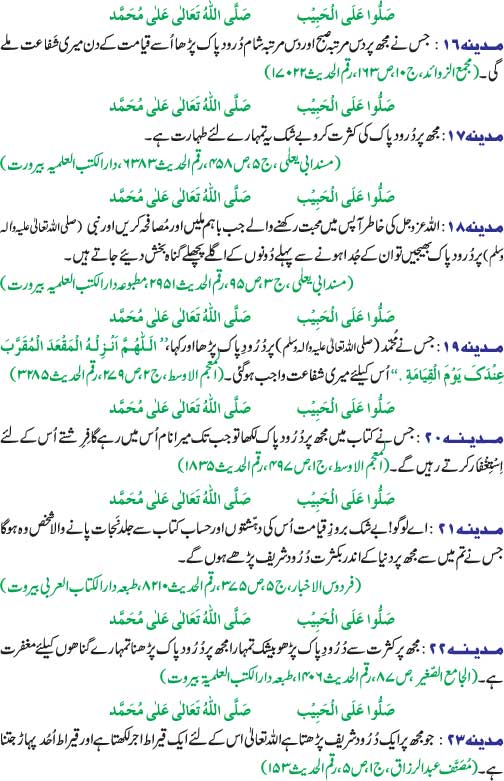
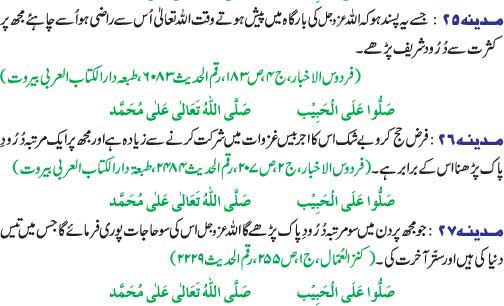
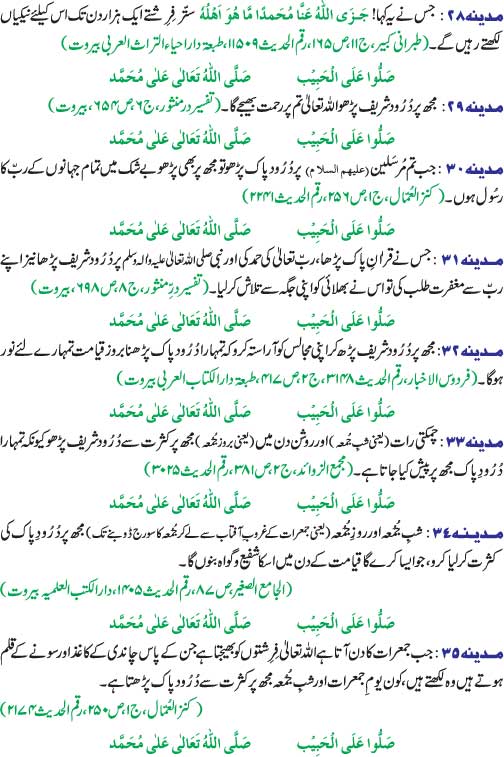
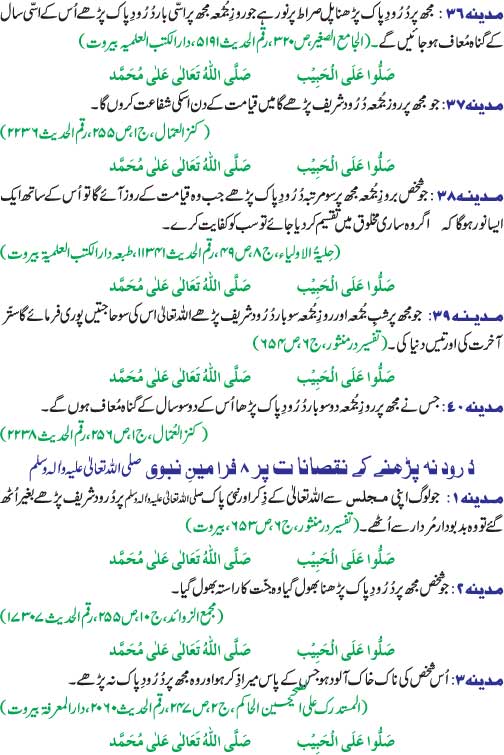
Durood Shareef Ki Fazeelat Hadith Ki Roshni Mein
Quranic Advice
It is narrated that the Prophet (saw) has said:
One who has even a particle of pride in his heart, shall not enter paradise. (Muslim)
Pride comes when you see your
- intelligence,
- wealth,
- friends,
- influence,
- titles and
- life
as your own achievements, instead of as gifts from ALLAH, the Al-Mighty.
When you finally view them as responsibilities that you must fulfill, you will be thankful for these gifts, and be afraid that you will be unable to fulfill them. The syukur and fear (khauf) will drown away the pride.
Remember,
- you will not bring even an atom of wealth, stocks, bonds, land or property, to the grave.
- you will not bring a string of degrees or qualifications from prestigious Universities to the grave.
- you will not bring your circle of friends, powerful connections, celebrities, and peers who hail you, to your grave.
- you will not bring your beloved parents, children, spouses or relatives to the grave.
- you will not bring your fame, reputation, honor to the grave.
- you will not bring your millions of adoring fans, and admiring colleagues to the grave.
- you will not bring any of the fine clothes in your closet, nor the expensive furniture in your living room, nor the million dollar apartment you saved a lifetime to purchase, to the grave.
- you will not even be able to prevent your carefully groomed hair, face and body from rotting, eaten by worms and maggots, when you are in the grave.
So when you have died, and your body has rotted away, you will then be asked by Allah,
where is the dunya (all that you once possessed) that you so loved?
where is the dunya (all that you once possessed) that you were so proud of?
where are your supporters (the admiring fans, the loving family, the approving peers, the powerful colleagues, the people who idolized and praised you always), who worshiped you?
The grim reality sets in the….you are now as you were when you were in your mother?s womb.
Then, you were in the dark womb of your mother, completely helpless, at Allah’s mercy, and ….you had no friends, no wealth, no power, no authority, no knowledge, no property … you possessed nothing, and you were then born, in humility, naked, covered in slime… you were nothing.
Then Allah showered you with His love and guidance, and gave you a portion of this worldly life, so that you may be thankful, and grateful, and that you bow humbly in submission.
But no, Man is rebellious.
36:77. Does not man see that We have created him from Nutfah (mixed male and female discharge semen drops). Yet behold! He (stands forth) as an open opponent!
Today, once again, you are in the womb, the dark, dark womb of Mother Earth, completely helpless, at Allah’s mercy, and …. once again, you have no friends, no wealth, no power, no authority, no knowledge, no property … you possess nothing, you have come full circle.
You are waiting to stand trial, on Judgement Day, a Day when you will face Allah in humility and fear, naked, covered in sin… and you will have to account to Allah, what you did with His gifts. And if you had walked the earth with pride, today, you will truly fear Allah, but that fear will not help you. Because…
One who has even a particle of pride in his heart, shall not enter paradise. (Muslim)
Seek out your pride, and repent.
Every single atom.
Beg Allah for His Mercy and His help to cleanse your hearts.
Seek out Allah’s blessings to you, and be grateful.
Every single blessing. From being able to wake up, to being able to swallow, see, smell and walk. For the gift of health. Wealth. Education. Realisation. Happiness. Love. Rizq. Fresh air. Clean water. Food on the table. The list in endless. Only that, sometimes, we are too blind to see.
[31:18] And turn not your face away from men with pride, nor walk in insolence through the earth. Verily, Allah likes not each arrogant boaster.
Oh Mankind, Fear Allah! He Possesses the Heavens and the Earth, and all that lies in between. And, we, his creation, possess nothing. Realize, repent, and humble yourself before your Rabb.
QuranicTruth
Quran KA Paigham
Unbeliever’s Argument In Hell
What the Qur’an teachers :
Before the fire they are brought, morning and evening, and then on the Day when the Last Hour comes, it will be said: Cast Pharaoh’s people into the worst suffering. They will contend with one another in the fire: The weak will say to those who were arrogant, “We have been your followers, so can you relieve us of some share of the fire?” The arrogant will reply: “We are all in it together. For God has judged between His creatures.” Those in the fire will say to the keepers of hell: “Pray to your Lord that He lighten this suffering of ours, though it be for one day only.” They will ask: “Did your messengers not come to you with clear evidence of the truth?” They will say: “Yes, indeed.” (The keepers of hell) will say: “Pray, then!” But the prayers of the unbelievers will be all in vain.
(The Forgiving; 40: 46-50)
It describes the end suffered by Pharaoh and his people as a result of their arrogant rejection of Moses’ call on them to believe in God’s oneness. The way this verse is phrased suggests that they are brought before the fire during the time between their death and the Day of Judgment. This may be a reference to the torment suffered in the grave. The statement that follows reads: “and then on the Day when the Last Hour comes, it will be said: Cast Pharaoh’s people into the worst suffering.” This means that this suffering precedes the Day of Judgment. It is a terrible punishment involving exposure to the fire morning and evening, either to make them expect its burning and pain, which is a terrible suffering, or to experience it, which is even worse. Then, on the Day of Judgment, they will be cast into the worst suffering.
The verse that follows tells us of something that happens after resurrection. The unbelievers are shown arguing in hell: “The weak will say to those who were arrogant, ‘We have been your followers, so can you relieve us of some share of the fire?’” This means that the weak are together with the arrogant in the fire of hell. The weak have not been spared on account of their weakness, or their being driven like cattle, having no say or choice. God granted them a position of honor, which equipped them to exercise free choice and to be responsible for what they choose. They relinquished all this and followed their arrogant leaders instead. They did not object to anything the leaders said. In fact, it did not occur to them that they could object. They did not think about what their arrogant leaders said to them, or the errors they landed them in: “We have been your followers.” The fact of their relinquishing responsibility and what God granted them could never serve as extenuating circumstances in God’s sight. Therefore, they will be in hell, driven there by their leaders, just as they used to drive them like sheep in the life of this world. We see them asking their leaders: “Can you relieve us of some share of the fire?” This question is a reminder of what such leaders used to assert, pledging to protect their followers against evil and harm.
Such arrogant leaders, however, are soon fed up with their weak followers’ requests. Their answer betrays their boredom, but nonetheless they acknowledge what has happened: “We are all in it together. For God has judged between His creatures.”
“We are all in it together.” We are all weak, lacking all support and help. We are all alike. So why do you put such a question to us when you realize that the noble and the weaker elements are all the same? “God has judged between His creatures.” There can be no review or change to His judgment. The matter is settled. No creature can reduce or amend God’s judgment.
When all realize that no refuge can be sought from God’s punishment except with Him, they all humbly appeal to the guards of hell, in a way that makes them all equal: “Those in the fire will say to the keepers of hell: Pray to your Lord that He lighten this suffering of ours, though it be for one day only.”
They want the guards of hell to intercede on their behalf, hoping that their terrible ordeal can be lifted a little. They ask them to pray to God to reduce their punishment for one day, just to breathe and have a bit of rest. Even a day’s reduction is worth such appeals.
The guards of hell, however, do not respond to this humble and passionate appeal. They know their limits, and they are aware of God’s law and that the time is long passed. Therefore, they increase the suffering of the dwellers of hell by rebuking them and reminding them of the reasons for their suffering: “They will ask: ‘Did your messengers not come to you with clear evidence of the truth?’ They will say: ‘Yes, indeed.’”
The question and its answer suffice. There is no need for any more argument. The guards of hell leave them to their fate, allowing them to sink into despair. “(The keepers of hell) will say: Pray, then!” If any praying will change your situation even a bit, why do you not offer such prayers yourselves? The verse concludes with a comment on such prayers: “But the prayers of the unbelievers will be all in vain.” Such prayer is ignored, remains unanswered. Those who say it are forgotten, be they the leaders or their followers.
– By NAUSHAD SHAMIM AL-HAQ
Wudu: Faraiz, Ahkam Aur Janabat Ka Sharai Hukam