
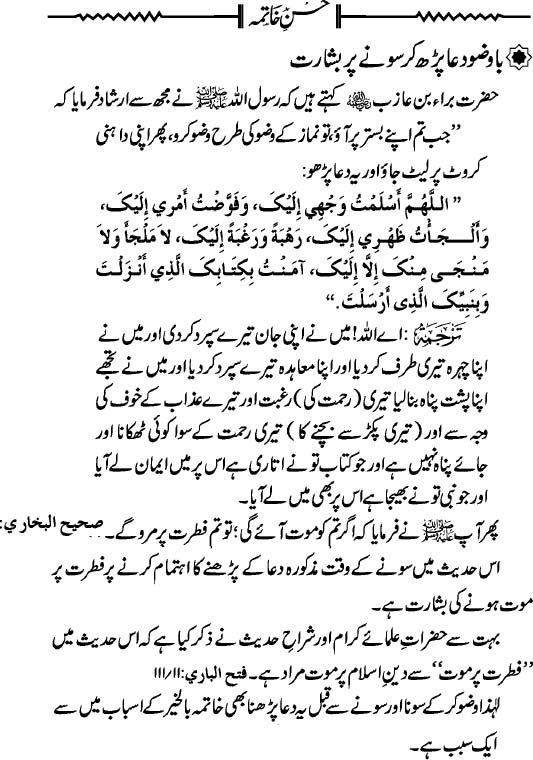
Husn e Khatma, Khatma Bil Khair Ba-Wudu Dua Parh Kar Sona
Some Verses From Surah Al-Ahzab
[Qur’an, Al-Hazab, Surah 33:4-9] Allah has not made for any man two hearts inside his body. Neither has He made your wives, whom you declare to be like your mothers’ backs, your real mothers. [az-Zihar is the saying of a husband to his wife, “You are to me like the back of my mother,” i.e., You are unlawful for me to approach], nor has He made your adopted sons your real sons. That is, but your saying with your mouths. But Allah says the truth, and He guides to the (Right) Way.
Call them (adopted sons) by (the names of) their fathers: that is more just with Allah. But if you know not their father’s (names, call them) your brothers in faith and Mawalikum (your freed slaves). And there is no sin on you concerning that in which you made a mistake, except in regard to what your hearts deliberately intend. And Allah is Ever Oft-Forgiving, Most Merciful.
The Prophet is closer to the believers than their own selves, and his wives are their (believers’) mothers (as regards respect and marriage). And blood relations among each other have closer personal ties in the Decree of Allah (regarding inheritance) than (the brotherhood of) the believers and the Muhajirun (emigrants from Makkah), except that you do kindness to those brothers (when the Prophet صلى الله عليه وسلم joined them in brotherhood ties). This has been written in the (Allah’s Book of Divine) Decrees – (Al-Lauh Al-Mahfuz).”
And (remember) when We took from the Prophets their covenant, and from you (O Muhammad (saw)), and from Nuh (Noah), Ibrahim (Abraham), Musa (Moses), and Esa (Jesus) son of Maryam (Mary). We took from them a strong covenant.
That He may ask the truthful (Allah’s Messengers and His Prophets) about their truth (i.e., the conveyance of Allah’s Message that which they were charged with), and He has prepared for the disbelievers a painful torment (Hell-fire).
O you who believe! Remember Allah’s Favor to you, when there came against you hosts, and We sent against them a wind and forces that you saw not [i.e., troops of angels during the battle of Al-Ahzab (the Confederates)]. And Allah is Ever All-Seer of what you do.
Qur’an, Al-Ahazab, Surah 33:4-9
Masnoon Dum Kay Fawaid
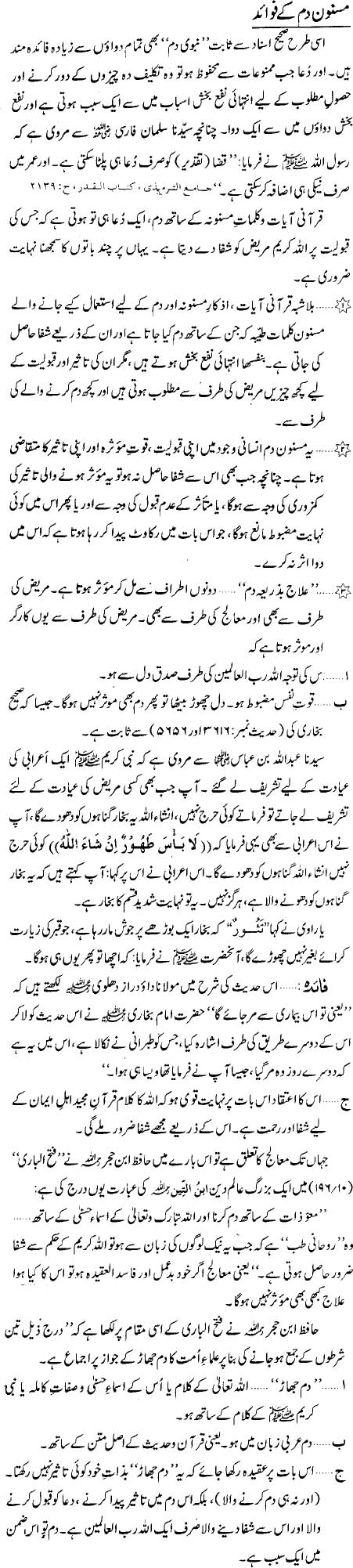
Masnoon Dum Kay Fawaid
Ruling On Visiting The Sick
Sometimes, someone we know falls ill. So it is important to know the rulings and etiquette of visiting the sick from an Islamic point of view.
Visiting the sick is a fard kifaayah or a communal obligation. (i.e. when someone in the community falls sick, some of the Muslims must go and visit him. Otherwise, the whole community will be sinful. (AL-Ikhtiyaaraat by Ibn Taymiyyah)
This is based on the order of the Prophet (pbuh) : “Feed the hungry, visit the sick, and free the captives.” (Bukhaari)
The rewards for visiting the sick
The Messenger of Allaah (pbuh) said:
1) “When the Muslim visits his (sick) Muslim brother, he is harvesting the fruits of Paradise until he returns.” (Muslim)
2) “Whoever visits a sick person or visits a brother in Islam, a caller cries out to him: ‘May you be happy, may your walking be blessed, and may you occupy a dignified position in Paradise.” (Tirmidhi- hasan by al-Albaani)
3) “Whoever visits a sick person is plunging into mercy until he sits down, and when he sits down he is submerged in it.” (Ahmad– Saheeh by al-Albaani)
4) “There is no Muslim who visits a (sick) Muslim early in the morning but seventy thousand angels send blessings upon him until evening comes, and if he visits him in the evening, seventy thousand angels send blessings upon him until morning comes, and he will have a garden in Paradise.” (Saheeh al-Tirmidhi. )
Who to visit
Visit those whom you know, as well as those whom you do not know. (Muslim).
The scholars say that you may visit non-mahrams as long as there is proper covering, no risk of fitnah, and no Khalwa (being alone together). (Islam-qa)
You may visit non-Muslims as well, since the Prophet (pbuh) visited a Jewish boy and called him to Islam, and he became Muslim. (Bukhaari).
Who is considered a sick person
If the sickness is preventing the person from seeing people, going out, etc., then the scholars say he is considered a sick person and one should try to visit him. However, if he is sick, but he is still going about his work, seeing people, etc., then it is not obligatory to visit him. (Al-Sharh al-Mumti’)
Principles to be followed when visiting
* Ask the person how he is, how he is feeling, etc., following the perfect example of the Prophet (pbuh). (Tirmidhi -hasan by al-Albaani).
* Try to cheer the patient up and talk positively. Give him glad tidings of healing Insha Allah, because this will comfort the sick person.
* The patient and his feelings and condition should be the topmost and only concern at all times.
* Generally speaking, one should make his visit short and not sit for too long with the patient, as it may be hard on the patient and his family.
* Consider the time of your visit (Not to visit too late at night or at the time of the patient’s nap, etc.)
* Do not keep visiting him every day, as it may be burdensome for the sick person. However, if it is someone close, and you know that they feel pleased and comforted to see you, then you may visit continuously.
* Do NOT sit on the patient’s bed, even if you do have to stand, as this might shake the bed and cause him pain, and he may be too polite to say anything.
* Do not be loud or make excessive noise.
* Do not overcrowd the patient with too many visitors at the same time. If you happen to visit him at a time when he already has other visitors, it may be better to politely leave and come back at a later time.
Make Dua for the sick person
* The Prophet (pbuh) said this dua three times when visiting the sick:
“La bas, tuhur in sha Allah” (No worry, it is a purification, if Allah wills).” (Bukhaari.)
* The Prophet (pbuh) used to place his right hand on the sick person and say: “Adhhib al-ba’s Rabb an-nas, wa’shfi anta al-Shafi, la shifa’a illa shifa’uka shifa’an la yughâdir saqaman ” (Take away the pain, O Lord of mankind, and grant healing, for You are the Healer, and there is no healing but Your healing that leaves no trace of sickness).” (Muslim)
* The Prophet (pbuh) said: “Whoever visits a sick person who is not yet dying, and says seven times in his presence: ‘Asalu Allâha rabb al-arsh il-azîm an yashfiyaka
(I ask Allaah, Lord of the mighty Throne, to heal you), Allah will heal him of that sickness.) (Saheeh Abi Dawûd.)
May Allah enable us to understand and appreciate the Sunnah and apply it, not just in this matter, but in each and every walk of our life. Ameen.
Umar Bin Salim Nishapuri (Rehmat Ullah Aleh)
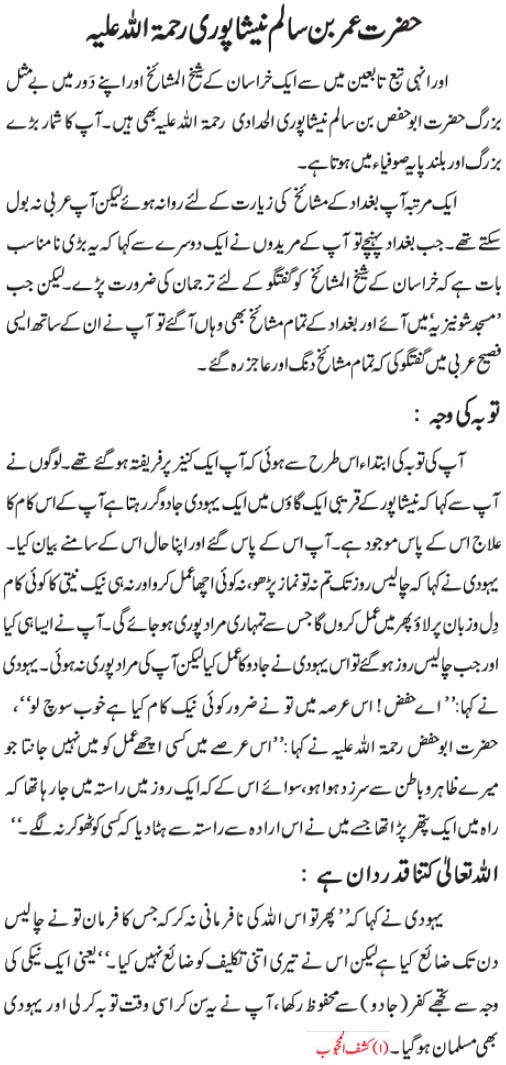
Hazrat Umar Bin Salim Nishapuri (Rehmat Ullah Aleh)
Difference Between Slave And Servant
Many translators of the Qur’an and A/hadith translate the Arabic word ABD as servant, whereas its meaning is slave. They do it because in their mind, the word slave has become obsolete. It is not so as they think, but if it is so, then one should explain what a slave is. And then use slave in translation.
The main differences between a slave and a Servant are:
Servant is paid a salary, while slave has no salary.
Servant’s job criteria and schedule are fixed. While slave has no schedule and no job criteria, no leave, no relief, on duty 24/7. No choice. If a master slaughters slave, it is his right as if he has slaughtered a cow or a lamb.
If you have a servant to cook – you cannot ask him to clean your toilet bowl, but if you have a slave, you can ask him any/everything you may like.
A servant is on a service contract, but a slave is property of his master.
Allah s.w.t is Creator and Master of Universes & all that exists, and all the rest are created by Allah s.w.t. So all the created are slaves of Allah s.w.t., Who is Master of all creations.
A slave cannot be a servant, and a servant cannot be a slave!.
If you replace slave with servant – it will totally change the meaning of the text of Qur’an & A/hadith.-Because the people who do not know what a slave is will not be able to grasp the true meaning of Qur’an & A/hadith – They will simply understand as if those people like Nuns and Priests are servant of God. If you say serve only God then you mean to say to the people to become Nuns or priests.
Allah s.w.t does not want His slaves to perform duties unwillingly or by force, as the Human master wants. If anybody does it unwillingly, his efforts are not accepted.
In Worship of Allah s.w.t – two motives/intentions are essential:
1. Do it with the best of your abilities & WITH ALL LOVE FOR ALLAH S.W.T ALONE.
2. Do it to please Allah s.w.t – NOT TO JUST FULFILL A FORMALITY –
3. & Remember I/We/You/He /She/ ARE ALL 24/7 ON DUTY.- Means Slaves of Allah s.w.t
4. Being Approved “Abd” (slave) of Allah s.w.t is a high-ranking position – The more an abd is obedient and Love more Allah s.w.t the higher becomes his rank & the highest ranks is attained by the Last Prophet pbuh and In Sha Allah he will be elevated to Muqa’m-e-Mahmoodah.
Aur Hum Nay Tumhare Liye Tumhara Zikr Buland Kar Diya
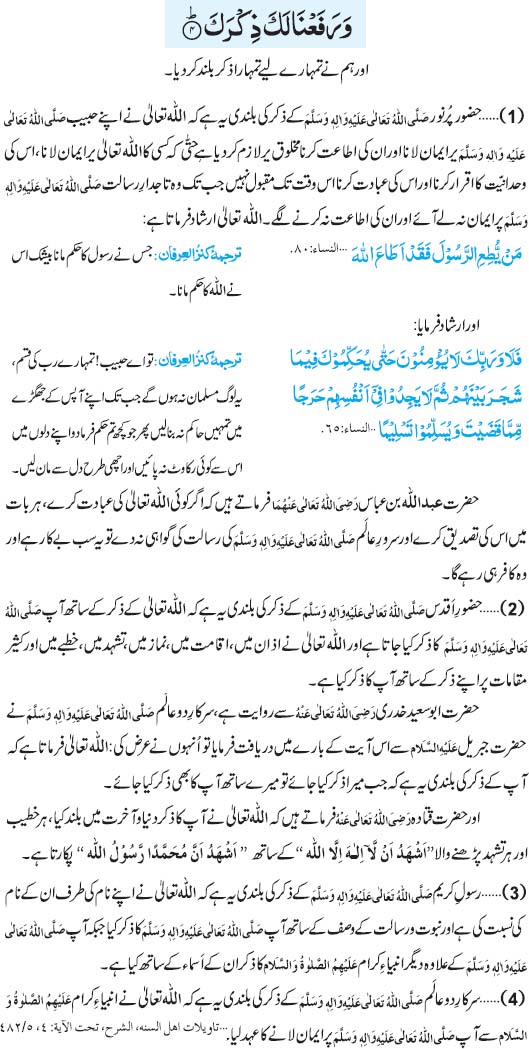
Aur Hum Nay Tumhare Liye Tumhara Zikr Buland Kar Diya
Rewards for Sickness
In the name of Allah, the Most Merciful, the All-Compassionate
“May the Peace and Blessings of Allah be Upon You”
Praise be to Allah, we seek His help and His forgiveness. We seek refuge with Allah from the evil of our own souls and our bad deeds. Whomsoever Allah guides will never be led astray, and whomsoever Allah leaves astray, no one can guide. I bear witness that there is no god but Allah, and I bear witness that Muhammad is His slave and Messenger.
Rewards for Sickness
One should not look to sickness as a gloomy episode, but should remember the great good in it. It is one form of affliction with which Allah (SWT) tests His servants, giving them a chance to acquire rewards, as was explained above, as is further emphasized below.
Removal of Sins and Elevation in Ranks
Abu Hurayrah (RA) reported that the Prophet (SAW) said: “Whenever a Muslim is afflicted by harm from sickness or other matters, Allah will drop his sins because of that, like a tree drops its leaves.”
[Bukhari and Muslim]
Abu Saeed al-Khudree (RA) reported that the Prophet (SAW) said: “A Muslim is not afflicted by hardship, sickness, sadness, worry, harm, or depression – even if pricked by a thorn, but Allah expiates his sins because of that.” [Bukhari and Muslim]
Aishah (RA) narrated that once some pain afflicted the Prophet (SAW), causing him to suffer and turn about in his bed. She said, “Had one of us done this, you would have blamed him.” He (SAW) replied: ” An ailment is intensified for the righteous. Whenever a believer is afflicted by a hardship, whether it is a thorn or more, a sin is taken off from him because of it, and he is elevated by one rank (in Jannah). ” [Ahmad]
Retaining Rewards for Deeds Before Sickness
Usually, when a believer falls sick, he would not be able to do the same amount of good (prayer, fasting, helping Muslims, etc.) that he used to do when he was well. But Allah, out of His great mercy, continues to record for him the good deeds that he was forced to stop because of his sickness.
Abu Moosa Al-Asharee narrated that the Prophet (SAW) said: “For a traveling or sick person, his deeds will be recorded in accordance with what he used to do when he was resident or well.” [Bukhari]
Abdullah Bin Amr reported that the Prophet said: “No (believing) person gets sick, but (his deeds) will be recorded for him in accordance with what he used to do when he was well.” [Bukhari]
Uqbah Bin Aamir reported that the Prophet (SAW) said: “Each day’s deeds are sealed with it. Thus, when a believer gets sick, the angels say, ” Our lord! Your servant such and such, You have restrained him (from doing good this day).” And the lord replies, ” Seal his day in accordance with his (usual) deeds, until he is cured or dies”. [Ahmad]
Reason for the Reward
Atta Bin Rabaah reported that Ibn Abbaas (RA) told him, “Do you want to see a woman from the people of Jannah (paradise)?”
He said “Yes”.
He said, ” It is this black woman.
She had come to the Prophet (SAW) saying,” I have (epileptic) seizures, and I get exposed, so supplicate to Allah for me.”
He (SAW) said: ” If you wish, be patient, and you will attain Jannah; or if you wish, I will ask Allah to cure you.”
She replied, ” I will be patient ! But my body gets exposed (because of the fall), so supplicate to Allah for me that I do not become exposed.” and he (SAW) did.” [Bukhari and Muslim]
The scholars have differed in opinion as to whether a sick person will be rewarded for the sickness itself or for being patient during it. The correct opinion is that if he is patient and submits to Allah’s will, as in the above hadith, he would be rewarded for both the submission and the sickness; otherwise, he would not be rewarded at all, because he resented Allah’s decree. This is what should be understood from Ibn hajar al-Asqalaanees words: “The authentic hadeeths are clear in that the rewards are recorded once affliction strikes a Muslim. As for patience and acceptance, they are virtues for which a person may get additional rewards over those for the affliction.” ‘Abdullah Bin ‘Amr reported that the Prophet (SAW) said: “If a Muslim is pricked by (as little as) a thorn in the worldly life, and he seeks its reward from Allah, and some of his sins will be removed. because of it, on the Day of Judgement.”[ Bukhari ]
“True believers are only those whose hearts are filled with awe whenever God is mentioned, and whose faith is strengthened whenever His revelations are recited to them. In their Lord do they place their trust.” (Chapter 8: Verse 2)
By Asma bint Shameem
12 Rakat Sunnat-e-Muakkadah Kay Fazail
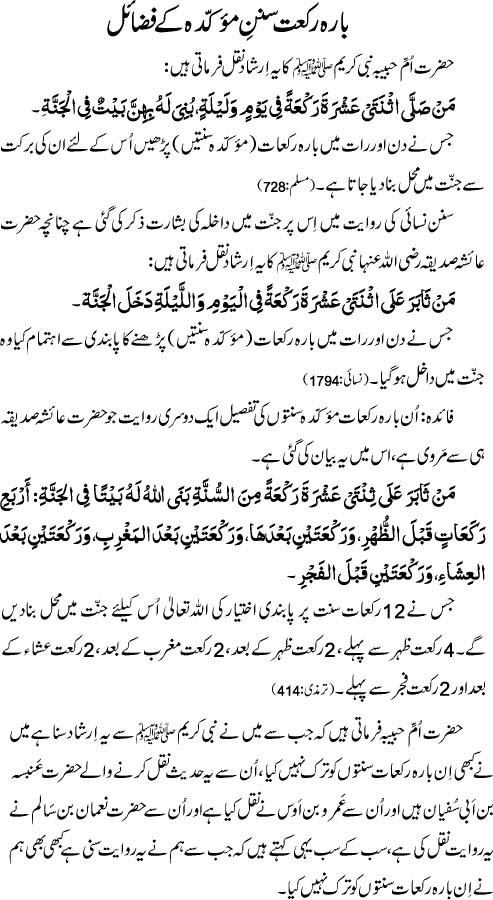
12 (Bara) Rakat Sunnat-e-Mokada Kay Fazail
Supplications From Allah’s Quran
[1] “Thee alone we worship and to Thee alone we pray for help; Guide us (O Lord) to the path that is straight; The path of those You have blessed; not of those who have incurred Your wrath, nor of those who have gone astray.” [1:5-7]
[2] “And there are some among them who say: Our Lord, grant us good in this world and good in the Hereafter, and save us from the torment of the Fire.” [2:201]
[3] “Our Lord! Bestow on us endurance, make our foothold sure, and give us help against the disbelieving folk.” [2:250]
[4] “We hear and we obey. Grant us THY forgiveness, Our Lord; to THEE we shall all return.” [2:285]
[5] “O our LORD! Take us not to task if we forget or unwittingly do wrong! “Our LORD! Lay not upon us a burden such as THOU didst lay upon those who lived before us! Our LORD! Make us not bear burdens which we have no strength to bear! “Efface THOU our sins, and grant us Forgiveness, and Bestow THY Mercy upon us! THOU art our LORD Supreme: Support us, against disbelieving folk” [2:286]
[6] “Our LORD! Cause our hearts to deviate after Thou hast guided us. And bestow on us mercy from that which proceeds from Thy Presence. Truly, Thou, Thou alone art The Giver.” [3:8]
[7] “Our Lord, we believe; forgive us our sins and protect us from the punishment of the Fire,” [3:16]
[8] “Our Lord! Forgive us our sins and anything we may have done that transgressed our duty: Establish our feet firmly, and help us against those that resist Faith.” [3:147]
[9] “‘Our Lord! THOU have not created all this without purpose- THOU are far above that!- protect us from the torment of the Fire.” [3:191]
[10] “we have believed. Our Lord! Forgive us our sins, efface our bad deeds, and collect us up [at death] with the virtuous” [3:193]
[11] “Our Lord! Grant us what You have promised us through Your Messengers. Disgrace us not on the Day of Resurrection; indeed, You never break Your promise.” [3:194]
[12] “Our Lord! We believe, so write us down with the witnesses (of truth).” [5:83]
[13] “O, our Sustainer! Place us not among the people who have been guilty of evildoing!” [7:47]
[14] “Enough for me is Allah. There is no god but He. In Him, I have placed my trust, and He is the Lord of the Great Throne.” [9:129]
[15] “And they said, `In ALLAH do we put our trust. Our Lord, make us not a trial for the wrongdoing people; And deliver us by Thy mercy from the tyranny of the disbelieving people.” [10:85-86]
[16] ” ‘Glory to our Lord! Truly, the Promise of our Lord has been fulfilled!'” [17:108]
[17] “Our Lord! Bestow on us Mercy from Thyself, and dispose of our affairs for us in the right way!” [18:10]
[18] “My Lord! Then place me not among the wrong-doing people.” [23:94]
[19] “Our Lord! We believe, so forgive us, and have mercy upon us, for Thou art the best of the merciful ones.” [23:109]
[20] “O my Lord! Grant Thou forgiveness and mercy, for Thou art the Best of those who show mercy!” [23:118]
[21] “Our Lord! Avert from us the Wrath of Hell, for its Wrath is indeed an affliction grievous, [25:65]
[22] “Our Lord, grant us in our wives and our offspring the joy of our eyes, and make us leaders for those who guard against evil.” [25:74]
[23] “My Lord, save me from these wrongdoing, oppressive people!” [28:21]
[24] “My Lord, help me against these people given to spreading corruption.” [29:30]
[25] “Limitless in His glory is He who has made [all] this subservient to our use – since [but for Him, ] we would not have been able to attain to it.” [43:13]
[26] “Help me, O Lord, I have been overcome!” [54:10]
[27] “And all those who come after them (and follow in their footsteps) pray: “O our Lord! Forgive us and our brothers (and sisters) in Religion who have preceded us in faith, and let not our hearts entertain any ill-feeling against any of the believers. O, our Lord! You are All-Forgiving, All-Compassionate (especially toward Your believing servants).” [59:10]
[28] ” Our Lord, make us not [objects of] torment for the disbelievers and forgive us, our Lord. Indeed, it is You who is the Exalted in Might, the Wise.” [60:5]
[29] “O our Sustainer! Cause this our light to shine for us forever, and forgive us our sins: for, verily, Thou hast the power to will anything!” [66:8]
[30] “I seek refuge with the Lord of the Dawn; From the mischief of created things; From the mischief of Darkness as it overspreads; From the mischief of those who practice secret arts; And from the mischief of the envious one as he practices envy.” [113:1-5]