
Eating And Drinking With The Right Hand, And The Prohibition Of Eating With The Left Hand
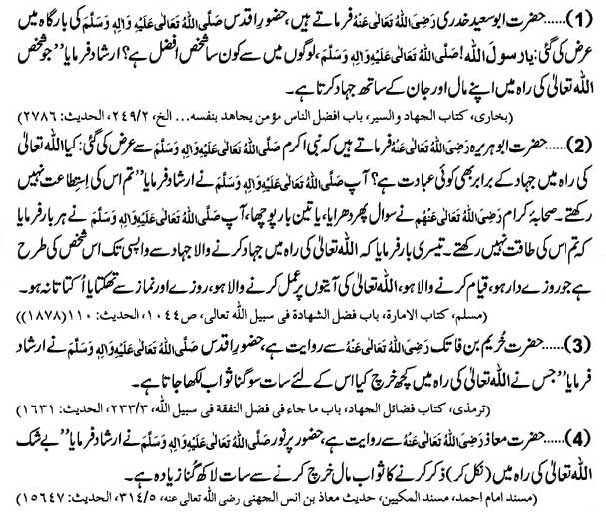
We have hitherto come across the Prophets words to Umar Ibn Abee Salamah (ra), O young boy, mention Allah’s name, eat with your right hand, and eat from what is next to you. In another Hadeeth, Jaabir Ibn Abdullah (ra) reported that the Messenger of Allah (saas) said:
Do not eat with the left (hand), for indeed Shaitaan eats with the left (hand). 1
And in yet another Hadeeth, Umar (ra) reported that the Messenger of Allah (swt) said,
When one of you eats, then let him eat with his right (hand) and if he drinks, then let him drink with his right (hand), for verily, Shaitaan eats with his left (hand) and drinks with his left (hand)2
Commenting on the ruling expressed in these narrations, Ibn Al-Jawzee said, Since ones left hand is made for Al-Istinjaa (using a rock, or the equivalent today of tissue paper, to clean the affected area after one relieves himself) and for touching impurities, and since ones right hand is for handling food, it is not appropriate for one hand to do the work of the other. By using one hand for a task that is specific to the other hand, one either debases something (the right hand) of high ranking or raises something (the left hand) of low ranking. And whosoever acts contrary to the dictates of (this) wisdom acts in concord with shaitaan.
Even though the above-mentioned Ahadeeth are famous to the degree that almost every single Muslim knows at least one of them – or at least knows its ruling – some Muslims (may Allah guide them) continue to eat with their left hands. And if you were to remind one of them, he might say something along the lines of, Eating with my left hand has become a habit, and I feel that it will be hard to break. Shaitaan makes such reasoning seem pleasing to their hearts, in order to prevent them from following the shariah. That one persists in eating with his left hand even after he is reminded not to proves that Eemaan (faith) in deficient in his heart. Worse and more evil is one who refuses to eat with his right hand not because of the excuse just mentioned, but because of his pride and arrogance. Salamah Ibn Al-Akwa (ra) reported that, in the company of the Messenger of Allah (saas), A man was eating with his left hand, and so the Prophet (saas) said,
Eat with your right (hand).
He said, I am not able to. The prophet (saas) answered,
May you not be ble to. Nothing prevented him other than pride, and so he (never later) lifted it to his mouth (i.e., the mans right hand became paralyzed) 3
And this wording is from Ahmads narration of the Hadeeth: His right hand never thereafter reached his mouth. An-Nawawee said, The Hadeeth shows that it is permissible to supplicate against a person who, without having an excuse, acts contrary to a ruling of the shariah. It also shows that we should order to good and forbid evil in all situations, even when it comes to eating. And finally, we learn from the Hadeeth that it is recommended to teach the manners of eating to a person when he violates one (or more) of them.
Related Issue : If one has a valid excuse – such as sickness, a recent surgery, etc. – for not eating with his right hand, then it is okay for him to eat with his left hand. And Allah (swt) does not charge a person with more than he can bear.
1) Relate by Muslim (2019), Ahmad (14177), Ibn Maajah (3268), and Maalik (1711). And the wording mentioned above is from Muslims narration of the Hadeeth.
2) Related by Muslim (2019), Ahmad (4523), At-Tirmidhee (1800), Abu Daawood (3776), Maalik (1712), and Ad-Daarimee (2030)
3) Related by Muslim (2021) and Ahmad (16064).
Kis Baat Ka Intezar
Husband And Wife: Mutual Rights And Obligations
In Islam the marriage of a man and a woman is not just a financial and physical arrangement of living together but a sacred contract, a gift of God, to lead a happy, enjoyable life and continue the lineage. The main goal of marriage in Islam is the realization of tranquility and compassions between the spouses. For the attainment of this supreme goal, Islam defines certain duties and rights for the husband and wife.
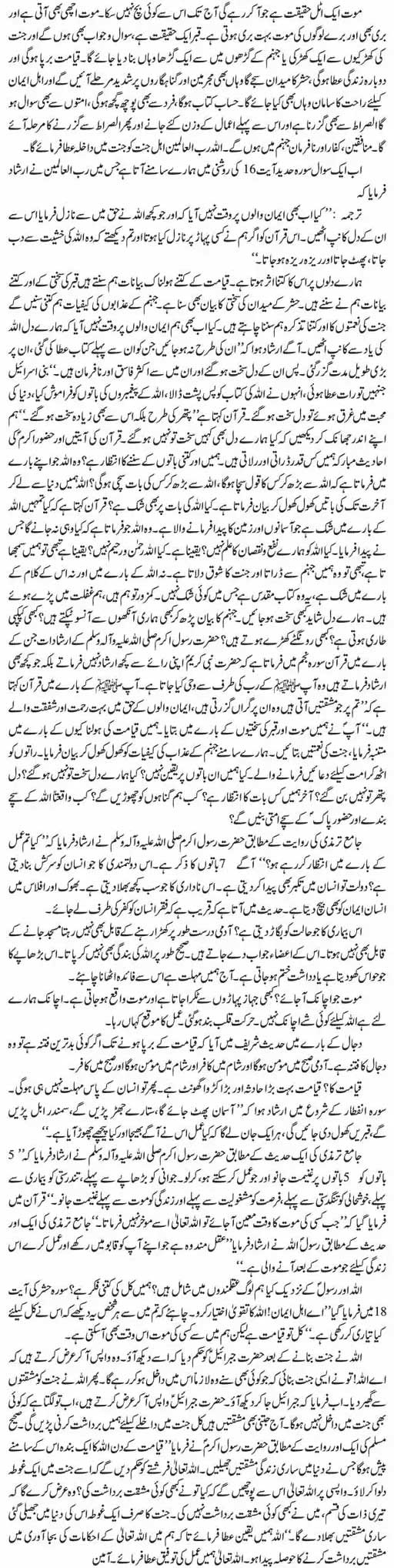
Piety is the basis of choosing the life partner. Several statements of Holy Qur’an and Sunnah prescribe kindness and equity, compassion and love, sympathy and consideration, patience and goodwill. The Prophet (peace be upon him), says: “The best Muslim is the one who is best to his family.” Also, he says, “… and the most blessed joy in life is a good, righteous wife.” (Reported by At-Tirmidhi)
The role of the husband revolves around the moral principle that it is his solemn duty to Allah to treat his wife with kindness, honor, and patience; to keep her honorably or free her from the marital bond honorably; and to cause her no harm or grief. Allah Almighty says : “…and live with them honorably. If you dislike them, it may be that you dislike a thing through which Allah brings a good deal of good.” (4:19)
The role of the wife is summarized in the verse that women have rights even as they have duties, according to what is equitable; but men have a degree over them. Allah Almighty says, “And they (women) have rights (over their husbands as regards living expenses) similar (to those of their husbands) over them (as regards obedience and respect) to what is reasonable, but men have a degree (of responsibility) over them. And Allah is All-Mighty, All-Wise.” (2:228)
This degree is usually interpreted by Muslim scholars in conjunction with another passage which states, among other things, that men are trustees, guardians, and protectors of women because Allah has made some of them excel others and because men expend of their means. Allah Almighty says: “Men are the protectors and maintainers of women, because Allah has made one of them to excel the other, and because they spend (to support them) from their means. Therefore the righteous women are devoutly obedient and guard in their husband’s absence what Allah orders them to guard. As to those women on whose part you see ill condct, admonish them (first), (next) refuse to share their beds (and last) and beat them (lightly, if it is useful). But if they obey you, seek not against them means (of annoyance). Surely, Allah is ever Most High, Most Great.” (4:34)
Since the Holy Qur’an and the Sunnah have commanded kindness to women, it is the husband’s duty to: consort with his wife in an equitable and kind manner; have responsibility for the full maintenance of wife, a duty which he must discharge cheerfully, without reproach, injury, or condescendence. Allah Almighty says: “Let the rich man spend according to his means; and the man whose resources are restricted, let him spend according to what Allah has given him. Allah puts no burden on any person beyond what He has given him. Allah will grant after hardship, ease. (65:7)
Components of maintenance:
Maintenance entails the wife’s incontestable right to lodging, clothing, nourishing, and general care and well-being.
The wife’s residence must be adequate so as to provide her with the reasonable level of privacy, comfort, and independence. The welfare of the wife and the stability of the marriage should be the ultimate goal.
What is true of the residence is true of clothing, food, and general care. The wife has the right to be clothed, fed, and cared for by the husband, in accordance with his means and her style of living. These rights are to be exercised without extravagance or miserliness.
Non-material rights:
A husband is commanded by the law of God to treat his wife with equity; respect her feelings, and to show her kindness and consideration.
The husband is also commanded not to show his wife any aversion or to subject her to suspense or uncertainty. He should not keep his wife with the intention of inflicting harm on her or hindering her freedom.
Let her demand freedom from the marital bond, if he has no love or sympathy for her.
Wife’s obligations:
The main obligation of the wife as a partner in a marital relationship is to contribute to the success and blissfulness of the marriage as much as possible. She must be attentive to the comfort and well being of her mate. She may neither offend him nor hurt his feelings. Perhaps nothing can illustrate the point better than the Qur’anic statement which describes the righteous people as those who pray saying: “… Our Lord! Bestow on us from our wives and our offspring the comfort of our eyes, and make us leaders of the Muttaqun (the pious).” (25:74)
This is the basis on which all the wife’s obligations rest and from which they flow. To fulfill this basic obligation, a wife must be faithful, trustworthy, and honest. She must not deceive her mate by deliberately avoiding conception lest it deprives him of legitimate progeny. She must not allow any other person to have access to that which is exclusively the husband’s right, i.e. sexual intimacy. She must not receive anyone in his home whom the husband does not like. She may not accept their gifts without his approval. This is probably meant to avoid jealousy, suspicion, gossip, etc., and also to maintain the integrity of all parties concerned.
The husband’s possessions are her trust. If she has access to any portion thereof, or if she is entrusted with any fund, she must discharge her duty wisely and thriftily. She may not lend or dispose of any of his belongings without his permission.
With respect to intimacy, the wife is to make herself desirable, to be attractive, responsive, and cooperative.
A wife may not deny herself to her husband; due consideration is, of course, given to health and decency.
Moreover, the wife is not permitted to do anything that may render her companionship less desirable or less gratifying. If she neglects herself, the husband has the right to interfere with her freedom to rectify the situation and ensure maximum self-fulfillment for both partners. She is not permitted to do anything on his part that may impede her gratification.
Khud Pasandi Ki Muzamat
Eid al-Adha
It is a road-map to success and a reminder of the standard of excellence, great devotions and triumph of high achievements. It charts the direction in the battle of life for those who does actually strive to do deeds and reach for their goal, their prize. The promised prize that no human being could imagine the joys kept hidden as reward for all that they did, await at the end of the road. The eye has seen not, nor the ear heard, nor does the heart of man ever conceive.
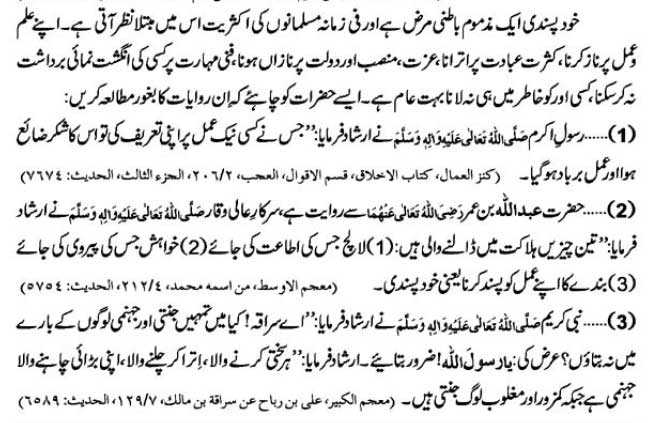
Abraham was certainly a model of faith for the people, obedient to Allah and upright. Allah pay back people who do good and this event is one of the proofs of Allah mercy thus indeed do doers of goods rewarded.
A great event when Abraham and his son Ishmael passed the trial successfully. We offer remembrance of Allah’s blessings, celebrate His name and offer the eid salaat to give thanks for sending us guidance and map to tread through the life’s path.
There should be no room for emotions which go against the commands and prohibitions of Allah. Eid teach us to trust that He shall not give us more than what we can bear. He will either shield us from suffering or will give us unfailing strength to bear it. Was it not said to ‘follow My Guidance, no fear shall be on them, neither shall they sorrow’ Certainly Allah knows best and was best witness when Ishmael said:
“O my father! Tie my hands and legs so that I do not struggle.
Put a blindfold over your eyes so that you do not have to see me die
And tighten your cloak so that my mother does not see my blood splattered on your clothes. Make your knife sharp so that you can do your job quickly. That way I will feel no pain.”
Peace be upon Ibrahim. Indeed this was a clear trial.
Eid al-Adha is a light that shine our way near and far,
The love of Ibrahim for Allah was true, tested by fire to stay forever.
Devotion so endless, will always light the way.
It is a light that could shine the difficult ways in times of trials. We can do more than just lament the flaws of the Muslim Ummah, for a better world to live and make the word of Allah dominant in the world. If we can all sacrifice what we love most for Love of Allah as Ibrahim did to his son Ishmael. Only then we will know the power and wisdom of Eid al-Adha and deserve what Allah has promised, to grant succession and security after fear. If we can stand strong in the middle of trials and hardships, know that surely Allah help will find way to shine through.
This event also reminds us of one of the pillar of Islam, the hajj. It manifests a unique unity, dispelling all kinds of differences. Muslims from all corners of the world, wearing the same dress, respond to the call of Hajj in one voice and language: LABBAIK ALLA HUMMA LABBAIK (Here I am here I am O lord!).
Hajj is a great congress that gives an opportunity to Muslims all over the world to meet annually. The time, venue and even the invitation has been set by the One True God when Allah, the Almighty, said to Ibrahim:
“You call, and I will convey your call.”
How To Do Eid-ul-Adha Prayer
Eid is a special occasions and one of the things which makes it so is the Eid-ul-Adha congregational prayer.
Since this prayer comes only once a year, there is often confusion about how to perform this prayer. Here is how to do it:
In general, when praying any Salah, always follow the Imam in prayer. Do not make your movements (i.e. bowing, prostrating, etc.) before he does or different from him.
Eid prayer consists of two units (Rakat in Arabic, singular is Raka). The main difference in the way this prayer and any other prayer of two Rakat is performed is the number of Takbirs that are done.
Takbirs is an the Arabic word referring to when “Allahu Akbar” is said and the hands are raised to the ears.
Step 1: Make an intention of doing two Rakat behind the Imam for Eid prayer along with six additional Takbirs.
The First Raka
Step 2: After the Imam has said “Allahu Akbar” the first time, you should raise your hands and follow. This is the first Takbir of the prayer.
Step 3: There will be 3 Takbirs before the Imam starts reciting Quran. Each time the Imam says “Allahu Akbar”, you should follow by raising your hands, then putting them on your sides.
After the third Takbir, the Imam will begin reciting the Quran. At that point, you should put your hands below the navel (or on your chest), with your right hand on top of the left.
Step 4: Listen to the recitation of the Holy Quran. The Imam will recite Surah Al Fatiha (the first Surah of the Quran) and then another Surah.
Step 5: When the Imam says “Allahu Akbar” go into Ruku (the bowing position).
Step 6: Stand up straight when he says Sami Allahu liman Hamidah (Allah hears those who praise Him), and say “Rabbana lakal Hamd” (our Lord praise be to You) in a low voice.
Step 7: When the Imam says “Allahu Akbar” go into Sujud (prostration). You will do two prostrations as in normal prayer.
The Second Raka
Step 8: The Imam will first recite from the Holy Quran (first Surah Al Fatiha and another Surah.
Step 9: After the recitation, before going into Ruku, there will be 3 Takbirs. Follow the Imam. Raise your hands after each “Allahu Akbar”. After the third Takbir, go into Ruku (the bowing position).
Step 10: Stand up straight when the Imam says Sami Allah huliman Hamidah, and say “Rabbana lakal Hamd” in a low voice.
Step 11: When the Imam says “Allahu Akbar” go into Sujud. You will do two prostrations.
Step 12: After this, you sit for the complete Tashshahud.
Step 13: After the Imam ends the prayer by turning to his face to the right first and saying “Assalamu alaikum wa Rahmatullah” and then to his left and doing the same, you should follow.
Step 14: Do not get up right away. The Imam will give a short Khutbah (speech). Please stay still and listen. It is recommended to do so.
Falsafa-e-Qurbani
The Manner Of Giving Greetings Of Peace
In order of best, second best, and third best, these are the ways of extending greetings of peace:
1) “Assalaamu ‘Alaikum Warahmatullahi Wabarakaatuhu”: Peace as well as the mercy and blessings of Allah upon you.
2) “Asslaamu ‘Alaikum Warahmatullah” : Peace and the mercy of Allah (swt) upon you
3) “Assalamu ‘Alaikum”: Peace upon you.
This order is proven by the narration of Abu Hurairah (RA), in which a man passed by the Messenger of Allah (saas) – who was seated in a gathering – and said, “Assalaamu ‘ Alaikum.” The Prophet (saas) said, “Ten good deeds (are Written for him).” Another man passed by and said, “Asslaamu ‘Alaikum Warahmatullha,” and the Prophet (saas) said, “ Twenty good deeds.” Then another man passed by and said, “Assalaamu ‘Alaikum Warahmatullahi Wabarakaatuhu,” and the Prophet (saas) said, Thirty good Deeds (Related by Al-Tirmidhee (2689), who said, “the Hadeeth is Hasan Saheeh)
Allah (swt) said in Quran:
“When you are greeted with agreeting, greet in return with what is better than it, or (at least) return it equally” (Qur’an 4:86)
It’s a Humble request Brothers to spread Greeting as it is to get Reward from Allah (swt) (without making shortcuts)
Jazak Allah Khair
Practical Tips For A Fine Hajj
Haj is the ‘ultimate’ journey, the journey of a lifetime. Yet I’ve seen so many people, brothers and sisters, confused, angry, frustrated or just simply ignorant during Haj. So here is a piece of sincere advice for all of my brothers and sisters going for Haj this year.
Educate yourself before you go
This is the most important point. They say “Knowledge is Power,” and it is. I’ve seen people confused, not knowing what to do, looking left and right, bewildered during Haj. In the end, they just follow what the rest of the crowd is doing without knowing if what they are doing is from the Shariah of Prophet Muhammad (peace be upon him) or not. Indeed, I know people who have gone and come back from Haj, and they didn’t know what kind of Haj they performed, how many days one was required to stay in Mina, and so on. In fact, some didn’t know it takes seven rounds around the Ka’ba to make one Tawaf!
Going to Haj without knowing the basics of how to perform Haj and Umrah is like placing someone who doesn’t know how to offer Salah in the middle of a congregation. He may follow the movements in Ruku’ and Sujood, but does he really know how to pray? Does such a prayer even count?
So, study the rituals of Haj before you go. Learn how to perform this magnificent journey in a manner that is closest to the Sunnah. Because the closer it is to the Sunnah, the more acceptable it will be to Allah. Learn about the common mistakes pilgrims do, so you can avoid them.
Go with a prepared heart
Every year at Haj, you see only two kinds of people. The first kind will be sitting calm and patient, even when they are stuck for five hours in traffic, wisely utilizing the time making Dhikr of Allah or reading the Qur’an. The other kind will be grumbling and complaining, fidgeting restlessly in his seat, cussing at the bus driver and wasting his whole time fighting with whoever is sitting next to him.
Why is that? Because the first kind of people come with prepared hearts and the second type don’t.
Haj is not a mere physical journey, it is a spiritual journey of the heart and soul. And just as it is important to learn the rituals of Haj, it is equally important to condition yourself spiritually. Remember, Haj is an act of worship, the fifth pillar of our Religion. So, have Khushoo’ in it.
Trust Allah and have complete faith in Him. Be sure that He will take care of you. Be kind to others and have patience and forbearance.
Funeral prayer
Hardly any obligatory prayer in the Haram is not followed by a funeral prayer. I’ve noticed several brothers and sisters sitting there and not participating in this great act of worship, just because they don’t know how to. The Prophet (peace be upon him) said, “Whoever attends the Janazah until he offers the prayer will have one Qirat (of reward), and whoever attends until (the deceased) is buried will have two Qirats.” It was said, “O Messenger of Allah, what are the two Qirats?” He said, “Like two great mountains,” meaning, of reward. (Al-Bukhari and Muslim)
Don’t get overwhelmed
When you look at the large number of people there for Haj, don’t get overwhelmed or disturbed. Instead, raise up your head high, feel proud and thank Allah. After all, all those people are none, but your own brothers and sisters in Islam. This is the Ummah of your beloved Prophet, Muhammad (peace be upon him). They belong to you and you belong to them. They are a part of you, just as much as you are a part of them. All of you are there for one and one purpose only – to worship Allah, the One God. So, love them, show mercy to them and make Du’a for them.
Time is precious
Utilize your time to its maximum while in Makkah and Madina. Do all your prayers in the mosque. When you pray in the Grand Mosque in Makkah, the reward is multiplied by 100,000 times.
When you get to Mina, busy yourself with making Du’a, Dhikr, reading the Qur’an, etc. Your stay here is only a few precious days. You can’t waste it by talking, relaxing, and doing nothing, as some people do.
And when you are in Arafah, know that that’s the day you were waiting for. That’s what Haj is all about. The Prophet (peace be upon him) said, “Haj is Arafah.” (Abu Dawood)
Put in all you have got on the Day of Arafah. Take advantage of every second. Do not waste even a single moment. Make a Du’a list and do lots and lots of Du’a. The Prophet (peace be upon him) said: “The best of Du’a is Du’a on the day of Arafah, and the best thing that I and the Prophets before me said is, ‘La ilaha ill-Allah Wahdahu la Shareeka lah (There is no god worthy of worship but Allah alone with no partner or associate).’” (Al-Tirmidhi, authenticated by Al-Albani)
Not on vacation
Some people forget that they are going on Haj. They expect Mina to be a five star hotel. So they complain about food, weather, crowds, and just about everything.
Remember this is Haj, not a vacation. Remember, not so long ago people traveled for months through dangerous terrain and rough weather to perform Haj. If we think about that, then is there anything left to complain about?
Don’t just say it
When you recite the Talbiyah, don’t just say it like a parrot without knowing what it means and what it implies. Think about the greatness of these words and the Magnificence of the One you are saying these words to.
Haj Mabroor
Obviously, everybody wants their Haj to be ‘Mabroor’ (accepted) because the Prophet (peace be upon him) said, “There is no reward for Haj Mabroor except Paradise.” (Al-Bukhari)
They asked, “What makes Haj Mabroor, Messenger of Allah?” He replied, “Providing food to people and spreading (the greeting of) Salam (peace).” (Fath Al-Bari, 4/446)
Thus we see that being kind to people and serving and helping them leads to a Haj Mabroor.
So go ahead and help that old lady with her luggage and help someone else cross the street. Move over to make room in the row for your fellow Muslim so that he/she too can find a place to pray. Distribute candy among children, pass out glasses of Zamzam water, smile at everyone, and say Salam to those you know and those you don’t.
Keep you eyes and ears open for every opportunity to do good and jump at any chance you get to spread Khair – all for the sake of Allah alone – and Insha Allah your Haj will be one of Mabroor.
– Muslimmatters