
Why Is Ramadan The Month Of Qur’an?
MAY you have a happy and blessed Ramadan! It is the month of the Qur’an as well as the month of all good deeds. A Muslim is recommended to read the Qur’an and do good deeds in this blessed month as much as he can. In this context, we recall the Prophetic Hadith addressed by the Prophet (peace be upon him) to his Companions on the last day of Sha’ban: “O people! A great month has come; a blessed month in which is a night better than a thousand months; a month in which Allah has made it compulsory upon you to fast by day, and voluntary to pray by night. Whoever draws nearer (to Allah) by performing any of the (optional) good deeds in (this month), shall receive the same reward as performing an obligatory deed at any other time; and whoever performs an obligatory deed in (this month), shall receive the reward of performing 70 obligatory deeds at any other time. It is the month of patience, and the reward of patience is Paradise. It is the month of charity and a month in which a believer’s sustenance is increased. Whoever gives food to a fasting person to break his fast, shall have his sins forgiven, and he will be saved from the Hell-Fire, and he shall have the same reward as the fasting person, without his reward being diminished at all.” (Reported by Ibn Khuzaymah)
Ramadan is the month in which the Qur’an was revealed. Allah says: The month of Ramadan in which was revealed the Qur’an, a guidance for mankind, and clear proofs of the guidance, and the Criterion (between right and wrong). So whoever of you sights (the crescent on the first night of) the month of Ramadan, he must observe Saum that month . . .” (Al-Baqarah 2:185)
This verse establishes the link between Ramadan and the Qur’an. We know that the Prophet (peace be upon him) was in the habit of retreating to Mount Hira during Ramadan and it was during one of these periods of contemplation that the Archangel Gabriel appeared to him with the first revelation. So Ramadan marks the beginning of the call to Islam and the prophetic mission of Prophet Muhammad (peace be upon him).
Secondly, when Ramadan Fasting became obligatory, the Prophet (peace be upon him) used to recite the Qur’an with Gabriel. Gabriel used to descend from the heavens every night to read everything that had so far been revealed to the Prophet (peace be upon him).
Thirdly, when we offer our Taraweeh prayers, it is recommended that over the course of the month recitation of the whole Qur’an be completed. This presents a great opportunity for those who haven’t read the whole Qur’an to hear it.
Shaitan Kay Behkaney Ka Andaz
Lessons And Moralities Of Fasting
RAMADAN is a month of discipline, self-control, patience, and good behavior. In Ramadan, Muslims are expected to gain the fruits of fasting, namely, piety and consciousness of Allah. In this context, Allah, Most High, says in the Glorious Qur’an : “O you who believe! Observing As-Saum (the fasting) is prescribed for you as it was prescribed for those before you, that you may become Al-Muttaqun (the pious).” (Al-Baqarah 2:183)
Also, He says: “And He it is Who has put the night and the day in succession, for such who desires to remember or desires to show his gratitude.” (Al-Furqan 25:62)
Life and death and the succession of nights and days have a purpose and that is to test us and to give us an opportunity to express our thanks and gratitude to our Creator and Sustainer. The month of Ramadan comes and goes. We must examine ourselves now and see what we have learned and achieved during this month. The test of success of this month lies in the effects it has left upon us as follows:
Discipline
We learn in this month how to discipline ourselves for the sake of Allah. We follow a strict schedule of eating and drinking. We are constantly aware that even in our such mundane activities as eating and drinking, we must follow divine injunctions. We change our habits in our daily routines because we learn that we are not the servants and slaves to our habits, but always the servants of Allah. Then after Ramadan, we have to keep this spirit of discipline in other modes of our life and must continue with our submission to the commands of Allah.
Renewal of devotional life
Ramadan renews our enthusiasm for worship and devotion to Allah. In this month we are more careful of our daily prayers and have special prayers at night. There is no religion without prayer and Muslims learn in this month how to strengthen and deepen their religious life.
Renewal of contact with the Qur’an
Ramadan and the Qur’an are linked together from the beginning. It was in this month that this divine message was revealed to Prophet Muhammad (peace be upon him). We are told that the Prophet (peace be upon him) was fasting when he received the first revelation. Fasting prepares the believers’ hearts to learn the Word of Allah. It is the most suitable condition for our spiritual and mental communication with the Qur’an. The Muslim Ummah pays more attention to the Qur’an in this month. This renewed contact with the Qur’an must help us in following its message.
Renewal of identity with the Ummah
Ramadan is not an individual experience only, but it is an experience in community. The whole Muslim Ummah fasts together in one and the same month. We identify with one another in our obedience to Allah. This gives us a new sense of togetherness and association. Ramadan teaches us that the Muslim Ummah is the community of piety and devotion to Allah and its members derive their strength from each other in deeds of piety and virtue. The bonds that are based on piety and virtue are the strongest and these bonds prove good for mankind. The strength of the Muslim community lies in its commitment to the values of goodness, morality and piety. Ramadan leaves an imprint of all these values upon the Muslim Ummah.
A fresh sense of care and sympathy
Fasting in the month of Ramadan helps us to understand the suffering and the pains of the poor and needy. By our voluntary hunger and thirst we realize what it means to be deprived of basic necessities of life. Ramadan is called the month of charity and sympathy. We learn how to be more kind and generous in this month. Many Muslims also pay their Zakah in the month of Ramadan.
Jihad or struggle
Fasting in Ramadan and Jihad both of them were prescribed in the same year, that is, the second year of Hijra in Madina. Fasting prepares for hardships and sacrifices. These are two important things without which Jihad is not possible. Muslims learn in Ramadan how to struggle against the forces of evil in their own selves, in the society around them, and in the world at large.
Taqwa
To summarize all the moral and spiritual gifts of Ramadan, we can say that Ramadan gives us the great gift of Taqwa (piety). Taqwa is the sum total of Islamic life. It is the highest of all virtues in the Islamic scheme of things. It means, God-consciousness, piety, fear and awe of Allah and it signifies submission to Allah and total commitment to all that is good and rejection of all that is evil and bad.
Nigahein Jhuka kar Rakhna Aur Haram Se Bachna
نگاہیں جھکاکررکھنےاورحرام چیزوں کو دیکھنے سے بچنے کی ترغیب
Ten Things About Ramadan
1 – Fasting this month is a pillar of Islam
The Prophet (peace be upon him) said: “Islam is built on five (pillars): The testimony that there is no god worthy of worship except Allah and that Muhammad is the Messenger of Allah. Establishing prayer. Paying Zakah. Fasting in Ramadan. Haj to the House (the Ka’bah).” – Bukhari and Muslim
2 – Revelation of Qur’an
“The month of Ramadan in which was revealed the Qur’an, a guidance for mankind and clear proofs for the guidance and the criterion (between right and wrong)…” (Qur’an, 2:185)
“Verily, We have sent it (this Qur’an) down in the Night of Al-Qadr (Decree).” (Qur’an, 97:1)
3 – Laylat-al-Qadr (Night of Decree) is in this month
The Night of Al-Qadr (Decree) is better than a thousand months (i.e. worshiping Allah in that night is better than worshiping Him a thousand months, i.e. 83 years and 4 months).
“Therein descend the angels and the Rooh [Jibreel (Gabriel)] by Allah’s Permission with all Decrees, (all that night), there is peace (and goodness from Allah to His believing slaves) until the appearance of dawn” (Qur’an, 97:1-5)
4 – Forgiveness of sins
The Prophet (peace be upon him) said: “Whoever fasts Ramadan out of faith and in the hope of reward, his previous sins will be forgiven.” – Bukhari and Muslim
The Prophet (peace be upon him) said: “Whoever spends the nights of Ramadan in prayer out of faith and in the hope of reward, his previous sins will be forgiven.” – Bukhari and Muslim
5 – Paradise opens and Hell closes
The Messenger of Allah (peace be upon him) said: “When Ramadan comes, the gates of Paradise are opened and the gates of Hell are closed, and the devils are chained up.” – Bukhari and Muslim
6 – Every night people are saved from Hell
The Prophet (peace be upon him) said, “At every breaking of the fast, Allah has people whom He redeems.” – Musnad Ahmad – classed as saheeh by Al-Albani
7 – Equivalent to fasting 10 months
The Prophet (peace be upon him) said: “Whoever fasts Ramadan then follows it with six days of Shawwaal, it will be like fasting for a lifetime.” – Saheeh Muslim
The Prophet (peace be upon him) said: “Whoever fasts Ramadan, a month is like ten months, and fasting six days after al-Fitr will complete the year.” – Musnad Ahmad
8 – Taraweeh equivalent to praying all night
The Messenger of Allah (peace be upon him) said, “Whoever prays qiyaam with the imam until he finishes, it will be recorded for him that he spent the whole night in prayer.” – Abu Dawood – Classed as saheeh by Al-Albaani in Salaat Al-Taraaweeh, p. 15
9 – Umrah equivalent to Hajj
The Messenger of Allah (peace be upon him) said, “When Ramadan comes, go for ‘Umrah, for ‘Umrah in Ramadan is equivalent to Haj.” (Bukhari) According to a report narrated by Muslim, “… is equivalent to doing Haj with me.”
10 – Offering Iftar
The Messenger of Allah (peace be upon him) said, “Whoever gives iftaar to one who is fasting will have a reward like the fasting person, without detracting from the fasting person’s reward in the slightest.” – Tirmidhi and Ibn Maajah – classed as saheeh by Al-Albani
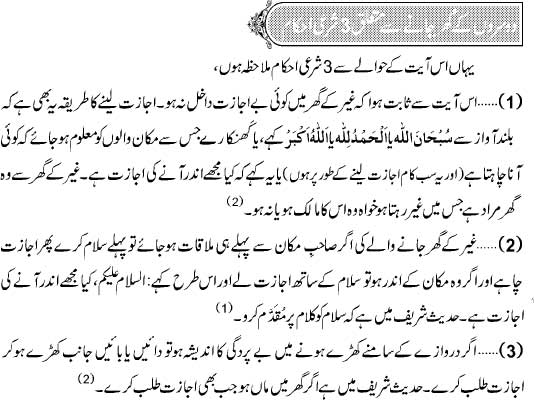
Dosroo Kay Ghar Janey Kay Ahkam
Ramadan Tips For First-Timers
1. Don’t expect it to be easy. Thirty consecutive days is tough. But with Allah’s help, it will become the best 30 days of your life.
2. Remember: Ramadan is not about abstaining from food and drink till sunset only and being compassionate toward the poor, it is also about cyour heart from sinful thoughts and actions and zooming out of this world and seeing the real meaning behind it. Don’t let your fasting be restricted to thirst and hunger.
3. Enjoy the moments of fasting by getting to know your self, your weaknesses and strengths. Ramadan is a real eye opener as the devils are all locked up and you get to know just exactly how sinful your soul is. Can’t blame it on the devil this time. If you find yourself still thinking of doing something wrong, then try to meditate on that and how to cure your heart from this.
4. Do good to everyone. Begin that holy month by forgiving all those who have wronged you. Call, email or visit those who have hurt you. Wish them a happy and blessed Ramadan.
5. Try to get as many loved ones as you can gather for “iftar” every day. It is a chance to reconnect with family and friends.
6. Don’t forget to include the poor and less fortunate in your daily meal plans.
7. Take your friends and family to Taraweeh prayers every day. Together you will pray for each other and for all. It will be a memorable experience in sha Allah.
8. Make it a plan to touch somebody’s life everyday. Start planning from now, whom you can help and how.
9. Finally, compete with yourself to bring out the very best in you. Allah is watching. Make Him happy.
Al Sadiq, Al Aameen (Sallallahu Alayhay Wasallam)

Optimal Benefit From Ramadan
Ramadan is a month of discipline, self-control, patience, and good behavior. In Ramadan, Muslims are expected to gain the fruits of fasting, namely, piety and consciousness of Allah. In this context, Allah Most High says in the Glorious Qur’an: “O you who believe! Observing As-Saum (the fasting) is prescribed for you as it was prescribed for those before you, that you may become Al-Muttaqun (the pious).” (Al-Baqarah 2:183)
Ramadan is the most blessed month in the Islamic calendar. It is primarily a spiritual training course intended to help us cultivate essential virtues and skills in order to lead a meaningful life. Most often we live at a very superficial level of our existence, forgetting our true essence and identity as human beings.
In other words, we become totally preoccupied with the physical and material dimensions, forgetting the spiritual core of our personalities. Ramadan, therefore, comes to remind us of who we truly are and how we can discipline ourselves in such a way that we are fully awake to our full spiritual potential.
In order to benefit from the blessed month of Ramadan and its spiritual regimen, I suggest that we focus on the following:
Welcome Ramadan with great fervor and spirit and expect to come out of it fully transformed in body, mind, and soul.
Perform all of the acts of worship while being fully awake to their inner dimensions and meanings. Most often we allow ourselves to go through these rituals as mere mechanical chores with the result that we gain virtually no benefit from them either spiritually or morally.
Let your fasting be a fasting of body, mind, and soul.
Imam Ghazali once pointed out that a vast majority of people fast only for namesake. For while staying away from food, drink, and sexual gratifications, their minds, eyes, ears, tongue, and other faculties feast on haram (unlawful matters). Therefore, in order to gain any true benefit from our fasts, we need to impose a total self-restraint upon all our faculties and stay away from all sinful and idle thoughts, words, and actions, and nurture the thought and remembrance of Allah.
Ramadan is not merely a month of fasting; it is rather a season to cultivate all sorts of virtues and good habits. It is the perfect opportunity to break free of all negative habits that have been holding us back from achieving the true happiness and perfection that is ours as a birthright.
So seize the opportunity and focus on achieving real goals to make it a true life-changing and life-enhancing experience.
Ramadan is the month of empathy and generosity. In fact, one of the main purposes of fasting is to instill in us empathy for the poor and the less deprived. By exposing us to compulsory hunger, we are given a practical lesson in hunger and thirst and thus we become better motivated to empathize with the poor. Hence we are ordered to practice the optimum level of charity in the month of Ramadan.
Ramadan is the time to familiarize ourselves with the Qur’an, the true source of guidance, illumination, healing, and mercy-Allah’s perfect gift to humanity. We can only do justice to the Book when we go beyond merely chanting and memorizing it to reflecting and meditating upon the Revealed Word and respond to it in true spirit by acting upon its teachings.
One of the main purposes of all of the acts of worship in Islam is to cultivate in us a true sense of community and spirit of fellow humanity. Therefore, it is imperative that our compassionate words and acts be extended not only towards ourselves but also towards all of Allah’s creation.