

Examples Of Equality In Islamic History
ISLAM calls for equality between people. Prophet Muhammad (peace be upon him) said: “An Arab has no superiority to a non-Arab and a white man has no superiority to a black one except through piety and good deeds.”
The following examples prove this Islamic concept.
Abu Dharr of the Ghifar tribe somehow got angry with the freed slave of Abu Bakr, Bilal of Abyssinia. Both of them were the companions of the Prophet (peace be upon him).
The altercation became prolonged and Abu Dharr in his fury called Bilal, the son of a black-skinned mother.
Bilal complained to the Prophet, who addressed Abu Dharr saying, “Did you call him a name reviling his mother? It appears you still retain vestiges of Jahiliyyah (Period of Ignorance before Islam).” The Prophet also said in reply, “You are his brother (and should be considerate and kind to him).”
Abu Dharr was ashamed and repentant and out of extreme repentance and humility requested Bilal to trample his face with his feet.
Another example is when, during the lifetime of the Prophet, a woman of the Bani Makhzoom tribe, Fatimah, was found guilty of theft. She was brought to the Prophet so that she might receive her punishment according to the Shari ‘ah (Islamic Law).
The Quraish tribe very much resented it since it involved their tribal prestige and dignity. So they thought of intercession by somebody for the remission of her punishment.
It was therefore decided after deliberation to send Osamah Bin Zaid for such intercession since he was very much in favor with the Prophet. So he was approached, prompted to intercede and he talked to the Prophet on this issue.
The Prophet was very angry and said to Osamah, “You intercede in the matter of the limits prescribed by God?”
Then he called a big gathering of the believers and, in a touching manner, said, “The people before you who met their doom, discriminated between the austocrats and the common people in the dispensation of justice for crimes like theft. The high-placed were spared while the weaker sections of society were readily punished. By God, if Fatimah Bint Muhammad had committed theft, I would have amputated her hand also. A third example involves Adi Bin Hatim(one of the elite of his time) who came to Madinah before embracing Islam and found the companions sitting around the Prophet.
They had just returned from some battle and some of them still had the armory and helmets on. ‘Adi, witnessing the awe of the Prophet and their reverence for him, himself fell in awe.
Meanwhile, a humble woman of Madinah came to the Prophet and requested to see him in private.
The Prophet readily agreed to talk to her. He got up and at some distance from the gathering talked to her for a sufficiently long time, and having finished with her came back to the gathering.
When ‘Adi witnessed this state of affairs, he was very much touched by this inconceivable concept of generosity in action and embraced Islam.
A fourth example was offered when, after 21 years of hard struggle, the Prophet conquered Makkah. Those who had rejected him, had driven him out of his home and had been waging wars with him, were brought before him vanquished. But even then, he called them to the Faith and kept in view those lofty principles that he had preached in the vales of Makkah or had enforced in Madinah as a ruler when he was laying the foundations of a new civilization in the Islamic history.
That day he proclaimed those principles that he had been preaching while he had not yet gained his final victory.
Standing at the gate of the Ka’aba he said, “O you people of Quraish! Allah has, this day, put an end to your pride of the Jahiliyyah (Days of Ignorance) and also the pride of your ancestry. Keep in mind! All men are the offspring of Adam, and Adam was fashioned out of clay”. The Quraish who held an exalted position in the Arab society, and had a high opinion of themselves, listened to him in silence with bowed heads. On this occasion he recited the following Qur’anic verse which he had been reciting off and on: “O Mankind! We created you from a single (pair) of a male and a female, and made you into nations and tribes, that you may know each other (not that you may despise each other). Verily, the most honored of you in the sight of God is (he who is) the most righteous of you.”
The fifth example came in the period of the caliphate of Abu Bakr. He set the example of a ruler whose heart was full of sympathy for his subjects without distinction of rank or class. Notwithstanding his position as the head of the Muslim state, he would visit the girls of the locality whose fathers had fallen martyrs in wars.
He milked their goats for them and assured them that his new responsibilities would not stand between him and his routine of benevolent acts such as that.
It can be said with certainty that there is not a single incident as glorious, outstanding and based on the noble sentiments of fraternity as the ones cited above, anywhere in the lives of the greatest men in the history of mankind.
There is an incident connected with George Washington, the savior of America, that he was once going along the road when he saw some soldiers trying to lift a stone but were unable to do so. Their supervisor was standing close by but not lending a helping hand. Washington asked him to come to their help, but he refused saying that it was below his dignity.
Washington , kept his sheet on one side of the road and helped them lift the boulder, and said to them when departing that whenever they needed help in a difficulty of that type they could enlist his help at such and such address.
Certainly this is a unique incident and is an example of a high standard of morality, but cannot be compared with the incidents mentioned above.
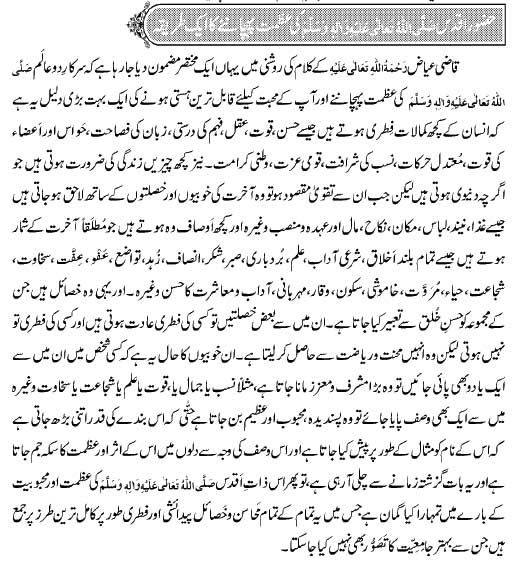
Huzoor-e-Aqdas Sallallaahu Alaihi Wasallam Ki Azmat
Prophet Muhammad – A Mercy For All Creatures
Mercy for Animals
Prophet Muhammad (peace be on Him) was kind to every living creature and this kindness knew no limits. He was very kind to animals as well. Arabs, like all ignorant and illiterate people, were very unkind to their animals. It was very common in Arabia to put a collar round the neck of a camel, but this practice was stopped on the Prophet’s orders. People used to cut pieces of flesh from living animals and cook and eat them. This common practice was forbidden.
It was also forbidden to shear their hair or tails. Prophet Muhammad said that the tail was the brush and fan (of these animals and their hair was their quilt. He also forbade people to keep animals tied to their working equipment for long time and said, ” Don’t make the backs of animals your chairs.” Animals fights were also made unlawful. Another custom was to tie up an animal and practice arrow shooting on it. This was also prohibited.
Once prophet Muhammad (peace be on Him) saw a donkey on the road with a brand on its face, and said, ” Allah’s curse is on him who branded it.” As people had to brand their camels and sheep in order to identify them, they were told to brand them on parts which were not so tender. Anas reported that he went into a herd of sheep and saw Allah’s Messenger branding them on the ears.
Once the Prophet was on a journey with his companions and they stopped for rest at a certain place. A bird had laid an egg there. A man took away the egg and the bird began beating her wings in a state of great distress. The Prophet inquired who had hurt her by taking her egg. When the man admitted that he had done that, the Prophet asked him to return the egg to the nest.
A companion who had some baby birds wrapped in a piece of cloth came to the Prophet. On inquiry, he told Prophet Muhammad, ” I heard a noise from a bush, went there, saw these chicks, and took them out. When their mother saw what had happened, she began to hover over my head.” The Prophet told him to go back and return the chicks.
Once he saw a camel on the road, whose belly had shrunk so much because of extreme hunger that it had become one with its back. He said, ” Fear Allah in your treatment to these animals who cannot speak. ” Muhammad himself fed animals, tied carriers and milked goats.
Prophet Muhammad ( peace be on him) once told a story to his companions. There was a man who went on a journey and on his way felt very thirsty. He found a well and went down into it and drank water. When he came out of the well he saw a dog who was also very thirsty and was licking the salty ground with his tongue. Thinking that the animal was thirsty like him, he again went down into the well, filled his leather socks with water and gave it to the dog. Allah was so pleased with this action of the man that he granted him Paradise. There is another story about a woman going to Hell who starved her cat to death.
Prophet Muhammad ( peace be on him) was so kind and gentle that he advised his companions to be nice and considerate even while slaughtering animals for food. He asked them to slaughter them with the sharpest weapon, thus causing the minimum pain and suffering to the animal. He also forbade them to sharpen the weapon in front of the animal or when the animal was ready for slaughter, but told them to do these preliminaries before the animal was brought for slaughter.
Prophet Muhammad ( peace be on him ) taught people by word and deed to be kind and polite to everyone. Abu Hurairah reported the Prophet as saying, ” A believer is friendly ( and kind). ” Ayeshah reported Allah’s Messenger as saying, ” Allah is gentle and likes gentleness. He gives for gentleness what he does not give for harshness and what He does not give for anything else.”
Ayeshah also reported Allah’s Messenger as saying, ” He who is given his share of gentleness is given from his share of good of this world and the next, but he who is deprived of his share of gentleness is deprived of his share of the good of this world and the next.” Abdullah Ibn Masud reported Allah’s Messenger as saying, ” Shall I not tell you about the man who is kept away, from Hell and from whom Hell is kept away? From the person who is gentle and kind, accessible and of an easy disposition.
Prophet Muhammad, by his own example, had instilled this kind of behaviors in his companions, who, after him, set an example for other people. This is shown by the following incident. It is reported by Abdullah Ibn Jafar that he passed by a grazing field and saw an Abyssinian slave guarding a herd of goats. A dog came and sat in front of him. He took out a loaf of bread and gave it to the dog, who ate it. Then he gave the second and third loaves of bread to the dog who ate them all. He inquired of the slave how many loaves of bread he got daily from his master. He replied that he got as many as he saw.
At this, he asked why he gave all his bread to the dog. The slave replied that the dog did not belong to that place and must have come hoping for food from a long distance, hence he did not like his effort to be wasted. Abdullah said that he liked his action so much that he bought the slave along with the goats and the grazing field from his master, set him free and give him all the goats and the grazing field. The slave thanked him and prayed for him and gave all the goats and the grazing field in charity and went away.
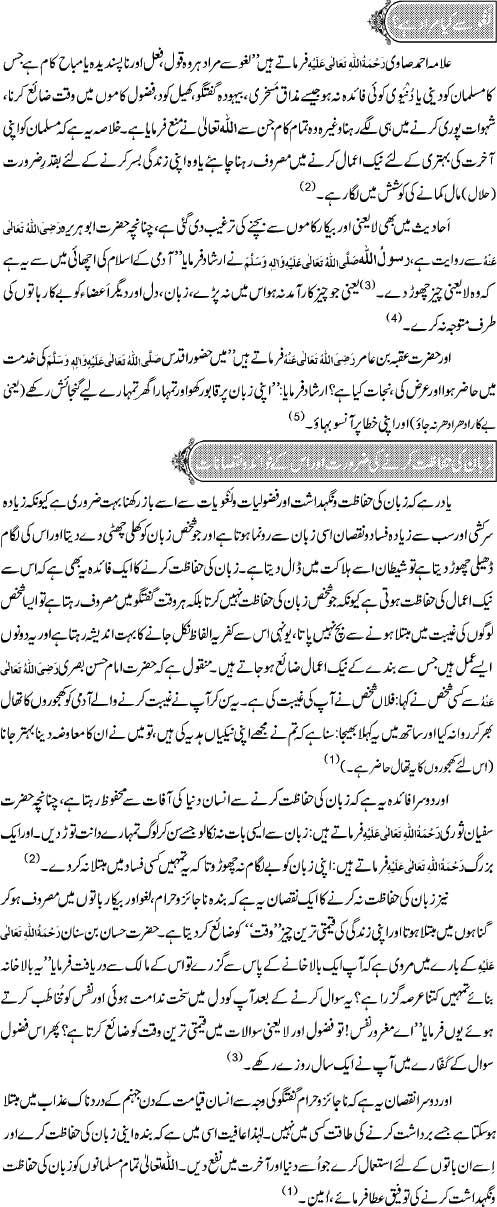
Zaban Ki Hifazat
The People Of Paradise Will Laugh At The Fire
After Allah (swt) admits the people of Paradise to Paradise, they will call out to their opponents among the kuffaar in Hell, rebuking and scolding them:
“And the dwellers of Paradise will call out to the dwellers of the Fire [saying]: “We have indeed found true what our Rabb promised us; have you also found true, what your Rabb promised [warnings, etc]? They will say “Yes”. Then a crier will proclaim between them: “The Curse of Allah is on the Dhaalimoon [wrongdoers]” [7:44]
The kuffaar used to dispute with the believers in this world, making fun of them and insulting them, but on that Day the believers will be victorious: they will be in a state of everlasting joy, looking at the wrongdoers and making fun of them:
“Verily, al-Abraar will be in delight, on thrones, looking [at all things]. You will recognize in their faces the brightness of delight. They will be given to drink pure sealed wine, the last thereof will be the smell of musk, and for this let [all] those strive who want to strive. It [that wine] will be mixed with Tasneem, a spring whereof drink those nearest to Allah. Verily [during the earthly life] those who committed crimes used to laugh at those who believed, and whenever they passed by them, used to wink to one another [in mockery]; and when they returned to their own people, they would return jesting; and when they saw them, they say, “Verily! These have indeed gone astray!” But the [disbelievers] had not been sent as watchers over them [the believers]. But this Day those who believe will laugh at the disbelievers on [high] thrones, looking [at all things]. Are not the disbelievers paid [fully] for what they used to do?” [83:22-36]
By Allah, the kuffaar will finally get the punishment that they deserve, a punishment that fits their crimes. The believer who is now in the luxury of Paradise will remember that colleague or friend who used to encourage him to follow kufr in this world and called him to embrace those misguided principles that would have placed him in the ranks of the kuffaar and enemies of Allah (swt). He will tell his companions about that former colleague, and tell them to look at him and his punishment. When he sees how he is being punished, he will realise the extent of the blessing that Allah (swt) has bestowed upon him, and how Allah (swt) has saved him from a similar fate. Then he will address his former companion and rebuke him:
“Then they will turn to one another, mutually questioning. A speaker of them will say, “Verily I had a companion [in the world] who used to say, “Are you among those who believe [in resurrection after death], [that] when we die and become dust and bones, shall we indeed [be raised up] to receive reward or punishment [according to our deeds]?” The Man said, “Will you look down?” So he looked down and saw him in the midst of the Fire. He said, “By Allah! You have nearly ruined me. Had it not been for the Grace of my Rabb, I would certainly have been among those brought forth [to Hell].” [Allah (swt) informs about the true believer that he said], “Are we not then to die [any more]? Except our first death and we shall not be punished? [after we have entered Paradise] Truly this is the supreme success! For the like of this let the workers work.” [37:50-61]
Azan Kay Fazail

Al-Isra’: The Prophet’s Unique Journey
GLORIFIED (and Exalted) is He (Allah) Who took His slave (Muhammad, peace be upon him) for a journey by night from Al-Masjid Al-Haram [at Makkah] to Masjid Al-Aqsa [in Jerusalem], the neighborhood whereof We have blessed, in order that We might show him (Muhammad, peace be upon him) of Our Ayat (proofs, evidence, lessons, signs, etc). Verily, He is the All-Hearer, the All-Seer. (17:1)
Surah Al-Israa’ begins with glorifying Allah, the most fitting action to confirm the bond between Allah and His servants in the atmosphere of compassion and friendliness imparted by the mention of the night journey. The Surah emphasizes the position of man as Allah’s servant. The emphasis here is needed in the context of the Prophet’s ascension to heaven where no human being had gone before.
It is important in this context that the status of man’s servitude to Allah should always be remembered.
There must be no confusion of status similar to that which happened in the case of Jesus on account of his birth, his being raised to heaven at the end of his life on earth, and the powers that were given to him during life. All these caused some people to confuse his status and to claim that he had a divine nature. In its simplicity and purity, Islam insists that no similarity could ever exist between Allah and any creature.
The Arabic text of this opening verse uses the verb Asra, which denotes “traveling during the night.” It is sufficient then to use this verb to denote the time of the action. Yet the verse adds the word laylan or “by night” to give an added sense of the still night and the ease of travel.
The journey from the Grand Mosque to Al-Aqsa Mosque was one chosen by Allah, the Compassionate Who knows everything. It provided a link between all monotheistic faiths from the time of Abraham and Ishmael to the time of the last Prophet, Muhammad (peace be upon them all). It also established a link between the holy places in all these religions. It seems that this unusual journey served as an announcement that the Last Messenger was the heir to the heritage of all former Messengers. His message staked a claim to all these holy places. Thus it becomes a journey that goes beyond the scope of time and place.
The opening verse describes Al-Aqsa Mosque as one with blessed environs. This description shows the blessings surrounding the mosque and flowing in abundance. This impression could not have been given with a direct description such as “the mosque which We have blessed.”
This is another example of the refined use of language characteristic of the Qur’an.
The Prophet’s night journey was a telling sign, and it was accompanied by others, as the opening verse says in stating its purpose : “…. in order that We might show him of Our Ayat…”. Covering the distance between the Grand Mosque in Makkah and Al-Aqsa Mosque in Jerusalem in a very short period that did not allow the Prophet’s bed to become cold is a sign of Allah’s power, whatever the means used to accomplish it. It opens our minds to new horizons in the universe and reveals latent potentials within mankind.
It shows that those human beings chosen by Allah to be the bearers of His message have the latent ability to receive whatever greater powers He wishes to give them. It is Allah Who has honored man, giving him a favored position among His creation, and endowed him with such potentials.
“Verily! He is the All-Hearer, the All-Seer.” He indeed hears and sees all that is beyond the reach of our hearing and seeing faculties.
It is especially impressive that the opening verse of this Surah starts with glorifying Allah: “Glorified (and Exalted) is He (Allah) Who took His slave for a journey by night.”
After defining the purpose of this journey, the Surah finishes with highlighting two of Allah’s attributes, perfect hearing and seeing that encompass all things.
This quick movement across purposes reflects the finest points of the expression used. The glorification is addressed to Allah Himself, and the statement about the purpose of the night journey comes from Him, while the description of Allah’s powers is made in the form of an indisputable statement. All these forms are combined in one verse so as to give their different imports.
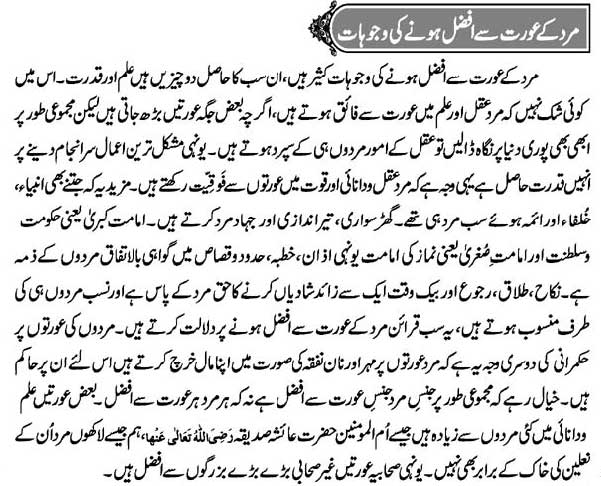
Mard Kay Aurat Say Afzal Honay Ki Wojohat
مرد کے عورت سے افضل ہونے کی وجوہات
Miscellaneous Hadith
Narrated by ‘ Ibn Umar : Allah’s Apostle said, “The worst lie is that a person claims to have seen a dream which he has not seen.”
Narrated by Ibn ‘ Umar : I saw in a dream a piece of silken cloth in my hand, and in whatever direction in Paradise I waved it, it flew, carrying me there. I narrated this (dream) to (my sister) Hafsa and she told it to the
Prophet who said, (to Hafsa), “Indeed, your brother is a righteous man,” or, “Indeed, ‘Abdullah is a righteous man.”
Narrated Abu Huraira: The Prophet said, “I have been given the keys of eloquent speech and given victory with awe (cast into the hearts of the enemy), and while I was sleeping last night, the keys of the treasures of the
earth were brought to me till they were put in my hand.” Abu Huraira added: Allah’s Apostle left (this world) and now you people are carrying those treasures from place to place.
It is learnd tat one day when Prophet(pbuh) was to deliver the speech on a Friday. He(pbuh) climbed the stairs of the Mimber-e-mubarak and said AMEEEN thrice climbing each step. The follower’s(r.a) inquired about that and Prophet(pbuh) replied that when He(pbuh) was climbing the stairs of the Mimber-e-mubarak Jibrael-e-Ameen came and made three supplications to the Almighty ALLAH on which Prophet(pbuh) said Ameen.
It is the matter of concern that the supplication was made by best of the angel’s and Prophet(pbuh) said Ameeen on that….. The following are the three supplications made by Jibrael-e-Ameen on which Prophet(pbuh) said Ameeen..
1. Curse of ALLAH be on the person who does not fast during the month of Ramadan even if he’s well (without any diseases or physical problems).
2. Curse of ALLAH be on the person who do not obey and listen to their parents.
3. Curse of ALLAH be on the person who after listening and saying the name of the Holy Prophet(pbuh) do not recite DAROOD SHAREEF.
May ALLAH paak guide us the straight path and bless us all with the wealth of reciting DAROOD SHAREEF all the time.. Ameeeeen YA RABBAL ALAMIN..