
Gratitude For Childhood Favors
The first few years of the Prophet’s life saw him suffering repeated loss of his immediate relatives and carers. His father died when he was on a journey, perhaps unaware that his wife was pregnant. He stayed most of the first four or five years of his life with his wet nurse, Haleemah, in a desert encampment. It was a tradition among the top families in Makkah that they gave their newborn children to be nursed by women in the desert, believing that there the children would grow up stronger. Perhaps Makkah suffered attacks of infectious diseases, and keeping the children away gave them a better chance of survival. However, Haleemah and her family felt that Muhammad (peace be upon him) brought them some subtle blessing. Therefore, she was keen to keep him with her as long as possible. Hence she persuaded Aminah, his mother, to leave him with her. This was agreed, and Haleemah only returned the young Muhammad to his mother when he was five years of age. Only a year later, Muhammad lost his mother. He was then cared for by his grandfather, Abd Al-Muttalib, who was the most distinguished figure in Makkah and by now a very old man. Two years later Abd Al-Muttalib died and Muhammad moved home again, going now to his uncle, Abu Talib.
Abu Talib loved his orphan nephew, Muhammad, as one of his own children. There was about him an air of serenity and quiet acceptance of what life might present. Hence, he was dear to all around him, particularly his aunts. Yet Abu Talib and his family were the closest to his heart, because of the care he received in his uncle’s home. We see him, as he became a young man, talking to another uncle of his, Al-Abbas, during a time of hardship when all things were scarce in Makkah, saying: “You see how things are in the city, with people finding it hard to make ends meet. Your brother, Abu Talib is a poor man, and he has a large family. We better do something to help him. How about the two of us taking one of his children each to look after?” They went to Abu Talib with their proposal. Al-Abbas took Jaafar, and the Prophet took Ali. This was long before the start of Muhammad’s prophethood. The two young lads thus found good homes where they were welcome, and their father’s burden was significantly lightened.
His close relationship with his uncle, Abu Talib, continued for the rest of the latter’s life. The Prophet would have dearly loved that Abu Talib should accept Islam, but this was not to be. However, Abu Talib continued to extend his care and protection to his nephew against all opposition by his tribe, the Quraysh. Moreover, the Prophet continued to give Fatimah bint Asad, Abu Talib’s wife, a special position of favor in his heart. He acknowledged her favor and unwavering care when he was a child. As he grew up, he always showed her dutiful respect and often favored her with generous gifts, according to his means.
Abu Talib died three years before the Prophet’s emigration to Madinah. Fatimah bint Asad followed the Prophet to Madinah sometime after he had settled there. The Prophet was so delighted with her arrival, welcoming her as one of his closest relatives. It was with deep grief that he later received the news of her death. He prayed God to give her a high position in heaven. He gave instructions to those who were preparing her body for burial to use his own garment to wrap her with. When her grave was ready, he went in first and lied where she was to be placed, praying that angels would attend her there. His companions looked at him, wondering why he did that when he never did it with any other funeral. They saw him praying for her forgiveness, with his eyes tearful. He said to them: “Next to Abu Talib, she was the one who took best care of me when I was young.”
Another person who earned the Prophet’s gratitude was Thuwaybah, a slave woman owned by his uncle Abu Lahab. She breast-fed him in his early days of life, before he was given to Haleemah. Thus, she nursed him for a few weeks after his birth. The Prophet cared well for her, inquiring after her when he was in Makkah. When he got married, his wife Khadeejah was very hospitable to her. Then at one point, Khadeejah approached Abu Lahab, proposing to buy Thuwaybah so that she might set her free. Abu Lahab would hear nothing of the sort. Abu Lahab, who stubbornly opposed the Islamic message and took a hostile attitude to the Prophet, could not countenance the prospect of Muhammad being seen in Makkah in such a light, showing a great favor to the slave woman who nursed him in his early days. Yet, when the Prophet immigrated to Madinah, Abu Lahab himself set Thuwaybah free. Therefore, the Prophet used to send her money and clothes whenever he could. He learnt of her death in year seven after his settlement in Madinah. When the news was brought to him, he asked about her son, Masrooh. He was informed that he died earlier, and that she had no other relatives.
While those we have mentioned had special positions with the Prophet because they looked after him when he was young, the Prophet was very kind to all his relatives. He respected his uncles, loved his aunts and was kind and friendly with all. He would visit anyone of them who was ill, praying for their recovery. Needless to say, that was the best thing such an ill person could hope for, because the Prophet’s prayers were always answered. He urged them all to do good works so that they would enter heaven on merit. He advised them that their relation with him would not benefit them unless they worked for their own salvation. Some of them opposed his message and took a hostile attitude. This was very painful to him. However, when they changed their attitude and accepted Islam, the Prophet received them with open arms, praying for their forgiveness.
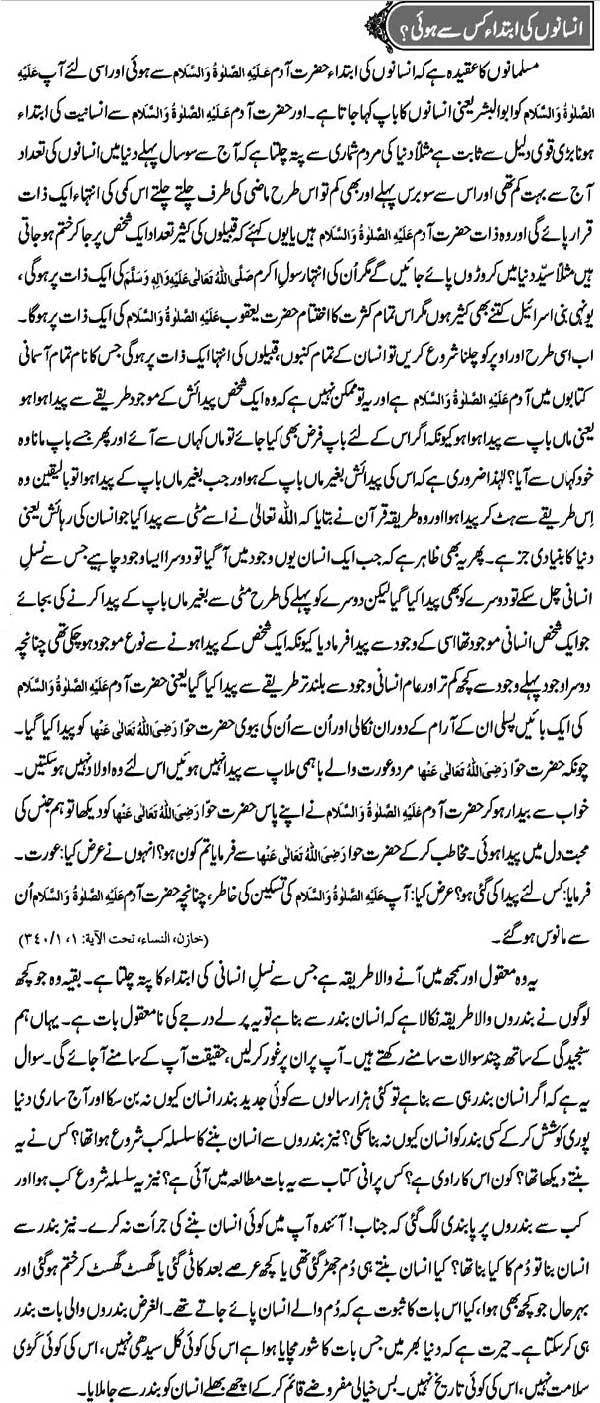
Insan Ki Ibtada Kiss Say Hui
Prophet Muhammad (pbuh): Implementing General Orders
Since Islam is a complete way of life, it wants the government of the Muslim community to implement its principles and carry out its orders. There is no rigidity in the Islamic system of government.
Islam simply lays down broad lines, which must be observed. Within these broad lines, any system that is acceptable to the Muslim community is appropriate. One of the principles that Islam lays down is consultative decision making in all spheres of life. Therefore, any system of government that is essentially consultative is acceptable from the Islamic point of view.
When orders are made and decisions taken, the question is: Who implements them? Let us take the case of an order that pertains to the social life of the community. If the order is clear and does not admit divergent interpretations, should individuals take it upon themselves to ensure its implementation? For example, Islam requires women to dress modestly and to cover all their bodies, with the exception of their faces and hands, when they go out. Suppose a woman goes out wearing clothes that clearly violate Islamic rules, can her neighbors force her to observe the Islamic dress code? The answer is that they may only give her advice in a way that does not alienate her from Islam. They can use no force or undue pressure. It is the government that has the authority to ensure that Islamic rules are observed. It may enact regulations that deal with such a contravention of Islamic law.
The Prophet (peace be upon him) made this very clear, and gave us a practical example. Abdullah ibn Umar reports that the Prophet asked him to bring him a knife. When he did, the Prophet made sure that it was sharpened. He gave the knife to Ibn Umar and told him to bring it with him the following morning. “On the morrow he went out with a group of his companions and walked through the streets of Madinah, where wine had just been imported from Syria. He took out the knife and cut off every wine container he saw. He then gave me the knife, and ordered those with us to go along with me and to help me. He commanded me to go through all markets and to cut off every wine container I find. I did so, leaving no single container.”
This apparently happened shortly after the drinking of intoxicant drinks was finally made strictly forbidden. The Prophet could have issued a general order that anyone who saw a container of wine should cut it off or break it. That would have led to much chaos. To prevent this, he started the action himself, in the presence of a group of his companions. He then ordered a certain person to complete the task, appointing helpers for him so that no one could question his authority.
Unfortunately, some Muslims who are keen to see Islam implemented try to take the Islamic law into their own hands. This is not acceptable from the Islamic point of view, as it will lead to much chaos and will leave the community divided. No individual or group can appoint themselves overseers to ensure the implementation of Islamic law. Its implementation is left to the Muslim government. If the government of a Muslim country does not implement Islam, it will be answerable to Allah for this omission. This does not give individuals the right to act on their own.
– By NAUSHAD SHAMIM AL-HAQ
Visiting The Sick And Comforting Them
Even sickness for a Muslim is a blessing of Allah. The reason for this is that if a pious person falls ill, then his status is elevated and if a sinner falls ill then his sins are forgiven.
To visit a sick person is known as “Iyaadat.” This is to show human kindness and it is a means of earning Sawaab. Most of all it is the Sunnah of the Prophet (sallal laahu alaihi wasallam).
When a person visits a fellow Muslim who is ill, then he gains the Mercy of Almighty Allah and the gift of Jannat. The Prophet (sallal laahu alaihi wasallam) has stated: “If a Muslim visits his fellow Muslim brother who is ill in the morning, then 70 000 Angels pray for that person until the night and if he visits at night then they pray for him till the morning, and due to his Iyaadat, he gains a garden in Paradise.” In another Hadith, it has been narrated that if a person makes fresh Wudhu and intends to visit an ill person only for Sawaab, then he is kept away from Hell as far as the distance of a 70 year journey.
It is also Sunnah to allow the sick person to eat whatever he desires. When visiting a sick person, one should not be rowdy, unpleasant or unkind. Do not visit the sick person for a long period. You should make D’ua and then take leave. When visiting the sick also ask the sick person to make Du’a for you since their Du’as are readily accepted.
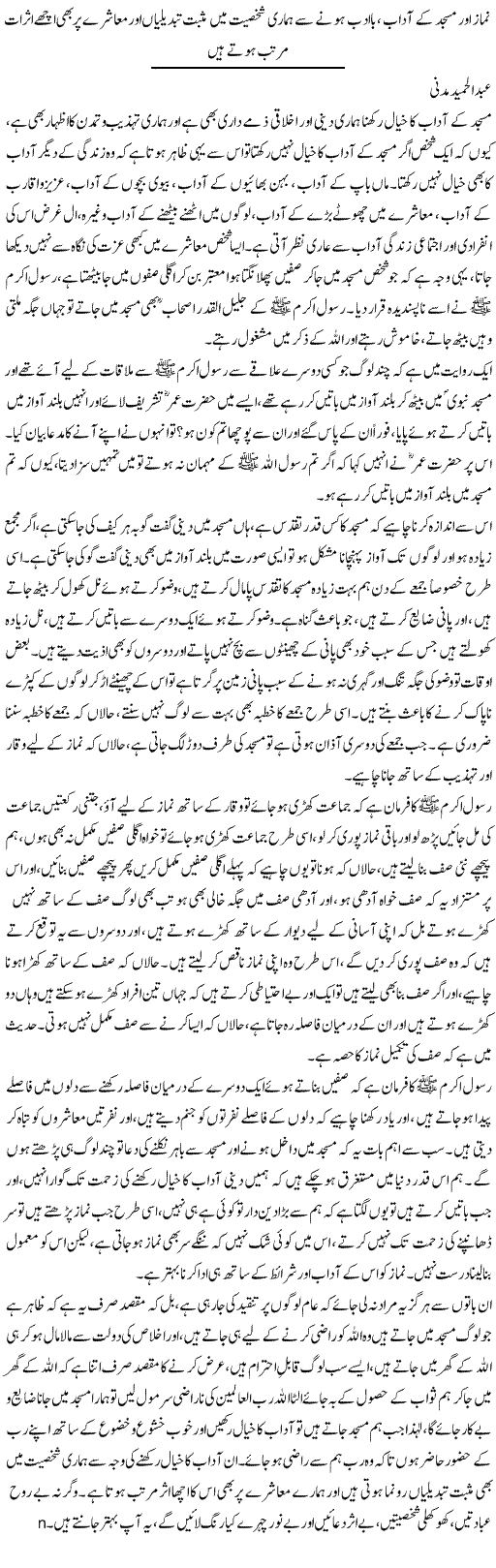
Namaz Aur Masjid Kay Aadaab
Nothing Escapes God’s Knowledge
The unbelievers say: “What! After we have become dust, we and our forefathers, shall we be brought back (to life)” We have been promised this before, we and our forefathers! This is nothing but fables of the ancients.” Say: “Go all over the earth and see what happened in the end to the guilty.”
Do not grieve over them, nor be distressed by what they scheme. They ask: “When will this promise be fulfilled, if what you say be true?” Say: “It may well be that something of that which you so hastily demand has already drawn close to you.” Your Lord is indeed most bountiful to people, but most of them are ungrateful. And indeed your Lord knows all that their hearts conceal and all that they bring into the open. There is nothing that is hidden in the heavens or the earth but is recorded in a clear book. (The Ants; Al-Naml: 27: 67-75).
Resurrection and the life to come make up the most difficult point to accept by the unbelievers. They reject this argument completely, claiming that since their forefathers were similarly warned and nothing happened to bring them back to life, then all claims about the hereafter are baseless. In order to emphasize their rejection of this concept, they hasten the coming of the punishment unbelievers are threatened with.
In a short verse, the surah gives an impression of the forthcoming horror, imparting a touch of ridicule of their attitude: “Say: It may well be that something of that which you so hastily demand has already drawn close to you.” Thus the surah strikes fear in their hearts and makes them worry about the impending punishment. It could easily be close coming from behind, like someone riding behind another. Yet they cannot perceive it. Thus, they are hastening it when it is closely overtaking them. What a frightening surprise to fit their ridicule.
But who can tell? What God has kept for Himself will remain hidden behind a curtain that reveals nothing whatsoever. Something very serious, extremely terrible could be moments away. It is wise, then, to be warned and to be ready at all times to what may lie behind the thick curtains.
“Your Lord is indeed most bountiful to people, but most of them are ungrateful.” Perhaps one of the most important aspects of God’s bounty is that He allows people respite when they do wrong or fail to do what is required of them. He does not hasten His punishment, giving them chance after chance to reflect on their position, repent of their mistakes, and turn back to the right path. Nevertheless, most of them are ungrateful for the grace God bestows on them. Rather, they ridicule the whole idea and hasten their own punishment, or continue in their erring ways, refusing to reflect and take heed. “And indeed your Lord knows all that their hearts conceal and all that they bring into the open.” He gives them this respite although He is fully aware of the feelings they harbor in their hearts as also what they declare by word and deed. This means that the respite is given them in the full knowledge of their actions and feelings. But they will inevitably have to face the reckoning of all this.
This round concludes with a statement emphasizing God’s perfect knowledge that overlooks nothing anywhere in the universe: “There is nothing that is hidden in the heavens or the earth but is recorded in a clear book.” Let imagination travel anywhere in the universe, thinking of any hidden thing: A secret, object, piece of news or information, force or power; it is all recorded and included in God’s knowledge. Nothing is lost or overlooked. God’s knowledge is emphasized throughout the surah, and this reference to it here is just one of many.
Having emphasized the point on God’s perfect knowledge, the surah moves on to speak about the differences among the Children of Israel on fundamental issues. What the Qur’an states concerning these differences is part of God’s knowledge, and it provides the final, indisputable word on these issues. It is an example of how God judges between people in dispute. This is stated so that it provides some comfort to the Prophet so that he would leave them to God to judge between them as He pleases.
“This Qur’an explains to the Children of Israel most of that over which they disagree.”
The Christians have long been in dispute concerning Jesus Christ and Mary, his mother. Some said that the Christ was purely human, while others maintained that the Father, the Son and the Holy Spirit are three different forms in which God reveals Himself to mankind. They allege that God is made of these three elements, making Jesus the Son. Thus, God the Father came down in the form of the Holy Spirit and took human form inside Mary and was born in the form of Jesus. Others still said that the Son is not eternal like the Father, but created in this world. As such, he is of a lower status than the Father and subject to Him. A different group denied that the Holy Spirit was one of the three elements. The Council of Nicaea held in 325 AD and the Council of Constantinople held in 381 decided that the Son and the Holy Spirit are equal to the Father in divinity. It further decided that the Son was born from the Father in eternity and that the Holy Spirit emanates from the Father. Likewise, the Council of Toledo, held in 589, also made the same decision concerning the Holy Spirit. The Eastern and Western Churches split over this point, and continued to differ. The Qur’an gives the final word to end all such disputes. It describes the Christ as God’s ‘Word that He gave to Mary and a soul from Him.’ (4: 171) He is certainly a human being, no more: ‘He was nothing but a servant of Ours whom We had graced and whom We had made an example for the Children of Israel.’ (43: 59)
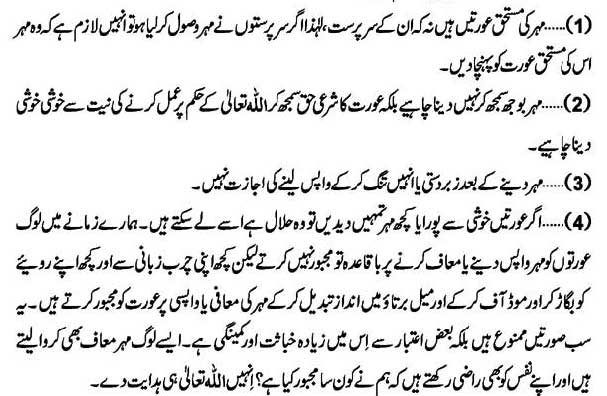
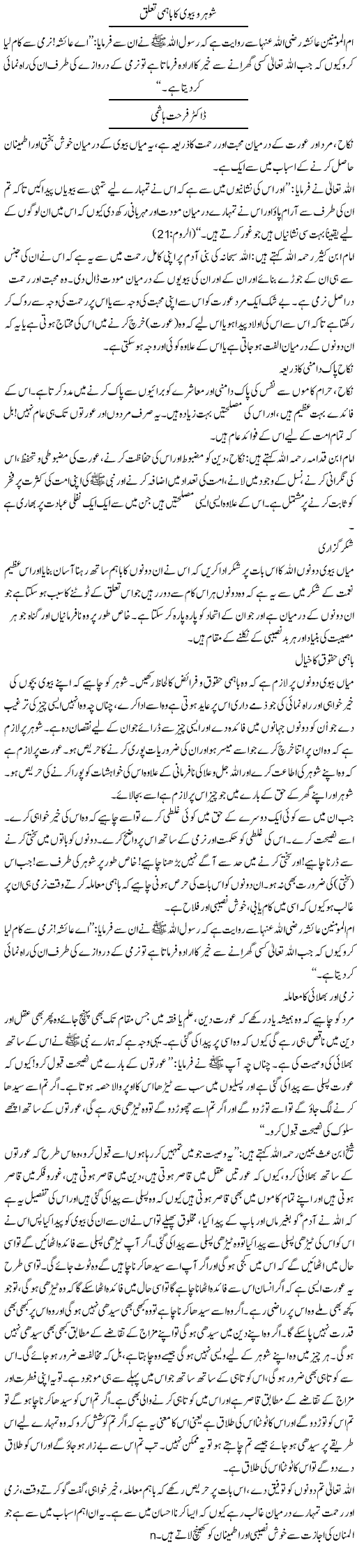
Shohar Biwi Ka Bahmi Taluq
Umm al-Mo’mineen Hadrat Sayyidah Maymoonah bint al-Harith Radi Allahu Anha
Hadrat Umm al-Mo’mineen Sayyidatuna Maimoona Radi Allahu Ta’ala Anha was the last wife of the Holy Prophet (Sallallaho Alaihi wa Aalihi wa Sallam). She was the daughter of Harith bin Huzn and Hind bint Awf. She belonged to the tribe of Banu-Hilala. The Holy Prophet (Sallallaho Alaihi wa Aalihi wa Sallam) had another wife from the same tribe. The other wife’s name was Sayyidah Zainab Radi Allahu Ta’ala Anha, commonly known as Ummul-Masakeen (Mother of the needy and poor). Maimoona was her second adopted name. Her first name Barra was changed by the Holy Prophet (Sallallaho Alaihi wa Aalihi wa Sallam) and the new name Maimoona was given. Her father Harith bin Hazam was one of the respected chief of tribe Banu-Hilala and he had sixteen daughters. One of his daughters namely Umm al-Fadhl was the wife of Hadrat Abbas Radi Allahu Ta’ala Anhu, who was the Holy Prophet’s uncle. His another daughter namely Umm-e-Salma was married to Hadrat Hamzah Radi Allahu Ta’ala Anhu, another uncle of the Holy Prophet (Sallallaho Alaihi wa Aalihi wa Sallam). Another daughter Lubaba was the mother of Hadrat Khalid bin Walid Radi Allahu Ta’ala Anhu (A renowned General of Muslims who fought against Iranians and was given the title of ‘Sword of Allah’ by the Holy Prophet Sallallaho Alaihi wa Aalihi wa Sallam). Harith’s some other daughters were later married to Hadrat Umar Radi Allahu Ta’ala Anhu, the second Caliph and Hadrat Ali Radi Allahu Ta’ala Anhu, the fourth Caliph. Another daughter Asma was married to Hadrat Jafar Radi Allahu Ta’ala Anhu. Thus most of Hadrat Maimoona’s sisters were married to the pioneering revolutionary leaders of Islam.
The Prophet (Sallallaho Alaihi wa Aalihi wa Sallam) was about sixty years old at the time of his marriage with Hadrat Maimoona. She lived three years’ married life with the Holy Prophet (Sallallaho Alaihi wa Aalihi wa Sallam). Prior to her marriage twice. Her first marriage took place with Masood bin Amr. Masood divorced her and then she was married to Abu Rahim bin Abdul Aza. Abu Rahim died in the seventh year of Hijra. After Abu Rahim’s death the Holy Prophet’s Uncle Hadrat Abbas persuaded the Holy Prophet Mohammad (Sallallaho Alaihi wa Aalihi wa Sallam) to marry Sayyidah Maimoona.
Maymuna or Barra as she was then called, yearned to marry the Prophet. She went to her sister, Umm al-Fadhl to talk to her about that and she, in turn, spoke to her husband, Sayyiduna Abbas Radi Allahu Ta’ala Anhu. Hadrat Abbas immediately went to the Messenger (peace and blessings of Allah be upon him) with Maymuna’s offer of marriage to him and her proposal was accepted.
The Holy Prophet (Sallallaho Alaihi wa Aalihi wa Sallam) was wearing Ihram (Ihram is the dress for performing Hajj or Umrah comprised of two sheets of cloth, one wrapped around the waist and the other around the shoulder. After putting on Ihram, one can not trim his hair, cut his nails, abuse or have intercourse etc.). In the same condition he sent five hundred Dirhams as Mehr to Hadrat Maimoona and the Nikah ceremony was Performed While on return after Umrah from Makkah Mukarramah to Madina Munawwarah, he stayed at a place called Saraf. This place is ten miles away from Makkah Sharif on way to Madina Munawwarah. At Saraf, the feast of Walima ( The feast, i.e. lunch or dinner offered to friends and guests on the next day of the marriage) was held.
A great event followed the marriage of Hadrat Maimoona’s to the Holy Prophet (Sallallaho Alaihi wa Aalihi wa Sallam). Hadrat Maimoona’s nephew Hadrat Khalid bin Walid embraced Islam. He was a very talented and brave man from the Quraysh tribe. He was also a great warrior and renowned soldier. After her marriage when Hadrat Maimoona went to Madina Munawwarah with the Holy Prophet (Sallallaho Alaihi wa Aalihi wa Sallam), Hadrat Khalid bin Walid addressed his tribe and declared, “I can no longer remain in your fold”. Thus a great force in the shape of Hadrat Khalid came to Islam’s side.
The Prophet gave her the name, Maimoona, meaning “blessed”, and Sayyidah Maimoona lived with the Prophet for just over three years, until his death. She was obviously very good natured and got on well with everyone, and no quarrel or disagreement with any of the Prophet’s other wives has been related about her. Hadrat Sayyidah ‘A’isha said about her,
“Among us, she had the most fear of Allah and did the most to maintain ties of kinship.”
It was in her room that the Prophet first began to feel the effects of what became his final illness and asked the permission of his wives to stay in Sayyidah Ayesha’s room while it lasted.
Hadrat Maimoona had a great love for teaching and preaching of Islam. She has narrated forty-six traditions and according to some, seventy-six traditions. People used to come to her for the solution of their various religious problems and she always guided them with intelligent replies to their questions.
She was a kind and very pious lady. During her life, she set many slaves free. Once during the life of the Holy Prophet Sallallaho Alaihi wa Sallam, she set a slave free to enjoy the rights of a free citizen, the Holy Prophet (Sallallaho Alaihi wa Aalihi wa Sallam) praised her saying,
“Maimoona, Allah will reward you for this act”.
She was also a great scholar of religion. Even her nephew Ibn Abbas who later became a great scholar interpreter and commentator of the Holy Quran, was her pupil.
After the beloved Prophet’s passing away, (peace and blessings of Allah be upon him) Sayyidah Maimoona continued to live in Madina Munawwarah for another forty years, passing away at the age of eighty, in 51 A.H., (may Allah be pleased with her), and according to Ibn Ishaq, She passed away in 63 A.H. being the last of the Prophet’s wives to pass away. She asked to be buried where had married the Prophet at Saraf and her request was carried out.
Hadrat Ibn-e-Abbas Radi Allahu Ta’ala Anha led her funeral prayers. When her coffin was lifted and was carried towards the grave, Hadrat Ibn Abbas Radi Allahu Ta’ala Anha said:
“Don’t shake her bed. Be respectful and carry her with ease. She is the wife of the Holy Prophet (Sallallaho Alaihi wa Aalihi wa Sallam)”.
Advice On Dealing With Anger
Anger is one of the evil whispers of Shaytan, which leads to so many evils and tragedies, of which only Allah knows their full extent. For this reason Islam has a great deal to say about this bad characteristic, and the Prophet (saws) described cures for this “disease” and ways to limit its effects, among which are the following:
(1) Seeking refuge with Allah from the Shaytaan:
Sulayman ibn Sard said: “I was sitting with the Prophet (saws), and two men were slandering one another. One of them was red in the face, and the veins on his neck were standing out.
The Prophet (saws) said, I know a word which, if he were to say it, what he feels would go away. If he said “I seek refuge with Allah from the Shaytan,” what he feels (i.e., his anger) would go away.’”
(Reported by al-Bukhari, al-Fath, 6/337)
The Prophet (saws) said: “If a man gets angry and says, I seek refuge with Allah, his anger will go away.” (Saheeh al-Jaami‘ al-Sagheer, no. 695)
(2) Keeping silent
The Messenger of Allah (saws) said: “If any of you becomes angry, let him keep silent.” (Reported by Imam Ahmad, al-Musnad, 1/329; see also Sahih al-Jaami, 693, 4027)
This is because in most cases, the angry person loses self control and could utter words of kufr (from which we seek refuge with Allah), or curses, or the word of divorce (talaaq) which would destroy his home, or words of slander which would bring him the enmity and hatred of others. So, in short, keeping silent is the solution which helps one to avoid all that.
(3) Not moving
The Messenger of Allah (saws) said: “If any of you becomes angry and he is standing, let him sit down, so his anger will go away; if it does not go away, let him lie down.”