

Surah Al-Fatihah Ki Taseer
True Piety
[Quran: 3:92] “By no means shall ye attain righteousness unless ye give (freely) of that which ye love; and whatever ye give, of a truth Allah knoweth it well.”
[Bukhari, Book #2, Hadith #44]
The Prophet (Peace Be Upon Him) has said: “Narrated Talha bin ‘Ubaidullah: A man from Najd with unkempt hair came to Allah’s Apostle, and we heard his loud voice but could not understand what he was saying, till he came near, and then we came to know that he was asking about Islam. Allah’s Apostle said, “You have to offer prayers perfectly five times in a day and night (24 hours).” The man asked, “Is there any more (praying)?” Allah’s Apostle replied, “No, but if you want to offer the Nawafil prayers (you can).” Allah’s Apostle further said to him: “You have to observe fasts during the month of Ramadan.” The man asked, “Is there any more fasting?” Allah’s Apostle replied, “No, but if you want to observe the Nawafil fasts (you can.)” Then Allah’s Apostle further said to him, “You have to pay the Zakat (obligatory charity).” The man asked, “Is there anything other than the Zakat for me to pay?” Allah’s Apostle replied, “No, unless you want to give alms of your own.” And then that man retreated, saying, “By Allah! I will neither do less nor more than this.” Allah’s Apostle said, “If what he said is true, then he will be successful.
Qayamat Kay Ahwal Hadith Ki Roshni Mein
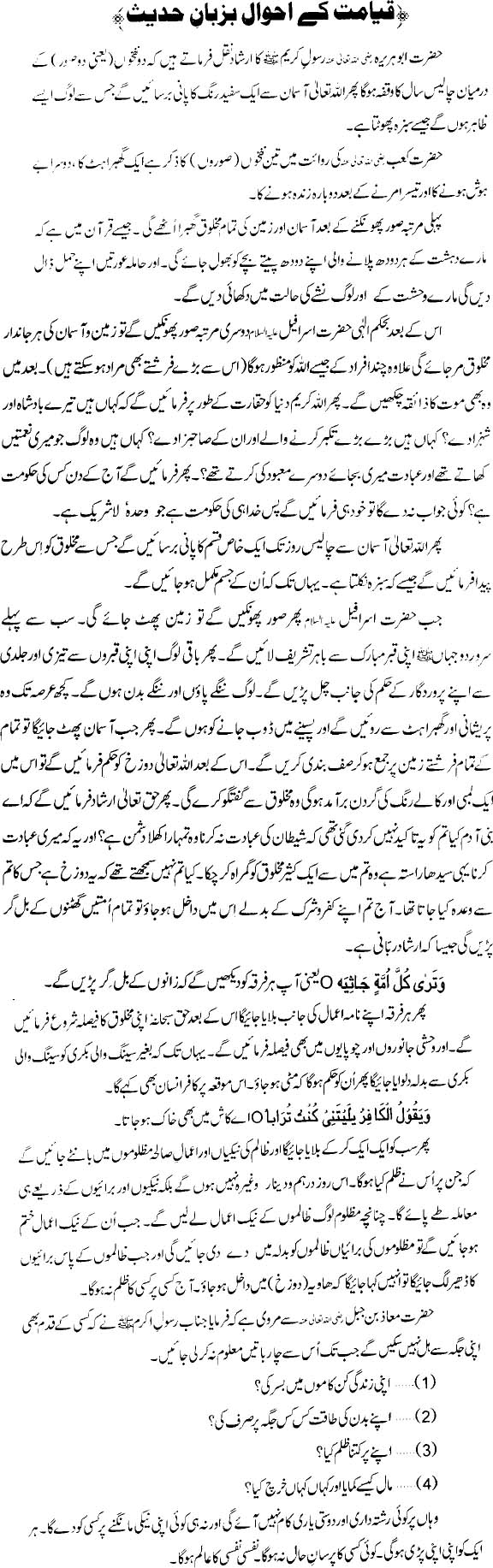
Qayamat Kay Ahwal Hadith Ki Roshni Mein
Islamic Tarbiyyah Of Children
In the tarbiyyah of children, you should remember that children often learn from example. The proper conduct and example of parents are crucial in the upbringing of children.
Parents who expect their children to be disciplined and to work hard must themselves be disciplined and work hard. Parents who expect their children to be truthful must not be in the habit of telling lies.
Also, it is important to remember that the treatment given to children in the early years of their life can have far-reaching effects on their mental and emotional state later on in life.
In the tarbiyyah of children, you should try to remember that:
Children should be happy and cheerful. And have a zest for life and living. They should be able to feel something of the carefree joy and excitement of growing up, especially before they are mukallaf. They should not be battered and terrorized.
They should be trained to grow up with the attitudes and habits, the adab or etiquette of Islam: “Be generous, kind and noble to your children and make their habits and manners good and beautiful (Akrimuu awlaadakum was ahsinuu adabahum),” said the noble Prophet (sallAllahu alayhi wasallam).
Among the virtues and habits they should develop are:
- The habit of being honest and truthful;
- The habit of being gentle and polite, for according to the noble Prophet (sallAllahu alayhi wasallam), “Gentleness adorns everything” without being timid, afraid, and cowed down;
- The habit of being helpful and considerate without being loutish in their behavior to others.
- The habit of being clean and neat and tidy, of looking after their hygiene and appearance.
Children need to develop the adab or the etiquette of Islam: when and how to greet; how to speak, sit, eat, and how to perform natural functions like personal toilet cleanly and efficiently as taught by the beloved Prophet (sallAllahu alayhi wasallam); to do everything in the manner, time and place that is appropriate for it, for example: to be reverent in salat, attentive in class, robust and full of zeal in play.
Children need to develop physical fitness and skills, to be strong and courageous. The Prophet (sallAllahu alayhi wasallam) recommended that children be taught horse riding, swimming, and archery.
One Muslim ruler once suggested that his child be taught swimming before reading or writing because someone else may read and write for him, but no one can swim for him!
From the noble Prophet (sallAllahu alayhi wasallam)’s recommendations, we see that children need to lead an active outdoor life and be proficient in some of the martial arts. They should have the stamina for demanding play and demanding work. This implies at least that they should be adequately fed.
Children need to develop a thirst for knowledge, beneficial knowledge through listening, observation, reading, and interacting with others. It is recommended that children be taught from an early age to recite and read the Quran and develop a love for it. At an early age, they have the capacity to memorize it, and it is common for many children and youths to memorize the whole or large parts of the Quran.
From the age of seven, the Prophet (sallAllahu alayhi wasallam) recommended that children should get in the habit of performing salat, and by the age of ten, they should be required to do so regularly.
Children need to develop skills and be creative and inventive. They should be trained from an early age to take on responsibilities, to organize and take initiative, rather than be timid and submissive. They should be able to spend their time usefully and profitably.
They need to develop skills that would fit them for contemporary living and for the particular society in which they live. This may involve anything from the skills of running an efficient and creative home to the skills that would enable them to earn a living and help them in the process of tarbiyyah when their turn comes. Give a person a fish, and you feed just one person; teach a person to fish, and he can feed hundreds, says an apt Chinese proverb.
Above all, correct tarbiyyah should ensure that children develop a love for Islam, a love for Allah and His Prophet (sallAllahu alayhi wasallam), and that they develop a feeling of pride in being Muslim and a willingness to strive for the good of others.
They need to realize the benefits of Islam, the foundations on which it is based, and their need for Islam. They need to value Islam and live by Islamic values.
Abdul Wahid Hamid
from Islam: The Natural Way
Al-Khansa RA Ki Apne Charo Betoon Kay Sath Jang Mein Shirkat
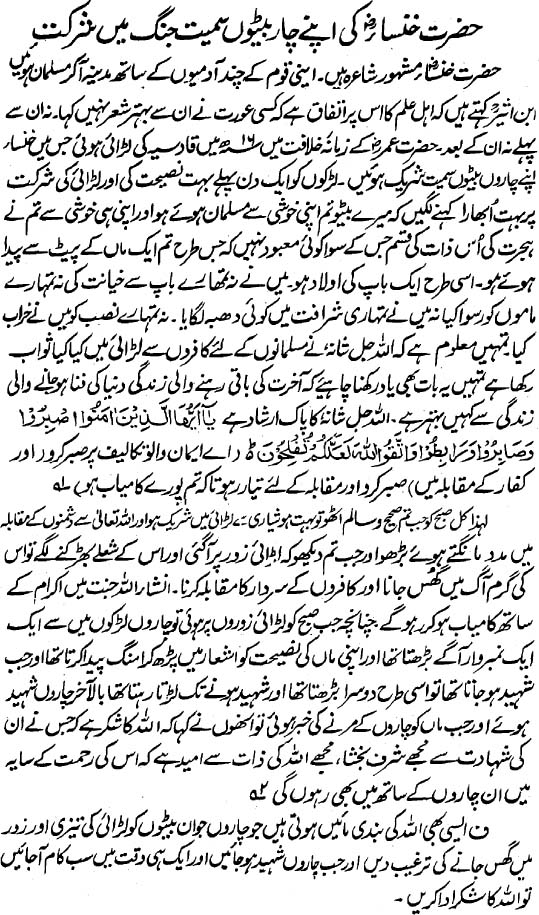
Al-Khansa RA Ki Apne Charo Betoon Kay Sath Jang Mein Shirkat
Excel In Seeking Allah’s Forgiveness
[Allah’s Quran – 3:133] “And vie one with another for forgiveness from your Lord, and for a paradise as wide as are the heavens and the earth, prepared for those who ward off (evil);”
Emulate the Prophet’s Example:
[MUSLIM, Book #004, Hadith #0984] “Aisha reported: The Messenger of Allah (may peace be upon him) often recited these words: Hallowed be Allah and with His praise, I seek the forgiveness of Allah and return to Him. She said: I asked: Messenger of Allah, I see that you often repeat the saying” subhan Allahi bihamdihi astag firullahi watubuilaih” whereupon he said: My Lord informed me that I would soon see a sign in my Ummah, so when I see it I often recite (these) words: Hallowed be Allah and with His Praise, I seek forgiveness of Allah and return to Him. Indeed, I saw it (when this verse) was revealed:” When Allah’s help and victory came, it marked the victory of Mecca, and you see people entering into Allah’s religion in troops, celebrate the praise of Thy Lord and ask His forgiveness. Surely He is ever returning to Mercy.”
Tahajjud Ki Namaz Kay Fazail

Tahajjud Kay Fazail
True Guidance: Only From The Quran
“This is a communication to be transmitted to mankind so that they may be warned by it and so that they will know that He is One God and so that people of intelligence will pay heed.” [14: 52]
“It is a Book We have sent down to you, full of blessing, so let people of intelligence ponder its Signs and take heed.” [38:29]
“Am I to desire someone other than Allah as a judge when it is He Who has sent down the Book to you clarifying everything?” Those We have given the Book know it has been sent down from your Lord with truth, so on no account be among the doubters.” [6: 114]
“In this way, we have sent it down as Clear Signs. Allah guides anyone He wills.” [22: 16]
“And We have indeed made the Qur’an easy to understand and remember: then is there any that will receive admonition?” [54:17]
As is seen in the above-quoted verses, Allah informs us that only the people of intelligence, who have the faith described in the Qur’an, can take heed. And remember that the Qur’an is made easy for us to reflect and take advice.
Husn-e-Khatima: Madina Tayyaba Mein Qayam Aur Wahan Moat Ka Pana

Husn-e-Khatima: Madina Tayyaba Mein Qayam Aur Wahan Moat Ka Pana
The Ummahs Humiliation A Manifestation Of Allah’s Punishment
“Then when there came the first of the two promises (of Divine Punishment), We sent against you servants unto Us who were most powerful in warfare. Then they penetrated the homes. Indeed, it was a decree executed.”
(Surah Bani Israaeel, aayat 5)
“When the final promise (of Divine Punishment) came, (it came) so that they could (the kuffaar) disfigure your faces and enter the Musjid (i.e. Musjidul Aqsa) as they had entered the first time, and so that they could utterly destroy whatever they overran.”(Surah Bani Israaeel, aayat 8)
In these Quranic verses, Allah Ta’ala refers to His punishment which He had inflicted on the Muslims of former times. The specific community referred to in these verses is Bani Israel. Two occasions of punishment are mentioned here. On both occasions, Allah Ta’ala used the kuffaar to overwhelm, punish, and humiliate the Muslims. The punishments had taken the form of kuffaar atrocities-pillage, plunder, killing, and humiliating the Muslims, as well as the desecration of Musjidul Aqsa
The ayat specifically mentions the destruction that the kuffaar wrought to the Masjid Aqsa. Allah Ta’ala allowed the kuffaar to invade the Masjid Aqsa —to defile and violate its sanctity. The then Muslims were just as helpless as present-day Muslims. They had to suffer the punishment and humiliation without being able to offer any response and unable to defend either themselves or their holy places.
Allah’s Servants
It is significant that in the ayah, the Quran refers to the kuffaar who had defiled and destroyed Musjidul Aqsa and who had ravaged the Muslims of the time, as `servants unto Us’. This style of expression conveys that the kuffaar were appointed by Allah Ta’ala to inflict the punishment, atrocities, and humiliation on the Muslims who are supposed to be the true and obedient slaves and servants of Allah Ta’ala.
This style of expression implies that the domination of the kuffaar over Muslims is in fact a manifestation of Allah’s punishment. Throughout the world’s history, this has always been the case. When the Muslim Ummah had transgressed all bounds of disobedience and had firmly resolved to adopt transgression, sin, and kuffaar lifestyle as their way of life, then Allah Ta’ala unleashed His punishment, which sometimes came in the form of natural disasters and sometimes in the form of kuffaar brutality and domination.
The Cause
In this age, too, Muslims have degenerated to the lowest level of fisq and fujoor (transgression and immorality). The Sunnah of Rasulullah (sallallahu alayhi wasallam) has been jettisoned right out of our lives, and the lifestyle and concepts of the kuffaar have become the complete culture and code of life of Muslims. It is for this reason that Allah Ta’ala has manifested His punishment on us in the form of kuffaar atrocities and domination over the Ummah. He has made us the slaves of the very kuffaar whom we have appointed as our intellectual masters, whose lifestyle Muslims are emulating in its entirety. Therefore, He has once again sent His kuffaar `ibaad’ (servants) to punish and disgrace us, as he had done with Bani Israel when they had reached the point of no return in their transgression.
Thus, the cause of our degradation, humiliation, and of the calamities which are befalling the Ummah, is not America or the Shaitan. Rather, these events via the agency of the kuffaar are Allah’s punishment. It is He Who has chosen America to punish and humiliate the Muslims. It is He Who has chosen the Yahood to inflict such terrible acts of brutality on Muslims.