
The Fruits of Hajj
THERE is no doubt that Hajj has a great sublime effect on Muslims. During Hajj, more than two million Muslims stand in one place and share one aim, call upon One Lord, and follow one Prophet. It connects those millions with all prophets from Prophet Ibrahim and his son Prophet Isma’il (peace be upon them all) until Prophet Muhammad (peace be upon him). Hajj also links people with the Hereafter with the full hope of their sins be forgiven and go back to their homes with clean slate.
Hajj creates a sense of connection with all of the prophets (peace be upon them) from our forefather Ibrahim who built the Ka’bah to our Prophet Muhammad (peace be upon him) who respected the sanctity of Makkah. When pilgrims visit the sacred places and perform the rituals, they remember the visits of those noble prophets to this sacred place.
The whiteness of (male) pilgrims’ clothes is a sign of inward purity, cleanness of heart, and the purity of the message. This means that pilgrims should put aside all adornment and should show humility, and their clothes are a reminder of death when the deceased is shrouded in similar clothes. So it is as if pilgrims were preparing to meet Allah.
Assuming ihram at the miqat is a physical expression of worship and enslavement to Allah and of submission to His commands and laws. No pilgrim can pass it without entering ihram because it is a command from Allah and a law that He has prescribed. This confirms the unity of the Ummah.
Hajj is the symbol of tawheed (Oneness of God) and takes on meaning from the first moment the pilgrim enters ihram. Jabir ibn Abd Allah described the Hajj of the Prophet (peace be upon him): Then he started to say the words of tawheed : “Labbayka Allahumma Labbayk …. (Here I am, O Allah, here I am. Here I am, You have no partner, here I am. Verily all praise and blessings are Yours, and all sovereignty, You have no partner). (Muslim)
When all the people come together at Arafat and elsewhere, with no differentiation between them, this is a reminder of the Hereafter. All of them are equal in this place and no one is better than anyone else.
Hajj is a symbol of unity, because Hajj makes all people alike in their deeds, rituals, direction of prayer, and the places they visit, and the men are also the same in their clothing. So none are better than others, be they kings or servants, rich or poor. All are the same.
There is unity of feelings, unity of rituals; unity in purpose, unity in action, unity in words. The Prophet (peace be upon him) is reported to have said , “O mankind, there is no superiority for an Arab over a non-Arab, or for a non-Arab over an Arab, or for a white over a black, or for a black over a white. All of you are descended from Adam and Adam has been created from dust of the ground.” (Ahmad)
During the Hajj, more than two million Muslims all stand in one place, the men wearing the same type of clothes.
All the pilgrims share one aim, call upon one Lord, and follow one Prophet. What unity can be greater than this?
Hajj trains Muslims to be content with simple clothing and accommodation.
Hajj illustrates the importance of Muslims coming together and establishing harmony.
While we usually see people traveling by themselves, during Hajj we see people coming in groups. It also helps people get to know the situation of the Muslims from around the world.
What Marriage With Khadijah Reveals
Both her previous husbands having died, Khadijah Bint Khuwailid was a widow. She was known for her noble character, and the people of the Quraish would call her, “The Pious and Chaste One.”
She was also very wealthy; she would engage men to do business on her behalf. After she heard about the truthfulness and trustworthiness of Muhammad (peace be upon him), she proposed that he do business for her in Ash-Sham, promising to give him more than she gave to any other man who did business for her. He agreed and left Makkah in the company of Maisarah, Khadijah’s servant.
Muhammad (peace be upon him) made a lot of profit for Khadijah and she felt that her wealth was blessed more than ever before. Throughout the trip, Maisarah witnessed the wonderful character, nobility, and truthfulness of the Prophet (peace be upon him).
Based upon these reasons, she had a heart to heart discussion with her close friend Nafeesah Bint Munabbah, telling her about the positive feelings she was having about the Prophet (peace be upon him). Nafeesah went to the Prophet (peace be upon him) and proposed to him on behalf of Khadijah.
The Prophet (peace be upon him) was pleased with the proposal, but he nonetheless first went to his uncles to seek their advice; they all agreed that he should marry her.
And why shouldn’t he marry her, for she was the noblest woman among the Quraish; after her last husband had died, almost every Makkan chieftain proposed to her, and she refused them all.
And so shortly thereafter the Messenger of Allah (peace be upon him) married her. She was the first woman that the Prophet (peace be upon him) married, and he didn’t marry any other woman until she died. She gave birth to two of the Prophet’s sons and four daughters. The two sons were Al-Qasim and Abdullah.
Around the age that he was able to mount a riding animal, Al-Qasim died. Abdullah died as a child prior to his father’s prophet hood.
The daughters were Zainab, Ruqayyah, Umm Kulthoom, and Fatimah. They all embraced Islam, married, and migrated to Madina. When the Prophet (peace be upon him) married Khadijah, he was 25 years old and she was 40.
Benefits;
1. Trustworthiness and truthfulness are the two most important qualities of a successful businessman. They were the very two qualities that prompted Khadijah to ask the Prophet to do business on her behalf.
2. Allah decreed for the Prophet (peace be upon him) to marry the ideal wife who was both a suitable companion and a trusted counselor and helper. Khadijah helped the Prophet (peace be upon him) during difficult times, and participated alongside him in spreading the message of Islam.
One who invites others to the teachings of Islam is especially in need of a pious and good wife. Outside of the home, his days are filled with struggle, and he faces constant opposition from the enemies of Islam. He therefore is in dire need, within the home, of a partner who will comfort him and provide him with the strength and encouragement he needs to fulfill his religious duties.
3. The Prophet (peace be upon him) tasted the bitterness of losing his sons, just as previously in life, he tasted the bitterness of losing his parents. It was from the wisdom of Allah that none of his sons lived past their childhood. With their death, no one could then be tempted loving them to an extreme level and claiming prophethood for them. Furthermore, the early deaths of the Prophet’s children should serve as a comfort for those who aren’t blessed with sons, and for those who are blessed with sons but lose them at a very early age.
The death of the Prophet’s children was a form of tribulation and as the Prophet (peace be upon him) made it clear, no one is tested more severely than the Prophets.
Men who become leaders of nations turn to tyranny when their hearts are hard through a selfish and comfortable lifestyle. As for a leader who has experienced hardships and tests in life, and endures them with patience and forbearance, he is likely to then show compassion and sympathy to others who are afflicted with hardships.
4. In choosing Khadijah as a wife, the Prophet (peace be upon him) showed that he was primarily concerned with her nobility and character; after all, she was known in pre-Islamic days as “The Pure and Chaste One.”
Up until the age of 25, the Prophet (peace be upon him) lived a chaste life within a society that was replete with evil and ignorance, a society wherein one was free to have romantic and sexual counters with as many women as one desired.
Then when he did decide to marry, he married a woman who was almost twice his age. During the next 15 years of his life, there was no Shariah or set of laws to forbid him from engaging in extra-marital affairs, as did other members of the Quraish, yet he remained faithful to Khadijah, without even looking at any other woman, though there were many other women that were available.
The Prophet (peace be upon him) remained married to Khadijah alone until she died at the age of 65, at a time when the Prophet (peace be upon him) was himself approaching old age.
The story behind each marriage of his highlights the wisdom and wonderful character of the Prophet (peace be upon him).
Ref: Ali Muhammad As-Sallaabee, The Noble Life of the Prophet, Darussalam
Spend In Allah’s Way, Allah Will Spend On You
[Quran – 2:262 ] “Those who spend their wealth in the Way of Allah, and then do not follow what they have spent by demands for gratitude or insulting words will have their reward with their Lord. They will feel no fear and will know no sorrow.”
The Prophet (Peace Be Upon Him) has said:
[Bukhari, Book #64, Hadith #264 ] “Narrated Abu Huraira: ALLAH’s Apostle said, “ALLAH said, ‘O son of Adam! spend, and I shall spend on you.”
[Bukhari, Book #60, Hadith #206] “Narrated Abu Huraira: ALLAH’s Apostle said, “ALLAH said, ‘spend (O man), and I shall spend on you.” He also said, “ALLAH’s Hand is full, and (its fullness) is not affected by the continuous spending night and day.” He also said, “Do you see what He has spent since He created the Heavens and the Earth? Nevertheless, what is in His Hand is not decreased, and His Throne was over the water; and in His Hand there is the balance (of justice) whereby He raises and lowers (people).”
[Bukhari, Book #24, Hadith #522] “Narrated Abu Huraira : The Prophet said, “Every day two angels come down from Heaven and one of them says, ‘O ALLAH! Compensate every person who spends in Your Cause,’ and the other (angel) says, ‘O ALLAH! Destroy every miser.’”
[Bukhari, Book #3, Hadith #73] “Narrated ‘Abdullah bin Mas’ud: The Prophet said, “Do not wish to be like anyone except in two cases. (The first is) A person, whom Allah has given wealth and he spends it righteously; (the second is) the one whom Allah has given wisdom (the Holy Qur’an) and he acts according to it and teaches it to others.” (Fateh-al-Bari page 177 Vol. 1)
[Muslim, Book #005, Hadith #2178] “Abu Huraira reported ALLAH’s Messenger (may peace be upon him) as saying that ALLAH, the Most Blessed and High, said: O son of Adam, spend. I will spend on you. The right hand of ALLAH is full and overflowing and in nothing would diminish it, by overspending day and night.”
[Muslim, Book #005, Hadith #2179] “Abu Huraira reported ALLAH’s Messenger (may peace be upon him) as saying that ALLAH said to him:”spend, I will bestow upon you.” And the Messenger of ALLAH (may peace be upon him) said: The right hand of ALLAH is full and spending (the riches) liberally during day and night will not diminish (the resources of ALLAH). Don’t you see what (an enormous amount of resources) He has spent since He created the heaven and the earth, and what is in His right hand has not decreased? His Throne is upon the water. And in His other hand is death, and He elevates and degrades (whom He likes).”
[Muslim, Book #005, Hadith #2205] “Abu Huraira reported ALLAH’s Messenger (may peace be upon him) as saying: There is never a day wherein servants (of God) get up at morn, but are not visited by two angels. One of them says: O ALLAH, give him more who spends (for the sake of ALLAH), and the other says: O ALLAH, bring destruction to one who withholds.”
[Muslim, Book #005, Hadith #2256] “Abu Umama reported ALLAH’s Messenger (may peace be upon him) as saying: O son of Adam, it is better for you if you spend your surplus (wealth), but if you withhold it, it is evil for you. There is (however) no reproach for you (if you withhold means necessary) for a living. And begin (charity) with your dependents; and the upper hand is better than the lower hand.”
Burai Ka Hukam Naiki Se Rokna
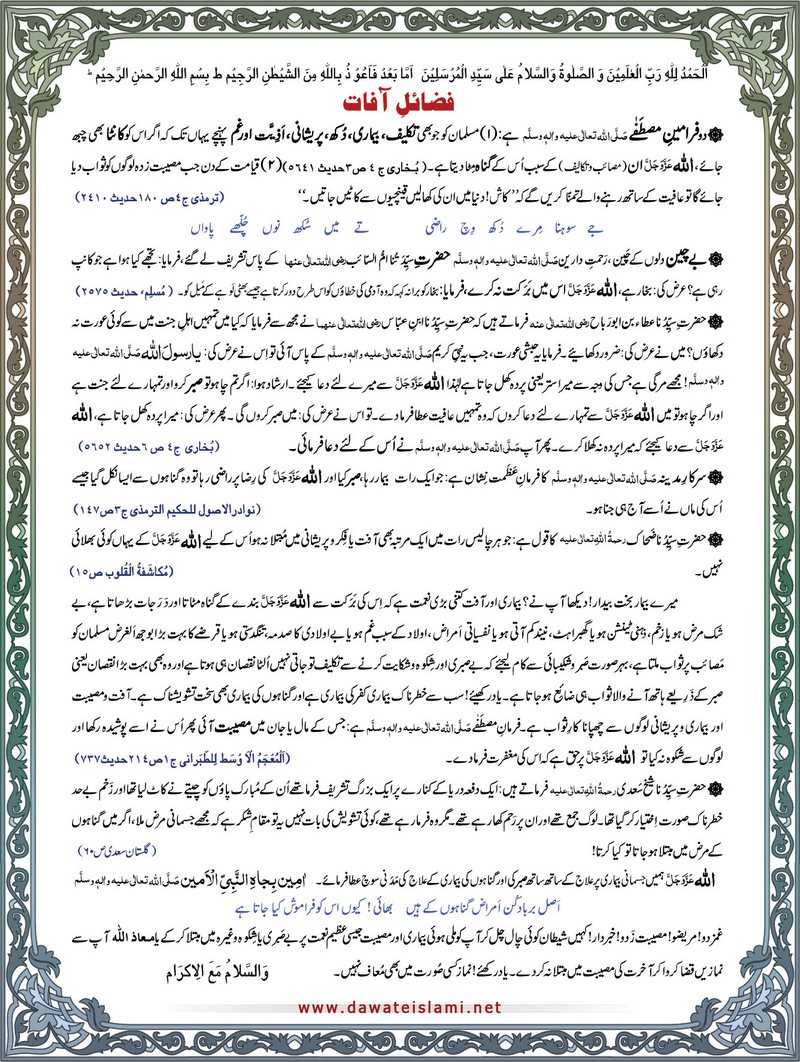
Fazail-e-Aafat
Click on image to enlarge and read the content “Fazail-e- Aafat”
Perfect System Of Life
One day the Prophet of Islam seated himself in a mosque in Medina, along with some companions. Shortly thereafter, a Bedouin entered the mosque and began urinating. The Prophet’s Companions rose with the intention of beating the Bedouin. But the Prophet forbade them to do so, asking them to let him be. When the man had finished urinating, the Prophet asked the Companions to fetch a bucket of water and wash the place clean.
Afterwards he explained to his Companions:
“You are sent to make things easy and not to make things difficult” (Fathul Bari, 1/386).
This illustrates for us an unwavering principle of Islam, that is, in social life when any unpleasant incident takes place, the believers should concentrate on finding a solution to the problem and not just think in terms of what punishment to mete out to the problem-maker. On all such occasions the urge to reform should be engendered within the believers instead of a desire to exact revenge. Such methods should be adopted as alleviate rather than aggravate the problem. Just as when some building is set on fire, the most natural impulse is to immediately extinguish it, rather than fan the flames to make it flare up even more.
In most controversial matters there can be both easy and difficult ways of resolving the problem. Treading the path of facility usually eases matters, whereas treading the path of difficulty can cause matters to flare up with even greater intensity. In all situations, Islam gives preference to the former, rather than to the latter approach.
This is an eternal principle of Islam, relating to both personal and social life. It ought to be applied in all matters inside as well as outside the home. It is a perfect principle on which to base a perfect system of life.
Sincerity In Intention
Sincerity has been interpreted as being upright, sincere, truthful, pure, distant from show and ostentation in one’s intention and conduct, and being closed to the things that cloud or foul one’s heart. Purity of intention, straightforwardness in thoughts, not pursuing any worldly purposes in relations with Allah, and loyalty in servitude to Him are also included in the meaning of sincerity.
The Muslim believes in the great importance of intention and its importance for the remainder of his deeds, both of this world and the Hereafter. This is because all deeds are based on intention. Depending on the intention, the deed is either valid or void.
This belief in the necessity of having an intention for every deed, and the obligation to make the intention proper, is based on Allah’s Words (which mean): “And they were not commanded except to worship Allah (being) sincere to Him in religion, inclining to truth, and to establish prayer and to give zakah (poor due). And that is the correct religion.” [Quran 98:5]
Allah also said (what means): “Say (O Muhammad): ‘Indeed, I have been commanded to worship Allah (being) sincere to Him in religion.'” [Quran 39:11]
This belief is also based on the words of Allah’s Messenger sallallaahu `alayhi wa sallam ( may Allah exalt his mention ) : “Verily, all actions are but driven by intention and for everyone is what he intended.” [Al-Bukhaari and Muslim]
Allah’s Messenger sallallaahu `alayhi wa sallam ( may Allah exalt his mention ) also said: “Certainly, Allah does not look at your shapes (appearance) or wealth. But He only looks at your hearts and deeds.” [Al-Bukhaari and Muslim]
The one who has a sincere intention is rewarded for a good deed and the one who has an evil intention will bear its burden, just like the one who did a sinful deed. All of that is due to intention alone.
At the Battle of Tabook, Allaah’s Messenger sallallaahu `alayhi wa sallam ( may Allah exalt his mention ) said: “There are people concerning whom you do not travel any distance, nor do you spend anything, nor do you pass any valley but they are with you in that matter.” The people said, “How is that?” He sallallaahu `alayhi wa sallam ( may Allah exalt his mention ) said, “They have been restrained due to some excuse, but they are with us because of the good intention.” [Al-Bukhaari and Abu Daawood]
Sincere intention is what makes the non-combatant equal in reward to the combatant. It is what makes the non-Mujahid receive a reward like that of a Mujahid (one who fights for the sake of Allah).
Allah’s Messenger sallallaahu `alayhi wa sallam ( may Allah exalt his mention ) has also said: “If two Muslims meet each other with their swords, then both the killer and the killed will be in the Hell-fire.” Someone said, “O Allah’s Messenger, that is the case for the killer but why should that be the case for the killed?” He answered, “Because he wanted to kill his companion.” [Al-Bukhaari and Muslim]
The Animals And Birds Of Paradise
The kinds of birds and animals that exist in Paradise are known only to Allah. He ta’ala told us that among the delights enjoyed by the people of Paradise will be:
“..and the flesh of fowls any that they may desire” [56:21]
at-Tirmidhi reports from Anas that the Messenger of Allah (saw) was asked, “What is al-Kawthar?” He said, “That is a river that Allah has given me… and in it are birds with necks like the necks of camels”. ‘Umar said, These birds will be in bliss”. The Messenger of Allah (saw) said, “Those who eat them will be more blissful””. [Mishkaat al-Masaabeeh, 2/91]
al-Haakim and Abu Na’eem reported from Ibn Mas’oud that “a man brought a haltered she-camel and said, “O Messenger of Allah, this she-camel is for the sake of Allah”. He said, “You will have seven hundred haltered she-camels in Paradise” [Silsilat as-Saheehah, 2/228 no. 634; a similar report is narrated by Muslim, Mishkaat al-Masaabeeh, 2/350, 3799]
Namaz Ki Ahmiyat
