
We All Sin, But Who Among Us Repents?
Committing sins and falling into error is an unavoidable human trait, such that Allah’s Messenger (peace be upon him) said, “By the One in whose hand is my soul, if you were not to commit sin, Allah would have swept you out of existence and would have brought about another people who commit sin, and then seek forgiveness, and He would then forgive them.” (Ahmad, vol. 20, p. 344; Al-Tirmidhi, vol. 4, p. 659) He also said, “All the children of Adam sin repeatedly, and the best of those who sin repeatedly are those who repent frequently.” (Sahih Muslim, vol. 4, no. 2749)
Repenting to Allah (Tawbah) is one of the greatest characteristics of people of faith; Allah says, ‘‘…and turn to Allah in repentance, all of you, O believers, that you might succeed.” (Qur’an, 24:31) He also says, ‘‘O you who have believed, repent to Allah with sincere repentance. Perhaps your Lord will remove from you your misdeeds and admit you into gardens beneath which rivers flow (on) the Day when Allah will not disgrace the Prophet and those who believed with him. Their light will proceed before them and on their right; they will say, “Our Lord, perfect for us our light and forgive us. Indeed, You are Able to do all things.” (Qur’an, 66:8)
Ibn Al-Qayyim defines repentance by stating that “the reality of repentance is to have regret for that which one has committed in the past, to disassociate oneself from it in the here and now and to have the resolve to not return to it in the future.” (Madarij Al-Salikin, vol. 1, p. 199)
When a servant happens to slip and disobey Allah, if he is righteous, two inseparable qualities are manifested. The first is swift remorse and return to Allah – the heart that is alive with Iman (faith) neither continues with disobedience nor continues transgressing; it is quick in resorting back to his Lord in repentance.
Allah says, “And those who, when they commit an immorality or wrong themselves (by transgression), remember Allah and so seek forgiveness for their sins – and who can forgive sins except Allah? – and (who) do not persist in what they have done while they know.” (Qur’an, 3:135) He also says, “And whoever does evil or wrongs himself but then seeks forgiveness of Allah will find Allah Oft-Forgiving, Most Merciful.” (Qur’an, 4:110)
He also says, “And Paradise will be brought near to the righteous, not far. (It will be said), ‘This is what you were promised – for every ‘Awwab’ and keeper (of His covenant). Who feared the Most Merciful unseen and came with a heart returning (in repentance).’” (Qur’an, 50:31-33) Ibn Kathir said, “Awwab means one who continually returns, repents and renounces.” (Tafsir Ibn Kathir, vol. 4, p. 229)
The second quality is not to regard disobedience as a trivial matter. The righteous Believer does not regard sinning as being insignificant regardless how negligible the sin is classified as being. This is remaining true to the saying of Allah’s Messenger, “Beware of small sins, for the example of slight sins is that of a group of travelers who broke their journey in a valley. Then one of them brought in a stick and another came up with another piece until they were able to gather enough to bake their bread. Remember! If a person is held to account for his small sins, surely they will destroy him.” (Ahmad, vol. 37, p. 467)
This is why our righteous forefathers, may Allah be pleased with them, would take the utmost care not to fall into sin (whether major or minor); Anas Ibn Malik said, “You people do deeds which seem in your eyes as minute as a strand of hair while we used to consider those very deeds during the lifetime of the Prophet as destructive sins.” (Al-Bukhari, vol. 11, no. 6492)
Abdullah Bin Mas‘ud said, “A believer sees his sins as if he were sitting under a mountain, which he fears may fall on him; whereas the wicked person considers his sins as flies passing over his nose and he just drives them away like this.” (Al-Bukhari, vol. 11, no. 6308) Abu Shihab (the sub-narrator) moved his hand over his nose in illustration.
Muslims Should Strive For Unity
MUSLIMS should strive their best to achieve unity in all aspects. It is against the spirit of Islam to see Muslims divided. It is high time for Muslims to be united and forget about their differences. Unity is a unique feature of Islam.
Allah says: “O you who believe! Be conscious of Allah as you aught to be conscious of Him, and die not except in a state of Islam. And hold fast, all together, by the Rope which Allah (stretches out for you), and be not divided among yourselves…” (Qur’an 3:102-105).
At another place the Qur’an says: “As for those who divide their religion and break up into sects, you have no part in them in the least: their affair is with Allah: He will in the end tell them the truth of all that they did.” (6:159)
Disunity among Muslims is our greatest problem today. We are at present a very fragmented and divided people. We have disunity at every level: within our communities, at the local level, national and international level. We talk about unity and discuss the problem of disunity in our meetings and conferences, but we fail to be united. We fail to work together, although everything in our religion and in our condition demands that we come together and work together.
Unity is our religious obligation. In Islam unity and faith are interrelated. People of faith are united. The more faith they will have, the more united they will be. Allah says in the Qur’an, “Indeed the Believers are brothers to each other … ” (49:10)
What Do We Know About Angels From The Authentic Sources Of Islam?
- They are a part of the world of the Unseen, belief in them is an integral part of faith and denying their existence or cursing them is disbelief (Kufr).
- They are created from light, as the Messenger of Allah (peace be upon him) said: “The angels are created from light just as the Jinn are created from smokeless fire and mankind is created from what you have been told about.” (Sahih Muslim)
- They were created before mankind, because the Qur’an says: “Behold, your Lord said to the angels: ‘I will create a khalifah on earth…’” (Qur’an, 2:30)
- The greatest of all the angels is Jibreel (Gabriel, peace be upon him), the Trustworthy Spirit, who brought the Revelation from Allah to the final Messenger, (Muhammad, peace be upon him) and to the Messengers before him.
- The angels have wings. “Praise be to Allah, Who created (out of nothing) the heavens and the earth, Who made the angels messengers with wings – two, or three, or four (pairs).” (Qur’an, 35:1)
- They have an unparalleled beauty and have different sizes, duties and status.
- They do not eat or drink. This is indicated by the conversation between Ibrahim (peace be upon him) and the angels who visited him in human form, who refused to eat the fatted calf he placed before them. (Qur’an, 51:26-28)
- They do not get bored or tired of remembering and worshiping Allah: “They celebrate His praises night and day, nor do they ever slacken.” (Qur’an, 21:20)
- Their number is known only to Allah, and they are extremely large in numbers according to various authentic narrations.
- Jibreel (Gabriel) and Mikael (Michael) are mentioned by name in the Qur’an (2:98), as is Malik, the Keeper of HelI (Qur’an, 43:77); Israfeel is mentioned in an authentic narration reported by Muslim; Munkar and Nakeer are mentioned by name as the questioning angels in Sahih Al-Jami.’
- Angels can travel at unimaginable speeds and have the power to take on human forms, as in the story of the angels who visited Ibrahim and Lut (peace be upon them) (Qur’an, 11:69-83); the visit of Jibreel to Mary (peace be upon her) “he appeared before her in the form of a man in all respects…” (Qur’an, 19:17-21); and the visits of Jibreel to the Messenger of Allah (peace be upon him) where he was once seen by the Companions as “a man with very white clothing and very black hair… No mark of travel was visible on him, and none of us recognized him.” (Sahih Muslim)
Namaz

Sending Salutations On The Prophet
Sending salutations on the Prophet (peace be upon him) is a form of worship. The Qur’an says : “Allah sends His Salat (Graces, Honors, Blessings, Mercy) on the Prophet (peace be upon him), and also His angels (ask Allah to bless and forgive him). O you who believe! Send your Salat on (ask Allah to bless) him (Muhammad) and (you should) greet (salute) him with the Islamic way of greeting (salutation i.e. As-Salamu Alaikum). (33:56)
In this verse, Muslims have been commanded two things; sallu ‘alaihi, meaning to be inclined to somebody, to attend to him with love and to bend over him, and sallimu taslima, meaning to attend to him with love and to praise somebody and to pray for somebody. When the word yusalli is used with regard to Allah, it cannot mean that Allah should pray to someone else but that He conveys blessings on someone. But when this word is used for His servants whether angels or men, it contains a sense of love, praise and a prayer for mercy. Therefore, the meaning of the command to the believers sallu ‘allaihi (upon the Prophet) is to ask Allah to confer blessings upon him.
The Prophet (pbuh) said: “When a Muslim asks one blessing for me, Allah sends 10 blessings upon him, and forgives his sins and raises his rank 10 degrees. In another Hadith the Prophet (pbuh) said: “When a person sends one salutation on me the angels send 70 mercies upon him.”
Ubayy Bin Ka’ab narrated: “O Prophet of Allah I spend one-third of my supplication time in sending salutations upon you.” The Prophet (pbuh) replied, “If you increase it would be better for you.” So Ubayy Bin Ka’ab said, “If I make two-third of my supplication time in sending salutation upon you?” The Prophet (pbuh) replied, “If you increase it will be better for you.” So Ubayy Bin Ka’ab said, “Then I will spend the entire time of my supplication in sending salutations upon you.” The Prophet (peace be upon him) replied, “Then Allah will be sufficient for you for this world as well as the next.”
Sending salutations on the Prophet removes many problems for us in this world as well as the next. Ka’ab Bin ‘Ujrah reported: “The Prophet (pbuh) came to us and we asked him, “O Messenger of Allah we already know how to say salaam to you but how should we supplicate for you? ” He said: “Exalt the mention of Muhammad and the family of Muhammad as You exalted the family of Ibrahim. You are the Praised One and Glorious. O Allah, bless Muhammad and the family of Muhammad as You blessed the family of Ibrahim. You are the Praised One and the Glorious. (Bukhari and Muslim)
Ibn Masud reported the Messenger of Allah (pbuh) as saying: “The people who will be nearest to me on the Day of Resurrection will be those who supplicate Allah most often for me.” (Al-Tirmidhi-Hasan)
And Anas reported, “The best of your days is Friday, “so supplicate Allah more often for me in it, for your supplications will be showed to me. “He was asked, “O Messenger of Allah, How will our blessings be displayed to you when your decayed body will have mixed with the earth?” The Prophet (pbuh) replied: “Allah has prohibited the earth from consuming the bodies of the Prophets. “The Messenger of Allah (pbuh) said: “The miser is the one in whose presence I am mentioned but he does not supplicate for me.”
Turning Away From Pointless Talk
Wasting valuable time in pointless talk, gossip and chatter is something that few are able to avoid. Imam Al-Bayhaqi mentions valuable narrations in his book The Seventy-Seven Branches of Faith.
Allah’ the Most High, has said: “Successful are the believers, who are humble in their prayers, and who turn away from pointless talk,” (Qur’an, 23:1-3) and: “Those who do not bear witness to what is false, but when they pass by pointless talk, pass by with dignity.” (Qur’an, 25:72) and: “When they hear pointless talk, they turn away from it.” (Qur’an, 28:55)
Pointless talk (laghw) is speech which is futile and irrelevant, and bears no relation to any true purpose. It brings no benefit to the one who utters it, and may well bring him misfortune instead.
Ali (may Allah be pleased with him) related that the Messenger of Allah (peace be upon him) said, “It is part of a man’s sound practice of Islam that he leaves alone that which is of no concern to him.” (Al-Tirmidhi, Ibn Majah)
Dhu’l-Nun said, “Whoever loves Allah, lives truly, and whoever is inclined to anything else damages his mind. A foolish man comes and goes, paying attention to what is nothing, while the intelligent man thinks over his own thoughts scrupulously.”
Who Will Enter Paradise
First and foremost, I want to remind you that Allah created Paradise and Hellfire, and divided people into believers and disbelievers.
And, He will give paradise to the one who obeys Him, and He will give the Hellfire to the one who disobeys Him.
Allah Says:
“For those who answered their Lord’s call (believed in the oneness of Allah and followed his Messenger Muhammad (P.B.U.H), i.e., Islamic Monotheism) is the best reward (i.e., paradise). But those who answered not His call (disbelieved in the oneness of Allah and followed not His Messenger Muhammad (P.B.U.H.) if they had all that is in the earth together its like, they would offer it in order to save themselves (from the torment, but it will be in vain). For them, there will be the terrible reckoning. Their dwelling place will be Hellfire and worst indeed is that place for rest.”
Narrated Anas bin Malik [May Allah be pleased with him]:
Allah’s prophet (P.B.U.H.) used to say, “A disbeliever will be asked: suppose you had as much gold as to fill the earth, would you offer it to ransom yourself (from the Hell-fire)? He will reply, “Yes”. Then it will be said to him, “You were asked for something easier than that (to join none in worship) with Allah (i.e., to accept Islam, but you refused).”
Allah says:
“Verily, the dwellers of paradise, that day, will be busy with joyful things, they and their wives will be in pleasant shade, reclining on thrones. They will have therein fruits (of all kinds) and all that they ask for. (It will be said to them) salaam (peace be on you) – a word from the Lord (Allah), Most Merciful.”
Allah’s Messenger Muhammad (P.B.U.H.) said;
“When anyone of you dies, his destination is displayed before him both in the forenoon and in the afternoon, so if he is from the people of paradise, he is shown his place in paradise and if he is from the people of Hell, he is shown his place in Hell.”
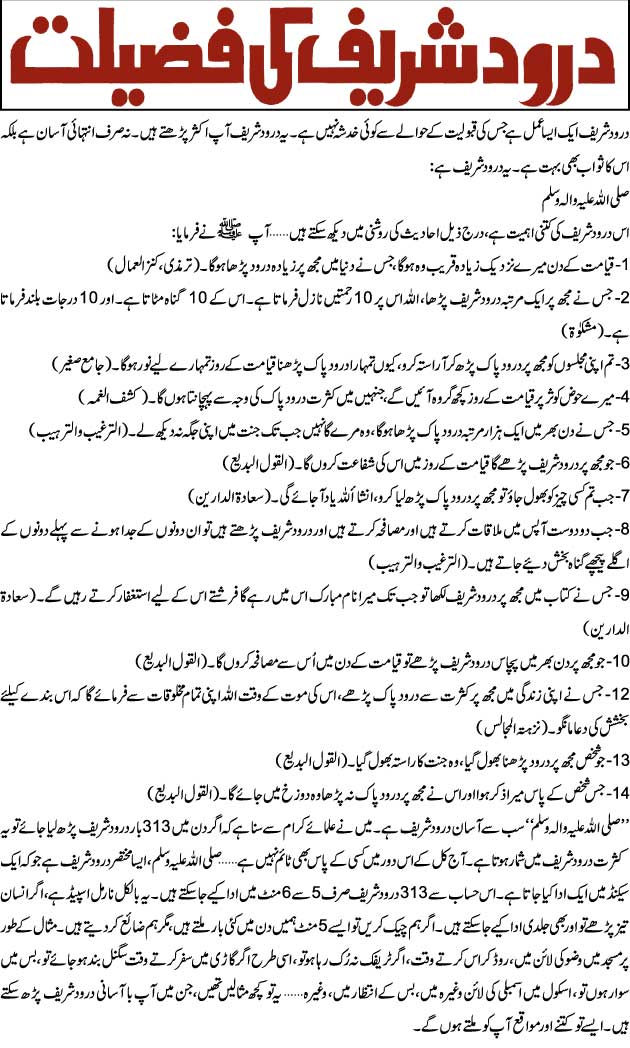
Durood Shareef Ki Fazeelat
Prophet Muhammad: The Ideal Husband
The family in general and the wife in particular is a precious trust and great responsibility that a Muslim must shoulder and never neglect. In this matter, just like in all others, the Prophet, sallallaahu `alayhi wa sallam ( may Allah exalt his mention ), is an example for all husbands in the way he treated and nurtured his wives.
The Prophet, sallallaahu `alayhi wa sallam ( may Allah exalt his mention ), encouraged people to nurture their families; he, sallallaahu `alayhi wa sallam ( may Allah exalt his mention ), said: “Allah will ask every person about those under his guardianship. (He will ask) whether he protected and preserved them, or squandered them; (this is) the extent to which He will ask man about his family members.”
What did the Prophet, sallallaahu `alayhi wa sallam ( may Allah exalt his mention ), do with regard to nurturing his wives? How did he, sallallaahu `alayhi wa sallam ( may Allah exalt his mention ),, educate them, enjoin them to do good and forbid them from doing evil? What was his manner and method in talking to them and being kind to them? These questions are answered below.
· The Prophet, sallallaahu `alayhi wa sallam ( may Allah exalt his mention ), would teach his wives matters pertaining to faith:The Prophet, sallallaahu `alayhi wa sallam ( may Allah exalt his mention ), would teach his wives matters related to faith and creed and expound to them the oneness of Allah The Almighty and His greatness. He, sallallaahu `alayhi wa sallam ( may Allah exalt his mention ), would explain the Names and Attributes of Allah to them, as well as matters related to the Hereafter. Once he, sallallaahu `alayhi wa sallam ( may Allah exalt his mention ), was talking to ‘Aa’ishah, may Allah be pleased with her about accountability in the Hereafter and said: “He who is questioned will be punished.” `Aa’ishah, may Allah be pleased with her then asked, “Does Allah not say (what means): {Then as for he who is given his record in his right hand. He will be judged with an easy account}[Quran 84: 7-8]He sallallaahu `alayhi wa sallam ( may Allah exalt his mention ) clarified and this, saying:“This does not mean holding people to account. Rather, it refers to merely presenting to them their records, but the one who will be questioned will certainly be punished.”
· The Prophet, sallallaahu `alayhi wa sallam ( may Allaah exalt his mention ), would teach his wives supplications and the mention of Allah The Almighty:The Prophet, sallallaahu `alayhi wa sallam ( may Allah exalt his mention ), also taught his wives designated mentions of Allah The Almighty, such as how to seek refuge in Allah The Almighty from evil, etc. Once, he, sallallaahu `alayhi wa sallam ( may Allah exalt his mention ), saw the moon and said to ‘Aa’ishah may Allah be pleased with her: “O ‘Aa’ishah! Seek refuge in Allah from the evil of this, as it is (what is referred to by) ‘The evil of darkness when it settles.’ (referring to Quran: 113: 3]).”He, sallallaahu `alayhi wa sallam ( may Allah exalt his mention ), was pointing to the moon, as it is an indicator of the approach of evening, during which many evils can take place.
· The Prophet, sallallaahu `alayhi wa sallam ( may Allah exalt his mention ), would teach his wives to fear Allah The Almighty:The Prophet, sallallaahu `alayhi wa sallam ( may Allah exalt his mention ), would run back and forth, in and out of his house, whenever he felt the wind and saw the clouds forming, and signs of disturbance would appear on his face. Once ‘Aa’ishah may Allah be pleased with her said to him when he did so, “People rejoice upon seeing the wind (and clouds) while I see you do what you do (i.e., become disturbed).” He, sallallaahu `alayhi wa sallam ( may Allah exalt his mention ),responded: “O ‘Aa’ishah! What assurance do I have that it will not be one of punishment? Allah has punished earlier nations with the wind; when these people felt the wind (and saw) the clouds approaching, they said, ‘This is a cloud bringing us rain!’”Thus, a Muslim must always fear Allah The Almighty and His punishment.
· The Prophet, sallallaahu `alayhi wa sallam ( may Allah exalt his mention ), would make his wives accustomed to worship:The Prophet, sallallaahu `alayhi wa sallam ( may Allah exalt his mention ), would train his wives to wake up at night to perform the voluntary night prayers, by waking them up himself. Moreover, his teaching was not limited to prayer, as he, sallallaahu `alayhi wa sallam ( may Allah exalt his mention ), instructed ‘Aa’ishah may Allah be pleased with her to spend in charity, saying: “Do not hoard, otherwise, Allah will withhold from you.”[Al-Bukhaari and Muslim] He, sallallaahu `alayhi wa sallam ( may Allah exalt his mention ), thereby taught her not to restrict her spending in charity and to be extremely generous. This shows how keen he, sallallaahu `alayhi wa sallam ( may Allaah exalt his mention ), was to instruct his wives in recommended matters and not just regarding mandatory matters or prohibitions.