
Two Women Who Stood Up To Pharaoh
“And Allah has set forth an example for those who believe: the wife of Fir’awn, when she said: ‘My Lord! Build for me a home with You in Paradise, and save me from Fir’awn and his work, and save me from the wrong-doers.’” (Qur’an, 66:11)
Qatadah said while explaining the verse: “Fir’awn (Pharaoh) was the most tyrannical and hardened disbeliever on Earth, and by Allah, his disbelief did not affect his wife when she decided to obey her Lord.”
Abu ‘Uthman An-Nahdi reported that Sulayman said: “Fir’awn’s wife was tortured in the heat of the sun. When her torturers would take a break and walk away, the angels would shade her with their wings, and she would see her home in Paradise.”
Al-Qasim Bin Abi Bazzah said: “Fir’awn’s wife asked who won, and it was said to her: ‘Musa and Harun won.’ So, she would say: ‘I believe in the Lord of Musa and Harun.’ Fir’awn said to those around him: ‘Look for the largest rock you can find. If she sticks to what she said, throw it on her. If she retracts what she said, she will remain my wife.’ When they came to her, she looked towards the sky and saw her home in Paradise. So, she stuck to what she said and her soul was taken, and the rock was thrown on her lifeless body after her soul had been taken.’ “
The scholars say regarding her statement: “My Lord! Build for me a home with You in Paradise” that she chose her neighbor (Allah) before mentioning where she wanted to live (a home in Paradise).
Abu Al-Aliyah said that Fir’awn’s wife turned to believer because of the wife of Fir’awn’s treasurer. What happened was that this woman was sitting and combing the hair of Fir’awn’s daughter one day, and the comb fell from her hand. So, she said: “May whoever disbelieves in Allah be destroyed!” Fir’awn’s daughter said to her: “You have a lord besides my father?” She replied: “The Lord of me, your father, and everything is Allah.” So, Fir’awn’s daughter hit her and went to tell her father.
Fir’awn sent for her, saying: “You worship a lord besides me?” She said: “Yes. Your Lord, mine, and of everything is Allah, and I worship Him.” So, Fir’awn tortured her by putting her on a stake and stretching out her arms and legs and setting loose snakes on her body. One day, when she was in such a state, he came to her and said: “Will you give up?” She replied: “Your Lord, mine and of everything is Allah.” He said to her: “I will kill your son if you do not do not retract what you said.” She said: “Do whatever you want,” and he killed her son, and she could hear his soul calm her down by saying to her: “Be happy, my mother! You have such and such reward with Allah!”
She remained patient until Fir’awn came to her another day, and she said the same to him as she had before. So, he killed another of her sons, and she could hear his soul calming her down as well.
Fir’awn’s wife heard all this, and this caused her to become a believer. Allah took away the soul of the wife of Fir’awn’s treasurer, and Fir’awn’s wife suddenly realized the reward, status, and honor that this woman had in Paradise.
So, she increased in her faith and certitude until Allah caused Fir’awn to discover her faith, and he said to his followers: “What do you know about Asyah Bint Muzahim?” They replied by praising her, and he said to them: “She worships someone besides me!” They said: “Kill her,” and he placed her on a device that stretched her arms and legs away from her body. So, Asyah called upon her Lord, saying: “My Lord! Build for me a home with You in Paradise!” Fir’awn happened to walk by when she said this, and she smiled because she saw her home in Paradise, and Fir’awn said to those watching: “Aren’t you amazed at her insanity? She smiles while we are torturing her?!”
So, Allah took her soul away to Paradise, and may Allah be pleased with her.
– Tafsir Ibn Kathir (4/504-505)
Angels
Angel Gabriel brought Allah’s words to the Prophet Muhammad (pbuh) and therefore we call Gabriel the Messenger Angel. There are many other angels and we can read about them in the Quran.
Each of us has two angels who accompany him. These angels take note of everything we do. They write down our good deeds and our bad deeds. We call these angels the Writing Angels. There are other angels, too. For example, there is an angel who helps people when they die. This angel brings death, so we call him the Angel of Death.
We cannot see the angels because they are made of things which our eyes cannot see. But all the same, we know that they are there, because Allah has told us so. Sometimes, we can even feel the presence of these angels.
Angels are created by Allah, just as man and everything else has been created by Him. Angels obey Allah and are His servants. They perform many tasks and keep the world in being by obeying Allah’s commands.
We know that when the sun rises and sets, when the clouds move in the sky, when the raindrops fall, when the plants grow and many other things happen in nature, it is Allah Who has created them and Allah Who sustains them. Nothing can happen without Allah’s will. In the same way, Allah created the angels who obey Him. They carry out His will, and take great care that everything goes according to Allah’s will. They are the obedient servants of Allah.
Allah wanted man to obey Him, to pray to Him and to do good. He wanted man to know about Allah. That is why the Angel Gabriel was sent by Allah. The Angel Gabriel told Muhammad what Allah wanted man to do. This was Gabriel’s task. Through the Angel Gabriel, Allah had spoken to many prophets before Muhammad (pbuh), so that man would remember and not forget what Allah wants him to do. We can read about this in the Quran. Here there are the stories of Adam, Nuh, Ibrahim, Musa (Alaih Salwat Ajmaeen) and many other prophets. All of them have said to man:
IN ALLAH ALONE YOU SHOULD BELIEVE
ALLAH ALONE YOU SHOULD WORSHIP
ONLY GOOD DEEDS YOU SHOULD DO
Muslim’s Way Of Dealing With Suffering?
Suffering may be physical, like illnesses, or emotional, like frustrations or losing those whom we love or failing in any aspect of our lives. Hardly anyone escapes one or more of these aspects throughout life. Sometimes we ask ourselves why God destines us to have suffering and what benefits will He gain by watching us in pain.
According to Islamic faith, Allah (God) in His wisdom prescribed suffering for essential purposes. Only the believers know this wisdom and feel its sweetness in their hearts. In Arabic language, the word for suffering is ibtilaa , which constitutes a big philosophy in Islamic thought and is the title of a major chapter in all books of faith in this religion.
For the unjust, suffering is a punishment. This is a fact that has long been proved in scriptures when they tell about the fate of the people of Lot, the Pharaoh and his army, the people of Noah, etc. As for those who believe, even if they are sinners, ibtilaa carries a different message rather than punishment. It could be a test through which Allah may want to elevate His pious servants to higher ranks in the hereafter.
In this context Prophet Muhammad (peace be upon him) said, If Allah wants to do good to somebody, He afflicts him with trials (Al-Bukhari). This trial could be as serious as losing one s sight or having any other weakness or sickness. Allah says in a Hadith Qudsi, If I deprive My slave of his two beloved things (his two eyes) and he remains patient, I will let him enter Paradise in compensation for them (Al-Bukhari).
I do believe that this is the reason all Allah s messengers were tried in this life: Think of Jesus (peace be upon him) when he was betrayed and driven to the threat of the cross, before he was uplifted and rescued by God. Think of Muhammad (peace be upon him) who lost five of his six children, including the only male child, during his life as a father. Think of Job and his long suffering with sickness. Think of all the rest: None of them lead a normal, cozy life; Allah made them suffer because He loved them.
The purpose of this ibtilaa could be otherwise. It could be a means to clean away the believer s sins and bring him or her back to his or her earlier purity. In this meaning our beloved Prophet (peace be upon him) said, No fatigue, nor disease, nor sorrow, nor sadness, nor hurt, nor distress befalls a Muslim, even if it were the prick he receives from a thorn, but that Allah expiates some of his sins for that (Al-Bukhari). He also said, No Muslim is afflicted with any harm but for that Allah will remove his sins as the leaves of tree fall down (Al-Bukhari). It is human nature that when man is in trouble, he comes closer to Allah, running to Him in prayer and supplication, refraining from the stray path that he has led. When one is worn out with one of these tests of life, one starts to rethink and reconsiders one s course of life and may determine to change.
Two reactions are expected from the believers once they are exposed to any suffering, in order to deserve the price of either erasing their sins or elevating their rank in Paradise. The first one is to show patience, and the second is to show gratitude to God for sending them this test. God says in Qur’an what means: Only those who are patient shall receive their reward in full without reckoning. (Az-Zumar 39:10)
Don t think that patience and gratitude are easy reactions. In fact, they need a lot of training till they become an inherent behavior. It is useful for the suffering ones to understand that showing intolerance or feeling annoyance or displeasure in relation to what God destines for them, may deprive them of the fruitful reward of ibtilaa . This fact may help them to discipline themselves to these noble reactions and help them overcome the natural human feelings of shock and panic to reach this super-human feeling of acceptance and contentment.
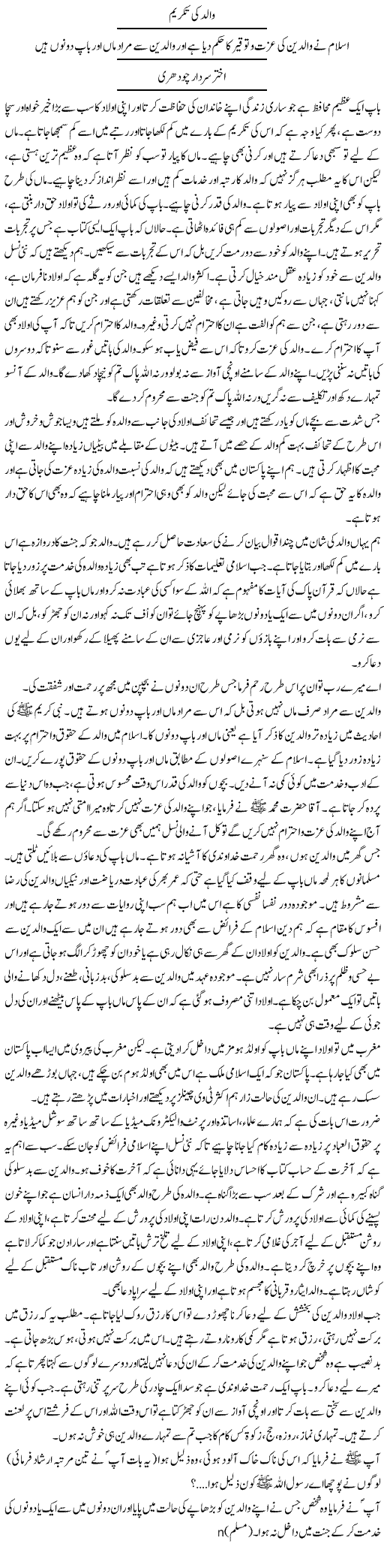
Walid Ki Takreem
The Pleasure Of Learning
THE rise of Muslims to the zenith of civilization in a period of four decades was based on Islam’s emphasis on learning.
This is obvious when one takes a look at the Qur ‘an and the traditions of Prophet Muhammad (peace be upon him) which are filled with references to learning, education, observation, and the use of reason.
The very first verse of the Qur’an revealed to the Prophet of Islam reads: “Read: In the name of your Lord who created man from a clot. Read: And your Lord is the Most Generous Who has taught by the pen, taught man that which he knew not.” (Qur’an 96:1-5)
The pursuit of knowledge and the use of reason, based on sense observation are made obligatory on every Muslim, man and woman.
The following traditions of the Prophet (peace be upon him) supplement the foregoing teachings of the Qur’an in the following way:
“The acquisition of knowledge is compulsory for every Muslim, whether male or female.”
“The ink of the scholar is more sacred than the blood of the martyr.”
“Seek knowledge from the cradle to the grave.”
“God has revealed to me, ‘Whoever walks in the pursuit of knowledge I facilitate for him the way to Heaven.'”
The Islamic Empire for more than 1,000 years remained the most advanced and civilized nation in the world. This is because Islam stressed the importance and respect for learning, forbade destruction, developed in Muslims the respect for authority, discipline, and tolerance for other religions. The teachings of the Qur ‘an and Sunnah drove many Muslims to their accomplishments in science and medicine.
Learning is a natural pleasure. This pleasure is inborn and instinctive. The pleasure of learning is one of the essential pleasures of the human race. Without learning, survival itself is threatened.
The process of learning starts right after birth. It is true that babies who can barely talk investigate problems with all the zeal and excitement of explorers, make discoveries with the passion and absorption of dedicated scientists. At the end of each successful investigation, one can see on the tiny face an expression of innocent and pure heartfelt pleasure.
The pleasure of learning is not confined to learning from textbooks, which are too often tedious. But it does include learning from magazines (periodicals), newspapers, TV, radio and travelers. When you stand in a library in front of thousands of books, do not think they are lumps of lifeless paper, but minds alive on the shelves. Each has its own voice, which is as inaudible as the radio broadcast waves falling directly on the ears.
There are many people in this world who have played themselves to death, or eaten and drunk themselves to death. Nobody ever died because of thinking or learning.
People who avoid learning, or abandon it, find no joy in life, find that life is drained dry. No learner has ever run short of subjects to explore.
The pleasures of learning lead to happiness. One can live longest and best and most rewardingly by attaining and preserving the pleasure of learning.
Learning is everyone’s birthright. Everyone – young or old, rich or poor, male or female – has access to learning. Exercise your birthright. Remember what you have learned cannot be stolen by others.
Recognizing People’s Qualities
The Prophet Muhammad (peace be upon him) valued all his companions recognizing that they were people of honesty, integrity and good judgment. Had they been otherwise, they would not have defied the world around them by accepting Islam. They were the ones who stood by his side, supporting him in all situations. Those who joined his call in its early days earned an even higher position of distinction. The Prophet was very loyal to all his companions, but those who were quick to respond to his call claimed a greater share of his love. One of these was Zayd ibn Harithah.
When he was still a child, Zayd was kidnapped from his tribe’s quarters by some attacking group, and sold as a young slave. He was sold by one master after another, until he was taken by an uncle of Khadeejah, who was to become the Prophet’s first wife. This took place long before he started to receive God’s revelations. Khadeejah was given Zayd as a gift by her uncle, and she gifted him again to her husband, Muhammad, after she married him. Zayd’s father learned of his son’s whereabouts and came to Makkah to buy him back. When he offered this to Muhammad, the Prophet made a counteroffer of giving him Zayd back for free, if Zayd wished to go back with him. But when offered the choice, Zayd opted for staying with his master, Muhammad. His father was amazed, but he told him that he had seen certain qualities of Muhammad that made him unwilling to change his situation with him for any other. Impressed, the Prophet announced his adoption of Zayd as his own son. Zayd’s real father was happy with this arrangement and left Makkah to go back home. Zayd was a favorite of the Prophet, and reciprocated his feelings. Later, when Islamic revelations started, he was, according to some authentic reports, the first man to embrace Islam. He continued to be called as Zayd ibn Muhammad until the prohibition of adoption, at which point he reverted to his original name.
Aishah, the Prophet’s wife, reports: “Zayd ibn Harithah arrived back in Madinah when the Prophet was in my home. He came over and knocked. The Prophet immediately got up to open, putting on his robes, as he was undressed. By God, I never saw him undressed before or after this incident. He embraced Zayd and kissed him.” (Related by al-Tirmidhi and al-Baghawi.)
Why We Need To Pray
After a long and hectic day at work, how difficult it is for a tired person to go out to the mosque and concentrate on his prayers to Allah, the Almighty. Snuggled up in a warm and cozy bed, how difficult it is to get up at the call of the Mu`ezzin: “Come to prayer! Come to success!”
The famous doctor and philosopher, Ibn Sina (Avicenna), recalls such a moment in his life. One cold and icy night, he and his servant were resting at an inn in a remote part of Khurasan. During the night, he felt thirsty, so he called to his servant to bring him some water. The slave had no desire to leave his warm bed, so he pretended not to hear Ibn Sina’s call. But finally, after repeated calls, he reluctantly got up and went to fetch the water.
A little while later, the melodious sound of the adhan (call to prayer) filled the air. Ibn Sina began to think about the person calling the people to prayer. “My slave, Abdullah,” he mused, “has always respected me and admired me. He seizes any opportunity to lavish praise and affection on me, but tonight he preferred his own comfort to my needs.
“On the other hand, look at this Persian, slave of Allah: He left his warm bed to go out into the chilly night, he made ablution in the icy water of the stream, and then he ascended the high minaret of the mosque to glorify Him Whom he truly serves: ‘I bear witness that there is none worthy of worship except Allah. I bear witness that Muhammad is the Messenger of Allah’.”
Ibn Sina records: “I learned the essence of true love, that love which results in complete obedience.” The love of Allah demands total and unconditional obedience. Allah, the Almighty says:
Say (O Muhammad, peace be upon, to mankind): “If you (really) love Allah then follow me, Allah will love you and forgive you your sins. And Allah is Oft-Forgiving, Most Merciful.” (Qur’an, 3:31)
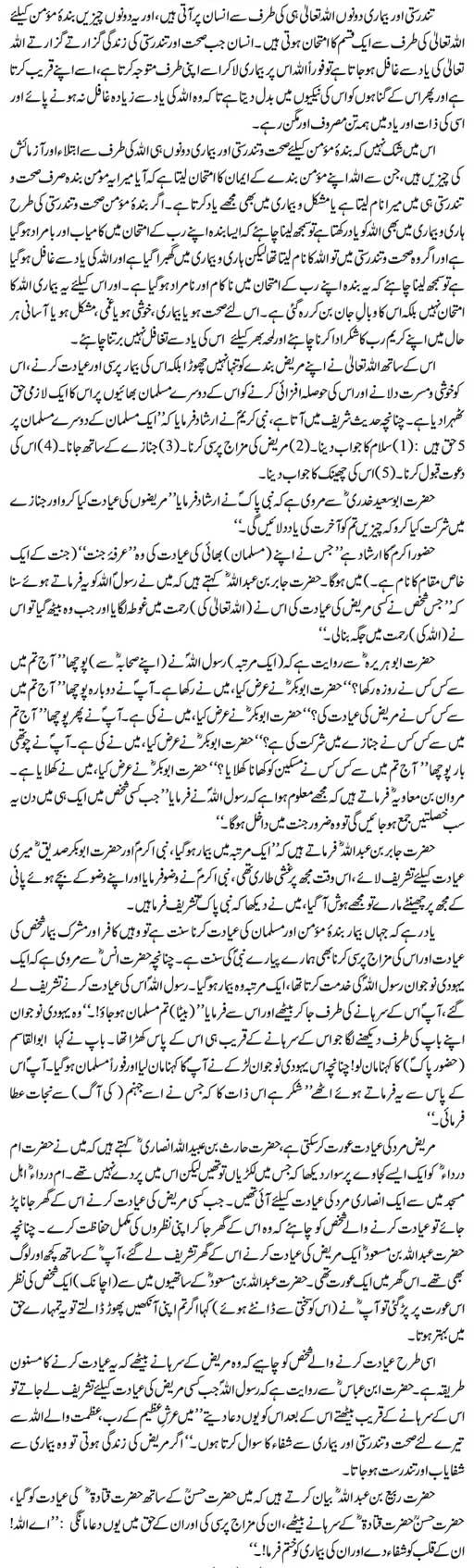
Mareez Ki Ayadat K Fazail
Love The Prophet & Follow Him
Love is A Beautiful Emotion. It Encompasses All The Most Beautiful Things in The World. Every Relation And Connection Gets Stronger And More Durable When There is An Element Of Affiliation And Love Added To it. Beginning From Our First Love As A Child For Our Mother To Choosing Someone To Spend Our Whole Life With, Love is What Makes Life Worth Living. And, Like All Precious Things in The World, This Priceless Treasure Demands Guarantees To Keep it Flourishing.
When you love someone, they are always on your mind and become the driving force of your direction in life. You love to follow them, obey them, do whatever you can to please them and try your best to avoid whatever displeases them. You share with them your problems and consult them for their best advice. Their name soothes you and their company is the most precious time of your day. Never do their messages and mails go unread or ignored. The world sees you change when this beautiful feeling overpowers you, whether this love be for a human, a mission, a career or simply a car or a gadget. Love changes your priorities and the color of this feeling is evident on your face and in your feelings, words, and actions.
We all love the Prophet Muhammad , the personality whose greatness is acknowledged by Muslim and non-Muslim thinkers and scholars-a warm friend and a guide for his companions, a devoted and loving husband to his wives, a shady tree for his daughters, a leader of the Ummah (community), an exemplary politician and a reformist who transformed the most uncultured Bedouin into the most disciplined force of people known to history.
His message, which begins with the oneness of Allah , gives answers for all the problems we face today. But how many of us have actually explored the message he brought? Do we really know the message? The Qur’anic code of life sent to us though our beloved Messenger of Allah still remains untouched, only to be ‘recited’ when we are in trouble or a calamity afflicts us, or it becomes a part of the deluxe package that goes with the bride. How many of us consult his way in our practical lives whether it’s a matter of celebration or woe?