
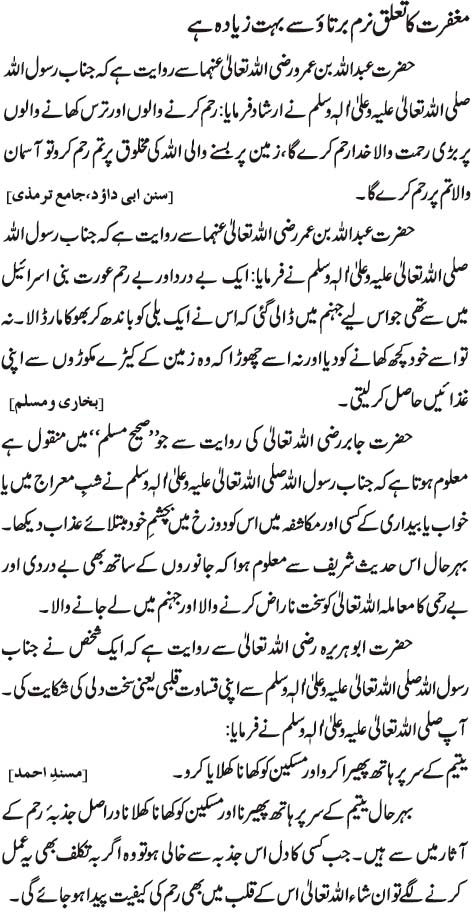
Maghfirat Ka Taluq Narm Bartao Say Bohat Zyada Hai
Those Who Obey Allah And His Messenger: In The Company Of The Blessed
[ALLAH’S Quran – 4:69] “He who obeys Allah and His Messenger shall be a recipient of Allah’s mercy and blessings. Such persons shall be placed in the distinguished position of those in whom all divine grace abounds: the Prophets, the veracious, the martyrs, and the pious in a world perverse, and how celebrated is the society.”
The Prophet (Peace Be Upon Him) has said :
[Muslim, Book #020, Hadith #4519] “It has been narrated on the authority of Abu Huraira that the Messenger of ALLAH (may peace be upon him) said: Whoso obeys me obeys God; and whose disobeys me disobeys God. Whoso obeys my commander obeys me, and whoso disobeys my commander disobeys me.”
[4:69 – Commentary] “A passage of the deepest spiritual meaning. Even the humblest man who accepts Faith and does good become at once an accepted member of a great and beautiful spiritual Fellowship. It is a company which lives perpetually in the sunshine of God’s Grace. (This passage partly illustrates 1:5). It is a glorious hierarchy, of which four grades are specified:
(1) The highest is that of the Prophets or Apostles, who get plenary inspiration from God, and who teach mankind by example and precept. That rank in Islam is held by Muhammad Mustafa (PBUH).
(2) The next are those whose badge is sincerity and truth; they love and support the truth with their person, their means, their influence, and all that is theirs. That rank was held by the special companions of Muhammad, among whom the type was that of Abu Bakr Siddiq.
(3) The next are the noble army of Witnesses, who testify to the truth. The testimony may be by martyrdom, as in the case of Imams Ḥasan and Ḥusain. Or it may be by the tongue of the true preacher, or the pen of the devoted scholar, or the life of the man devoted to service.
(4) Lastly, there is the large company of righteous people, the ordinary folk who do their ordinary business, but always in a righteous way. They are the rank and file of the beautiful Fellowship, in which each has his place and yet all feel that they derive glory from the common association (Cf.. 29:9).
Isha Ki Sunnato Ki Fazeelat

Isha Ki Sunnato Ki Fazeelat
The Inward Adab Of Supplication
Notes from Sheikh Ibn Ata’illah’s (d.709h) Hikam with its commentaries by Ibn Ajeebah and al-Shurnubi with anecdotes from Imam Qushayri’s Risalah
Worldly Provisions are decreed by Divine will previous to the suffering of the human race. This is why human entreaty is not the reason for Divine provision. Man’s supplication is therefore the manifestation of his servitude, poverty, and humility to his Lord. Sheikh Abu al-Hassan al-Shadhili al-Maghribi is recorded to have said, ‘The concern of your supplication should not be success in the fulfillment of your need, since this may leave you unanswered; rather, your purpose should be a humble call to your lord’.
How can your supplication entail Allah’s pre-eternal bestowal? The Divine order is exalted and way above the alliance of causes. Allah’s intention is absolute, where there is no room for qualification, and his will is prevalent where none rescinds His command.
Allah’s favor in you is not because of your supplication, it is because He wanted to favor you before your existence. Do you not ponder? Where were you when His favor embraced you and His shelter embosomed you in pre-eternity? There were no sincere acts, nor were there the states of the hearts at that time!? Yet there was none but purely His Grace and a Great measure of Benevolence for you. Hence, there is no consideration for anything but His decree, so await His kindness.
There are people whose etiquette sometimes leads them to pay no heed to their question whilst solely relying on His distribution and busying themselves in His remembrance. For them, etiquette is to busy themselves in His remembrance rather than their own. Allah says about such people, ‘I shall give the best of what I give to those who ask, to whoever busied himself with my remembrance over his quest’. They know Allah is the knower of the hearts and is the best planner. For the one who remembers Allah, invoking unites his dispersed heart and pervades his will and his broken resolve. This station is indicated in this verse, ‘and those who strive in our cause-We will certainly guide them to our paths’ (29:69). For others, to bring about the supplication to the tongue is to exhibit one’s absolute slavehood and neediness in front of his Lord. Allah says, ‘Call on your Lord with humility and in private’ (7:55). The former make no complaints about their state, knowing that it is not concealed to Him. For the latter, the early stage of their supplication is to mediate to their lord by means of their need of Him ‘faqr ilayhi’. It is then they realise that the Divine Entity is limitless and their need of Him is limited, thus it is merely impossible for them to intercede by their need. The Salik’s station is to mediate through his poverty, and the Arif’s station is to supplicate without this mediation or to stay silent.
For many, supplication is a means of relieving emotional frustration and stress. Upon commencing the supplication, one wants to pour out his/her concern and hurriedly awaits a response. This is not the spirit of supplication. Of course, supplication is a means of relieving one’s tensions, but some inward etiquettes have to be maintained therein.
Aamaal Jin Say Azab-e-Qabar Hota Hai

Wo Aamaal Jin Say Azab-e-Qabar Hota Hai
Why Halal And Haram?
In the name of Allah, the Most-Merciful, the All-Compassionate
“May the Peace and Blessings of Allah be Upon You”
Praise be to Allah, we seek His help and His forgiveness. We seek refuge with Allah from the evil of our own souls and from our bad deeds. Whomsoever Allah guides will never be led astray, and whomsoever Allah leaves astray, no one can guide. I bear witness that there is no god but Allah, and I bear witness that Muhammad is His slave and Messenger.
ALLAH SWT, the Almighty, created this magnificent and immaculate universe to favor HIS crowned creation, human beings. ALLAH SWT mentions in the holy Quran, “And HE has subjected to you whatever is in the heavens and whatever is in the earth – all from him. Indeed, in that are signs for a people who give thought” [Al-Jathiyah 45:13].
By virtue of HIS wisdom, ALLAH SWT has proclaimed many things comprised within this world as Halal (lawful) and few others Haram (unlawful) in order to assess our obedience towards HIM.
One of the objectives of this earthly life is to be constantly examined. Quran quotes, “(HE) who created death and life to test you (as to) which of you is best in deed” [Al Mulk 67:2].
Hence, the one who complies with Halal and abstains from Haram in all his matters will succeed. Imam Bukhari narrated that Jundab (RA) said, “The first thing of the human body to purify is the abdomen, so he who can eat nothing but good food (Halal and lawful) should do so”.
Islamic rulings clearly emphasize Halal and Haram, albeit some matters have not been categorized as legal or illegal. What is the way out then?
Narrated by An-Numan bin Bashir (RA): I heard Allah’s Apostle PBUH saying, Both legal and illegal things are evident but in between them, there are doubtful (suspicious) things, and most of the people have no knowledge about them. So whoever saves himself from these suspicious things saves his religion and his honour. And whoever
indulges in these suspicious things is like a shepherd who grazes (his animals) near the private pasture (hima) of someone else and at any moment he is liable to get in it. (O people!) Beware! Every king has a hima, and the hima of ALLAH on the earth is HIS illegal (forbidden) things. Beware! There is a piece of flesh in the body if it becomes good (reformed) the whole body becomes good but if it gets spoil the whole body gets spoils and that is the heart.” (Bukhari).
This hadith enlightens us to refrain from doubtful matters. It also elucidates that the one who consumes unlawful, pollutes his blood that circulates to his heart resulting in the heart being rendered corrupt, and ultimately the whole body is ruined. There could be times when a person may not know the lawfulness of a particular thing, as mentioned in the hadith: “and most of the people have no knowledge about them”. He should then seek advice from a pious scholar. ALLAH the Merciful says, “So ask the people of the message if you do not know” [Al-Anbiya 21:7].
We Muslims have a common tendency to be cautious about food and are casual about other matters concerning Halal and Haram. Sharia (Islamic law) has outlined rules about Halal and Haram in all religious and worldly affairs regarding food, drinks, clothes, marriage, business transactions, behavior towards others, private issues, or issues related to public, hunting, medication, festivals, living habits, and so forth.
In fact, one can say that Islamic rulings are mostly encompassing Halal and Haram, thus making it complicated to elaborate what is lawful and what is not. Rather, the following verses enlighten us …
ALLAH says, “Say, Who has forbidden the adornment of (i.e., from) ALLAH which HE has produced for HIS servants and the good (lawful) things of provision?. Say, They are for those who believe during worldly life (but) exclusively for them on the Day of resurrection. Thus do We detail the verses for a people who know. Say My Lord has only forbidden immoralities – what is apparent if them and what is concealed – and sin, and oppression without right, and that you associate with ALLAH that for which HE has not sent down authority, and that you say about ALLAH that which you do not know.” [Al Araf 7:32-33]
Furthermore, ALLAH the greatest instructs, “Say: Come, I will recite what your Lord has prohibited to you. (He commands) that you not associate anything with HIM, and to parents, good treatment, and do not kill your children out of poverty; WE will provide for you and them. And do not approach immoralities – what is apparent of them and what is concealed. And do not kill the soul which ALLAH has forbidden (to be killed) except by (legal) right. This has HE instructed you that you may use reason. And do not approach the orphan’s property except in a way that is best (i.e, intending improvement) until he reaches maturity. And give full measure and weight in justice.
We do not charge any soul except (with that within) its capacity. And when you speak (i.e., testify), be just (do justice), even if (it concerns) a near relative.
And fulfill the covenant (message) of ALLAH. This has HE instructed you that you may remember. And (moreover), this is MY path which is straight, so follow it; and do not follow (other) ways, for you will be separated from HIS way. This has HE instructed you that you may become righteous” [Al Anam 6:151-153]
Waldain Kay Liye Duaaien

Waldain Kay Liye Duaaien
Importance Of Friday In Islam
Friday is the sixth day of the Islamic week. The literal meaning of Friday is congregation. In Islam, this day is given more importance than any other day of the week. Every Friday, the prayer of jummah is offered, and special time is taken for this prayer.
Imams of all masjids deliver khutbah on a special topic every Friday. Muslims practiced this practice even before Muhammad s.a.w.w migrated from Makkah to Madinah, but in low numbers (reference ibn-e Majah 1082).
From various ahadith, it is proven that Muhammad s.a.w.w used to celebrate this day, and he declared jummah as weekly eid for Muslims. He s.a.w.w used to wear clean and new (washed) clothes, used to take bath, wear fragrance, wear surmah for this day specially.
Prophet Muhammad s.a.w.w described the virtues of Jummah prayer in the following hadith with these words: ” When the Friday comes, at every door of the Masjid there stands Angels who write down (the names of) those who come First, then who comes next. When the Imam sits down, the records are closed, and they come to listen to the reminder, i.e. the Khutba….” Muslim 1984.
From the history, it is proven that jummah was the most important day for the previous nations as well. It is still considered a blessed day in many religions, for example, Hinduism. Thus, Friday is considered a special and important day right from the very beginning of humanity.
“Narrated Abu Huraira: Allah’s Apostle (p.b.u.h) said, “Any person who takes a bath on Friday like the bath of Janaba and then goes for the prayer (in the first hour i.e. early), it is as if he had sacrificed a camel (in Allah’s cause); and whoever goes in the second hour it is as if he had sacrificed a cow; and whoever goes in the third hour, then it is as if he had sacrificed a horned ram; and if one goes in the fourth hour, then it is as if he had sacrificed a hen; and whoever goes in the fifth hour then it is as if he had offered an egg. When the Imam comes out (i.e. starts delivering the Khutba), the angels present themselves to listen to the Khutba.” Bukhari,2:425, Muslim,2:582 (Book of Friday Prayer)
Ali RA Ka Zikr Aur Ali RA Kay Chehre Ko Dekhna Ibadat

Ali RA Ka Zikr Aur Ali RA Kay Chehre Ko Takna Ibadat
The Children Of The Mushrikeen
The Messenger of Allah (saw) was asked about the children of the Mushrikeen, and he said, “Allah who created them knows best what they would have done”. [on the authority of Ibn ‘Abbaas, Saheeh al-Bukhaari, Kitaab al-Janaa’iz, Baab ma qilaa fi awlaad al-Mushrikeen, Fath al-Baari, 3/246]
Abu Hurayrah (ra) reported that the Prophet (saw) said, “Every child is born in a state of fitrah [the natural state of man] and his parents make him a Jew or a Christian, or a Magian, just as an animal produces a perfect baby animal: do you find it mutilated?” [Saheeh al-Bukhaari, Kitaab al-Janaa’iz, Baab ma qilaa fi awlaad al-Mushrikeen, Fath al-Baari, 3/246]
As Ibn Hajar said, “al-Bukhaari may Allah have mercy on him, indicating that he was refraining from giving an opinion on the children of the mushrikeen.
Later in his Saheeh, in the tafseer of Surat ar-Rum, he indicates that he favored the suggestion that they are in Paradise. He also organized the hadith in this chapter in such a way that shows this was his favored opinion. He starts with a hadith that indicates that we cannot say one way or the other, then quotes a hadith that indicates that they are in Paradise, and follows that with a hadith that clearly states that this is the case:
“As for the children around him, they are the children of mankind.” In another version, “As for the two children around him, every child is born in a state of fitrah.” Some of the Muslims asked, “Even the children of the Mushrikeen?” He said, “Even the children of the mushrikeen”
Ibn Hajar said, “This is supported by the hadith of Anas reported by Abu Ya’la, in which the Prophet (saw) said, “I asked my Rabb for the laheen [those who play or those who are unaware] of the children of mankind, that they would not be punished, and that was granted to me.” [its isnaad is hasan] Laheen was explained as meaning children, because of the hadith of ibn ‘Abbaas narrated by al-Bazzar. Ahmad reported from al-Khansaa bint Mu’aawiyah ibn Suraym from her paternal aunt who said, “I said, “O Messenger of Allah, who is in Paradise?” He said, “Prophets are in Paradise, martyrs are in Paradise and newborn babies are in Paradise”. Its isnaad is hasan. [Fath al-Baari, 3/246]
They also took as evidence the hadith, “The children of the mushrikeen are servants of the people of Paradise” [Ibn Mandah in al-Ma’rifah, Abu Na’eem in al-Hilyah, Abu Ya’la in al-Musnad and al-Albaani deemed it saheeh by the sum of its isnaad, Silsilat al-Hadith as-Saheehah, 3/452, no. 1468]
The idea that they are in Paradise is the opinion of some scholars, such as favored by Abul-Faraj Ibn al-Jawzee [Majmu’ Fataawa, 24/382, 4/303] an-Nawawi said of this opinion, “This is the correct position favored by those who study the words of Allah, “… And We never punish until We have sent a Messenger [to give warning]” [17:15]” [Fath al-Baari, 3/247]
al-Qurtubee also considered this the most likely t be corrected, reconciling the apparently conflicting reports by saying that the Prophet (saw) initially said they would be in Hell with their parents, then he refrained from passing any judgment and said “Allah knows best what they would have done”, then it was revealed to him that no one would be punished for the sins of another [17:15] so he stated that they would be in Paradise [at-Tadhkirah, p.515]. The trouble with this way of reconciliation, as Ibn Hajar said, is that this is not a matter that can be subjected to study and examination. It is a matter of al-Ghayb, which can only be known through revelation. And Allah knows best.
Some scholars, such as Hammaad ibn Zayd, Hammaad ibn Salamah, Ibn al-Mubaarak and Ishaaq, say that they are subject to the will of Allah. It was also transmitted by al-Bayhaqee in al-I’tiqaad from ash-Shaaf’iee. Ibn ‘Abdul-Barr said “This might be the opinion of Maalik, although there is no written evidence for that” [Majmu’ Fatawah, 4/281-404, 24/372] and Abul-Hasan al-Ash’ari attributed this opinion to Ahlus-Sunnah wal-Jama’ah, [Majmu’ Fatawah, 24/372].
This is also the favored view of Ibn Taymiyyah, who suggested that they will be tested on the day of Resurrection – “The correct view is what was said concerning them, Allah knows best what they would have done”. We cannot say of any particular individual that he will be in Paradise or Hell. Several hadiths state that on the Day of Resurrection, they will be tested in the arena of judgment: they will be given commands and prohibitions and those who obey will enter Paradise, whilst those who disobey will be sent to Hell.” He attributed this to Imaam Ahmad and Abul-Hasan al-Ash’ari, who attributed it to Ahlus-Sunnah [Majmu’ Fataawa, 24/372, 4/303, 4/281].
Ibn Hajar also stated that they would be tested in the Hereafter by being shown the Fire: whoever enters it will find it cool and safe, but whoever refuses to enter it will be punished. Ahadeeth to this effect was reported by al-Bazzar from Anas and Abu Sa’eed and by at-Tabaraani from Mu’aadh ibn Jabal. It has been proven through saheeh asaanid that the insane and those who lived between the time of Jesus (as) and Muhammad (saw) will also be tested in the Hereafter. al-Bayhaqee stated in al-I’tiqaad that this is the correct opinion. [Fath al-Baari 3/246].
The soundness of this opinion is indicated by the clear, unambiguous aayaat of the Qur’an, which tells the story of the righteous slave whom Musa (as) traveled to meet at the junction of the two seas. Explaining the reason why he killed the boy, he said, “And as for the boy, his parents were believers, and we feared lest he should oppress them by rebellion and disbelief” [18:80].
Muslim reports from Ibn ‘Abbaas (ra) “The Messenger of Allah (saw) said, concerning the boy was killed by al-Khidr, “He was decreed from the beginning to be a kaafir and if he had been left, he would have oppressed his parents with his rebellion and disbelief.” Commenting on this hadith, Ibn Taymiyyah said “It means that Allah decreed it in Umm al-Kitaab [the Register Book in Jannah] i.e. it was written that he would be a kaafir and if he had lived he would have been a kaafir indeed.”
al-Qurtubee said, in at-Tadhkirah [p.514]: “What makes this idea [that they will be tested in the Hereafter] weak is the fact that the Hereafter is not the place of testing; it is the place of recompense – the reward of punishment. al-Hulaymee said, “This hadith is not proven to be sound, and it contradicts the basic beliefs of the Muslims because the Hereafter is not the place of testing. Everyone will inevitably know about Allah, and there is no test when a thing is inevitable.”
This is incorrect and was refuted by Shaykh al-Islaam Ibn Taymiyyah, who said, “Responsibility only ceases when one enters the abode of recompense, which is either Paradise or Hell. In the arena of judgment, they will be tested just as they are tested in al-Barzakh. The individual will be asked, “Who is your Rabb? What is your deen? Who is your Prophet?” Allah (swt) says, “[Remember] the Day when the Shin shall be laid bare, and they shall be called to prostrate to Allah, but they [hypocrites] will not be able to do so” [68:42]…” [Majmu’ Fataawa, 24/ 372]
Testing will only cease when a person enters Paradise or Hell. al-Qurtubee’s suggestion that everyone will inevitably know Allah on that Day is correct, but the testing will take the form of orders and prohibitions, as is reported in a number of texts. Allah (swt) will test them by ordering them to enter the Fire: whoever obeys will be blessed, whilst whoever disobeys will be doomed.