
Who Is More Shy?
It is well known that the Prophet (peace be upon him) was extremely resolute in defending Islam and the Muslim community. He would not accept any compromise in matters of faith and would stand firm in resisting any injustice that may be aimed at even the weaker elements in the community. In fact he would defend the rights of non-Muslim people, provided that they did not participate in war against Islam and Muslims. Yet with all this firmness and courage, the Prophet was a very shy person when it came to his own personal matters or when the discussion involved some intimate matters such as body discharges.
Ayesha reports: “A woman asked the Prophet about the form of taking a bath after she has finished her period. ‘How do I conduct my bath,’ she said. He replied: ‘Take a piece of cotton, perfumed with musk, and use it to purify yourself.’ She asked: ‘How do I purify myself with it?’ He said: ‘Well, use it and purify yourself.’ She said: ‘How?’ He said: ‘All glory be to God! Do purify yourself.’ I pulled her toward me and said to her: ‘Use it to remove any traces of blood.’” (Related by Al-Bukhari).
Muslims used to ask the Prophet about every little detail. They realized that Islam meant much more than a belief or a conviction that certain principles are true. It is a complete way of life, which required them to conduct all their life affairs in accordance with its principles. Purification is an essential part of Islamic worship. A Muslim always keeps himself clean, washing off all impurity. Muslims are required to perform ablutions before they stand up in prayer. Likewise, they are required to wash all their bodies and their heads when they are in the state of ceremonial impurity. The Prophet told them this and they knew what is required. Hence, the woman’s question was not seeking this elementary information. She was asking for more intimate information concerning the cleanliness of the place where menses is discharged.
The Prophet understood what she meant. He, however, was too shy to speak to a woman explicitly about this. He had already told women how to take a purification bath. As he explained, a woman who has finished her period should bring enough water and whatever else she needs for cleanliness, washing her private parts. Then she performs the ordinary ablutions normally needed for prayer. Then she pours some water over her head and rubs her scalp, pushing her fingers through her hair. Then she pours water over all her body. After that, she uses a piece of cotton or wool and wet it with some perfume or musk and use it for purification. As the woman in this case, Asma bint Shakal, felt that purification meant ablution, in its two forms, she wondered how could she do the ablution with a piece of cotton or wool. The Prophet tried his best to make her understand what was beyond his words, but she was persistent, asking for more details. Here Ayesha realized the difficulty of the situation, pulled the woman aside and explained to her what the Prophet meant.
There is nothing embarrassing in all this. We only note that the Prophet was too shy to discuss such matters with a woman, even in the presence of his wife. However, Ayesha praised the woman and her people generally. She said: “Blessed be the Ansari women. Shyness has not stopped them from seeking better knowledge of their religion.”
– By Adil Salahi
Anger Management: An Islamic Perspective
WE Muslims are followers of Prophet Muhammad (peace be upon him), right? What better example of patience do we have than that of our own blessed Prophet himself? Prophet Muhammad (peace be upon him), who was sent to mankind to teach them good moral conduct, learned to control his anger toward the unbelievers and teach them appropriate expressions. He used to speak against being angry. We think that we have it tough, when one of his days was probably tougher than the whole of our lifetimes! When we look at his life, our own difficulties seem so pathetic in comparison. Imagine spending 13 years completely devoting his life spreading the word of Islam and suffering hardship. This was a man who had the burden of the whole of mankind’s future on his shoulder. Yet he had the tolerance and self-discipline to be able to forgive those around him who were themselves so ignorant.
The best example of this was when the Prophet (peace be upon him) went to Ta’if at the time when the followers of Islam were at their weakest and the Prophet (peace be upon him) himself had suffered the loss of both his wife Khadijah (May Allah be pleased with her) and his uncle Abu Talib. He went to this town in the hope that they would listen to what he had to say. Instead he was insulted and chased out of the town by the children who threw stones at him till (it was described) the blood flowed from his body to his feet making his sandals sticky with his own blood. The Prophet (peace be upon him) was so depressed that he prayed to Allah, who then sent down the angel of the mountains who asked for the Prophet’s permission to fold the mountains together and crush to death all those that lived there. But what was the Prophet’s reply? “Yes, kill them all as they did not listen to me”? No, of course not! His answer was “No, I hope Allah will bring from them people who will worship Allah alone, associating none with Him.”
This was the example of the Prophet (peace be upon him), even though he felt bitterness and was very angry with them, he had the discipline and control to not let his emotions control his actions and he forgave them realizing that they were merely misguided.
One companion asked him : “Give me some advice by virtue of which I hope for good in the life Hereafter, and he said, “Don’t be angry.” Another person asked what would save him from the wrath of God, and the Prophet (peace be upon him) said, “Do not express your anger.”
Once the Prophet (peace be upon him) asked his Companions: “Who among you do you consider a strong man?” They said the one who can defeat so-and-so wrestler in a fight, and he said, that is not so. The one who is strong is the one who can control himself at the time of anger. He also said that “anger is like fire, which destroys you from within, and it can also lead you to the fire of Hell by your own expressions of anger unjustly.”
So being angry is similar to being drunk. In both cases, we do not know what we are doing, hurting ourselves or someone else, and afterwards when the intoxication is over, we repent.
Sheikh Hassan Al Basri said that one of the signs of the Believers is that his anger does not get on upper hand over him. One should distinguish between natural response to wrongdoing and disbelief. A person who has no feelings about oppression, wrongdoing and disbelief is, in fact, an impotent person emotionally. It has been said, “Evil flourishes when a few good people do not do anything to oppose it.” Thus response to injustice and operation in a civilized way is the appropriate expression of anger. Being neutral to injustice is equal to contributing to injustice.
What Made The Companions Special
ABDULLAH bin ‘Amr bin ‘Aas narrated that a woman came to the Messenger of Allah (peace be upon him) with her daughter. On the daughter’s wrist were two heavy gold bracelets. The Prophet (peace be upon him) asked her, “Do you pay Zakat on this?” She replied, “No.” The Prophet said, “Would it please you that Allah will encircle you with two bracelets of fire?” The narrator commented that she took them off and threw them down in front of the Messenger, and said, “They are for Allah and his Messenger.” (Ahmad, Tirmidhi)
Think about this for a second – Fiqh of Zakah aside. Imagine if you were in this place. What would you do? Probably hum and haw, then half of Juz Amma (the last chapter of the Qur’an). Memorize the entire Qur’an (step by get them weighed, calculate the value, and give your Zakat.
But what did this Sahabiyyah (female Companion) do? She gave entire bracelets, both of them, as charity. She did not just pay the 2.5 percent of the value required for Zakah – she actually donated the whole thing in the way of Allah.
This is one of the things that makes the Companions of the Prophet (peace be upon him) so special (and so much better than us). We do the bare minimum, just to scrape by, but they go for the maximum reward.
How you can apply this today
Read about Ihsan. Learn about it. Ask yourself frequently: “What would it mean to do Ihsan in this thing I’m doing right now?”
Aim for the gold medal. Don’t be satisfied with memorizing only step, of course).
Give a Little Extra. If someone asks you for help – with some project, essay, exam, task, chores around the house (parents) – don’t just do the bit they ask, do a little extra. As Allah says: “Is there any reward for good other than good?” (Qur’an, 55:60)
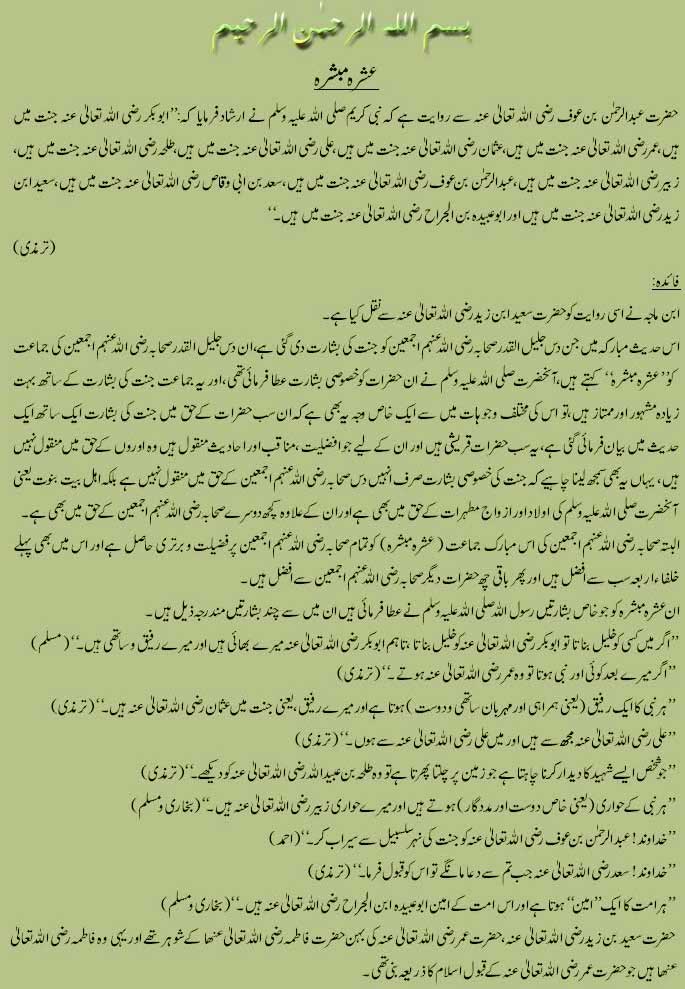
Ashra Mubashra
The Evils Of Envy
The topic of envy is a very important one. It is a serious problem that all of us need to cope with. Envy spreads through society like a frightful illness and it is an illness that demands treatment.
Envy is indeed a serious, sometimes fatal illness. It is an ignoble character trait that tears rifts between people, communities, and even nations. A community that is blackened by this loathsome quality is one wherein cooperation and love become virtually unknown. Enmity, hatred, and violence become the order of the day.
Envy occurs when we see some blessing in the hands of another and desire for that blessing to be lost to that person. Muslim scholars have defined this feeling in many ways, but all of their definitions contain this essential meaning – to wish for someone to lose something good that he or she has been blessed with.
Al-Nawawi describes envy in the following way: Envy is to desire for someone who enjoys a blessing to become bereft of it, regardless of whether that blessing is of a religious or worldly nature.
Al-Ghazali writes: As far as envy is concerned, Islamic scholars define it as the hatred of a blessing and the love that the one so blessed by it will become bereft of it.
Envy is something quite prevalent in the world. This is why the Qur’an speaks about it often. Allah says : “Do they envy the people on account of what Allah has given them of His grace?” [ Surah Al-Nisa’ : 54]
We must also not forget the famous story of Joseph (peace be upon him) and his brothers who envied his father’s love for him so much that they cast him into a well.
The Prophet (peace be upon him) warned against the ill consequences of envy upon the envier, saying: “Beware of envy, for indeed envy consumes one’s good deeds like fire consumes wood.” [ Sunan Abi Dawud (4903)]
The Prophet (peace be upon him) warned so sternly against envy because of how dangerous and ruinous it is. It can bring us to destruction in both our worldly and spiritual lives.
He also said: “Do not revile nor envy one another. Do not turn away from one another and do not sever ties. Be devotees of Allah and brothers to one another. It is not permissible for a Muslims to shun his brother for more than three days.” [ Sahîh al-Bukhari (6065) and Sahih Muslim (2559)]
Envy is indeed a great and deadly evil. When it strikes, it inevitably leaves destruction in its wake.
The Servants Of The People Of Paradise
The People of Paradise will be served by boys whom Allah (swt) will create to serve them and who will be most beautiful and perfect in form:
“They will be served by immortal boys, With cups, and jugs, and a glass from the flowing wine.” [56:17-18]
“And round about them will [serve] boys of everlasting youth. If you see them, you would think them scattered pearls.” [76:19]
Ibn Katheer, may Allah have mercy on him, said, “Boys of eternal youth will go around to serve people of Paradise, boys who remain in that youthful form forever, never changing or advancing in age. It was said that they will be wearing earrings, to emphasise their youth, because such a thing is appropriate for young people, but it does not befit those who are older. And Allah (swt) said [76:19] i.e. if you saw them going around to attend to the needs of their masters, with their beautiful faces and splendid colorful clothes and jewellery, you would think that they were scattered pearls. There is no more beautiful description than the picture of pearls scattered in a place of beauty.” [Tafseer Ibn Katheer, 7/184]
Some scholars suggested that these boys are the children of the Muslims and Mushrikeen who die in childhood, but this was refuted by al-‘Allaamah Ibn Taymiyyah (ra), who explained that these boys of eternal youth are part of the creation of Paradise: “..they are not the children of this world. When the children of this world enter Paradise, they will do so in a perfect form, like all the other people of Paradise, in the form of their father, Aadam.” [Majmu’ al-Fatawa, 4/279, 4/311]
The Purity of Islam
It is important in this present day that the children of Adam clearly understand the true meaning of Islam.
We must know the value of its purity, of its peacefulness, its unity, its sincerity, its honesty, and the value of its spirit and justice and truth. We must know the greatness of Allah Who rules over all this, and we must find tranquility in our lives, so that we will be able to guide others toward peacefulness.
To all those who have accepted Allah and His Messenger, Muhammad (peace be upon him), with perfect faith, certitude, and determination before we can bring peace to all life, before we can eliminate poverty, suffering, illusion, and disease in the world, before we can come to love every life as we do our own, we must first understand the value of absolute faith.
To have firm faith in Allah, the Almighty Lord, to know Him, to pray to Him, to believe with complete certitude in His messengers, prophets, and angels, to carry out the commandments sent through them, to bring into our consciousness His gracious qualities and all His attributes, and to dedicate our lives to His worship – this is the true meaning of Islam.
Islam is equality, peacefulness, and unity. Islam is inner patience, contentment, trust in Allah, and greatness of Allah. One who understands this and puts it into practice will be a true believer; he will know Allah and His commandments and practice the injunctions given through His revelations.
Allah sent His prophets to man to free him from his enslavement to earth, wealth, sensual pleasures, desires, thoughts and attachments. And yet man is suffering and can find no freedom; he is a slave to so many things. He has no peace, tranquility, equality, or love. The children of Adam must release themselves from the bondage of worldly pleasures.
If only man could acquire the wealth of Allah’s love and integrity, the wealth of His beautiful laws, then he would never lack in anything. That wealth is pure; it is the purity of Islam. If man had such inner wealth, he would never meet with loss in this world or in the Hereafter. He would be safe and secure in both worlds. Allah has asked mankind to accept this, to find freedom, and to raise the banner of unity on the staff of love.
People with strong faith know that it is important to cleanse their own hearts, while those with unsteady faith seek to find fault in the hearts and prayers of others. This becomes a habit in their lives. But those who pray to Allah with faith, determination, and certitude know that the most important thing in life is to surrender their hearts to Allah.
If the fountain of the heart is full, then all creations can come and partake of its clear water. If it is shallow, then all those who come will stir up the mud and have nothing but dirty water to drink.
Let us constantly strengthen our faith, certitude, and determination. Allah sent this gift of faith to each of the prophets and finally gave it in perfection to Prophet Muhammad (peace be upon him). The fundamental explanations of perfect faith were given to Allah’s messengers, and they in turn shared them with mankind. There are very deep meanings to be found in these.
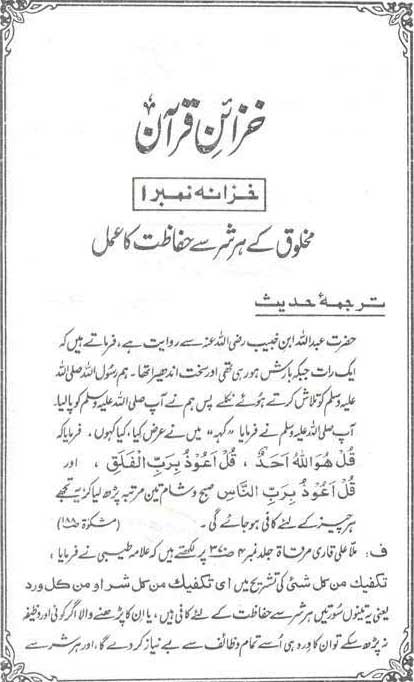
Khazain-e-Quran
Whoever Fills His Muslim Brother Needs
[Sahih Bukhari: Volume 3, Book 43, Number 622]
Narrated ‘Abdullah bin Umar (Radi Allah Anhu) : Allah’s Apostle (sal-allahu-alleihi-wasallam) said, “A Muslim is a brother of another Muslim, so he should not oppress him, nor should he hand him over to an oppressor. Whoever fulfilled the needs of his brother, Allah will fulfill his needs; whoever brought his (Muslim) brother out of a discomfort, Allah will bring him out of the discomforts of the Day of Resurrection, and whoever screened a Muslim, Allah will screen him on the Day of Resurrection.”
[Sahih Bukhari: Volume 3, Book 43, Number 624]
Narrated Anas (Radi Allah Anhu) : Allah’s Apostle (sal-allahu-alleihi-wasallam) said, “Help your brother, whether he is an oppressor or he is an oppressed one. People asked, “O Allah’s Apostle! It is all right to help him if he is oppressed, but how should we help him if he is an oppressor?” The Prophet said, “By preventing him from oppressing others.”
[Sahih Bukhari: Volume 3, Book 43, Number 629]
Narrated Abu Huraira (Radi Allah Anhu) : Allah’s Apostle (sal-allahu-alleihi-wasallam) said, “Whoever has oppressed another person concerning his reputation or anything else, he should beg him to forgive him before the Day of Resurrection when there will be no money (to compensate for wrong deeds), but if he has good deeds, those good deeds will be taken from him according to his oppression which he has done, and if he has no good deeds, the sins of the oppressed person will be loaded on him.”