
Unity Of Matter And Spirit
A feature of Islam is that it does not divide life into watertight compartments of matter and spirit. It stands not for denial of life but for the fulfillment of life. Islam does not believe in asceticism. It does not ask man to avoid material things.
It holds that spiritual elevation is to be achieved by living piously in the rough and tumble of life, not by renouncing the world. The Qur’an advises us to pray as follows: “…Our Lord! Give us in this world that which is good and in the hereafter that which is good …” (Qur’an, 2:201)
But in making use of life’s luxuries, Islam advises man to be moderate and keep away from extravagance. Allah says: “…and eat and drink but waste not by extravagance, certainly He (Allah) likes not (those who waste by extravagance).” (Qur’an, 7:31)
On this aspect of moderation, the Prophet Muhammad (peace be upon him) said: “Observe fasting and break it (at the proper time) and stand in prayer and devotion (in the night) and have sleep, for your body has its right over you, and your eyes have rights over you, and your wife has a claim upon you.”
Thus, Islam does not admit any separation between material and moral, mundane and spiritual life, and enjoins man to devote all of his energies to the reconstruction of life on healthy moral foundations.
It teaches him that moral and material powers must be welded together and that spiritual salvation can be achieved by using material resources for the good of man in the service of just ends and not by living a life of asceticism or by running away from the challenges of life. Islam seeks to establish equilibrium between the two aspects of life – the material and the spiritual.
It says that everything in the world is for man, but man was created to serve a higher purpose: the establishment of a moral and just order that will fulfill the will of Allah. Its teachings cater for the spiritual as well as the temporal needs of man. Islam enjoins man to purify his soul and to reform his daily life – both individual and collective – and to establish the supremacy of right over might and of virtue over vice. Thus Islam stands for the middle path and the goal of producing a moral man in the service of a just society.
Generosity Of Uthman (May Allah Be Pleased With Him)
During the caliphate of Umar (may Allah be pleased with him) there was a severe famine. The people of Madina were suffering due to a shortage of food.
A caravan of 1000 camels loaded with a large stock of food grains belonging to Uthman (may Allah be pleased with him) arrived from Shaam (Syria). Several merchants offered to buy all of it.
He asked them what profit they would pay. “Five percent,” they said. He answered that he could get a higher profit than that. They began to argue with him, saying that they did not know of any merchant who would offer him more than their quote.
He said to them, “I know of one who repays a profit of more than seven hundred to a dirham.” He then recited the verse of the Noble Qur’an in which Allah mentioned this profit. “The likeness of those who spend their wealth in the Way of Allah is as the likeness of a grain (of corn); it grows seven ears, and each ear has a hundred grains. Allah gives manifold increase to whom He pleases. And Allah is All-Sufficient for His creatures’ needs, All-Knower.” (Qur’an, 2:261)
“O traders! Bear witness with me that I donate all this to the poor people of Madinah!” Uthman said.
Dear readers, whatever we give for the sake of Allah is really ours and whatever we keep with us will one day be someone else’s. Let us follow the footsteps of our Prophet and the pious Sahabah, with whom Allah was pleased, by helping the needy ones.
Qualities of Muttaqun who will inherit Paradise
“And march forth in the way (which leads to) forgiveness from your Rabb, and for Paradise as wide as the heavens and the earth prepared for Al-Muttaqun (the pious).” (Qur’an, 3:133)
ALLAH in this beautiful verse of Surah Al-Imran is urging us to march forth towards His Mercy and Paradise, the final abode prepared specially for “Al-Muttaqeen”. Allah clearly mentions that the distinguished people for whom he created Paradise are the “Muttaqun.”
We all, of course, want this privileged status on the Day Of Judgment In Sha Allah. But who are they? How can we be like them? Allah did not leave us wondering about their characteristics, but specified them in the very next verse:
“Those who spend (in Allah’s cause – charity) in prosperity and adversity, who repress anger and who pardon men; verily, Allah loves Al-Muhsinun (those who do good).” (Qur’an, 3:134)
“They spend (in Allah’s cause) in times of prosperity and adversity.”
Allah has mentioned in several places the virtue of charity. Allah said:
“The likeness of those who spend their wealth in the way of Allah is as the likeness of a grain (of corn), it grows seven ears and each ear has a hundred grains. Allah gives manifold increase to whom He wills and Allah is All-Sufficient for his creatures needs, All-Knower.” (Qur’an, 2:261)
It is Allah’s promise that spending for His sake will be requited by Allah and that this investment will never be in loss In Sha Allah.
“They repress their anger.”
Allah knows his slaves. He did not make it difficult for us by ordering us not to get angry. Instead, He said that when we get angry we should repress it or swallow it.
Next time when something doesn’t go as planned or someone cuts your lane while driving, don’t burst. These affairs are too trivial for us to be smitten by anger. Let’s try our best to control our anger. We never know, this quality of ours might be the reason for us to be amongst the Muttaqeen who will enter Jannah!
•“Who pardon men.”
Forgiving is yet another admirable quality of the Muttaqeen. Forgiving is not just accepting apologies, but forgiving them from the heart and making Du’a for them that Allah also forgives them.
“...let them pardon and forgive. Do you not love that Allah should forgive you? And Allah is Oft-Forgiving, Most Merciful.” (Qur’an, 24:22)
“...and those who came after them say: “Our Lord! Forgive us and our brethren who have preceded us in Faith, and put not in our hearts any hatred against those who have believed. Our Lord! You are indeed full of kindness, Most Merciful.” (Qur’an, 59:10).
The verses of the Qur’an are crystal clear, we just need to strive our utmost to inculcate those qualities in us to achieve the best in this world and in the Hereafter.
ka’bah: The First House Of Worship
The Ka’bah is the first and the most ancient house of worship ever built for all mankind and it was dedicated solely to the worship of Allah. So by facing toward the Ka’bah in our prayers, we are stressing the unity of mankind under the Lordship of the One and Only God. Moreover, by facing toward the Ka’bah, we are stressing the concept of Allah the Almighty being the center of our lives.
Allah says in the Qur’an: “Verily, the first House (of worship) appointed for mankind was that at Bakkah (Makkah) full of blessing, and a guidance for Al-‘Alamin (mankind and jinn).” (3:96)
Thus, by ordering us to face toward the Ka’bah, we are taken back to our Adamic roots. One of the most essential messages of Islam is to break the barriers such as race, language ethnicity, etc. that separate human beings from one another by stressing their common origin in Adam and Eve. We need not emphasize the fact that racism has been and continues to be the scourge of humanity. Thus, through its entire teachings, Islam cuts at the roots of this menace. It is no wonder then that all of the Islamic rituals of worship stress equality and egalitarianism rather than division and distinction based on caste, clan, or status. One of the last messages delivered by the Prophet (peace be upon him) during his farewell pilgrimage was, “O people, (through Islam) Allah has abolished from your hearts your boasting about your ancestors. Remember all of you descended from Adam and Adam was created from the dust of the ground.”
Islam teaches us to worship One and Only God. Unlike all other religions, which tend to revere their founders excessively often to the point of worshiping them, Allah asks Prophet Muhammad (peace be upon him) to declare: “I am only a human being like you.”
Therefore, nothing is farther from the truth than stating that Muslims undertake the pilgrimage (Haj) to revere the Black Stone or the Ka’bah. While it is true that while going around the Ka’bah, some pilgrims may touch the Black Stone, doing so is not an integral rite of Hajj. It is, therefore, totally absurd and incorrect to say that Muslims go to Makkah to worship the Stone.
Touching the Stone is a mere symbolic act; it is merely intended to symbolize the beginning of the ritual of circumambulation around the Sacred House.
In this context, it is worth remembering what Caliph Umar said while touching the Black Stone: “I know for a certain fact that you are simply a stone; you have no power to benefit or harm anyone; if I hadn’t seen the Prophet (peace be upon him) touching you I wouldn’t have even bothered to touch you.”
We do not attach any importance to this Stone other than the fact that it was placed there by Prophet Ibrahim by the order of Allah. So we are merely renewing our memory of the great Prophet, whose faith and sacrifice is celebrated in the rituals of Hajj.
If anyone thinks otherwise, he is distorting Islam. The source for Islam is the Qur’an and the Sunnah and those who are well versed in these sources.
It is also not true to think that Muslims always turn to the East; rather they always turn toward the Ka’bah while performing their prayers, and its precise direction may be different, depending on where we are located in the world.
Maa Ki Dua

Maa Ki Dua
Indeed, I Love You
Ayesha reported that a man came to the Messenger of Allah (peace be upon him) and said: “O Messenger of Allah! Indeed, I love you more than I love myself, and I love you more than I love my family, and I love you more than I love my children.
When I am at home and I think of you, I am unable to contain myself until I can come to you and look at you. When I think about my death and your death, I know that when you enter Paradise, you will be raised to where the Prophets are. But, if I enter Paradise, I am afraid: will I be able to see you?”
So, the Messenger of Allah (peace be upon him) did not answer him at all until Jibreel revealed to him: “And whoever obeys Allah and the Messenger, then they will be in the company of those on whom Allah has bestowed His Grace – of the Prophets, the truthful, the martyrs and the righteous. And how excellent these companions are!” (Qur’an, 4:69)
– Silsilat Al-Ahadith As-Sahihah, no. 2933
Ignorance Must Not Be Encouraged
It should be known that our saying “ignorance is an excuse” does not mean that we encourage and call to ignorance, that ignorance has any merits, or that we are satisfied and pleased with it. Rather it is as one of the Salaf (righteous predecessors) said: “Allah has not been disobeyed with any sin worse than ignorance.”
Ignorance is the reason for sin and it incites sin and leads to it. Ibn Al-Qayyim says, “Yusuf, the eminently truthful and upright, said: ‘Unless You turn away their plot from me, I will feel inclined towards them and be one of the ignorant ones (jahileen).’ (Qur’an, 12:33) The word ‘Jahil’ (ignorant) means Those who do that which you have forbidden.”
Allah says: “Allah accepts only the repentance of those who do evil in ignorance and foolishness and repent soon afterward.” (Qur’an, 4:17)
Qatadah said: “The Companions of the Messenger of Allah (peace be upon him) agreed that everything by which Allah is disobeyed is ignorance.”
Others said. “The Companions agreed that anyone who disobeys Allah is an ignorant one (Jahil).”
Caliph Ali (may Allah be pleased with him) said, “It is enough honor for knowledge that he who is not able leaves it and one becomes happy if he is labeled with it, and it is enough of a censure for ignorance that its people disassociate themselves from it.” (Madarijus-Salikeen, 1/470 and Dhammul-Jahl of Ibn Rusulan)
Someone said, “There is in ignorance a death for its people before death, and their bodies before burial are graves, and their souls are in grief on account of their bodies, and there is no resurrection for them (from death) until the Resurrection.”
The cure for ignorance is to ask and learn, as the Messenger of Allah (peace be upon him) said, “Indeed the cure for ignorance is to ask.” (Ahmad, Abu Dawood, and Ibn Majah)
So, he made ignorance a disease and declared asking to be its cure. And Ibn Al-Qayyim said in his Ash-Shafiyatul-Kafiyah, “Ignorance is a fatal malady and its cure is in two things in agreement: A text from the Qur’an or from the Sunnah, and a physician possessing knowledge of the Religion.”
Paradise Is Not The Equivalent Of Deeds
Paradise is something of immense value; a person cannot earn it by virtue of his deeds alone – Muslim reported from Abu Hurayrah (ra) that the Prophet (saw) said,
“No one of you will enter Paradise by his deeds alone.” They asked, “Not even you, O Messenger of Allah?” He said, “Not even me, unless Allah covers me with His Grace and Mercy” [Saheeh Muslim, 4/2170, no. 2816]
The fact that some texts indicate that Paradise is the equivalent reward for deeds could be problematic, for example:
“No person knows what is kept hidden for them of joy as reward for they used to do.” [32:17].
However, there is no conflict between these aayaat and the meaning of the hadith. The aayaat indicates that good deeds will be a reason, not the price, for admission to Paradise. The hadith says that good deeds are not the price.
Two groups were misled in this matter: The Jabaariyyah, who took the hadith to mean that the reward is not connected to deeds, because man has nothing to do with deeds [i.e. everything is foreordained]; and the Qaadariyyah who took the hadith to mean that Paradise was the equivalent of good deeds, and man has the right to enter by virtue of his good deeds.
The commentator on at-Tahhaawiyyah said, “As for the idea that recompense results directly from one’s deeds, the Jabaariyyah and the Qaadariyyah are misled, and Allah has guided Ahl as-Sunnah. The ba’ of negation [nafyi] is not like the ba’ used for affirmation. The negation in the hadith “No one will enter Paradise by virtue of his deeds” [bi’ amaalihi] is the ba’ of substitution or exchange, as if good deeds were not the price of a man’s admission to Paradise. This is like the [false] Mu’tazili claim that good deeds will give a person the right to enter Paradise, whereas the truth is that admission to Paradise is by the Grace and Mercy of Allah. The bi’ in the ayah “a reward for what they used to do [jazaa’an bi maa kanoo ya’maloon]” [32:17] is known in Arabic grammar as the bi’ of causation, i.e. because of their deeds. But Allah is the Creator of Cause and Effect, so everything is referred back to His Grace and Mercy” [Sharh at-Tahhaawiyyah, 495]
Subhan Allah, Alhamdulillah And Allahu Akbar
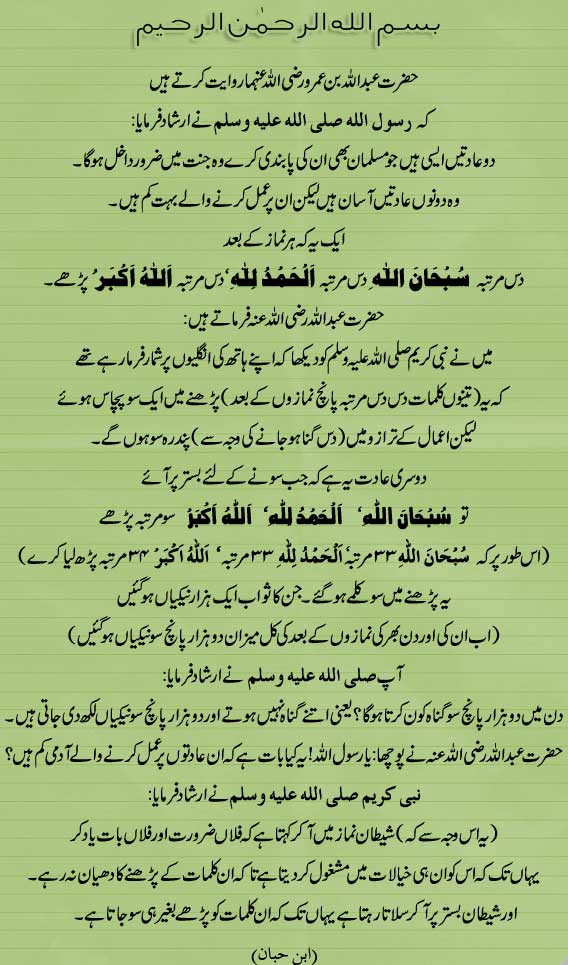
Subhan Allah, Alhamdulillah And Allahu Akbar
Fasting in Sha’ban
Imran Bin Husain relates the Holy Prophet (peace be upon him) having said to him or to someone else: ‘Did you fast in the middle of Sha’ban?’ He said: ‘No.’ Thereupon he (the Noble Prophet Muhammad, peace be upon him) said: ‘If you did not observe fast, then you should observe fast for two days. (Sahih Muslim)
The Noble Prophet Muhammad (peace be upon him) used to make preparations for the forthcoming month of Ramadan in the month of Sha’ban. He used to increase his prayers and observe fast for many days, particularly on three days, i.e. 13th, 14th, and 15th of, Sha’ban. He also used to exhort his companions to observe three fasts in this month and make preparations for the coming month. Sha’ban is in fact the precursor to Ramadan in order to attune oneself to the rigor of fasting. It is a period of training for Ramadan.
This Hadith has been interpreted differently by different scholars. One interpretation is that the man in question was accustomed to observe fast at the end of Sha’ban but he did not observe it as it was forbidden to do so.
The Noble Prophet (peace be upon him) asked him and he replied that he did not observe the fast at the end of Sha’ban. Then the Noble Prophet (peace be upon him) told him that this prohibition did not apply to those who were accustomed to fasting during those days. He was therefore asked to observe two fasts instead of one so that he might not be deprived of the good act he was doing or become slack in this good habit of devotion to Allah.
The second explanation is that the man did not observe a voluntary fast in the middle of Sha’ban which has a great reward in store for believers. On learning from the man that he has shown slackness in this, the Noble Prophet (peace be upon him) exhorted him to observe two fasts in the month of Sha’ban.
The Noble Prophet (peace be upon him) has however forbidden the believers from fasting on one or two days just before the month of Ramadan except in the case of a person who is accustomed to fasting. Fasting is also not allowed when the second half of Sha’ban starts.