
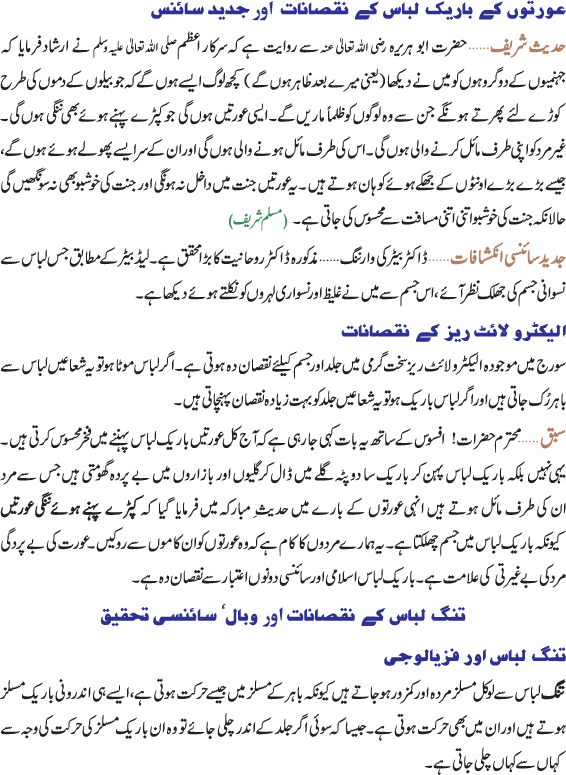
Barik Libas kay Nuqsanat
Priceless Value Of Righteous Actions
Islam came to aid the world and to make it a better place to live in. Be it countries, communities, or individuals, this great religion provides them with clear guidance. Allah has guaranteed those who live by the rules laid down in the Qur’an and the traditions of the Prophet eternal paradise.
As Muslims, we are commanded to perform righteous deeds and Allah says about those who perform righteous actions: “Verily, those who believe and do righteous good deeds, they are the best of creatures.” (Qur’an, 98:7)
Righteous actions will aid us in this world and in the hereafter. In the famous narration collected by Al-Bukhari and Muslim, the Prophet (peace be on him) said, “The dead person is followed (to his grave) by three: His family, his wealth, and his actions. Two of them return and only one remains. His family and wealth return, but his actions remain.”
From this narration, it is understood that our good actions and their benefits will remain with us forever.
But we need to look at what constitutes a righteous action. How often do people think they have performed a good action but in fact, they have not. So what are the conditions that a Muslim must fulfill in order for the action to be righteous? This is shown in the statement of Allah:
“Say (O Muhammad, peace be upon him): I am only a man like you. It has been inspired to me that your God is One God. So whoever hopes for the Meeting with his Lord, let him work righteousness and associate none as a partner in the worship of his Lord.” (Qur’an, 18:110)
For our deeds to be rewarded by Allah, we must first have the proper belief in Allah. We must worship Him alone and not associate anyone with Him. This is Tawheed, the foundation of Islam.
Simple Words That Protect From Every Harm
Khawlah Bint Hakim narrated that Allah’s Messenger (peace be upon him) said: “Whoever arrives somewhere and says: ‘I seek refuge with Allah’s complete Words from the evil He has Created (A’oodhu bi-Kalimaathillaahi- Ath-Thaammaathi min-Sharri maa Khalaq),’ nothing will harm until he leaves that place.” (Sahih Muslim, no. 2708)
In Taysir Al-Aziz Al-Hamid (p. 146), Sulayman Bin Abdullah relates that Al-Qurtubi commented on this by saying:
“And this is true and real, and I believe in it due to the textual proof as well as my own experience. Since I heard this narration, I would constantly act upon it and nothing was able to harm me until I left it.
One night, I was stung by a scorpion in Al-Mahdiyyah (a province in Tunisia). So, I thought to myself until I realized that I had forgotten to seek refuge using these words.”
In Al-Qawl Al-Mufid (1/155), Al-Uthaymeen commented on this Hadith:
“This protection is from all human and jinn devils – whether they are visible or invisible – until the person leaves that place. And there is no way that what is described in this narration will not take place, as these are the words of the truthful one who is believed (i.e. the Messenger of Allah)!
However, if what is mentioned in this narration does not take place, it is because of a preventative factor and not because of a deficiency in the method itself or the narration.
This also applies to anything that the Prophet (peace be upon him) mentioned as a Shar’ee method in which the desired outcome is not achieved. So, this is not because of a fault in the method and is rather because of the presence of an obstacle that is blocking the desired outcome.
For example, reciting ‘Al-Fatihah’ for a sick person is a form of healing. Some people recite it and find that the sick person is not healed.
This is not because of a deficiency in this method and is instead because there is something present that is preventing this method from bringing about its desired effect.
Another example is mentioning Allah before having sexual intercourse in order to prevent Satan from harming the future child.
Some people will mention Allah and find that Satan still ends up harming the child due to something that is preventing this effect from being achieved.
So, you should check yourself to figure out what the obstacle is so that you can remove it and experience the effect of the method.”
Making Du’a While Reciting Qur’an
Hudhayfah (may Allah be pleased with him) narrated, “Whenever the Prophet (peace be upon him) read a verse about Allah’s punishment, he would seek refuge in Allah. And whenever He read a verse mentioning Allah’s mercy, he would ask Allah for His mercy.” (Ahmad, 6/24, Abu Dawood, no. 873, and others; graded Hasan by Al-Albani)
Sheikh Abdul Aziz Bin Baz said: It’s Sunnah for every Muslim who reads the Qur’an – during prayer or elsewhere – to ask Allah for His bounty at the verses of mercy; and to seek refuge from the Hell-fire when he reads about Allah’s punishment. Furthermore, when a Muslim reads a verse that deems Allah above something, he declares it by saying, “Subhanahu wa Ta’ala.”
It’s recommended for every Muslim who reads “Is not Allah the Best of judges?” (Qur’an, 95:8) to say, “Indeed! I believe that to be true.” When one reads, “Is not He (Allah Who does that) Able to give life to the dead?” (Qur’an, 75:40), he should say, “Indeed! I bear witness to this.”
When one reads, “Then in what statement after this (the Qur’an) will they believe?” (Qur’an, ), he should say, “I believe in Allah.” (Qur’an, 77:50)
After the slave recites the verse, “Then which of the Blessings of your Lord will you both (jinns and men) deny? (Qur’an, 55:13), he should say, “We don’t deny any verses from our Lord.” And after reading, “Glorify the Name of your Lord, the Most High,” (Qur’an, 87:1), he says, “Subhana Rabbiyal A’la.”
All these acts are recommended for the Imam, followers, or a person reciting the Qur’an. These words are dua. They resemble saying “Ameen” after Fatihah, and Ameen should be said in the prayer and elsewhere after reciting Fatihah.
(Majmoo Fatawa Bin Baz, vol. 26, p. 62-63)
– Translated by Abdullah Bin Dwight Battle
Islam Deen-e-Insaniyat

Islam Deen-e-Insaniyat
Guidance From The Prophet (SAW)
Hadrat Anas ibn Malik (r.a.) said: ‘I heard the Messenger of Allah (saws) saying, “Allah, the Exalted, has said: `O son of Adam! I shall go on forgiving you so long as you pray to Me and aspire for My forgiveness, whatever may be your sins. O son of Adam! I do not care even if your sins should pile up to the sky and should you beg pardon of Me, I would forgive you. O son of Adam! If you come to Me with an earth full of sins and meet Me, not associating anything with Me in worship, I will certainly grant you as much pardon as will fill the earth.“
Related by At-Tirmidhi.
Commentary:
Regardless of the quality or the quantity of the sins one might have committed in one’s past, if one turns to Allah Subhanah and seeks sincere forgiveness; it is expected that they will find their Lord Forgiving and Merciful. Regardless of whether the sins one might have accumulated are major or minor, regardless of whether the sins one might have accumulated are so much that if piled up they would reach the heavens…..if one turns in ‘taubah’ unto their Lord and seeks sincere forgiveness before they meet with their appointment of death, The Lord Most Merciful will envelop such a repentant believer in His Forgiveness and Mercy.
If one were to die in a state whereby one did not seek repentance for their sins, and the sins were so many that they would fill the whole earth…provided one did not associate anything in worship with the Lord Most Majestic Most High (ie. did not commit the abomination of ‘shirk’), their Lord Most Gracious will grant them with as much pardon as will fill the whole earth! Such is the magnitude of the vastness of the Lord Most Merciful Who Created!
Allah And His Words
All of Allah’s words, which the Angel Gabriel brought to the Prophet Muhammad, are written down in a book. This book is called the Quran. In the Quran, we can read all that Allah says to us and to all mankind.
In the Quran, we can find stories of many other prophets, for Allah always sent prophets to mankind so that they would worship Him alone and do good. That is why there were many prophets before Muhammad.
We can also find many other things in the Quran. All that we as Muslims believe, and should do, is written there. When we know what is written in the Quran and follow it, we become good Muslims.
All that we know about Allah is what He Himself has told us. Allah told the Angel Gabriel to speak to Muhammad, and Muhammad told the people what the Angel Gabriel had said to him.
Allah is the only God. There is no god apart from Allah. That means, only Allah could have made mankind and the earth, moon, sun, and stars. Allah is the only One who created all these.
Of course, you know that many things on earth just work by themselves. For example, when you put seeds in the earth and wait a few months, plants will grow out of them. To put the seeds in the earth is easy, but there is an important question you must ask yourself: Where do we get the earth, and from where do we take the seeds? You may say that the seeds can be taken from other plants, and you would be right. But just think: those other plants also need the earth to grow in, so where does the earth come from?
Earth is made out of fine particles of sand, minerals, salts, and other materials. Where can we obtain the sand and other things from? Plants also need water to grow, so where does it come from? The plants need sunshine in order to shoot out from the ground. Where do we get sunshine from? We also need the day and night so that we can count how many days it takes for the plants to grow.
As we have already said, it is easy to put the seeds in the earth and wait till the plants grow out of it, but nobody can make all the things that are needed to make it work. No man can make earth and air, light and water, or the day and the night. It is exactly the same with all other things.
For instance, man can build houses. He needs stones to do this, but he cannot make the stones himself. Man can also build cars and airplanes. To do this he also needs, among other things, iron and rubber. Again, he cannot make iron and rubber himself. Iron can be found in some rocks, and when these rocks are made hot, the iron turns into fluid and flows out of them. Rubber can be found in certain trees. When the bark of these trees is cut, liquid rubber juice flows out. But the rocks in which the iron is found and the trees from which rubber flows were not made by man. Despite all his cleverness and skill, man is not able to do these things. This means that when a man makes cars or airplanes or manufactures anything else, he is using materials that are already there on Earth. Had they not been there ready to be used, man could not have made those cars, airplanes, and other things. Everything man uses to make something has been created by Allah. Allah has made all these things that man needs so that people are able to live, build houses, plant crops and rear animals for food and clothing and even make cars and airplanes.
Without Allah, man would not be able to do anything, for the simple reason that but for the will of Allah, man would not exist. It is Allah Who has created the earth, air, sun, water, and many other things that man needs in order to live. Without these, man cannot live and that means man could not exist on earth. It is Allah Who created man and He Who keeps him alive. Everything is from Allah. That is why we say: There is no god apart from Allah.
It is Allah Who has created everything. Allah has also told the man what he should do because that is good for him. Allah sent prophets to speak to the man. A man should always think of Allah and be grateful to Him, and obey the commands he has given through His prophets.
Are You Preparing For The Day Of Judgment?
Everyone in this world is well aware of the fact that this life is mortal. All of us are sent into this world for some specific time after that we have to dwell in eternal life which starts after the end of this life.
Humans pass through different phases after death i.e. separation of the soul from body, life, in the grave and the most important event that will happen on the Day of Judgment is when we will be held accountable for our deeds and when we will be questioned by our Lord Allah (S.W.T.) as He says in Quran:
“Then surely, We shall question those (people) to whom it (the book) was sent and verily, We shall question the Messengers.” ( Al-Araf, 6 and 7)
Two Methods of Accountability
On the Day of Judgment, every human being who is sent into this world in any era will be stood together at a place where they will be held accountable in front of God as He says in the Quran:
“The Day is approaching when every soul shall find itself confronted with whatever good it has done and whatever evil it has wrought. It will then wish there is a wide space between it and the Day! Allah warns you to beware of Him; He is most tender towards His servants.” (Surat Al-Imran, 30)
There will be two methods of accountability,
Those who have successfully spent their lives according to the teachings of Allah and His Prophet (PBUH) will be directly sent to paradise to live an eternal life with all the blessings they have been promised and will be considered the most successful people.
They will say: “Praise be to Allah Who has fulfilled His promise to us and made us the inheritors of this land, letting us settle in Paradise wherever we want. How excellent is the wage of those who work.” (Surat az-Zumar, 74)
Those who used to commit evil things in the worldly life will be questioned about their bad acts and surely they will have no answer for it except shame on their own deeds and begging pardon for their wrongdoings but the time of forgiveness will be over. Those people will be sent to hell fire where they will be tortured for their sins until they complete their punishments.
Kya Muslim Ko Valentine Day Manana Chahiye
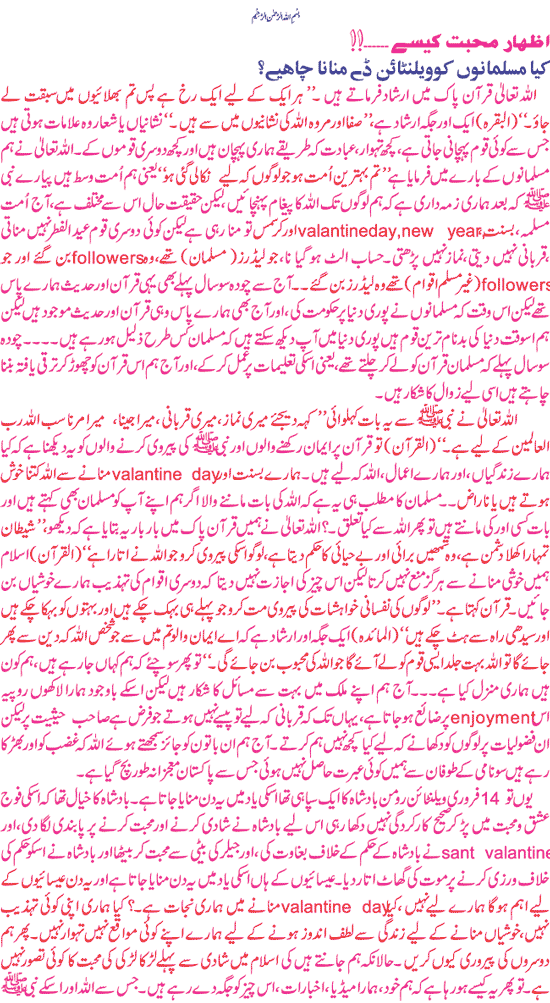
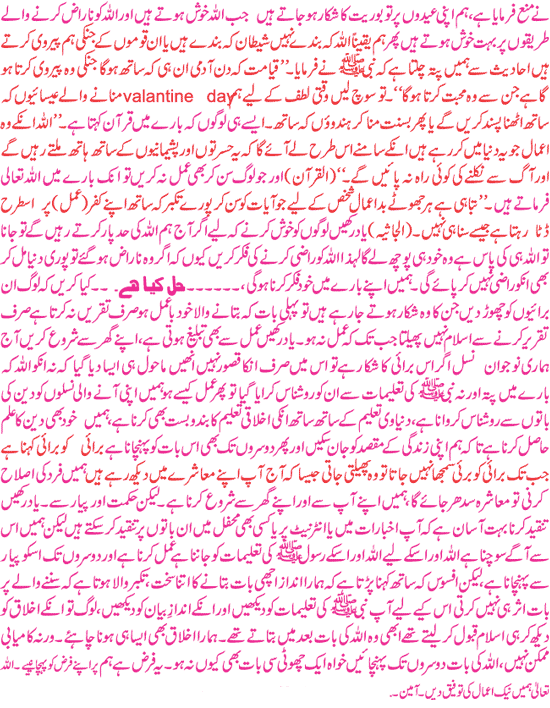
Kya Muslim Ko Valentine Day Manana Chahiye
On Valentine’s Day
Some Muslims, out of ignorance, have fallen into the evil of celebrating Valentine’s Day. Shopkeepers have jumped into preparing gifts for this day in the hope of earning some extra bucks. It’s sad that a pagan festival that promotes immorality is being observed by Muslims undermining their faith and Islamic values.
The Permanent Committee for Islamic Research and verdicts of Saudi Arabia declared it impermissible for Muslims to celebrate non-Muslim occasions like Valentine’s Day, which is also known as the ‘festival of love.’
“(This) is one of the festivals of the pagan Romans, when paganism was the prevalent religion of Romans, more than 17 centuries ago,” said Dr. Su’ad Ibrahim Saleh, professor of Fiqh at Al-Azhar University, Cairo in one of his articles.
Several customs connected with Valentine’s Day originate from the beliefs held in England and France during the middle ages. One such example is that birds begin to pair on February 14. According to research, the Romans introduced this pagan festival into the Christian world. In Saudi Arabia, however, it’s not permitted to celebrate this festival and the Commission for Promotion of Virtue and Prevention of Vice strictly banned the sale of any red roses, hearts or even wrapping paper on this day.
In Islam, expressing love is fine as long as it doesn’t fall into what is Haraam. Among the greatest of all types of love is the love for Allah and His Messenger, and the love for Islam. Loving our parents, family, and relatives is very much encouraged. Love of courtship is allowed only between married spouses. Islam highly recommends that spouses show affection and mercy towards each other. Islamic requirements are only in the best interest of society, to protect morality and nourish familial values. Immorality and Haraam relationships lead to the disintegration of families and ultimately to the degradation and destruction of society. Islam is the best model to follow. All praise and thanks be to Allah for giving us this blessing. We, who have divine guidance, are not in need of imitating the West.
The Prophet (peace be upon him) told us that Muslims would eventually fall into this error. Abu Sa’eed Al-Khudri narrated that the Prophet (peace be upon him) said: “You will certainly follow the ways of those who came before you, span by span, cubit by cubit until even if they were to enter a lizard’s hole, you would follow them.” We said, “O Messenger of Allah, (do you mean) the Jews and Christians?” He said, “Who else? !” (Al-Bukhari, 8/151, and Muslim, 4/ 2054)
This Hadith should serve as a stark reminder for all of us. We, instead of influencing others to enter the fold of Islam, are following them at the expense of our religion. May Allah protect all Muslims and guide them to the straight path. Aameen.