Kya Muslim Ko Valentine Day Manana Chahiye

Kya Muslim Ko Valentine Day Manana Chahiye
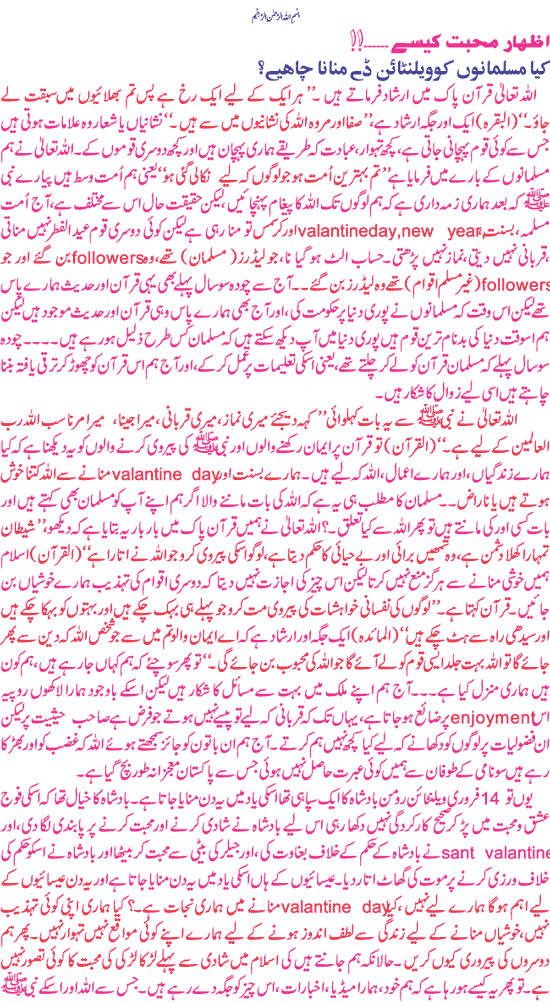
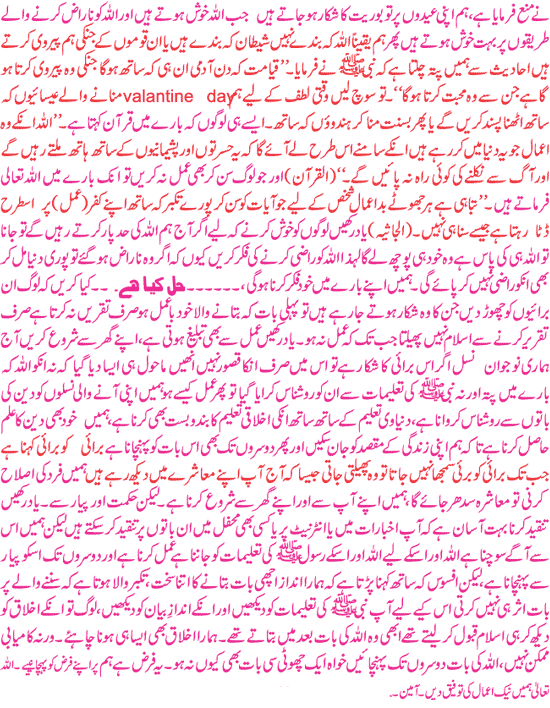
Some Muslims, out of ignorance, have fallen into the evil of celebrating Valentine’s Day. Shopkeepers have jumped into preparing gifts for this day in the hope of earning some extra bucks. It’s sad that a pagan festival that promotes immorality is being observed by Muslims undermining their faith and Islamic values.
The Permanent Committee for Islamic Research and verdicts of Saudi Arabia declared it impermissible for Muslims to celebrate non-Muslim occasions like Valentine’s Day, which is also known as the ‘festival of love.’
“(This) is one of the festivals of the pagan Romans, when paganism was the prevalent religion of Romans, more than 17 centuries ago,” said Dr. Su’ad Ibrahim Saleh, professor of Fiqh at Al-Azhar University, Cairo in one of his articles.
Several customs connected with Valentine’s Day originate from the beliefs held in England and France during the middle ages. One such example is that birds begin to pair on February 14. According to research, the Romans introduced this pagan festival into the Christian world. In Saudi Arabia, however, it’s not permitted to celebrate this festival and the Commission for Promotion of Virtue and Prevention of Vice strictly banned the sale of any red roses, hearts or even wrapping paper on this day.
In Islam, expressing love is fine as long as it doesn’t fall into what is Haraam. Among the greatest of all types of love is the love for Allah and His Messenger, and the love for Islam. Loving our parents, family, and relatives is very much encouraged. Love of courtship is allowed only between married spouses. Islam highly recommends that spouses show affection and mercy towards each other. Islamic requirements are only in the best interest of society, to protect morality and nourish familial values. Immorality and Haraam relationships lead to the disintegration of families and ultimately to the degradation and destruction of society. Islam is the best model to follow. All praise and thanks be to Allah for giving us this blessing. We, who have divine guidance, are not in need of imitating the West.
The Prophet (peace be upon him) told us that Muslims would eventually fall into this error. Abu Sa’eed Al-Khudri narrated that the Prophet (peace be upon him) said: “You will certainly follow the ways of those who came before you, span by span, cubit by cubit until even if they were to enter a lizard’s hole, you would follow them.” We said, “O Messenger of Allah, (do you mean) the Jews and Christians?” He said, “Who else? !” (Al-Bukhari, 8/151, and Muslim, 4/ 2054)
This Hadith should serve as a stark reminder for all of us. We, instead of influencing others to enter the fold of Islam, are following them at the expense of our religion. May Allah protect all Muslims and guide them to the straight path. Aameen.
Anas ibn Malik reports that the Prophet (peace be upon him) was sitting with a number of his companions when a funeral passed by. Those who were with him praised the dead person, and the Prophet said: “He has secured it.” Sometime later another funeral passed by and the same companions spoke negatively of the deceased. The Prophet said: “He has secured it.” Umar asked the Prophet: “What is it that was secured?” The Prophet said: “You praised the first one and he secured heaven, while you spoke negatively of the second and he secured his position in hell. You are God’s witnesses on earth.” (Related by Al-Bukhari).
Other reports of this incident clarify that the Prophet and a few of his companions were together when the two funerals passed by. In each case, the Prophet asked who the deceased was. They named the first person and said that he was a man who loved God and the Prophet and was keen to obey God’s orders and steer away from sin. They added that he was a very good and pious person with no doubt about the strength of his faith. When the second funeral went through and they named the deceased, they added that he was a man of bad manners, abusive, and negligent of his religious duties. Commenting on both cases, the Prophet used the same words, “He has secured it.”
The Prophet’s companions were amazed at this. Hence they asked what was secured by both persons. The Prophet told them that the one who received their unqualified praises secured heaven, while the others of whom they were very critical secured hell. Scholars give various explanations of this Hadith, with some of them saying that it is limited to the Prophet’s companions who were all very pious and would not praise or criticize anyone unless they were certain that he well deserved their praise or criticism. The majority of scholars, however, maintain that this Hadith has universal application. When several people, who are known to be pious and truthful, testify that a deceased person was good in character and behavior, God-fearing and kind to other people, God accepts their testimony, forgives that person his sins, and admits him to heaven.
What this means is that the person concerned tried throughout the best part of his life to implement Islamic teachings and values. When a person does that, his behavior is certain to be reflected on others who deal with him. It will be known to many people. They are bound to praise him when they learn of his death. They are considered God’s witnesses. He accepts what they say and deals with the deceased accordingly. The reverse is also true. Normally people tend to overlook a person’s misdeeds when he has died, preferring not to mention them. If, nevertheless, several people point out that the deceased was of bad character, ill-behaved, and defiant of God’s commandments, God accepts their testimony.
This Hadith encourages us to be good to others in whatever way we can. It tells us that observing Islamic teachings in all our dealings with other people will secure our admittance to heaven because such people will say what they know of our good character when we die. Their praise will be accepted by God as sound testimony and his ruling on our destiny will be based on that. This is what the Prophet’s words mean: “You are God’s witnesses on earth.” ‘You’ in this statement refers to all people.
-By Adil Salahi
Islam is a complete way of life and therefore teaches us good manners too. Cleanliness in Islam is given a lot of importance according to a famous Hadith which says, “Purification is half of faith.” (Muslim). It not only teaches us personal hygiene but also the cleanliness of our houses and neighborhoods.
Allah has indeed created man in the best form and granted him beauty, and so he wishes to see His slave in the best form as well. “Verily Allah is beautiful and loves beauty.” (Muslim).
The use of siwak or miswak holds great importance in Islam. Apart from keeping the body and limbs clean Islam teaches special cleanliness for the mouth in order to keep away from diseases and also to make one’s breath pleasant so that it doesn’t become a cause of discomfort to others. Since teeth are the doors of our mouth they should always be clean and shining as it adds beauty to a Muslim’s smile and face.
“Abu Hurairah (may Allah be pleased with him) narrated, that the Prophet (peace be upon him) said, ‘Was it not for my fear of imposing a difficulty on my Ummah I would have ordered that the miswak be used for every Salah’.” (Bukhari).
It was after listening to this saying of the Prophet (peace be upon him) that his companions made the use of miswak a part of their routine. Teeth are important components of the human body that need special care as there hides the secret of health. The minerals in this twig include potassium, sodium chloride, sodium bicarbonate, and calcium oxides. These ingredients strengthen the tooth enamel, and the bark contains an antibiotic that suppresses the growth of bacteria and the formation of plaque.
Research shows that regular use of miswak significantly reduces plaque, gingivitis, and the growth of carcinogenic bacteria.
Miswak not only cleans the teeth but also strengthens the gums. It further makes the mouth odor free and gets one close to his Lord by attaining a Muslim in the favor of Allah, the Almighty. Ibn Umar (may Allah be pleased with him) narrated that the Messenger of Allah (peace be upon him) said, “Make a regular practice of the miswak, for verily, it is healthy for the mouth and it is a Pleasure for the Creator (i.e. Allah is pleased with the Muslim who uses the Miswak).” (Bukhari)
It was the routine of our Prophet (peace be upon him) to use siwak before entering his house. He made sure to use the siwak before every salah. The Prophet (peace be upon him) used siwak when he got up for the night prayer. (Bukhari, Hudaifa)
The above mentioned Ahadith teaches us the importance of using siwak in our lives and during our acts of worship to make ourselves more presentable and likable in the sight of our Lord as well as the people around us. We must make it a habit to use siwak prior to reading Qur’an and Salah. It is a Sunnah to use it during fasting as well. The intense cleaning of our mouth keeps our mouth throat and digestive tract protected. Our Prophet (peace be upon him) has taught our Ummah a great medical formula to avoid germs.
Today, we see many young and old, men and women indulging in smoking cigarettes and sheesha thereby making their mouths full of foul smell and harming their precious teeth, gums, and lungs, leading to diseases that could even be fatal like cancer. They may think it’s fashionable although, in reality, it is a filthy habit that harms others also. If we would adopt this healthy habit of using the siwak we would not only gain worldly benefits, but also the favors of our Lord in the hereafter.
The Miswak is a great Sunnah of the Messenger of Allah (peace be upon him). May Allah guide all of us to leave our filthy habits and adopt a habit that is good for us and our religion.
– by Nawal Aqil

Aurat Ka Parda
The pleasures of this world are tangible and present, whilst the delights of Paradise are as-yet-unseen promises. People are readily influenced by what they can see and know instantly; it is hard enough for them to forgo something that is in front of them for the sake of something else that is in the future, so how much harder it is if the promise will not be attained until after death! So Allah (SWT) drew a comparison between the pleasures of this world and the joys of Paradise and explained that the delights of Paradise are far superior to this world’s pleasures. The Qur’an speaks at length denouncing this world of instant, fleeting pleasures and stating that the rewards with Allah as far better, to encourage man to strive hard for success in the next world:
“And strain not your eyes in longing for the things We have given them for enjoyment to various groups of them [mushrikeen and kuffaar] the splendour of this life that We may test them thereby. But the provision [good reward in the Hereafter] of your Rabb is better and more lasting” [20:131]
And “Beautified for men is the love of things they covet: women, children, much of gold and silver [wealth], branded beautiful horses, cattle and well-tilled land. This is the pleasure of the present world’s life but Allah has the excellent return with Him. Say: “Shall I inform you of things far better than those? For al-Muttaqoon there are Gardens with their Rabb, under which rivers flow. Therein [is their] eternal [home] and Azwaajun mutahharatun [purified mates or wives], and Allah will be pleased with them. And Allah is All-Seer of [His] Slaves” [3:14-15]
There are many reasons why the delights of Paradise are superior to the pleasures of this Dunya; Amongst them:
(i) The Pleasures of this Dunyaa are Fleeting.
“Say: Short is the enjoyment of this world. The Hereafter is [far] better for him who fears Allah..” [4:77]
The Prophet (saw) illustrated the inferiority of this Dunya by comparing it to what Allah has prepared in Paradise, “By Allah, this world in comparison with the Hereafter is nothing more than as if one of you put his finger” – and he gestured with his forefinger – “in the sea; let him see how much water he would retrieve” [Saheeh Muslim, 4/2193, no. 2858]. A finger dipped in the ocean would not even pick up one drop; this is how little this world is worth when compared with the Aakhirah.
Because these pleasures are so insignificant, Allah (SWT) has rebuked those who prefer the pleasures of this world to the joys of the Aakhirah:
“O you who believe! What is the matter with you, that when you are asked to go forth in the Cause of Allah [Jihaad] you cling heavily to this earth? Do you prefer the life of this world to the Hereafter? But little is the comfort of this life, as compared with the Hereafter” [9:38]
Muslim reports from ‘Abdullaah ibn ‘Amr (RA) that the Messenger of Allah (saw) said “The poor of the Muhajireen will enter Paradise forty years ahead of the rich”. (Mishkaat al-Masaabeeh, 2/663, no. 5235)
at-Tirmidhi reported from Abu Sa’eed, and Ahmad, at-Tirmidhi, and Ibn Maajah reported from Abu Hurayrah, that the Messenger of Allah (saw) said: ” The poor of the Muhajireen will enter Paradise five hundred years ahead of the rich of the Muhajireen” (Saheeh al-Jaami’ 4/90, no.4104).
Elsewhere the Prophet (saw) explained that these are the people who have nothing to be brought accounted for, and this is in addition to their jihad and virtue. al-Haakim reported from ‘Abdullaah ibn ‘Amr that the Messenger of Allah (saw) said, “Do you know who will be the first of my ummah to enter Paradise?” I said, “Allah and His Messenger know best”. He said, “The poor of the Muhajireen. They will come to the gate of Paradise on the Day of Resurrection and ask for it to be opened. The gatekeepers will say to them, “Have you been brought to account?” They will say, “What do we need to be brought to account for? We were carrying our swords and fighting for the sake of Allah (SWT) until we died.” Then the gates will be opened for them and they will stay there for forty years before anyone else enters”. (Silsilah al-Hadith as-Saheehah, 2/532, no. 853, al-Haakim said it is sahih according to the conditions of al-Bukhaari and Muslim).
al-Bukhaari reports from Usaamah ibn Zayd that the Prophet (saw) said, ” I stood by the gate of Paradise and saw that the majority of those who entered were the poor and wretched. The rich [Muslims] were detained while the people of Hell were ordered to be taken to Hell”. (Sahih al-Bukhaari, Kitaab ar-Riqaaq, BAab Sifaat al-Jannah, wan-Naar, Fath al-Baari, 2/345)
Some of the hadith quoted above stated that the poor will enter Paradise forty years ahead of other people while others state that the difference will be five hundred years. The two statements may be reconciled by pointing out that the poor are not all alike, and neither are the rich. As al-Qurtubee suggested (at-Tadhkirah, p.470) the poor vary in the strength of their Iman and their achievements, and the same applies to the rich. If we think in terms of the first of the poor and the last of the rich to enter Paradise then the time span will be five hundred years, but if we are thinking of the last of the poor and the first of the rich, then the time span is forty years. And Allah knows best.” (Ibn Katheer, an-Nihaayah, 2/345)
WHO amongst us dislikes being praised? Well, we might not do a certain act to be praised but yes we do feel happy when our work is appreciated. How we go ‘over the moon’ when our bosses appreciate our work.
Should I not remind you of a small deed by which Allah will remember you and praise you! That’s Dhikr, remembering Allah.
“Therefore remember Me (by praying, glorifying). I will remember you….’’ (Qur’an, 2:152)
You may remember Allah on this earth in a small gathering, but Allah, Who is high above the heavens, will remember you in a better gathering, amongst the angels.
Prophet Muhammad (peace be upon him) said, “Allah says: “I am as my slave expects me to be, and I am with him when he remembers Me. If he remembers Me inwardly, I will remember him inwardly, and if he remembers Me in an assembly, I will remember him in a better assembly (i.e., in the assembly of angels).’’ (Al-Bukhari and Muslim)
So when we attend Islamic lectures and classes of Qur’an and Hadith in which Allah is remembered, His Religion is taught, Insha, Allah, our Creator will mention us in gatherings better than ours. When we do Dhikr, like Tasbeeh (Subhan Allah), Tamheed (Alhamdulillah), Takbeer (Allahu Akbar), and Tahleel (Laa ilaha illAllah) to ourselves, Allah will also Insha, Allah remember and mention us. What a great honor!
Why should we do Dhikr?
• Command of Allah
“And remember the Name of your Lord every morning and afternoon.” (Qur’an, 76:25)
• Path to success
“…and remember Allah much, that you may be successful.’’ (Qur’an, 62:10)
• Best of deeds
The Messenger of Allah (peace be upon him) said, “Shall I not inform you of the best of your actions which are the purest to your Lord, which exalt you to the high ranks, which are more efficacious than spending gold and silver (in charity), and better for you than you should encounter your enemies whom you will smite their necks and they will smite your necks?’’ They said, “Certainly.’’ He (peace be upon him) said, “Remembrance of Allah the Exalted.’’ (Al-Tirmidhi)
• Easy way to earn a reward
Prophet Muhammad (peace be upon him) said, “Wudu’ is half of Salat, and the expression: Subhan Allah (Allah is free from imperfection)’ fills the Balance, and the expression: `Alhamdulillah (praise be to Allah)’ fills the space between the heavens and the earth.’’ (Sahih Muslim)
There are many more benefits of Dhikr, mentioning which is not possible in a short article. Dhikr is a deed that doesn’t take more than half a second of our time and has enormous benefits. Dear brothers and sisters, let’s keep our tongues moist with Dhikr. Besides it’s a very easy Ibadah. It doesn’t require us to be in ablution or facing the Qiblah; it is also not restricted to specific timings – we can do it while driving, doing our household work, buying groceries, etc.

Muslim Muashra Aur Orat
Health is the most important aspect of human life; without it we cannot function well. Today we have made material progress and technological advancement, but the world is widespread with an increasing number of diseases. Prophet Muhammad (peace be upon him) taught us many aspects of healthy living which Allah ordered him to teach mankind. He himself enjoyed good health.
The Prophet (peace be upon him)) prescribed black seeds (habbas-sawda), which he said is a cure for all diseases except death. It is true that if we take a few black seeds in the morning we are protected from many diseases – to mention only a few: coughs, colds, arthritis, nausea, constipation, etc. The Prophet (peace be upon him) said olive oil is a cure for many diseases which is quite true as has been proved by medical standards. One tbsp. of olive oil daily in the morning overcomes pains in the joints and lessens the risk of a heart attack. In the Qur’an, Allah prescribed honey as a cure for mankind, which is so true. If we take honey at breakfast we are protected from many diseases, for example, coughs, colds, asthma and depression, etc. We should make sure the honey is pure. If we apply it to our eyes we do not need glasses.
Prophet Muhammad (peace be upon him) regularly ate dates, which have been proved by medical standards to contain all the nutrients of a well-balanced diet. It is very energizing as well, and we know from the Prophet Muhammad s life that he was always energetic. He relished goat s milk, which is very low in fat and is a cure for many diseases. Moreover, he was very fond of all milk, drank himself, and presented it to others. Drinking milk reduces the risk of heart attacks as has been established by medical standards. He used to put honey in it and drink it which too is very energizing. Then he didn t have milk, he used to put honey in water and drink it which is also very energizing.
Prophet Muhammad (peace be upon him) prohibited the intake of pork as enjoined by Allah, as it is not healthy to eat its meat because it feeds on dirt which causes many diseases. In the Quran, it is also forbidden to use intoxicants that are not healthy as has been proved by medical standards. Even occasional drinking of wine causes migraine headaches.
Prophet Muhammad (peace be upon him) recommended using the miswak regularly, which keeps the teeth and gums clean and healthy. It is a cure for thyroid problems too, if we use it in the interior teeth and gums.
The Prophet (peace be upon him) recommended sleeping early, the night after Ishaa prayer, as early night sleep promotes health. He enjoined us to wake up early, as the early morning sunlight is beneficial for health and cures many diseases. He also advised us to rest in the afternoon after lunch, which refreshes us and now most workers in the U.S.A. are demanding a break in the afternoon for short naps as they say the Mediterranean naps refresh them and they have a better input to continue work instead of increase in wages.
The Prophet (peace be upon him) taught us to wash after relieving ourselves, which protects us from many diseases. He also ordered the use of the left hand for washing afterward since it protects us from becoming a carrier of many diseases. He recommended clipping the nails, which also keeps us from becoming a carrier of many diseases.
If we follow all the above-mentioned recommendations we can lead more healthy lives, which will be very fulfilling for us and the people around us, as was practiced and enjoined by Prophet Muhammad (peace be upon him).
Cleanliness and personal hygiene were taught and practiced by the Prophet (peace be upon him). He taught us to clean our teeth and wash ourselves by performing ablution before prayers, which protects us from many diseases. Cataract of the eyes develops due to air pollution, so doctors recommend washing the eyes after exposure from outside or workplaces to avoid cataract from developing. If we follow all these health points preached and practiced by the Prophet (peace be upon him), we can lead more healthy and fruitful lives.