
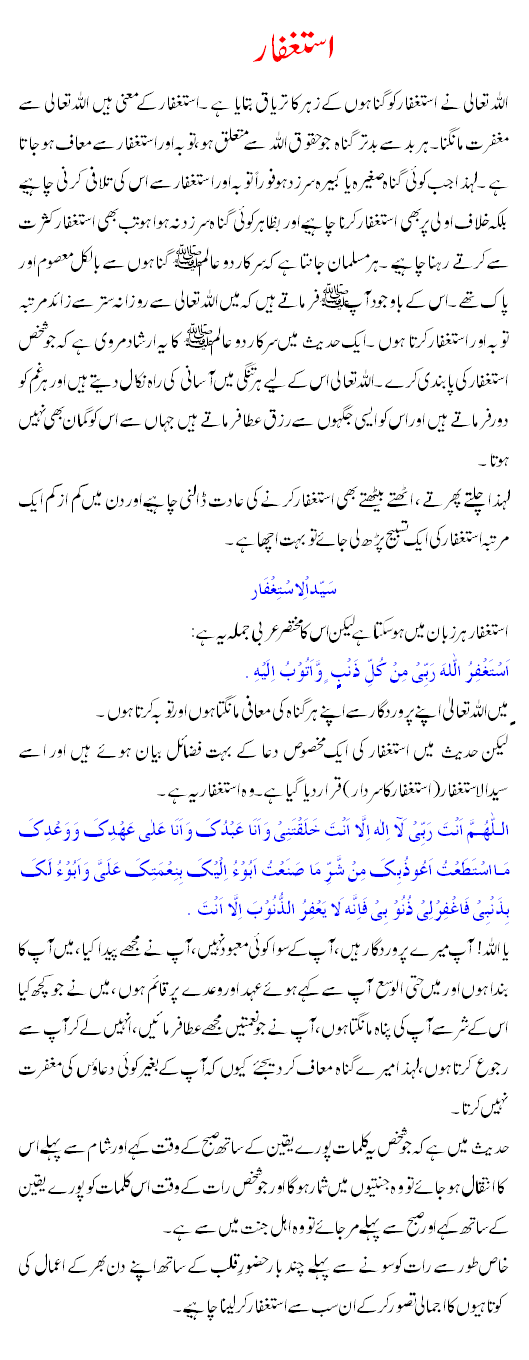
Istighfar
Differences Between The Levels Of Paradise
The Prophet (Sallallahu Alaihi Wasallam) explained that the people will be on different levels in Paradise according to their status. al-Bukhaari and Muslim report from Abu Sa’eed al-Khudri that the Prophet (saw) said, ” The people of Paradise will look at the people dwelling in the chambers above them in the same way that people look at a brilliant star shining far away on the horizon, in the East or West, because of their superiority [in reward] over them.” The people asked, “O Messenger of Allah, are these the dwellings of the Prophets which no one else can attain?” He replied, “No by the One in Whose Hand is my soul, they are for the men who believed in Allah, and also in His Messengers.” [Saheeh al-Bukhaari, Kitaab Bid’ al-Khalq, Baab Sifaat al-Jannah wan-Naar, Fath al-Baari, 6/220; Saheeh Muslim Kitaab al-Jannah, Baab tara’i Ahl al-Jannah Ahl al-Ghuraf, 4/2177, no. 2831]
Ahmad, at-Tirmidhi, Ibn Maajah, and Ibn Hibbaan reported from Abu Sa’eed that the Prophet (saw) said,”The people in the higher levels will be seen by those below them as if they were looking at a star rising on the horizon. Abu Bakr and ‘Umar will be among them; what good people they are!” [Saheeh al-Jaami’ as-Sagheer, 2/187, no. 2026]
al-Qurtubee said, “Know that these chambers will differ in height, and appearance according to the deeds of their occupants. Some of them will be higher than others. When the Prophet (saw) said, “No by the One in Whose Hand is my soul, they are for the men who believed in Allah (SWT) and also in His Messengers; he did not mention deeds or anything other than faith and belief in the Messengers, with no doubts or questions. Otherwise, how could these chambers be reached through the faith and belief of the ordinary people? If that were the case, then all the Muslims would reach these highest levels, and that is impossible” As Allah says, “Those will be rewarded with the highest place [in Paradise] because of their patience..” [25:75]
This patience often involved self-sacrifice and being steadfast for the sake of Allah, focusing on Him, and being a true slave to Him. These are the attributes of al-Muqarraboon, as Allah (SWT) says:
“And it is not your wealth, nor your children that bring you nearer to Us, but only he [will please Us] who believes and does righteous deeds; for such there will be twofold reward for what they did, and they will reside in the high dwellings [Paradise] in peace and security“. [34:37]
Here Allah mentioned the highest chambers or dwellings of Paradise and states that they will not be attained by means of wealth and children, but through faith and righteous deeds then they will have a double reward. Their place will be the high dwellings, which tells you that this is faith that gives one tranquillity and certainty and fills the heart. A person with such faith is content no matter what happens to him and in all situations and circumstances. If he does a good deed, he does not mix it with the opposite, which are evil deeds. Good deeds that are uncontaminated with evil deeds cannot be achieved except by the one whose Iman is very great and who is content and has no doubts, no matter what his circumstances. The faith and deeds of the one whose good deeds are contaminated are not like that, so his status will be lower” [al-Qurtubee, at-Tadhkirah, p. 464]
The inhabitants of the highest levels of Paradise will enjoy greater pleasures than the people below them. Allah (SWT) has promised two gardens to those who fear Him:
“But for him who fears the standing before his Rabb, there will be two gardens” [55:46]
Things To Do Before Friday Prayer
Friday prayer is very special. It is the only weekly prayer that must be offered in congregation at a mosque or a place known to the local community. As we pray five obligatory prayers every day, it is the only one in 35 prayers that has these conditions. It is at midday, so everyone is able to attend, even those who work night shifts. It is preceded by a speech delivered by the imam, who is required to remind his congregation of the Day of Judgment and to address some of the issues that are very important to the community.
Islam attaches particular importance to cleanliness and purity, both physical and spiritual. Since Friday prayer must be in the congregation, mosques are always full when it is offered. In order that people not to find at the mosque what makes them dislike attendance there, Islam requires that we observe certain rituals when attending Friday prayer. These are summed up in the following Hadith in which Salman Al-Farisi quotes the Prophet (peace be upon him) as saying: “Whoever takes a bath on Friday, purifying himself as much as he can, and then applies a touch of oil or uses some of the perfume of his household, then goes out to prayer, making sure that he does not separate two people, then prays whatever is assigned to him, then listens when the imam speaks, will have all his sins forgiven between that day and the other Friday.” (Related by Al-Bukhari).
The emphasis on cleanliness and good presentation is clear. The first thing one does on Friday is to take a bath or a shower before going out to the mosque. Then one applies oil or a similar product so as to make himself more presentable: his hair will be tidy and his appearance pleasant. He should also wear some perfume. The Prophet speaks of the “perfume of his household” to indicate that perfume should be in every Muslim’s home so that wearing it is common practice, done by everyone. In another version of this Hadith, the phrase used is “his wife’s perfume,” to indicate that if one does not normally use perfume, then he should borrow a touch of perfume from his wife. In the same version, reported by Abdullah ibn Umar, there is an added phrase: ‘then wears some of his better clothes’, which confirms the Quranic directive: “Dress well when you attend any place of worship.” (7: 31)
When one goes out, heading for the mosque, one should walk normally, without rushing or running. He must not engage in any heated argument or use vulgar language. When he arrives at the mosque, he must not go in between people sitting close to each other. The Prophet expresses this as “separating two people.” We all know that some people come late and yet try to move up to the middle of the front of the mosque, disturbing a few people as they walk through the rows. Instead, one should sit where there is a vacancy.
When the imam delivers his speech, everyone should listen attentively, trying to make the maximum benefit from the sermon. No side talk is permissible when the imam is speaking.
Observing all these simple instructions ensures good attendance at mosques and keeps mosques clean. What is more for the individual is forgiveness of sins for a week. Scholars say that the Hadith could be taken as indicating forgiveness of sins of the week that has already passed, or the forthcoming week. They also indicate that this applies to minor sins. Cardinal sins require more than attending Friday prayers to be forgiven. The first thing required is repentance and appealing for God’s forgiveness. Added to that is a firm resolve that one is not going to commit those sins again.
– By Adil Salahi
When One Is Too Tired To Pray
Zainab bint Jahsh, one of the Prophet’s wives, was very devout. She was keen to offer voluntary prayers and to fast. Furthermore, she excelled in handiwork. She did things and sold them, giving the proceeds to charity. As her home was adjacent to the mosque, she sometimes offered voluntary worship in the depth of the night in the mosque.
Anas ibn Malik reports: “The Prophet (peace be upon him) came one day into the mosque and found a rope stretched between two pillars. He asked what was the rope for.
He was told that it was put up for Zainab so that she would hold on to it during her prayer when she felt too tired. The Prophet said: ‘No. Take it off. Let everyone pray when they feel fresh and comfortable. When they feel tired, they should sit down.’” (Related by Al-Bukhari).
This is just an example of the fact that Islam does not overburden its followers with worship duties. Voluntary night worship is highly recommended. It earns rich rewards from God. Yet no one should go to extreme lengths in offering such worship. It is not right to test one’s endurance in worship. God has made fasting one of the best rewarding acts of worship. We fast in Ramadan as a duty, refraining from taking food or drink for the length of the day, from dawn to dusk. Yet when the fasting time is over, we enjoy a good meal. We have another meal just before starting the fast. Thus, we are able to cope without much strain. Some people tried to make fasting harder, by taking a drink at sunset and continuing the fast to the next day. The Prophet made it clear that was wrong. He issued clear orders that no one should do that.
The present hadith tells us a similar story with regard to prayer. His wife, who was known for her exemplary devotion, wanted to spend much of the night in worship. After a while, she was very tired and could not stand up in prayer. The following day, she asked for a rope to be tied to two pillars at a suitable height for her. She felt that if fatigue overtakes her and she is about to fall asleep, she could hold on to the rope in order to keep her awake.
Thus, her body would be crying for sleep but her mind wanted her to continue her voluntary worship. The Prophet disapproved. He was too kind to his people to allow this. Moreover, he wanted them to approach worship in a cheerful and comfortable frame of mind. If worship becomes too tiring, people would soon feel it a burden and might leave it altogether. Hence, he told them to offer voluntary worship only when they are fresh and alert.
This is in line with Quranic guidance. God says in the Qur’an: “God does not charge a soul with more than it can bear. In its favor shall be whatever good it does, and against it whatever evil it does. Our Lord, do not take us to task if we forget or unwittingly do wrong. Our Lord, do not lay on us a burden such as that You laid on those before us. Our Lord, do not burden us with what we do not have the strength to bear. Pardon us, and forgive us our sins, and bestow Your mercy on us. You are our Lord Supreme; grant us victory against the unbelievers.” (2: 286)
Such is the supplication of believers: that they should not have a burden that is too hard. Hence, they must not make worship too hard.
-By Adil Salahi
Hidayath Kay Asrar O Ramuz
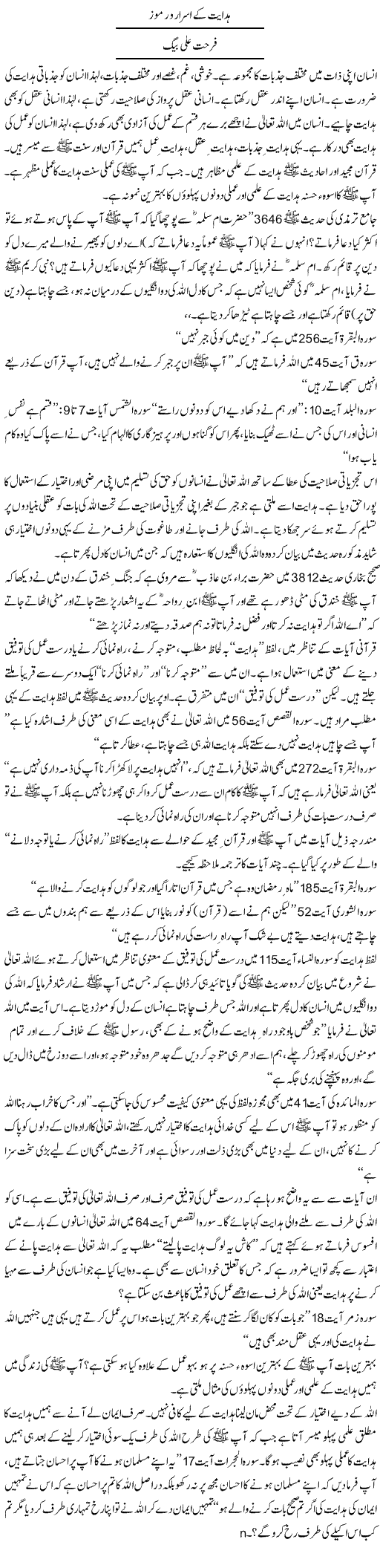
Hidayath Kay Asrar O Ramuz
Change Your Life
1 – Abu Hurayra reported that the Messenger of Allah, (PBUH), said,”This world is the prison of the believer and the paradise of the unbeliever.” [Muslim]
2 – Abu Hurayra reported that the Messenger of Allah, (PBUH), said, “The Fire is surrounded by indulgence (pleasures) of appetites and Jannah is surrounded by things people dislike.” [Agreed upon]
3 – Abu Hurayra reported that the Prophet, (PBUH), said, “A man follows the religion of his close friend, so each of you should be very careful about whom he takes as a close friend.” [Abu Dawud and at-Tirmidhi]
4 – Sahl ibn Sa’d reported that the Messenger of Allah, (PBUH), said, “Anyone who safeguards for My sake what is between his jaws and what is between his legs, I will safeguard Jannah (Paradise) for him.”[Agreed upon]
5- Anas reported that the Prophet, (PBUH), said, “None of you can truly be said to believe until he wants for his brother what he wants for himself.” [Agreed upon]
6 – An-Nu’man ibn Bashir reported that the Messenger of Allah, (PBUH), said, “The metaphor of the believers in their mutual love, mercy, and affection is that of the body. When one limb of it (the body) complains, the rest of the body collapses with sleeplessness and fever.“[Agreed upon]
7 – Abu Hurayra reported that the Messenger of Allah, (PBUH), said, “The strong man is not the one who throws people in wrestling. The strong man is the one who has control of himself when he is angry.” [Agreed upon]
8 – Jarir ibn ‘Abdullah reported that the Messenger of Allah said, “If someone does not show mercy to people, Allah will not show mercy to him.” [Agreed upon]
9 – Abu Muhammad al-Hasan ibn ‘Ali ibn Abi Talib said, “I memorized from the Messenger of Allah, (PBUH): ‘Abandon anything that gives you doubt for what gives you no doubt. Truthfulness is peace of mind and lying is doubt.” [At-Tirmidhi]
10 – Abu Umama Sudayy ibn ‘Ajlan al-Bahili said, “I heard the Messenger of Allah, (PBUH), speaking in the Hajj of Farewell. He said, ‘Fear Allah, pray your five prayers, fast your month (of Ramadhan), pay the Zakat on your property and obey your leaders and you will enter the Jannah of your Lord.” [At-Tirmidhi}
Joining Ties Of Kinship
Relatives are those who are related to you through blood and close ties; such as the brother, the uncle, the aunt, or their children. Everyone who has a tie of relation with you has certain rights upon you in accordance with how closely they are related to you. Allah said regarding this: “And give to the relative his right.” (Qur’an, 17:26). Allah also said: “And worship Allah alone, and do not set up any partner to Him in worship, and be kind and good to the parents, and to the relatives.” (Qur’an, 4:36)
So it is obligatory upon everyone to treat his relatives in the best possible manner, and to support them in accordance with their needs, and what they seek of help and support. And this is what is enjoined by the Shariah, the ‘Aql (sound reasoning), and the Fitrah (natural disposition).
There are several textual evidence encouraging and urging Silat-ur-Rahim (joining the ties of kinship).
The Prophet (peace be upon him) said: “Whosoever believes in Allah and the Last Day let him keep the ties of kinship.” (Al-Bukhari, no. 6138)
Unfortunately, many people do not observe this right and transgress the bounds. Some of them do not seek to join ties with relatives or show kindness to them; neither through wealth, nor through good behavior, nor through the giving of occasional gifts and presents nor through rendering help to them in their times of need. Indeed, days and months may pass without even seeing or visiting them! Sometimes, rather than seeking to join ties of kinship, some people even intend to sever such ties, by trying to harm their relatives – either through words or actions. Such people may keep close ties with those who are not relatives, yet cut off ties with their relatives!
Others only maintain ties of relationship with those who maintain ties with them and cut off ties with those who cut off from them. So they are not really maintaining ties of relationship; they are only acting tit-for-tat.
The true waasil (one who keeps ties of kinship) keeps ties of relation for the sake of Allah – regardless of whether his relations keep ties with him or not.
The Prophet (peace be upon him) said: “The waasil is not the one who merely does so out of reciprocation. Rather, the waasil is the one who even when the relatives cut off from him, still maintains ties with them.” So a man asked: “O Messenger of Allah. I have relatives with whom I maintain ties of kinship, yet they cut off from me. I treat them kindly, yet they treat me in an evil manner. And I am forbearing and patient with them, yet they behave rudely and ignorantly towards me.” The Prophet (peace be upon him) said: “If the situation is as you say, then it is as if you are filling their mouths with sand. And Allah will continue to aid and support you as long as you continue doing what you are doing.” (Al-Bukhari, no. 5911)
If there were no other rewards for keeping ties of kinship, except that Allah keeps ties with the waasil in this world and the hereafter, and that He extends His Mercy due to it, and makes malters easier through it, and removes distress and anxieties by it, then that would be more than sufficient. However, along with this, Silat-ur-Rahim brings family and relatives close to one another, increases love and compassion between one another, and cultivates the habit of mutual help in times of ease and hardship. These are well-known things that are experienced on a daily basis. When ties of kinship are not maintained, then each one of the mentioned benefits turns into the opposite, and great harm comes to society.
– By Sheikh Muhammad Saleh Bin Al-Uthaymeen
Paradise: The Eternal Abode
Paradise is the tremendous reward that Allah (SWT) has prepared for His beloved (awliyaa) and those who obey Him. It is complete joy and pleasure, where nothing is lacking and nothing can disturb its purity. What Allah (SWT) and His Messenger have told us about it makes out heads spin because our minds are not able to comprehend the greatness of such blessings.
Listen to the words of Allah (SWT) in this hadith qudsi:
“I have prepared for My righteous slaves that which no eye has seen, no ear has heard, and has never crossed the mind of any human being“.
Then the Prophet (saw) said, “Recite if you wish: “No person knows what is kept hidden for them of joy as a reward for what they used to do”. (32:17)
The joys of Paradise are far greater than the pleasures of this world, which pale into insignificance in comparison. al-Bukhaari reports from Sahl ibn Sa’d as-Sa’idee that the Messenger of Allah (saw) said: “A space the size of a whip in Paradise is better than this world and all that is in it“. (Fath al-Baari, 6/319, an-Nawawi’s commentary on Muslim 17/166)
Because admittance to Paradise and salvation from the Fire are according to Allah’s will and judgment, it is a great victory and tremendous success, as Allah (SWT) says:
“Only he who is saved far from the Fire and admitted to the Garden will have indeed attained the object of life [or: been successful]” (3:185)
“Allah has promised to believers – men and women – Gardens under which rivers flow, to dwell therein [forever], and beautiful mansions in Gardens of everlasting bliss. But the greatest bliss is the Good Pleasure of Allah. That is the supreme felicity [or success]“. (9:72)
“…and those who obey Allah and His Messenger will be admitted to Gardens with rivers flowing underneath, to abide therein [forever] and that will be the supreme achievement“. (4:13)
Soud Muashray Key Bigar Ka Sabab
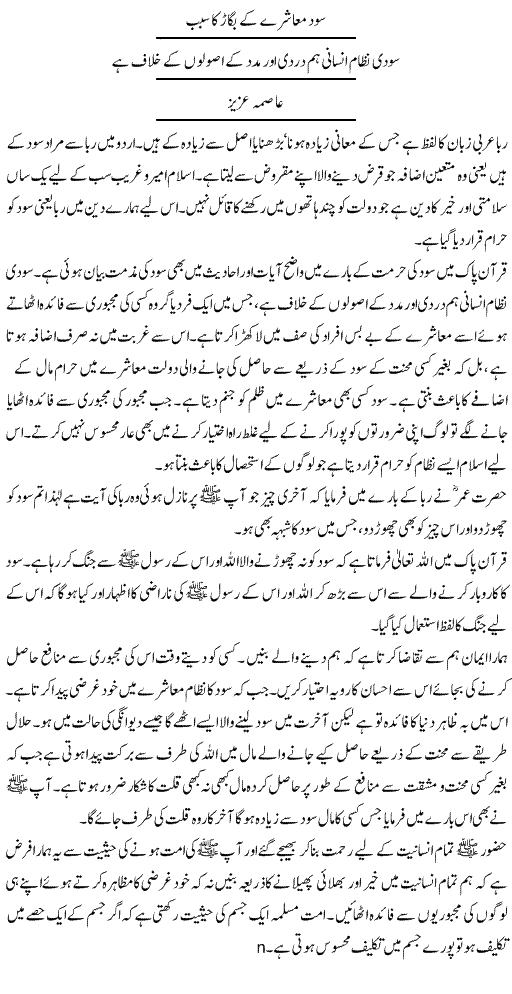
Soud Muashray Key Bigar Ka Sabab
They Never Look At Him In The Eye
The rights of the Prophet (peace be upon him) are the most important, after the rights of Allah. There is no human who has more rights than the Prophet. Allah said, what translated means:
“Verily, We have sent you (O Muhammad) as a witness, as a bearer of glad tidings, and as a warner. In order that you (O mankind) may believe in Allah and His Messenger, and that you assist and honor him (Muhammad)…” (Qur’an, 48:8-9)
Therefore, love for the Prophet (peace be upon him) should be more than one’s love for himself, his children, family, and worldly possessions. The Prophet (peace be upon him) said, what translated means: “None of you will reach belief till I become dearer to him than his children, parents and all humans.” (Al-Bukhari and Muslim)
The Prophet (peace be upon him) has many rights. Respect and appreciation for him should be observed in the best manner. Respecting the Prophet includes respect for and adherence to his Sunnah after his death. Due rights should be accorded to the Prophet without exaggeration. When one reads how the companions used to love and respect the Prophet, one knows the importance of this matter. When Quraish (the Prophet’s tribe) sent Urwa Bin Mas’ud to negotiate with the Prophet (peace be upon him) in Hudaibiyya, he was greatly impressed by how the companions treated the Prophet. He said, “I have visited the kings of Persia, Rome, and Abyssinia, but I have not seen any leader more revered and respected by his people than Muhammad.
If he ordered them to do anything, they do it promptly delay. If he performs Wudhu (washing up for prayer) they all seek the remainder of the water he used. They never look at him in the eye, out of respect.” This is how the Prophet (peace be upon him) was treated by his companions. He was Allah’s Messenger who possessed great qualities and the best conduct ever.
The rights of the Prophet include compliance with and submission to his orders and believing in what he informed us of the past and future happenings. When a Muslim wants to follow his religion, he must do so believing that the Prophet’s way is the best way. Believing in the Prophet includes the affirmation that his religion is the best religion. Allah said, what translated means:
“But no, by your Lord, they can have no faith, until they make you judge in all disputes between them, and find in themselves no resistance against your decisions, and accept (them) with full submission.” (Qur’an, 4:65), and, “Say (O Muhammad to mankind): If you love Allah then you follow me, Allah will love you and forgive you your sins. And Allah is Oft-Forgiving, Most Merciful.” (Qur’an, 3:31)
To defend the religion of the Prophet is one of his rights upon believers. Defending religion can be done by using arms, speech, and writing. To ignore attacks on the Prophet (peace be upon him) or on his religion is impermissible for Muslims. Muslims must strive to prevent, in the best manner, attacks on the Prophet’s character or on any aspect of his religion, which is the best religion sent to mankind.
– By Sheikh Muhammad Bin Saleh Al-Uthaymeen