


Pyari Baatein
Grateful For Every Kindness
It was customary for the Arabs in Makkah when Prophet Muhammad (peace be upon him) was born that they sent their newborn children to some Bedouins where the young ones were breastfed by wet nurses. They felt that spending the first few years in a desert environment ensured that the child would grow up physically and mentally strong. Indications suggest that Makkah suffered some infectious diseases, and its people felt that children would be spared such diseases in the desert’s open air. We have a detailed story of how the young Muhammad ended up with Haleemah, his Bedouin wet nurse. We need only mention that Haleemah and her family were most delighted to have him, feeling that the young child brought some subtle blessing into their life. Hence, after he was weaned, Haleemah begged Aminah, the Prophet’s mother, to allow her to keep him for some more time. This was agreed upon, and most probably Muhammad stayed with Haleemah until he was five years of age.
In normal cases, when a child spends the first few years of life with carers who are not of his own family, living away from his hometown, it is not expected that relations with such carers would be maintained into his adult life without an effort by both parties. Nor would it be expected that he would look at those days of his childhood with tenderness. Most of us remember very little of our early years. Besides, Haleemah and her people lived in the desert, while Muhammad (peace be upon him) spent the rest of his life in Makkah, except for his last ten years when he lived in Madinah. Yet we read that in his adult life, Muhammad showed genuine gratitude to those very people.
Fluctuations Of Life: Tests For Believers
A person s life in this world is not stable. One passes through alternating periods of happiness and dismay, strength and weakness, wealth and poverty, health, and sickness, etc. A true believer is one who maintains a clear level of faith throughout worldly fluctuations. He continues to remember Allah and ascribe the bounties to Him, and he turns to Him in submission, asking for relief from his affliction. This is described by the Messenger (peace be upon him), who said: Indeed amazing are the affairs of a believer! They are all for his benefit. If he is granted ease of living he is thankful, and this is best for him. And if he is afflicted with a hardship, he perseveres; and this is best for him. (Muslim)
Thus, a believer shows gratitude and thankfulness for all the wonderful blessings that Allah grants him. And he displays patience and submission during sickness and hardships, hunger, or other afflictions.
Hardships benefit the believer
Allah has decreed that, in this life, hardships and disasters strike both believers and non-believers. For a non-believer, they are inconveniences that hinder him from proceeding with his normal involvement in worldly life.
Expiation of sins
Abu Hurairah (may Allah be pleased with him) reported that the Prophet said, Hardships continue to befall a believing man and woman in their body, family, and property until they meet Allah burdened with no sins. (At-Tirmidhi)
Sign of Allah s Love
Abu Hurairah (may Allah be pleased with him) reported that the Prophet (peace and blessings be upon him) said, Whenever Allah wills good for a person, He subjects him to adversity. (Al-Bukhari and others)
Sign of Faith
Abu Hurairah (may Allah be pleased with him) and Kab Ibn Malik (may Allah be pleased with him) reported that the Prophet (peace and blessings be upon him) said,d (Allah be pleased with him) reported that the Prophet (peace be upon him) said,
<span style="color: #339966;">The parable of a believer is that of a fresh and moist plant; the wind tilts it this way and that way; and so is the believer; he continues to be subject to affliction. And the parable of a hypocrite is that of a firm cedar tree; it does not shake until it is uprooted all at once</span>. <span style="color: #999999;">(Al-Bukhari and Muslim)</span>
<!--more-->
<strong>Sign of righteousness</strong>
The prophets and righteous people are afflicted the most, and their rewards are the highest. Sa
The most in their suffering among the people are the prophets, then the best, then the (next) best. One is afflicted in accordance with his faith. If his faith is firm, his affliction is hard, and if his faith is weak, his affliction is light. Indeed, one would be so much subjected to adversity until he walks among the people without any sins. (Ahmad and At-Tirmidhi)
Early punishment
Anas (Allah be pleased with him) reported that the Prophet (peace be upon him) said,
When Allah wills good for a servant of His, He expedites his punishment in this life; and when He wills retribution for a servant of His, He holds his sins for Him to judge him by them on the Day of Resurrection. (At-Tirmidhi)
Multiplication of rewards
Anas (Allah be pleased with him) reported that the Prophet (peace be upon him) said,
The amount of reward is in accordance with the amount of suffering. When Allah loves some people, He tries them (with affliction). He who then is content (with Allah s decree) has achieved the acceptance (of Allah), and he who is dissatisfied (with Allah s decree) will attain the anger (of Allah). (At-Tirmidhi)
Rewards for sickness
One should not look to sickness as a gloomy episode but should remember the great good in it. It is one form of affliction with which Allah tests His servants, giving them a chance to acquire rewards, as was explained above, as is further emphasized below.
Removal of sins and elevation in ranks
Abu Hurairah (Allah be pleased with him) reported that the Prophet (peace be upon him) said, Whenever a Muslim is afflicted by harm from sickness or other matters, Allah will drop his sins because of that, like a tree drops its leaves. (Al-Bukhari and Muslim)
Retaining rewards for deeds before sickness
Usually, when a believer falls sick, he would not be able to do the same amount of good (prayer, fasting, helping Muslims, etc.) that he used to do when he was well. But Allah, out of His great mercy, continues to record for him the good deeds that he was forced to stop because of his sickness. Abu Musa Al-Ash`ari narrated that the Prophet (peace and blessings be upon him) said, For a traveling or sick person, his deeds will be recorded in accordance with what he used to do when he was resident or well. (Al-Bukhari)
Reason for the reward
Atta Ibn Rabaah reported that Ibn Abbas (may Allah be pleased with him) told him, Do you want to see a woman from the people of Paradise? He said, Yes. He said It is this black woman. She came to the Prophet (peace and blessings be upon him) saying, I have (epileptic) seizures, and I get exposed, so supplicate to Allah for me. He (peace and blessings be upon him) said, If you wish, be patient and you will attain Paradise; or if you wish, I will ask Allah to cure you. She replied I will be patient! But my body gets exposed (because of the fall), so supplicate to Allah for me that I do not become exposed. And he (peace be upon him) did. (Al-Bukhari and Muslim)
Abdullah Ibn Amr reported that the Prophet (peace and blessings be upon him) said If a Muslim is pricked by (as little as) a thorn in the worldly life, and he seeks its reward from Allah, some of his sins will be removed, because of it, on the Day of Judgment. (Al-Bukhari)
Backbiting And Slander: Root of All Evils
Backbiting, mockery, and slander are major social evils that have been prohibited by Allah the Almighty for the believers. They strain relations among people and corrupt society. They lead to hatred and animosity.
Allah the Exalted has said: “O, you who believe! Avoid much suspicions; indeed some suspicions are sins. And spy not, neither backbite one another. Would one of you like to eat the flesh of his dead brother? You would hate it (so hate backbiting). And fear Allah. Verily, Allah is the One who accepts repentance, Most Merciful. (49:12)
Abu Hurairah narrated that Allah’s Messenger (peace be upon him) said: “Beware of suspicion, for suspicion is the worst of false tales, and do not look for other’s faults and do not do spying on one another, and do not practice “Najsh” (i.e. to offer a high price for something in order to allure another customer who is interested in the thing.) and do not be jealous of one another and do not hate one another and do not desert (stop talking to) one another. And O Allah’s servants! Be brothers!” (Sahih Al-Bukhari, Vol. 8. Hadith no. 92)
Sahl Bin S’ad says that the Prophet (peace be upon him) has said a person who gives surety to (safeguard) that which is between the jaws (tongue) and that which is between his two legs (private organs), I guarantee his entrance into Paradise. (Bukhari and Muslim).
Abu Hurairah relates that Prophet Mohammad (peace be upon him) said that sometimes a person says something, which pleases Allah and in return, Allah raises his status, (rewards him) and sometimes a person says something which displeases Allah, it takes him into hell (Bukhari).
Allah the Almighty is so averse to mockery and slander that he dedicated a whole Surah to it, which is Surah Al-Humazah, (The Slanderer), which was revealed at a time when the Qur’an was following up the incidents faced by the Islamic Call. It portrays one of the actual scenes that happened at that time. This scene can be repeated in every Islamic environment and society. Some polytheists had subjected the Prophet (peace be upon him) and the believers to their taunts and scorns. The Qur’an was the infallible weapon that destroyed the cunning of the conspirators, shook the hearts of the enemies, and filled the believers with courage and fortitude.
Allah the Exalted says: “Woe to every slanderer and backbiter.” (104:1)
Islam forbids mockery, ridicule, and fault-finding in others. The Qu’ran describes these mannerisms as sordid and ugly. It adds warnings and threats to anyone indulging in them. The scorner or the mocker ridicules others, which is repugnant to Allah.
Murda Dafan Kerna
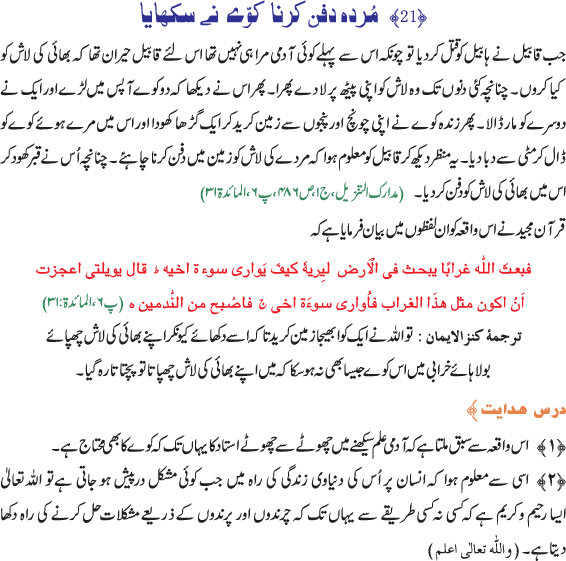
Murda Dafan Kerna
How To Deal With Food We Don’t Like
Bursting over food not cooked to our taste is a sin that few escape. Extreme fury and anger, mostly with spouses, is expressed by rejecting food and refusing to eat, undermining this great blessing many are deprived of.
Yes, mistakes happen. The wife may have forgotten to add salt. In such situations, we ought to be patient, as the Prophet (peace be upon him) was when his wives cooked food he didn’t like.
Abu Hurairah reported: “The Messenger of Allah (peace be upon him) never found fault with food. If he had inclination to eating it, he would eat; and if he disliked it, he would leave it.” (Al-Bukhari and Muslim)
Or he would say, “I do not feel like eating this.” (Al-Bukhari, no. 5076, and Muslim no. 1946)
Sometimes he would praise the food, as when he asked his family for food, and they said, “We have nothing but vinegar.” He asked for it and started to eat it, saying, “What a good food is vinegar.” (Sahih Muslim, no. 2052)
These Ahadith throw light on the Prophet’s excellent manners which ought to be followed by all Muslims. It is a deplorable state of affairs that when we find a dish a bit unsavory, we lose our temper and create quite a scene in the house.
Another important aspect is not hurting your wife’s feelings. He or she might have exerted so much effort in cooking that for us. Positive and encouraging statements are more helpful in correcting people than hurting their feelings.
Are We Born With Religion?
Sometimes people wonder whether religion is inherited. Could it be genetic? Is there something in man’s make-up that sways him to be religious, or to reject religion? If so, is he influenced by his parent’s religion? What about the children of interfaith marriages? The ready answer offered on the basis of both science and reason is that belief in a religion is not genetic.
It is something that we choose for ourselves, influenced by various factors, no doubt, but there is nothing in our makeup to make us lean toward a particular religion. When we are born, we have no knowledge of anything, whether religious or temporal. God says in the Qur’an: “Allah has brought you forth from your mothers’ wombs devoid of all knowledge, but He has given you hearing, and sight, and minds.” (16: 78) Our knowledge is acquired, not inherent. Yet we have the faculties of perception which will indeed influence how we react to what we acquire of knowledge.
This is indeed confirmed by the Prophet in the following hadith quoted by Abu Hurayrah: “Every newborn is born with sound nature. It is his parents who bring him up as a Christian, a Jew, or a Zoroastrian. It is just like an animal is born whole: you do not see any of them born with a cut ear.” As he reported this Hadith, Abu Hurayrah quoted the Qur’anic verse that says: “(It is) the natural disposition which God has installed into man. Nothing can change God’s creation. Such is the ever-true faith.” (30: 30)
The Hadith stresses the fact that we are all born with the same clear image of religion. It does not matter what religion our families follow, we have the same blank sheet at birth. We are just like clear and pure water which has no taste, smell, or color. When you add salt, sugar, or lemon juice to water, you make it salty, sweet, or sour. You can color it with whatever dye you put in it. The Prophet gives the analogy of cattle and how they are born completely: none is born with a cut ear or nose. It is people who print their marks on cattle or cut their ears or noses to mark them for identification.
The Prophet says that it is a child’s parents that make him a Jew, a Christian or a Zoroastrian. It is how they bring him up. Thus, it is the family and social environment that influence a child’s identity, giving him his religion.
When a child grows up in a religious environment, he will follow the religion he is brought up in. Likewise, if he is brought up in an atheist or agnostic environment, he will not care about religion.
If we imagine someone growing up without any environmental influence whatsoever as far as religion is concerned, he will retain his clear nature. As such, he tends to believe that the universe is created by a Supreme Being and that Supreme Being is one and has no partners. This is the religion of clear human nature. This is the natural disposition God has installed in man.
The more contemplation in the universe around us we do, the stronger is our belief that everything in it is controlled by its Creator, the Supreme Being we call God in English, Allah in Arabic, and by other names in other languages.
-by Adil Salahi
Balancing The Life Of A Muslim
It goes without saying that there are many demands on us as Muslims. We have a lot of work to do but unfortunately, there are not enough of us living up to the responsibilities Muslims face in this day and age.
First, we have a vital need to learn and understand Islam so that we may practice it in the way that pleases Allah most. We do this so that we may lead peaceful and successful lives here on earth and, Insha’ Allah are granted Allah’s mercy in the next life in Paradise.
Once we have a solid footing in understanding and practicing our faith, we must then invite others to Islam in the most proper and effective ways we can. This alone is a tremendous undertaking considering that there is such widespread ignorance of Islam in the world today. Defending Islam against those who seek to curb its growth and against those who abuse Muslims is also a major concern for all of us who are sincere in our desire to create strong bonds of brotherhood among the followers of Prophet Muhammad (peace be upon him).
We need to advance the condition of Muslims in the world today and restore the authority of Allah and His commands for the benefit of all mankind.
Of course, none of us can accomplish these things on our own. Nor can we do all of these things at once, as much as we’d like to. Setting priorities and establishing balance in our lives are most important. Priorities start with the Fard, or obligatory acts of worship (ibadat) and deeds (mu`amalat). This means that we have responsibilities toward Allah first, the One Who created us and provided us with everything we need in this life. We need to obey Him because we trust that He will only command us what benefits us and forbids us to do those things which cause us harm.
The importance of Prophet Muhammad (PBUH) is that he provides guidance and interpretation of Allah’s commands. The Qur’an provides guidance for all of mankind but cannot give us information regarding all of the details we come across in our daily lives. We will never match the Prophet’s piety and wisdom, but we are not expected to. The Prophet (PBUH) has encouraged us to hold fast to the Qur’an and then follow his ways to the best of our ability.
We need to build our own faith and understanding of Islam, and then work on our surroundings. As I mentioned above, we cannot do everything all at once. Our bodies have rights over us. Getting enough nutrition, sleep, and exercise is very important, but we do not spend all of our time on these things. Our families and friends have rights over us, but we do not spend all of our time and efforts trying to please them alone. Our society has rights over us, but we do not devote ourselves to serving it at the expense of neglecting ourselves and our loved ones. It is better to pick a cause to strive for and become excellent in it, rather than to spread oneself too thin working for many causes at once and therefore failing to give each one the attention and effort it deserves.
To summarize, basically, the priorities we need to set as Muslims should be as follows:
- Allah: following His commands and worshiping Him
- Prophet Muhammad (peace be upon him): implementing his Sunnah (Traditions & habits) as much as possible
- Parents: obeying and being kind to them
- Spouses and children: cherishing and protecting them
- Extended family: honoring and being kind to them
- Fellow Muslims and friends: loving them and encouraging them to do what is right
- Society: working to improve its condition and guiding it toward Allah.
This does not mean that we cannot focus on more than one thing at a time, only that we should never exert too much effort on things lower down on the list at the expense of those things higher up on the list.
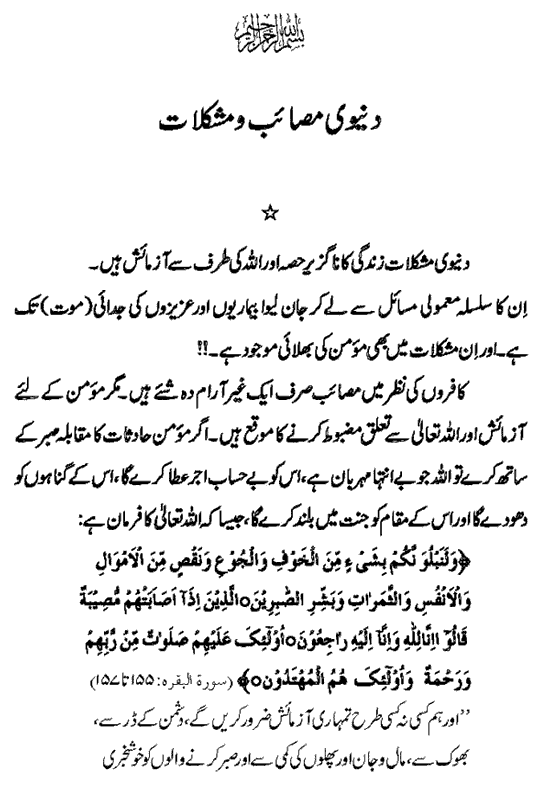
Dunya Ki Mushkilaat Aur ALLAH Ki Taraf Say Azmaish

Being Kind To Old Parents
The young man in his thirties takes a deep breath. He is standing in the hallway of a bustling hospital, waiting for the elevator, where he has brought his mother for a doctor’s appointment. She is walking slowly with her limp, blocking the way of several young people who are hurrying to get into the waiting lines. Whenever his mother’s slow movement blocks passersby, their faces barely hide their impatience. Embarrassed, the young man looks down and avoids their eyes, while patiently bearing with his elderly mother.
Allah says: “Your Lord has decreed that you worship none but Him and that you be kind to parents. Whether one or both of them attain old age in your life, say not to them a word of contempt, nor repel them, but address them in terms of honor. And spread over them humbly the wings of tenderness, and say: ‘O my Sustainer! Bestow Your grace upon them, just as they cherished and reared me when I was a child.” (Qur’an, 17:23-24)
Sometimes, people compare weak old age to human infancy. They make comparisons about how, when a person grows very old, they need to be helped to sit up, fed mashed, bland food, and cooed and cajoled to eat like babies. Some may need to wear adult diapers at night if their incontinence reaches an advanced stage.
However, the comparison may not be correct. No matter how hard it is for a new mother to take care of her baby round the clock, with nights providing little sleep and being on-call to change diapers or breastfeed at inopportune times, she has hope that this difficult phase will pass soon and that one day she will see her baby all grown up. She looks forward to the time when her baby will start to walk, talk and play. She knows that her tough initial motherhood duties will eventually lighten up with her baby’s growth and independence.