

kad’aawar Log
Soldier Who Entered The Hole
In one of the battles waged against the Romans, Muslims – under the commandment of Maslamah – surrounded a city that had a tall and well-fortified wall. The siege went on for months.
Then one night, one of the Muslim soldiers informed General Maslamah that he managed to make a hole in the wall. “It is only large enough for a slim soldier.” He knelt closer. “Quickly, send with me someone who can squeeze through and fight the army on the inside until he has opened the gates for all of us to enter.”
Maslamah sent out the news and that night someone volunteered. In a sweeping assault, the gate was opened and Muslims were victorious.
Maslamah, overwhelmed with happiness, sought the soldier who entered the hole. No one came forward. The announcements were repeated. Three days passed and no one took credit.
On the fourth day, a soldier approached Maslamah; his face wrapped in a scarf. He said to him, “I have news of the soldier that entered the hole.”
Maslamah sat up sharp, “Tell me who it is?”
“He has three conditions before exposing himself. Do you agree to this?” said the soldier.
“Of course,” Maslamah said.
“The first is you do not compensate him for what he did. The second is you do not tell anyone who he is. And the third is you shall not ask for his presence ever again. Do you agree?” asked the soldier.
“Agreed,” Maslamah replied.
The soldier uncovered his scarf and said, “It is I. I went through that hole only for the sake of Allah.” He then turned and walked away.
After that day, Maslamah was often heard praying, “O Allah, (on the Day of Judgment) grant me companionship with the soldier of the hole.”
Believe In Angels
Sheikh Saleh Bin Fawzan Al-Fawzan, author of ‘Belief in Angels and its Effect on the Life of the Ummah’ says, “Our purpose in learning about angels is not just for knowing about them for general understanding, rather, it is so that we become aware of their constant presence around us […] If we become conscious of the fact that there are two angels with us at all times recording our statements and actions, we would become careful of what we say and do…”
Belief in the existence of angels and their duties has an undeniably positive effect on our Faith (Iman):
It heightens self-awareness and God-consciousness, which makes us realize that not only actions, but even intentions have consequences.
The Qur’an tells us that there are two angels that accompany a person everywhere he goes, on his right side and his left, who record every word he utters (Qur’an, 50: 17-18).
Similarly, according to a narration, angels even record a person’s intentions:
Abdullah Bin Abbas (may Allah be pleased with them both), reported that the Messenger of Allah (peace be upon him), related from his Lord (Glorified and Exalted be He):
“Indeed Allah has recorded the good deeds and the evil deeds.” Then he clarified that: “Whosoever intends to do a good deed but does not do it, Allah records it with Himself as a complete good deed; but if he intends it and does it, Allah records it with Himself as 10 good deeds, up to 700 times, or more than that. But if he intends to do an evil deed and does not do it, Allah records it with Himself as a complete good deed; but if he intends it and does it, Allah records it down as one single evil deed.” (Al-Bukhari and Muslim)
There is another narration to the same effect, that the angels say: “O Allah, this is Your servant and he intends to do a bad deed, while Allah is more aware about that. Allah says: ‘Watch him, and record it if he does it.’”
Commenting on this narration, Imam An-Nawawi quoted Abu Ja`far Al-Tahawi as having said: “According to these Ahadith the angels appointed over human beings record man’s intentions, contrary to those who say that angels only record apparent deeds.”
It encourages steadfastness in acts of worship.
According to a narration, “There are angels who take turns in visiting you by night and by day, and they all assemble at the dawn (Fajr) and the late afternoon (`Asr) prayers. Those who have spent the night with you, ascend to heaven and their Lord, Who knows better about them, asks: `In what condition did you leave My slaves?’ They reply: `We left them while they were performing prayer (Salah) and we went to them while they were performing prayer.’’’ (Al-Bukhari and Muslim)
Thus, when the angels come or go, the people who are punctual in their prayers are distinguished by their piety. Similarly, angels surround people who are constantly engaged in remembering Allah by themselves (for instance, by reciting the Qur’an) or in assemblies. This encourages a believer to increase their acts of worship and to perform them with greater focus and presence of mind.
It fosters love for creatures that are beloved to Allah
Belief in angels fosters love in our hearts for them, as they are free from any physical or spiritual blemish, completely devoted to their worship and obedience to their Lord. It is a feeling of love that is unlike any worldly emotion, since it is solely for the sake of Allah, and for the sake of being pleased with what He is pleased with.
-Based on the book ‘Belief in Angels and its Effect on the Life of the Ummah’, by Sheikh Saleh Bin Fawzan Al-Fawzan
Forgive Those Who Wrong You
Son! You are a Salik (a person who is traversing the path of closeness to Allah Ta’ala). If someone wrongs or mistreats a Salik, then it is the obligation of the Salik that he (or she) should not think about revenge but should forgive that person for the sake of Allah Ta’ala. This is not demeaning. Instead, it creates love in the hearts of the people.
Translation of Hadith: The Holy Prophet (Sallallahu alaihi wa sallam) says: Forgiving increases the dignity of a person. You forgive people, Allah Ta’ala will grant you dignity.
Hadhrat Abu Sa‘eed (May Allah shower His mercy on him) says: Absolute forgiveness is that no revenge is taken on the oppressor. Instead, out of mercy for him, one supplicates for his good.
Hadhrat ‘Uqba bin A’amir (May Allah be well pleased with him) says: The Holy Prophet (Sallallahu alaihi wa sallam) held my hand and said: Shall I not make you aware of what is best in the manners of the people of this world and in the people of the hereafter?
Hadhrat ‘Uqba (May Allah be well pleased with him) said: Please tell me, o Prophet of Allah (Sallallahu alaihi wa sallam)!
He was told: The best characteristic is you establish relations with the person who breaks off from you, that you grant to the person who deprives you and you forgive the person who wrongs you.
Hadhrat Mu‘awiya (May Allah be well pleased with him) says: As long as you don’t have the capacity and chance to avenge yourself, bear and be patient. When you get the chance, then be forgiving and benevolent.
Once Hadhrat Ali (May Allah be well pleased with him) called out to his slave. He didn’t answer. He called again. Still no answer and neither did the slave appear before him. When he didn’t come even after calling him a third time, Hadhrat Ali (May Allah be well pleased with him) angrily went to the slave. He saw that the slave was lying. He asked: Why didn’t you answer? The slave said: Sir! With your manners, I had no fear that you would be cross with me, that’s why I didn’t answer. Hadhrat Ali (May Allah be well pleased with him) said: I forgive you. Go! You are free for the sake of Allah!
Hadhrat Qatada (May Allah be well pleased with him) says: The person of the highest status is the one who forgives mistakes the most.
A person abused Hadhrat Rab‘ee (May Allah shower His mercy on him) and started reviling him. Hadhrat Rab‘ee said: There is a valley between me and Jannah and I am busy in crossing it. If I cross it, then your abuses will hold no sorrow for me and if I cannot cross it, then your abusing me is correct. Go! I forgive you for the sake of Allah!
Do you see? This is the excellence of forgiveness. So, forgive others’ mistakes. Don’t ever think of revenge. Because of this, the improved condition of the heart is impaired.
[Excerpted from Mawaaiz-e-Hasana, Vol. 1, 264 by Muhaddith-e-Deccan Hazrath Syed Abdullah Shah Naqshbandi Mujadidi Quadri (Rahmatullah Alaih)]
5 Logoon Ki Dua
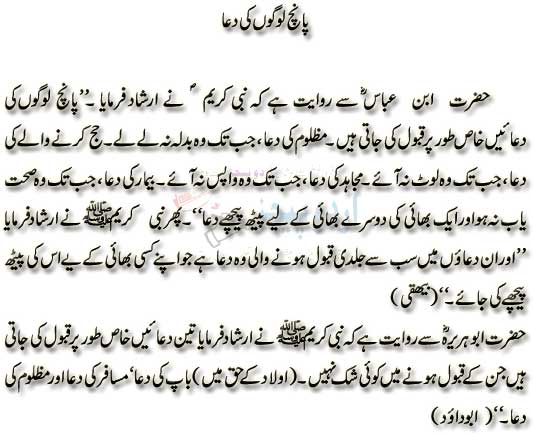
5 Logoon Ki Dua
Always Good To Others-It Ensures Peace
The Noble Messenger of Allah (peace be upon him) has enjoined the believers to be always good to others – animals as well as fellow beings, particularly fellow believers. His teachings of love and fraternity go to great lengths to ensure peace in every sphere of life. Let us see some of his teachings reported in Bukhari.
Anas Bin Malik relates that Allah’s Messenger Muhammad (peace be upon him) said, “Help your brother, whether he is an oppressor or is an oppressed one.” People asked, “Allah’s Messenger! It is all right to help him if he is oppressed, but why should we help him if he is the oppressor?” The Messenger of Allah (peace be upon him) said, “By preventing him from oppressing others.”
Abdullah Bin Umar relates that Allah’s Messenger (peace be upon him) said, “A Muslim is a brother of another Muslim, so he should not oppress him, nor should he hand him over to an oppressor. Whoever fulfilled the needs of his brother, Allah will fulfill his needs; whoever brought his brother out of the discomfort, Allah will bring him out of the discomforts of the Day of Resurrection, and whoever screened a Muslim, Allah will screen him on the Day of Resurrection.”
Mu’awiya Bin Suwaid relates: I heard Al-Bara Bin Azib saying, “The Prophet Muhammad (peace be upon him) ordered us to do seven things and prohibited us from doing seven other things.” Then Al-Bara mentioned the following:
To pay a visit to the sick (inquiring about his health),
To follow the funeral,
To say to a sneezer, “May Allah be merciful to you” (if he says, “Praise be to Allah”),
To return the greetings,
To help the oppressed,
To accept invitations and
To help others to fulfill their oath.
I Cannot Obey Him In Public And Disobey Him In Private
The grandfather of Abu ‘Abdullah Bin Zayd Bin Aslam narrated an interesting incident during the rule of Umar Bin Al-Khattab (may Allah be pleased with him):
Once when I was accompanying Umar Bin Al-Khattab (may Allah be pleased with him) on his patrol of Madina at night, it so happened that he leaned against a wall (to rest) when he felt tired. It was midnight, and (we heard) a woman say to her daughter, “O my daughter, get up and mix that milk with some water.”
The girl said, “O mother, did you not hear the decree of Amir Al-Mu’minin (chief of the believers) today?”
The mother said, “What was that?”
The girl said, “He ordered someone to announce in a loud voice that milk should not be mixed with water.”
The mother said, “Get up and mix the milk with water; you are in a place where Umar cannot see you.”
The girl told her mother, “I cannot obey Him (Allah) in public and disobey Him in private.”
Umar heard this, and told me: “O Aslam, go to that place and see who that girl is, and to whom she was speaking, and whether she has a husband.” So I went to that place, and I saw that she was unmarried, the other woman was her mother, and neither of them had a husband.
I came to Umar and told him what I had found out. He called his sons together, and said to them: “Do any of you need a wife, so I can arrange the marriage for you? If I had the desire to get married, I would have been the first one to marry this young woman.”
Abdullah said: “I have a wife.” Abdur-Rahman said: “I have a wife.” ‘Asim said: “I do not have a wife, so let me marry her.” So Umar arranged for her to be married to ‘Asim. The woman gave birth to a daughter, who grew up to be the mother of Umar Bin Abdul Aziz.
(Sifat Al-Safwah, Wafiyat Al-A’yan and cited by Ibn Al-Jawzi in Ahkam Al-Nisa’ pg. 441, 442)
Note: Umar Bin Abdul Aziz is one of the most respected caliphs for his honesty, justice, and devoutness, after the four rightly-guided caliphs.
Honoring One’s Ancestors Under Islam
To a believer, the proof of one’s belief is total obedience and devotion to Allah the Absolute. Accordingly, believers look upon the messages (Ayah) from Allah the Absolute as the legal standards for their daily lives, and conforming to those standards is the basis for their actions. This is because they are convinced that sometime after one’s death, although when is yet to be determined, there will come a day (the Day of Judgment) when there will be an account taking to the entrance to the next world, and the extent to which a believer accumulated deeds in line with the messages of Allah will be determined.
While believers may conform to the revelations of the Qur’an, it is their following the example and the practices of the Prophet Muhammad (peace be upon him) with respect to the events that occur in daily life that serve as a more practical moral indicator through a believer’s life. It is from this standpoint that I will look into the matters related to our theme.
The funeral prayer (Salat Al-Janazah) is performed at the funeral service for the deceased. The body is washed according to the prescribed method and wrapped in a seamless shroud and then transported to a mosque. After the service has ended, the congregation offers memorial prayers (Dua) led by the imam, and the body is then interred into the ground. The Prophet (peace be upon him) has said with regard to attending funerals: “A person who follows a funeral procession and offers the prayer for the deceased shall have the reward of one Qirat, and if he also attends the burial he shall have a reward of two Qirats. A Qirat is as great as Mount Uhud (a mountain in the northern part of AI-Madina, Saudi Arabia).”
Furthermore, if 100 of his brothers say prayers of intercession for the deceased, the prayers will be answered. The prayers of the intercession of even 40 of his brethren will be answered. In other words, according to tradition, Allah’s intercession will be granted to the deceased if a large number of believers participate in the funeral.
The following is enjoined regarding grieving and wailing for the deceased:
“O you who believe! protect yourselves and your families against a fire whose fuel is people and stones” (Qur’an, 66:6), and “A person who bears a burden (sin) may not bear another’s burden. If a person who is burdened calls upon another to bear that burden, not even a portion of it can be borne by the other, not even by a near relative.” (Qur’an, 35:18)
The meaning of these passages from the Qur’an becomes clear when one considers the following Hadith, which counsels that one must exercise self-control in coping with tragedies:
“The deceased is punished because of the wailing and lamentations of his family.”
As to the services at the grave after the burial, it is reported that the Messenger of Allah (peace be upon him) would say prayers at the grave of the deceased after burial. It is said that he would repeat “Allahu Akbar (Allah is great)” four times for the deceased.
Tausub Ki Laanat

Tausub Ki Laanat
The Huge Size Of The People Of Hell
When the People of Hell enter the Fire they will be huge in size, in a form that none can comprehend, except the One Who Created them.
According to a hadith narrated by Abu Hurayrah, the Messenger of Allah (saw) said: “The distance between the shoulders of the Kaafir in Hell will be like three days traveling for a fast rider” (Muslim, 4/290)
Abu Hurayrah reported that the Messenger of Allah (saw) said: “The molar of the kaafir or the eye-tooth of the kaafir, will be like Uhud, and the thickness of his skin will be like a journey of three (days)“. (Muslim, 4/2189, at-Tirmidhi, al-Haakim, Ibn Maajah and Ahmad)
Zayd ibn Arqam said, “The man who is destined for Hell will become huge in preparation for it so that one of his molars will be as big as Mount Uhud“.
This is narrated by Ahmad, who attributes it to the Prophet (saw) but Zayd did not state that he heard it from the Prophet (saw). (Silsilat al-Ahadith as-Sahihah, 4/131, al-Albaani said its isnaad is saheeh according to Ibn Maajah and Ahmad)
Abu Hurayrah reported that the Prophet (saw) said: “The kaafir’s skin will be forty-two cubits thick and his molar will be like Uhud and the space he occupies will be as wide as the distance between Makkah and Madinah.” (at-Tirmidhi) (Mishkaat al-Masaabeeh 3/103, sahih hasan)
Abu Hurayrah (ra) reported that the Prophet (saw) said: “The molar of the kaafir on the Day of Resurrection will be like Uhud, and the thickness of his skin will be seventy cubits. His upper arm will be like al-Bayda’, his thigh will be like Warqaan and the space he occupies will be like the distance between me and ar-Rabdhah” (al-Haakim and Ahmad – Silsilah al-Ahadith as-Sahihah, 4/94. al-Baydaa` could be the name of a mountain or it may refer to the well-known city in Morocco)
This increase in the kaafir’s body size will increase his suffering and torment. Commenting on the hadith narrated by Muslim on this subject, an-Nawawi said, “All of this is in order to intensify the suffering, and all of this is possible for Allah (SWT). We must believe in it because the truthful (Prophet) has told us about it” [Sharh an-Nawawi ‘alaa Muslim, 17/186]. Ibn Katheer in a comment on these hadith said, “So that their punishment and suffering may be more severe, as Allah (SWT) the Severe in punishment says:
“…that they may taste the Penalty“. (4:46)
[Ibn Katheer, an-Nihayah, 2/139]