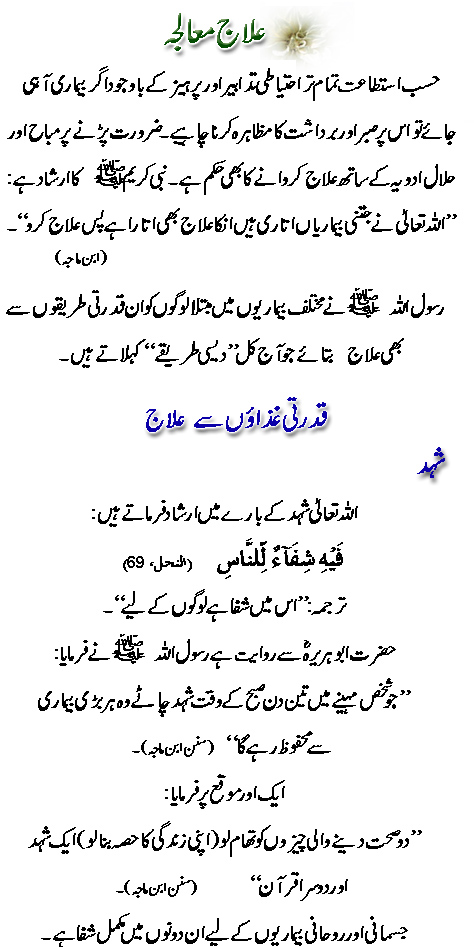
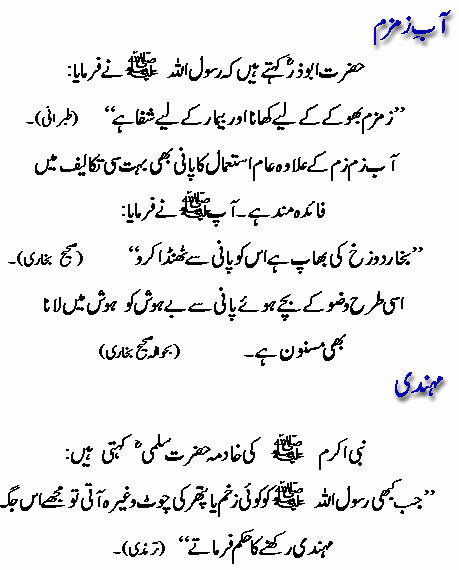
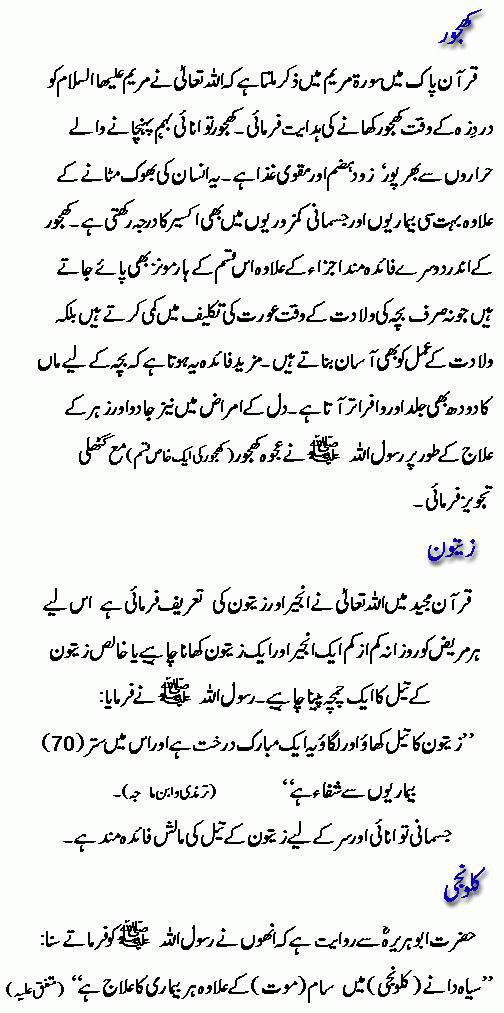
Ilaj Mualga Zaitoon, Mehndi, Shahad, Khajoor, ZamZam Aur Kalonji Say Ilag


Ilaj Mualga Zaitoon, Mehndi, Shahad, Khajoor, ZamZam Aur Kalonji Say Ilag
ABDULLAH Bin Umar relates that the Noble Prophet (peace be upon him) said, “Just as iron catches rust on contact with water, so are the hearts rusted.” People asked, “How to remove the rust of the heart?” The Noble Prophet (peace be upon him) said, “By remembering death and by reciting the Qur’an.” (Baihaqi)
To err, it is said, is human. Though the statement contains some grains of truth, believers are enjoined to seek forgiveness from Allah, not to be content with the above dictum. This teaching aims at encouraging them to look forward to the Lord with hope on one hand, and on the other at purging their lives of sins. And this twofold teaching leads believers onto the path of spiritual advancement.
In another Hadith the Noble Prophet (peace be upon him) says that a person gets a black spot on the heart on committing a sin; another spot on committing another sin, and so on. And if the person sticks to life in sin unrepentantly, his heart darkens. When a believer happens to commit a sin, he repents and hastens to seek forgiveness from Allah, and as a result, the black spot on his heart caused by the sin is removed. The life of the Noble Prophet (peace be upon him) was in perfect accordance with the Will of Allah yet he used to seek forgiveness from Allah, at least 70 times a day.
The Hadith offers two prescriptions for a believer to cleanse the heart: remembering death and reciting the Holy Qur’an frequently.
To remember death means that man should think that this life is just a respite that would not be given to him for the second time to do good. So the more one remembers death, the more one will be able to realize the transient and ephemeral nature of this life on earth, do good to earn the pleasure of Allah, and thus come closer to Him.
Recitation of the Holy Qur’an means reading it correctly, understanding its meaning, and acting upon it. It also includes the propagation of the message of the Holy Book. Those who are not well-versed in the Arabic language should make efforts to understand the message of the Qur’an through its translation into their respective native languages as well as learn the language in the Holy Book was revealed in.
A young man, a student in one of the universities, was one day taking a walk with a Professor, who was commonly called the student’s friend, of his kindness to those who waited on his instructions.
As they went along, they saw lying in the path a pair of old shoes, which they supposed to belong to a poor man who was employed in a field close by, and who had nearly finished his day’s work.
The student turned to the professor, saying: “Let us play the man a trick: we will hide his shoes, conceal ourselves behind those bushes, and wait to see his perplexity when he cannot find them.”
“My young friend,” answered the professor, “we should never amuse ourselves at the expense of the poor. But you are rich and may give yourself a much greater pleasure by means of this poor man. Put a coin in each shoe, and then we will hide ourselves and watch how this affects him.”
The student did so and they both placed themselves behind the bushes close by. The poor man soon finished his work and came across the field to the path where he had left his coat and shoes.
While putting on his coat he slipped his foot into one of his shoes, but feeling something hard, he stooped down to feel what it was and found the coin. Astonishment and wonder were seen upon his countenance. He gazed upon the coin, turned it around, and looked at it again and again.
He then looked around him on all sides, but no person was to be seen. He now put the money into his pocket and proceeded to put on the other shoe, but his surprise was doubled on finding the other coin.
His feelings overcame him; he fell upon his knees, looked up to the heavens, and uttered aloud a fervent thanksgiving in which he spoke of his wife who was sick and helpless, and his children without bread, whom this timely bounty, from some unknown hand, would save from perishing.
The student stood there deeply affected, and his eyes filled with tears. “Now,” said the professor, are you not much better pleased than if you had played your intended trick?”
The youth replied, “You have taught me a lesson that I will never forget. I feel now the truth of these words, which I never understood before: “It’s more blessed to give than to receive.”
Abdullah bin Abbas (radi Allahu anhu) reported that the Prophet (sallAllahu alaiyhi wassallam) said that encouraging good, prohibiting evil, lifting the burden of the weak person, and removing an offensive thing from a path are all acceptable prayers to Allah. [ibn Majah]
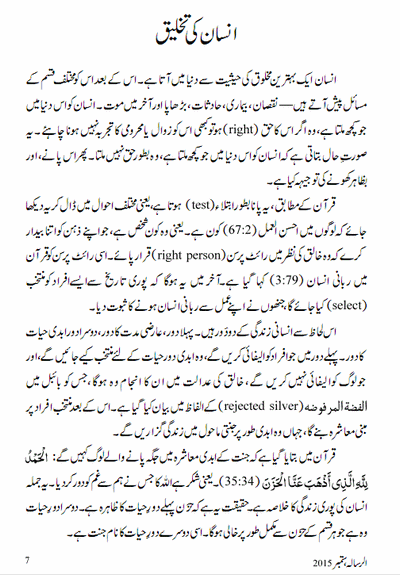
Insan Ki Takhleeq
One of the great qualities of Prophet Muhammad (peace be upon him) was that he never took revenge on anyone for personal reasons and always forgave even his firm enemies. His wife `Aishah reported that Allah s Messenger was not unseemly or obscene in his speech, nor was he loud-voiced in the streets, nor did he return evil for evil, but he would forgive and pardon. The people of the Quraysh rebuked him, taunted and mocked him, beat him, and abused him. They tried to kill him and when he left for Madinah, they waged many wars against him. Yet when he entered Makkah victorious with an army of 10,000, he did not take revenge on anyone. He forgave all. Even his deadliest enemy, Abu Sufyan, who had fought so many battles against him, was forgiven, as was anyone who stayed in his house.
Prophet Muhammad (peace be upon him) also pardoned the leaders of Ta’if, who had engaged ruffians to pelt him with stones when he visited that town to invite them to Islam.
Abdullah Ibn Ubayy, the leader of the hypocrites of Madinah, worked all his life against Prophet Muhammad (peace be upon him) and Islam and left no stone unturned in trying to defeat his mission. He withdrew his 300 supporters in the Battle of Uhud, which almost broke the backbone of the Muslims. He engaged in intrigues and acts of hostility against the Prophet of Islam and the Muslims.
An Abyssinian slave who had killed Prophet Muhammad s (peace be upon him) beloved uncle Hamzah in the Battle of Uhud was also forgiven when he embraced Islam after the Conquest of Makkah. The wife of Abu Sufyan, who had cut open Hamzah’s chest and torn his liver and heart into pieces in the Battle of Uhud, quietly came to the Prophet (peace be upon him) and accepted Islam. He recognized her but did not say anything. She was so impressed by his magnanimity and stature that she said, O Allah s Messenger, no tent was more deserted in my eyes than yours; but today no tent is dearer in my eyes than yours.
Habar Ibn Al-Aswad was another vicious enemy of Prophet Muhammad (peace be upon him) and of Islam. He had inflicted a grievous injury on Zaynab, daughter of the Prophet (peace be upon him). She was pregnant when she emigrated from Makkah to Madinah. The polytheists of Makkah obstructed her and Habar Ibn Al-Aswad intentionally threw her down from the camel. She was badly hurt and miscarried as a result. Habar committed many other crimes as well. He wanted to run away to Persia but then he came to Prophet Muhammad (peace be upon him), who forgave him.
Prophet Muhammad (peace be upon him) was all for forgiveness and no amount of crime or aggression against him was too great to be forgiven by him. He was a complete example of forgiveness and kindness.
He always repelled evil with good, for, in his view, an antidote was better than poison. He believed and practiced the precept that love could foil hatred and aggression could be won over by forgiveness. He overcame the ignorance of the people with the knowledge of Islam, and the folly and evil of the people with his kind and forgiving treatment.
With his forgiveness, he freed people from the bondage of sin and crime and also made them great friends of Islam. He was an exact image of the following verse of the Qur’an: The good deed and the evil deed cannot be equal. Repel (the evil) with what is better (i.e. Allah orders the faithful believers to be patient in the time of anger, and to excuse those who treat them badly) then verily he, between whom and you there was enmity, (will become) as though he was a close friend (Fussilat 41:34).
The skin has wrinkled, the bones have softened, and the hair is colored, yet the enthusiasm for sins, the pleasure of disobedience, and the neglect of the hereafter have not dwindled. This is our state – the uncles of the Muslim Ummah.
It is quite saddening to note that despite the reality dawning upon us with every passing day, we do not stop to reflect on what answer we will have when we return to Allah. Elderly Muslims today – men and women – have so much time to kill in Haraam activities than do anything useful at all.
Oh, but the television shows have to be religiously followed! The latest movies, the new controversies in the media, the year-long sports events, the celebrity news, and (how can one forget) the gossip and backbiting all need our time!
Unfortunately, we are drowned in sins. And to add to that we constantly backbite to destroy whatever negligible good deeds we have.
The companion Amr Bin Al-As said, “…I am amazed at one who spots an impurity in the eye of another but is unable to detect it in his/her own eye, or who attempts to remove a grudge from another’s heart while making no attempt to remove grudges from his/her own heart…” (Al-Bukhari, Book of Manners, no. 1295)
Just as this article is being read, innumerable number of people would be breathing their last. If today we were to be called into account for what we have done, what would be our state? How prepared are we? Are we actually worrying about our own future and working towards making Jannah our goal?
Shaheed-E-Minbar-O-Mehrab
Among all the wives of the Prophet (peace be upon him), Umm Salamah (radiAllahu anha) was perhaps the one who was most sensitive to the interests of the community. She shared the hopes and difficulties of her fellow Muslims at both the individual and the community levels. We saw how she expressed their feelings to the Prophet when the Muslims were told that they could not go to Makkah for their worship rituals and had to return home. Her advice to the Prophet on that day took away all the strain and ensured their compliance with his orders.
After the Tabuk expedition, a few Muslims who did not join the Muslim army tied themselves up in the mosque, as a sign of repentance. They were untied when it was time for prayer, and then they tied themselves up again when the obligatory prayer had finished. They were uncertain about what judgment was to be made in their cases. Their self-imposed restraint was a gesture of their repentance. One of them was Abu Lubabah (Radi Allahu Anhu).
As the Prophet was at Umm Salamah’s home one night, just before the dawn prayer, he received revelations that included the Verse that says: “There are others who have acknowledged their sins, after having mixed righteous deeds with evil ones. It may well be that God will accept their repentance. God is Much-Forgiving, Ever-Merciful.” (9: 102)
The Prophet smiled and Umm Salamah (radiAllahu anha) asked him why he smiled. He said: “God has accepted Abu Lubabah’s repentance.” She asked him: “May I be the one who gives him the good news?”
She opened her door and looked inside the mosque. She said: “Abu Lubabah! Rejoice, for God has accepted your repentance.” Some people rushed to release him, but he refused, saying that he would beg them not to do so, for he wanted the Prophet to release him. We see how she was so pleased for someone who was totally unrelated to her. She shared his joy at the happy news.
Many years later, when the Muslim community went through the very difficult days that saw the assassination of the third Caliph, Uthman (Radi Allahu Anhu), and a serious split in the community, another wife of the Prophet, Ayesha (radiAllahu anha), was about to leave Madinah, marching at the head of an army that sought to gather support for their stand.
Umm Salamah objected to this attitude. She went to Ayesha (radiAllahu anha) and counseled her against going. She said it was wrong for a widow of the Prophet to embark on such a course of action.
As for her own position in those days, she was totally supportive of Ali (Radi Allahu Anhu), the fourth Caliph. She went to him and said: “I would have joined your army, but I know that such an action would be in disobedience of God’s orders and I believe you would not accept it from me. However, this is my son, Omar. He is dearer to me than my own life. He will join you and will fight for your cause.”
Her position then was characteristic of the great insight that enabled her to gauge what best served the interests of the Muslim community.
Umm Salamah (radiAllahu anha) lived long after the Prophet. In fact, she was the last of the Prophet’s wives to die. Her death took place in the year 61, and she was buried at Al-Baqee, the burial place of many of the Prophet’s companions in Madinah.
By: Adil Salahi
Life without tolerance becomes a living hell because everybody will be biased against other religions, races, nationalities, cultures, classes, and points of view. Islam has paid due attention to this issue realizing how vital it is in the life of any society. In this article, I shall try to shed some light on this issue in light of the Holy Qur’an and Sunnah.
Prophet Muhammad (peace be upon him) was the ideal example of tolerance. He taught his Companions to respect human beings regardless of their religion, race, color, language…etc. and this is one of the characteristics that made people embrace Islam through its long history.
One of those who recently embraced Islam said that what it so attractive about Islam is that it accepts the other, although the other does not usually accept it for no logical reason.
He noticed that Muslims are ordered to believe in all the Holy Books and all Prophets and Messengers and honor them, “The Apostle believes in what has been revealed to him from his Lord, as do the men of faith. Each one (of them) believes in God, His angels, His books, and His apostles. “We make no distinction (they say) between one and another of His apostles.” And they say: “We hear, and we obey: (We seek) Your forgiveness, our Lord, and to You is the return of all.” (Qur’an, 2:285)
When Prophet Muhammad (peace be upon him) migrated to Madina, he found the Jews inhabiting part of it, he did not expel them from the city. Instead, Prophet Muhammad (peace be upon him) signed a treaty with them giving them the right to live in it peacefully, but they as usual did not abide by the treaty. The Prophet (peace be upon him) also used to receive delegations belonging to other religions like Christianity, dealing with them with due respect and courtesy.
Also, we must realize that people are of different natures and backgrounds, cultures and languages and this is one of the norms of nature. This is clearly stated in the Holy Qur’an, “O mankind! We created you from a single (pair) of a male and a female, and made you into nations and tribes, that you may know each other (not that you may despise (each other). Verily the most honored of you in the sight of Allah is (he who is) the most righteous of you. And Allah has full knowledge and is well acquainted (with all things).” (Qur’an, 49:13)