
Muslim Woman’s Role As A Mother
A Muslim woman’s main role is to care for her house and fulfill the responsibility placed on her shoulder by her Lord. This does not mean to oppose a woman’s work; rather, the stress is on the fact that the main work of a woman is to work in her house. Her product is her children. It is valuable work indeed.
Apart from her role as a wife, the Muslim woman has a very important role as a mother. The status and value attached to parents in the Muslim World are very high. The Qur’an emphasizes this in Surah Al-Israa 17:23-24 and Surah Luqman 31:14.
It is reported that a man came to the Prophet (peace be upon him) and asked: “Messenger of Allah, who is the most deserving of good care from me?” The Prophet replied: “Your mother (which he repeated three times)” then your father, then your nearest relatives in order”.
The Muslim mother has consequently a great feeling of security about the type of care and consideration she can expect from her children when she reaches old age. As the verse of the Qur’an quoted above indicates, thankfulness to parents is linked with thankfulness to Allah, and a failure in either of these respects is indeed a major failure in one’s religious duties. In both the Qur’an and Hadith, the principles of strong belief and good conduct are highly stressed, and good conduct begins at home with one’s closest relatives.
Listen to the best Teacher and Guide for humanity, Prophet Muhammad (peace be upon him) as he elevated women from their status as chattel to the dignity of being equal servants of Allah with men. Yet, their status in society was not conditioned upon entering man’s world. Their most important task is to take care of their homes and children. The Prophet (peace be upon him) says in this regard, addressing women: “Take care of your home for that is your Jihad.” (Musnad Ahmad). Jihad is the epitome of Islamic life. Declaring homemaking as Jihad for women is giving it the highest possible status in an Islamic society.
Not only is it an all-important task, but only women are also uniquely qualified to do it. It is not by accident that pregnancy and nursing are purely feminine tasks. Allah has given women the special talents and psychological makeup needed to take care of children. There is no substitute for mother’s milk or mother’s love. No one can extract a bottle of motherly compassion. Her patience, kindness, willingness to sacrifice her own comforts, and her natural affinity for children – and the children’s natural affinity for the mother – are the key to the successful upbringing of children. A mother understands the children’s problem even when they cannot express it. She can uniquely sense their needs, both physical and emotional. She can satisfy some of these herself. For others, children need the father. But even he needs her insights in discharging his responsibilities in this area. No daycare center or nursery can make up for the absence of the mother and father.
Mothers are the silent workers who are indispensable for building the character of the next generation. A believing mother who understands the crucial nature of her responsibility will imbue her children with faith and moral values, as much as she can. She will raise children with courage, honesty, truthfulness, patience and perseverance, love and kindness, faith and self-confidence. On the other hand, a society without mothers and homemakers will produce at-risk youth.
This role of a woman is like that of the archers in the battle of Uhud. It looked less important but was the key to the fate of the entire army. If women hold on to their front, the entire army will succeed. If they leave it for “greater action” elsewhere, everyone will lose.
Ikhlas – A Commandment of Allah
Say (O Muhammad, peace be upon him): “Verily, my Salat (prayer), my sacrifice, my living, and my dying are for Allah, the Lord of the Alamin (mankind, jinn, and all that exist). He has no partner. And of this, I have been commanded, and I am the first of the Muslims.“ (Qur’an, 6:162-163)
In defining Ikhlas (sincerity), Al-Jurjani said it is not to seek any audience for your deeds other than Allah.
Allah said: “Who has created death and life that He may test you which of you is best in deed. And He is the All-Mighty, the Oft-Forgiving.” (Qur’an, 67:2)
Commenting on this verse, Al-Fudayl Ibn ‘Iyaadh said, “It is those deeds that are most correct and most sincere.”
The students asked, “What are deeds that are correct and sincere?”
He replied, “If a deed is done sincerely, yet is not done correctly, it will not be accepted. And if a deed is done correctly, but not sincerely for Allah, it will not be accepted. It must be done sincerely and correctly. Sincerely – for Allah alone. Correctly – in accordance with the Sunnah.”
What contradicts Ikhlas
Riyaa’ – to perform an act of worship with the intention of showing it off to people, seeking their praise.
Sum’ah – verbal statements that a person makes for the sake of people. An example of someone making ballooned talks just so others will think highly of him.
‘Ujb – when a person becomes impressed with the ‘great’ deeds he has done.
All these are viruses that can kill our deeds and turn them against us on the Day of Resurrection.
Ya’qoob Al-Makfoof Rahimahullah used to say, “The sincere one is he who hides his good deeds in the same way that he would hide his bad.”
Insincerity is something very dangerous and can lead a person to ruin.
Ibnul Qayyim Rahimahullah said, “Deeds without sincerity are like a traveler who carries dirt in his water jug. The carrying of it burdens him and it brings no benefit.”
May Allah make us all from those whose deeds are done in accordance with the Sunnah, deeds that are done sincerely for His sake alone.
Allah, Taqdeer and Shaitan
Young man: Who are you? Can you answer my questions?
Scholar: I am one of Allah’s (SWT) slaves and In Sha Allah, I will be able to answer your questions.
Young man: Are you sure? A lot of Professors and experts were not able to answer my questions.
Scholar: I will try my best, with the help of Allah (SWT).
Young Man: I have 3 questions:
1. Does God exist? If so, show me his shape.
2. What is Taqdeer (fate)?
3. If the Shaitan (Devil) was created from fire, why in the end will he be thrown into Jahannum (Hell), which is also created from the fire? It certainly will not hurt him at all, since the Shaitan and Jahannum are both created from fire. Did God not think of it this far?
Suddenly, the Scholar slapped the young man in the face very hard.
Young Man: (Feeling pain) Why are you getting angry at me?
Scholar: I am not angry at you. The slap is my answer to your three questions.
Young Man: How can that be? I really don’t understand!
Scholar: How does it feel now that I’ve slapped you?
Young Man: Of course, I feel pain.
Scholar: So do you believe that pain exists?
Young Man: Yes.
Scholar: Show me the shape of the pain then?
Young Man: I cannot.
Scholar: That is my first answer. All of us feel God’s existence without being able to see His shape. Last night, did you dream that you will be slapped by me?
Young Man: No.
Scholar: Did you ever think that you will get a slap from me, today?
Young Man: No.
Scholar: That is Taqdeer. My hand that I used to slap you, what is it created from?
Young Man: It is created from the skin.
Scholar: How about your face, what is it created from?
Young Man: Skin.
Scholar: How do you feel after I slapped you?
Young Man: In pain, of course.
Scholar: Even though the Shaitan and Jahannum were created from fire, if Allah (SWT) wants, inshallah, hell will become a very painful place for the Shaitan.
Khana Khane Kay Tarikay Aur Jadeed Science


Khana Khane Kay Tarikay Aur Jadeed Science
Prophet Muhammad: Normal Family Relations
After marriage women need to adjust to the demands of their new status. The couple would have known each other very well and they would be familiar with what each of them requires for a happy and settled home life. It is often the case that families stay together because of public duty, or because a break-up is too costly, socially or materially.
Prophet Muhammad (peace be upon him) lived with his first wife, Khadijah (Radi Allahu anha), for 25 years. After her death, he married several wives, but he was with the first of these, Sawdah (Radi Allahu anha), for several years before he married again. All his marriages were necessitated by legislative, social, or political reasons. This means that each one of his wives realized at the time of her marriage that she was being married to a person who received direct revelations from God. This was a far more honorable position than that of any king or emperor. How could they adjust to their new positions? What sort of training did they need for such an adjustment?
Umar ibn Al-Khattab (Radi Allahu anhu) tells us of an occasion when he was at home thinking about a problem he was facing when his wife asked him what was on his mind. He told her that it was none of her business. She said: “How could you say that when your daughter, Hafsah, would ask her husband, the Prophet, about his affairs and would object to something he might wish?” Shocked, Umar (Radi Allahu anhu) went to his daughter and asked her if that was true. She confirmed that it was. Umar (Radi Allahu anhu) counseled his daughter not to do this again, reminding her that should she be divorced, her position with God and the Muslim community would be greatly undermined. Umar (Radi Allahu anhu) further asked another of the Prophet’s wives, Umm Salamah (Radi Allahu anha), about this, because she was related to him. She confirmed it and he tried to counsel her, but she said: “How strange that you, Umar (Radi Allahu anhu), are trying to interfere between God’s messenger and his wives?”
What this tells us is that life in the Prophet’s home was just as normal as it was, and remains, in most families. A married couple may have the occasional disagreement, and if a wife feels that she did not receive what she wants, she may be upset with her husband. She may object to a decision he might have taken and tries to persuade him to change it. If she fails, she may decide not to speak to him, or she may sulk for a while. A little later, things may sort themselves out. The fact that the other party was God’s messenger did not affect this relationship. They looked at it as a normal married life. Thus, the position of the Prophet as God’s messenger disappears, and what is left is the relationship between a man and his wife.
In the Prophet’s case, this was governed by his advice to us all: “The best of you is the one who is best to his wife and family. I am the best of you to my wives and family.” This Hadith sets a principle that the best of all people are those who are kind and compassionate in their dealings with their wives and children. It also sets a practical example that we should all follow. This was the example provided by the best person to have ever lived on earth, Muhammad (peace be upon him).
– by Adil Salahi
Holding On To Burning Coals
The Prophet (peace be upon him) said: “There will come a time of patience when the one who adheres steadfastly to his religion will be like one who holds a burning coal.” (Al-Tirmidhi, no. 2260, authenticated by Al-Albani)
Strange, strange times we are passing through. In one part of the world, a man may grow up in a land where he has never heard of anything except Islam; while in another place, a woman may struggle and face isolation while trying to adhere to this ‘never-heard-of strange’ religion. The former may spend his life praying, fasting, and giving charity, while the other may die in persecution and violence. Most of us will lie in shades of gray between these two black-and-white realities.
Without a doubt, several Muslims around the world are going through severe trials. They are being pressured to accept beliefs, systems, and lifestyles that other societies have termed ‘ideal’ instead of the Islamic ones. A man sporting a beard may become a terror suspect, women should remove their veils to either be ‘liberated’ or be part of a secular society, and youth cannot be ‘cool’ unless they drink in pubs and lose their virginity before the marriage. What do you do when the world tells you to be ashamed of your identity and the path that you know with full conviction is true? What do you do when holding on to your faith is akin to holding on to burning coals?
The first thing we should do when we face such – or any – trouble turns to Allah for help. Address your du’a to him. He has heard us and answered our prayers in our most difficult times in the past, He provides us and has given what we didn’t even ask for, so to Him we need to turn – and expect – help.
Realize the futility of what is being propounded. Ideas, values, beliefs, and systems keep changing in today’s world. What was good yesterday, is bad today; what is bad today, is good tomorrow! A fine example is the financial crisis. Yesterday, everyone in America was laughing at those who preferred saving and not taking loans more than their income. The ‘ideal’ thing to do then took mortgage loans; spending went up to 135 percent of a person’s salary! Today, after the crisis has hit, people are saying, saving was the right thing to do!
Islam’s teachings always remain the same. Its principles never change. Any path that is different from that of Islam is bound to fail. In America, those who did not take interest-based loans and did not spend extravagantly are better off in the current crisis. In short, those who stuck to Islam, despite what people around them said during that time, have emerged victorious.
The examples are too many, but the point is: don’t be blinded into confusion during Fitan (trials). Be strong and stand firm, because, by Allah, you are upon the truth. At work, and at social gatherings, your adherence to Islam may be questioned and ridiculed, but that should not deter you. Go back to the Qur’an and Sunnah, read them for comfort and your faith will automatically increase. Reflect on the verses of the Qur’an, and reflect on the evidence Allah gives to prove the truthfulness of His Message. Is there any uncorrupted truthful divine book with so many miracles present today? Has anyone ever brought forth a book similar to the Qur’an?
The more you learn about Islam, the more your faith in it will increase In Sha Allah. In fact, Allah revealed the Qur’an in stages to Prophet Muhammad (peace be upon him) to strengthen his heart. Learning will not be so fruitful unless we practice the knowledge we have. So the product of our knowledge should be righteous deeds.
Contribution Of Islam To The Human Thought
To arrive at a correct appraisal of the Prophet’s (peace be upon him) contribution to human thought, one has to view it in the background of the history of the world as a whole. That would reveal that this unlettered dweller of the desert of Arabia, who was born in the “dark ages” some 1,400 years ago, was the real pioneer of the modern age and the true leader of humanity. He is not only the leader of those who accepts his leadership, but also of those also who do not acclaim him as such: even of those who denounce him! The only difference is that the latter are unaware of the fact that his guidance is still imperceptibly influencing their thoughts and their actions and is the governing principle of their lives and the very spirit of modern times. It was Prophet Muhammad (peace be upon him) who turned the course of human thought from superstition-mongering, love for the unnatural and the inexplicable, and monasticism towards a rational approach, love for reality, and a pious and balanced worldly life.
It was he who, in a world that regarded only supernatural happenings as miracles and demanded them for the verification of the truth of a religious mission, inspired the urge for rational proof and faith in them as the criterion of truth. It was he who, in place of baseless speculation, led human beings to the path of rational understanding and sound reasoning on the basis of observation, experiment, and research. It was he who clearly defined the limits and functions of sense perception, reason, and intuition. It was he who brought about a rapprochement between spiritual and material values. It was he who harmonized faith with knowledge and action. It was he who created the scientific spirit with the power of religion and who evolved true religiosity on the basis of the scientific spirit. It was he who eradicated idolatry, man-worship, and polytheism in all forms so thoroughly, and created such a firm faith in the unity of God that even those religions which were based entirely on superstitions and idolatry were compelled to adopt a monotheistic theme. It was he who changed the basic concepts of ethics and spirituality.
To those who believed that asceticism and self-annihilation alone formed the standard of moral and spiritual purity -that purity could not be achieved except by running away from worldly life, disregarding all the urges of the flesh, and subjecting the body to all types of tortures – it was he who showed the path or spiritual evolution, moral emancipation, and attainment of salvation through active participation in the practical affairs of the world around them. It was he who brought home to man his true worth and position; those who acknowledged only a God incarnate or a son of God as their moral preceptor or spiritual guide were told that a human being like them, having no pretension to godhead, could become the vicegerent of God on earth. It was he who stressed the point that no person could claim holiness, authority, or kingship as a birthright and that no person could be born with the stigma of untouchability, slavery, or serfdom on his person. It was he and his teachings that inspired the thoughts of the unity of mankind, equality of human beings, true democracy, and real freedom in the world. Leaving aside this realm of thought and moving a bit further, one will find countless practical results of the leadership of this unlettered person firmly impressed with the laws and ways of the world.
So many principles of good behavior, culture, civilization, purity of thought and deed, which are prevalent in the world today, owe their origin to him. The social laws which he gave have infiltrated deep into the structure of human social life, and this process continues up to this day. The basic principles of economics which he taught have ushered in many a movement in world history and hold out the same promise for the future. The laws of governance which he formulated brought about many an upheaval in political notions and theories of the world and continue to assert their influence even today. The fundamental principles of law and justice which bear the stamp of his genius have influenced, to a remarkable degree, the administration of justice in the courts of nations, and form a perpetual source of guidance for all legists to come. This unlettered Arab was the first person who set in motion for the first time practically the whole framework of international relations and regulated the laws of war and peace. For no one had previously even the remotest idea that there could be an ethical code of war or that relations between different nations could be regulated on the grounds of common humanity.
5 Hazar Farishtay Maidan-e-Jang Mae
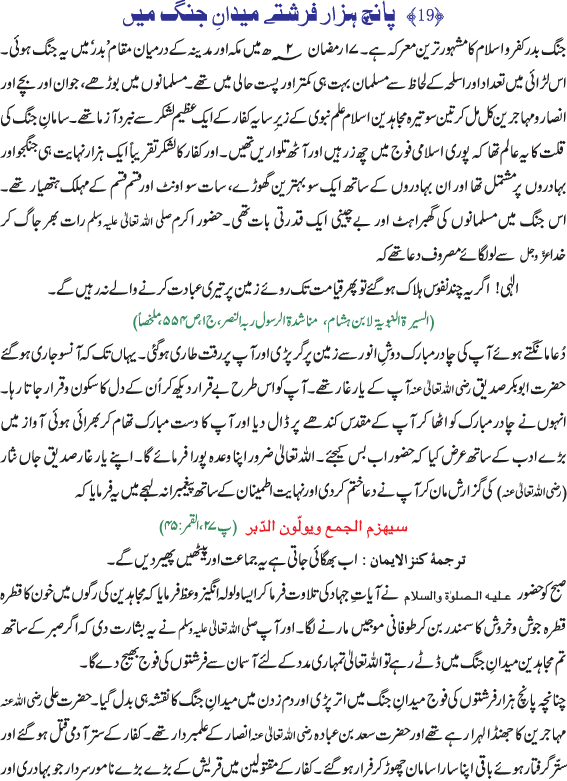
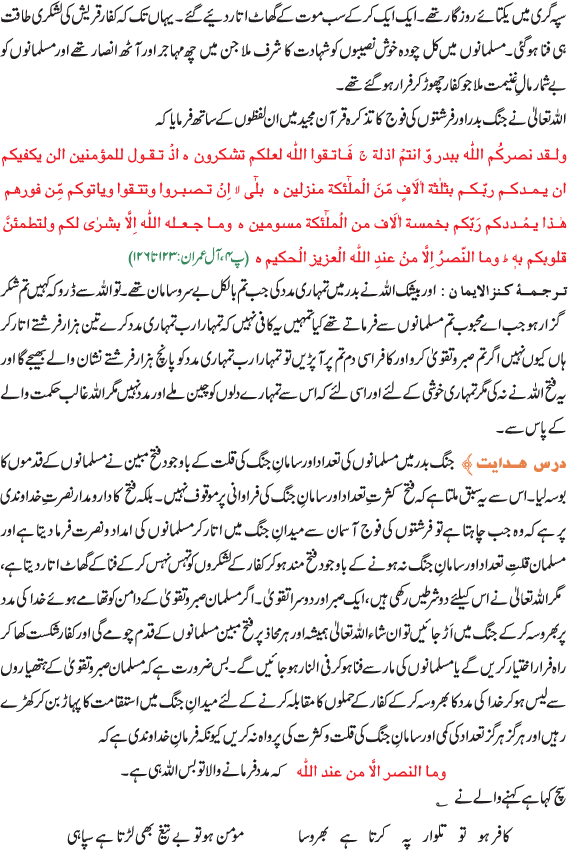
5 Hazar Farishtay Maidan-e-Jang Mae
Blessings Of A Simple Marriage
A man came to Sufyan Bin Uyainah (may Allah have mercy on him) and complained about his wife. “I am the lowest and most despicable thing to her,” he said. Sufyan lowered his head for a few moments and asked, “Perhaps you wanted her in order to better your status?” The man said, “Indeed, Abu Muhammad.” Sufyan replied, “Whoever goes for glory will be tested with humiliation; whoever goes for wealth will be tested with poverty; but whoever goes for religiousness, Allah will bring together for his glory and wealth with the religion.”
Sufyan then mentioned his own story to the man. “We were four brothers,” he said. “Muhammad, ‘Umran, Ibrahim, and I. Muhammad was the eldest, ‘Umran was the youngest, and I was in the middle. When Muhammad wanted to marry, he desired status and married a woman of higher standing, so Allah tested him with ignominy. ‘Umran desired wealth, so he married a richer woman and Allah tested him with poverty, as (her family) took everything from him and gave him nothing.”
“I pondered over their situation,” Sufyan continued. “Once when Mu’ammar Bin Rashid came to us, I consulted him and told him the story of my brothers. He reminded me of the Hadith of Yahya Bin Ja’dah and the Hadith of Ayesha.” The first Hadith states that the Prophet (peace be upon him) said, “A woman is married for four things: her religion, her status (lineage), her wealth or her beauty; so take the religious one and be successful.” (Al-Bukhari and Muslim) The second Hadith of Ayesha states that the Prophet (peace be upon him) said, “The most blessed woman is she who is easiest to maintain.” (An-Nasa’i)
“Thus,” Sufyan said, “I chose (to marry a woman of) religion and with a modest dowry, in accordance with the Sunnah of Allah’s Messenger (peace be upon him) and Allah gave me status and wealth along with the religion.” – Abu Nu’aym, Hilyatu Al-Awliya (7/289, 290)
Note: The second Hadith has been graded weak by scholars. However, scholars point out there is another narration that supports and adds to its meaning, which states: “It is from the good qualities in a woman that she (is taken in marriage with) an easy dowry, an easy proposal (via her guardian) and an easy womb (i.e. she is fertile and bares children without difficulty).” (Musnad Ahmad)