
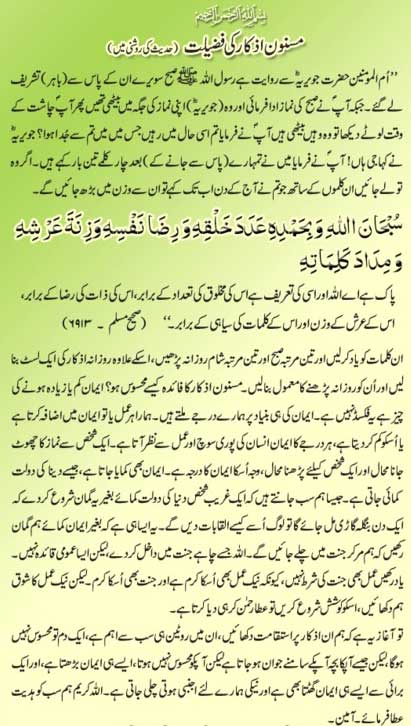
Masnoon Azkar Ki Fazeelat
Fair Dealing In Islam
Jurists have defined justice and equality as keeping a thing in its right place or keeping the balance. It is this which keeps the sky and the earth in their right places. If today justice were to be excluded from this world, there would be such a deluge of cruelty and brutality as would sweep off even our foundations.
The life of nations depends upon justice. This is a very important and valuable right that Islam has given to man.
The Holy Qur’an has laid down: “… And let not the hatred of some in stopping you from Masjid Al-Haram lead you to transgression …” (5:2). “And let not the enmity and hatred of others make you avoid justice. Be just: that is near to piety; and fear Allah …”( 5:8). Stressing this point the Qur’an again says: “O you who believe! Stand out firmly for justice, even though it be against yourselves, or your kin, be he rich or poor, Allah is a Better protector …” (4:135) This makes the point clear that Muslims have to be just not only with ordinary human beings but even with their enemies.
Justice and equality were the two main factors for the expansion of the Islamic state from Arabia to Spain and from there to India. Some Christians and Hindus say that Islam was spread at the point of the sword. But the sword the Muslims had in their hands was justice. Take any book of history you will find this event recorded therein. When Abu Obaida, the Muslim supreme commander of Syria, had to evacuate the Syrian town of Hims, in the face of a sudden attack by a superior Roman force, he summoned the padres and the elite of the town and said to them:
“We received revenue from you, so that we may spend it on your defense and betterment. But we cannot do it any longer, as we have to evacuate this town under duress. Therefore take back the seven hundred thousand dirhams you paid to us as revenue and tribute.” On seeing this astounding and unparalleled justice of their Muslim rulers, Chief Padre said: “No deed of justice and equality can excel this unrivaled masterpiece of yours. I give you my pledge that if ever we are at liberty to choose our rulers, we shall choose you Muslims and none other.”
Hajj A Model For Life
The blessed days of Hajj are approaching, and Muslim pilgrims are traveling to the holy sites. The memories and spirituality of Hajj are really moving. Pilgrims cannot help but have tears in their eyes while observing this magnificent gathering that is heading to the House of Allah in total submission and devotion. The pilgrims supplicate humbly, asking Allah to wipe off their sins, accept their Hajj, and grant them happiness in this world and the hereafter.
But should all of these awe-inspiring feelings be restricted to a few days of Hajj? I always think of Hajj as a journey intended to guide us on how to lead our larger journey of life. It is the model after which Muslims should pattern their lives. This connection between Hajj and life is very important; after all, both of them are journeys that need special preparation and should have special goals.
Take, for example, the first steps pilgrims take in preparation for their Hajj journey. They pay off their debts and bathe themselves. The lesson here is that our lives should be based on purity and cleanliness. How beautiful life would be if each and every one of us tried to adhere to this principle? If only everyone tried to steer clear of anything that may taint their beliefs or blemish their relations with Allah. Of course, it may happen that Muslims commit a sin or succumb to Satan’s whispers, but once such a thing occurs, they hasten to “clean” and “wash” their spirits. Just as they wear pure and clean clothes for their Hajj journeys, they are keen to meet Allah after the journey of life with a pure and clean heart.
“Labbayk, Allahumma, labbayk. Here I am, O Allah, at Your service.” This eternal call, chanted by millions of pilgrims every year, gives us further inspiration. The pilgrims respond to Allah’s call with pleasure, paying no heed to the trouble they may undergo; they come to Him declaring in words and in deeds their submission to His commands, their unconditional obedience to His orders, their love of what He loves, and paying their honor to what He honors. This is the spirit that Muslims should keep throughout their entire lives. Labbayk, Allahumma, labbayk. This is not merely a ritual phrase to be uttered in Hajj and then forgotten afterward, rather, it is a motto for every Muslim, a way of life.
After hours, even longer days, and months of travel, pilgrims reach Makkah and cool their eyes with the sight of the holy sites. Throughout their observances of Hajj, in their movements from place to place, and from rite to rite, Muslims recall great scenes of sacrifice by their great forbears, such as Prophet Ibrahim (peace be upon him) and his family, Prophet Muhammad (peace be upon him) and his noble companions. These glorious scenes inspire us and motivate us to face the challenges of life with a bold heart as well as to rise up to our responsibility of working and sacrificing in defense of our religion and for the advancement of our Ummah.
Death
We know very well that everyone has a fixed period of life. We do not live longer or shorter than this fixed period of life. Soon we will be transferred from this worldly life to the GRAVES. Where we will be alone with our deeds only. If they are good, we will be in a state of well-being, and if they are not, we will be in torment until the Day of Resurrection. The DAY, when records and ledgers of deeds will be unveiled. At that time, the scales will be placed and people’s deeds will be measured. Whoever had done an atom’s weight of good shall see it, and whoever had done an atom’s weight of evil shall see it.
On that DAY, the sun will descend upon people until it is only a mile away, People will be sweating according to their deeds. Some will sweat up to their ankles, some up to their knees, some up to their waists, and some will be submerged in sweat completely. On that DAY a bridge extended over Hell will be set over the Infernal Fire. It will be thinner than a strand of hair and sharper than a sword. Trust and ties of kinship will be sent forth and will stand on both sides, right and left. People will pass on it according to their deeds. Some will pass like lighting, some will pass crawling and some will be in between the fast and the slow. On that DAY people will be divided into two groups, one in Paradise and others in the Hell Fire.
We still have time to re-check our faith & belief since it is the duty of each and every one of us to find out the truth and follow it. We must check the authenticity of what we are following. Are we following the true religion or are we just following the elders and religious leaders with closed eyes. We should take advantage of the time we have on Earth as an opportunity to prepare ourselves for death and all that comes after it. God has told us in the Holy Quran how we can decrease the horrors that come after death.
According to Muslims the only true religion on earth is ISLAM. Everyone has their own choice to find out the truth but one must not decide anything just by seeing the followers only. Rather one must study sacred scripture to find out the truth. ISLAM is for the whole of mankind so whoever accepts it and follows it will get successful. Accepting is not enough till we follow it in true spirit. Let us ask our creator O’ Allah, Creator of the Heavens and the Earth, Knower of the unseen and the seen, we ask You for guidance and to make us witness that You are ALLAH and that there is no true deity but You Alone, the Eternal. The One who begets not, nor was begotten and that there is none co-equal or comparable unto to You; You have the Majesty and Bounty, You are the Ever-Living, the Eternal Guardian. We ask You for true repentance for the bad we have done. Ease for us the horrors of that Day and make us among the happy ones and join us with the righteous, O Allah, the Sustainer of all that exists show us the right path and guide us towards accepting and following the true religion ISLAM………..Ameen.
Nasihat
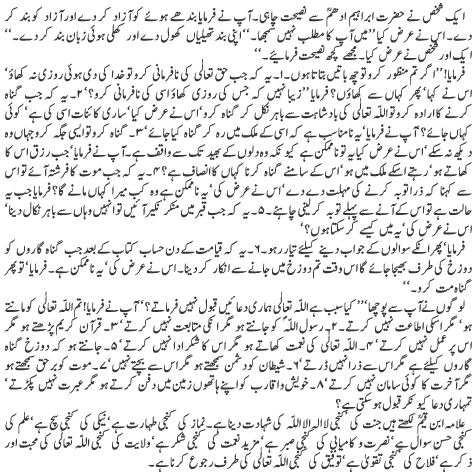
Nasihat
Hajj Tips For Pilgrims
- Always have drinking water as you may become dehydrated.
- Use your time wisely – be busy with Dhikr, Du’a, and recitation of the Qur’an.
- Wear comfortable, ‘broken-in’ footwear, that does not conceal fingers or ankles.
- Be very careful to stay within the specific boundaries during the days of Hajj, especially in Arafat – overstepping them may affect the correctness of your Hajj.
- If you wear spectacles, secure them with a spectacle cord.
- Take some rest on the night of Muzdalifah because the following day is full of activity and requires energy.
- Observe landmarks when going out so you can find your way back.
- Arrange a meeting place with your group in case you get lost.
- Keep the phone number of your hotel/flat and the group leader with you whenever you go out.
- Don’t go out alone on the days of Hajj as it is very easy to get lost.
- Always inform someone in the group when you go out and when you are expected to return.
- Have some cash with you when you go out, in case you get lost.
- Bathrooms are aplenty at Hajj sites, select one which is clean.
Five Special Privileges For Muslims
Jabir ibn Abdullah quotes the Prophet (peace be upon him) as saying: “I have been given five privileges which were not given to anyone before me: I have been supported by fear traveling a month ahead of me; the earth has been assigned to me as a place of worship and a source of purification.
“Anyone from my community may pray wherever he is when prayer is due. War gains have been made lawful to me while they were not made lawful to anyone before. I have been allowed to intercede on behalf of my followers. Prophets before me used to be sent to their own local communities while I am sent to all mankind.” (Related by Al-Bukhari).
The Prophet outlines these five privileges, acknowledging God’s favors and expressing his gratitude. He is in no way boasting about them. He is also highlighting them to his community so that they will remain grateful to God for them.
The first privilege is that the Prophet was supported by fear being struck into the hearts of his enemies.
A question arises here: Is this privilege special for the Prophet only or extended to his community in later generations? There is no clear indication given by the Prophet on this point.
Many scholars are of the view that it is special for the Prophet only, but some of them say that it applies to the Muslim community in all generations, provided that it adheres to Islam in all its affairs.
The second privilege concerns prayer, which is an essential element in all divine religions. The Prophet says: “There is no goodness in a religion that does not include prayer.”
The Prophet stresses here the fact that Muslims offer their prayers anywhere and can use the earth for dry ablution if they have no water.
This is an important privilege because earlier prophets had to offer their prayers in their temples or special places of worship. We all make use of this privilege all the time.
We conduct our congregational prayers in mosques, as well as in our places of work, schools, colleges, or at home.
A Muslim who works all day long in an office or a factory where there are hundreds of employees who are non-Muslims can easily take a few minutes to offer his prayers at his place of work, without disrupting his work.
Firm Faith In Allah
Jabir Bin Abdullah relates: We went along with Allah’s Messenger (peace be upon him) on an expedition towards Najd and Allah’s Messenger (peace be upon him) found us in a valley abounding in thorny trees. Allah’s Messenger (peace be upon him) stayed for rest under a tree and he suspended his sword by one of its branches under which he was taking rest.
The persons scattered in the valley and they also began to take a (rest under the trees, and Allah’s Messenger (peace be upon him) said: “A person came to me while I was asleep and took hold of the sword. I woke up and found him standing upon my head and I had hardly become alert that the sword was in his hand. And he said: “Who can protect you from me?” I said: “Allah.” He again said: “who can protect you from me?” I said: “Allah” He put his sword in the sheath (and you can see) this man is sitting here.” Allah’s Messenger did not in any way touch him. (Sahih Muslim)
This hadith brings into light the staunch faith the Holy Messenger (peace be upon him) had in Allah. The Holy Messenger’s relation with his Creator was so deep and close that no one can read an account of his sacred life without realizing a sense of the Majesty of Allah and of His Infinite Might and Power.
How much trust be reposed in the help and protection of Allah can be seen in the fact that although all the Companions used to keep a close watch no harm might come to the Messenger’s life and a few among them constantly remained with him as sentinels.
Among these are Sa’ad Bin Muadh, Muhammad bin Musalama, Zubair Bin Awwam, and Abbad Bin Bishr. But when the verse of Surah Al-Maidah: ‘And Allah will protect you from all people’ was revealed to the Holy Messenger (peace be upon him), he asked all his sentinels to leave him to the protection of Allah, as He has promised to him, and there is no protecting hand more powerful and mighty than the Hand of Allah. This shows the Holy Messenger’s firm faith in Allah.
Munafiq Ki Nishaniyaa’n
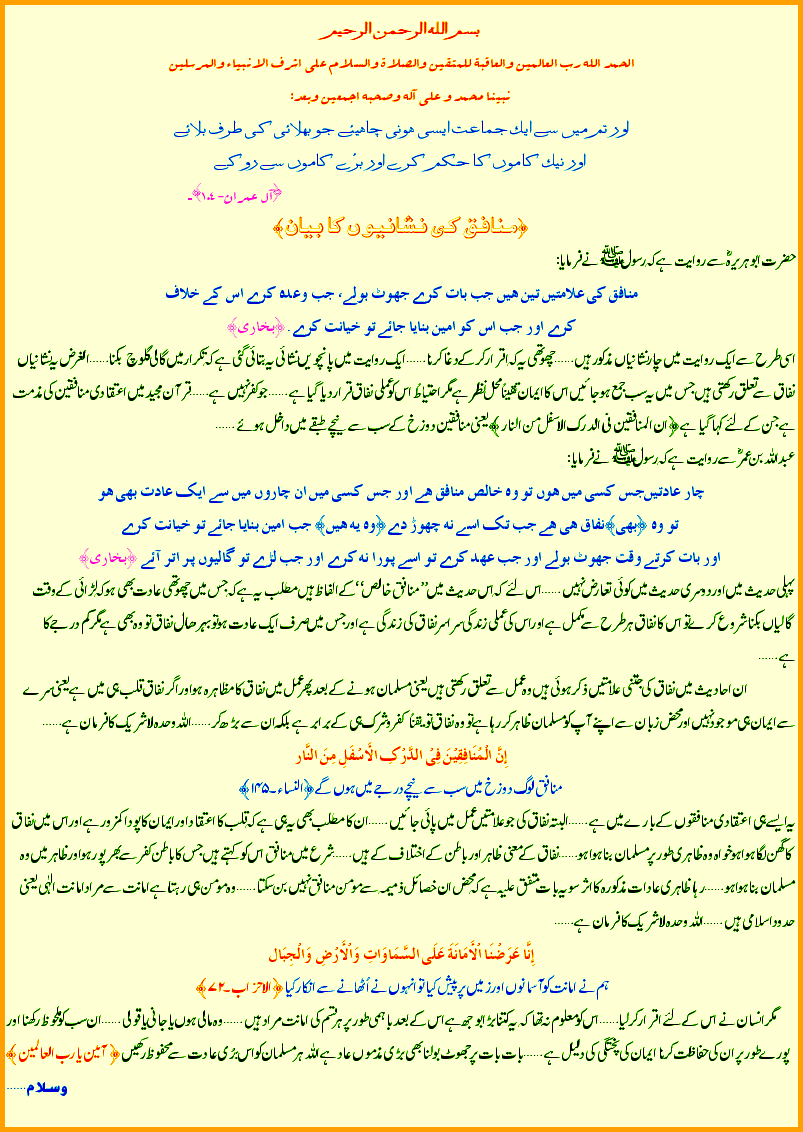
Munafiq Ki Nishaniyaa’n
From Governor To A Carpenter
ALI Bin Al-Maymoon Al-Abbasi was a governor and son of the Caliph. He lived a life of opulence in a large castle. Anything he wanted in this world was easy for him.
One day, looking down from a balcony in the castle, he saw a man toiling in the fields. On succeeding days, Ali paid more and more attention to the man and witnessed that he always worked straight through the morning, after which, he would take a break, make ablution from a stream, and pray two units of prayer. Only when the evening came would he quit his work and go home to his family. To learn more about him, Ali invited him one day and asked him many questions. He soon learned that the worker had a wife, two sisters, and a mother that were all under his care, and it was for their sake that he toiled so assiduously.
Ali asked, “And do you have any cause to complain?” He answered, “No, All praise is due to Allah, Lord of all that exists.”
So impressed was he by the simple laborer, that Ali quit the castle, resigned from his position, and traveled abroad. He was found dead years later in the vicinity of Kharasan. After leaving the castle, he worked as a carpenter, and he found happiness in his new life, happiness that was foreign to him in his former one.
“While as for those who accept guidance, He increases their guidance, and bestows on them their piety” (Qur’an 47:17)
– excerpt from Aaidh Bin Abdullah Al-Qarni’s book “Don’t be sad”