

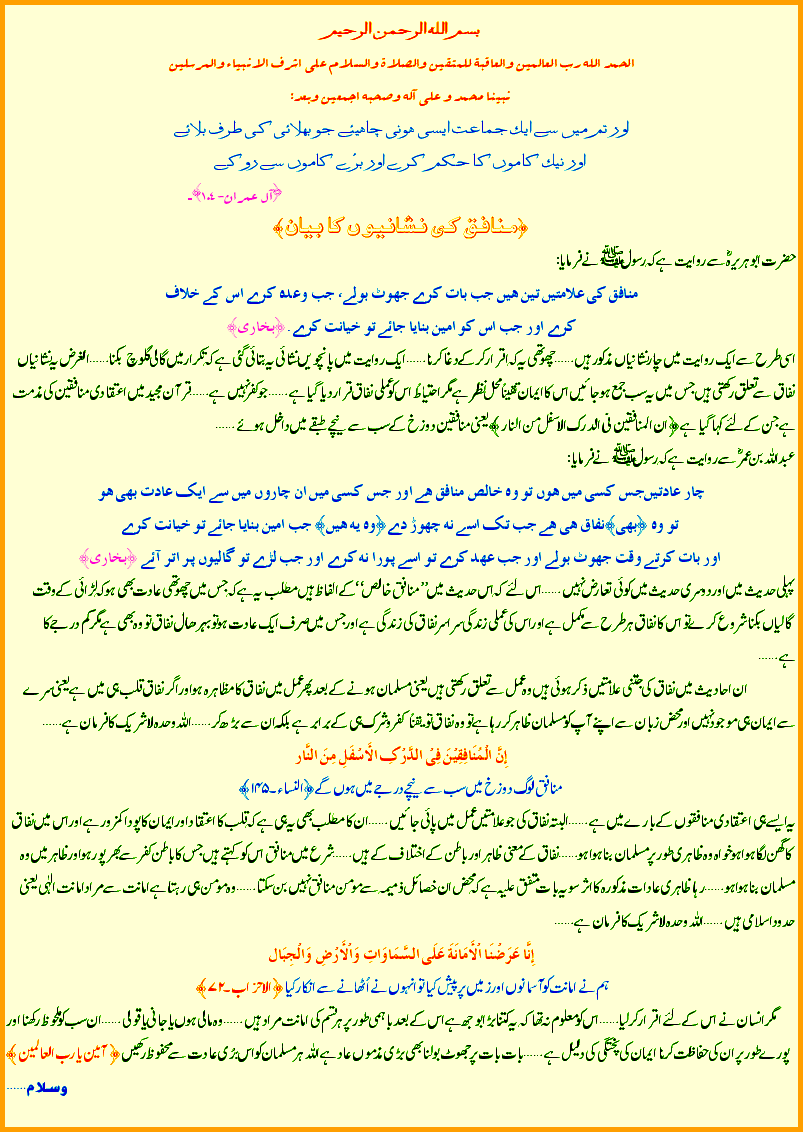
Munafiq Ki Nishaniyaa’n
From Governor To A Carpenter
ALI Bin Al-Maymoon Al-Abbasi was a governor and son of the Caliph. He lived a life of opulence in a large castle. Anything he wanted in this world was easy for him.
One day, looking down from a balcony in the castle, he saw a man toiling in the fields. On succeeding days, Ali paid more and more attention to the man and witnessed that he always worked straight through the morning, after which, he would take a break, make ablution from a stream, and pray two units of prayer. Only when the evening came would he quit his work and go home to his family. To learn more about him, Ali invited him one day and asked him many questions. He soon learned that the worker had a wife, two sisters, and a mother that were all under his care, and it was for their sake that he toiled so assiduously.
Ali asked, “And do you have any cause to complain?” He answered, “No, All praise is due to Allah, Lord of all that exists.”
So impressed was he by the simple laborer, that Ali quit the castle, resigned from his position, and traveled abroad. He was found dead years later in the vicinity of Kharasan. After leaving the castle, he worked as a carpenter, and he found happiness in his new life, happiness that was foreign to him in his former one.
“While as for those who accept guidance, He increases their guidance, and bestows on them their piety” (Qur’an 47:17)
– excerpt from Aaidh Bin Abdullah Al-Qarni’s book “Don’t be sad”
Turning To Allah
Turning to Allah individually and collectively is the only way to safety, peace, and security both in this world and in the hereafter.
Umar ibn Al-Khattab – a companion of the Prophet Muhammad(peace be upon him) and caliph (ra – may Allah be pleased with him) said: “We were lowly and weak then Allah made us mighty with Islam. So when we seek mightiness in other than Islam, Allah humiliates us and brings us low.”
Umar (ra) could see this in his time. Imagine how much clearer it has become since! Once the Romans captured the great Companion of the Prophet Muhammad(may the peace and blessings of Allah be upon him) Hudhaifa (ra) and a number of other Muslims took them to their king. The king asked him to leave Islam and become Christian, but he refused. Then the king imprisoned him and tortured him but he still refused. Then the king didn’t feed him long enough and offered him pork and wine, but Hudhaifa (ra) refused them both. He preferred hunger and thirst to them.
Next, the king offered to marry him to his daughter and share his property with him if he would leave Islam and become a Christian. Still, Hudhaifa (ra) refused. Next, thee brought a huge vat of boiling water, threw one of the other Muslims in it, and cooked him alive while Hudhaifa (ra) watched. The King told him that either he leaves his religion or he will cook him too.
Hudhaifa (ra) began to cry and the king thought he had broken him. He asked him “What has made you cry?” Hudhaifa (ra) replied: “I was wishing that I had one hundred souls so I could offer them all in the path of Allah now as I die.” Hercules was shocked at his resolve and said, “Just come and kiss my head and I will let you go.” Hudhaifa (ra) said: “No, not unless you release all of the Muslims along with me.” Hercules said: “I give you that.” So, Hudhaifa (ra) kissed his head and all of the Muslim prisoners were released and they returned to Madinah.
When he returned, the Khalifa (caliph) Umar ibn Al-Khattab (ra) called him and asked him all about what happened which Hudhaifa (ra) told him all about. Then, Umar (ra) said: “I want to ask you two questions. First: Why didn’t you eat the pork and drink the wine when Allah has made it lawful for the one in necessity saying
{But whoever is driven by necessity in a critical situation…} (Al-Ma’idah: 3)
Hudhaifa (ra) said: “O commander of the faithful (Umar – ra), in order that they would have no chance to detract from Islam.” Umar (ra) was pleased with this answer. Then, Umar (ra) asked: “Why did you kiss Hercules the leader of the Romans?” Hudhaifa (ra) answered “When I placed my mouth on his head I did not kiss him. Rather, I spat on his head but he thought I kissed it. Umar (ra) was again pleased with Hudhaifa’s (ra) actions and he kissed Hudhaifa’s (ra) head in front of a crowd of people. Then he said: “It is upon every Muslim to kiss the head of Hudhaifa (ra)!”.
Hell Worst Destination
- Hell is so deep that if a stone were to be thrown into it, it would travel for 70 years to reaching the bottom.
- The breadth of each of the four walls around Hell is equivalent to a distance covered by a walking journey of 40 years.
- Hell has 7 gates.
- Hell had been lit for one thousand years until its flames became red. Again it was heated for another thousand years till its color became white. Still again it was burnt for a further thousand years and its white color flame turned pitch black.
- Even the most fierce fire of this world is 70-fold cooler than the fire of Hell.
- The lightest punishment in Hell would be the wearing of ” Fiery shoes which would cause one’s brain to boil.
- Hell is infested with venomous snakes and scorpions the size of donkeys and if they were to bite a person then he or she will suffer pain for 40 years.
- For food, the dweller of Hell would be given Zaqqum which is a prickly tree, so bitter, that even if a single molecule of it were to spill onto this earth it would make all the foodstuff of the world bitter and unpalatable.
- For drinking, the denizen of Hell would be provided with hot, boiling pus mixed with blood, matter, urine, and tears, etc. of the dwellers of Hell. If a bucket of this foul liquid were to be splashed over this earth, the entire world would be upset and disrupted by its most foul stink.
- Boiling water would be poured over Jahannami’s head and this will cause their internal organs to melt and leak out through their feet.
Dunya
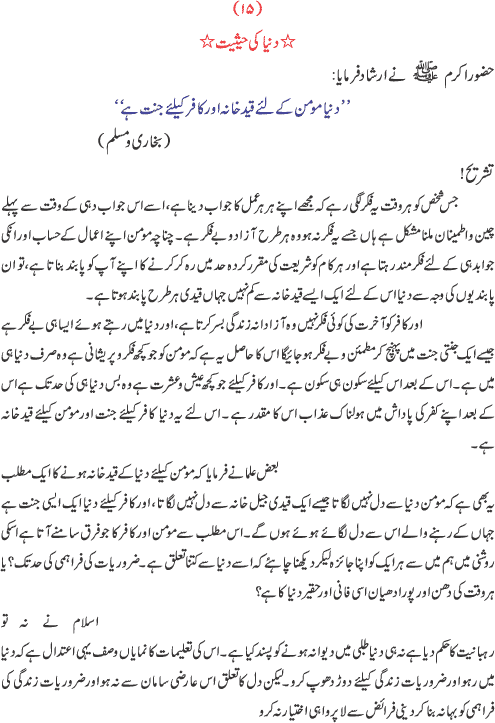
Dunya
Hajj – The Real Blessings
What are the blessings of Hajj? One may describe them in great detail. But, in the Qur’an, where Allah instructs Prophet Ibrahim to invite people to come to Hajj, so: “That they may witness things that are of benefit to them…” (22: 28)
Hence, the real blessings of Hajj can only be experienced by those who actually perform it. Imam Abu Hanifah, it is narrated, was unsure which act of worship was more excellent among the various ones laid down by Islam. But once he had performed Hajj, he had no hesitation in declaring that Hajj was the most excellent of all.
I shall now try to give you, briefly, some idea of its blessings.
The Journey
We usually think of journeys as of two kinds: those made for business and those made for pleasure. In both cases, it is to fulfill your worldly desires and benefit yourselves that you leave your homes, separate from families, and spend money — all is done for your own sake. No question arises of sacrifice for any higher, sublime purpose.
But the journey that is the Hajj is quite different in nature. This is not meant for any personal end. It is undertaken solely for Allah and the fulfillment of the duty prescribed by Allah. Nobody can be prepared to undertake this journey until and unless he has love of Allah in his heart, as well as fear of Him, and is convinced that Allah wants him to do what he is doing. That you are willing to bear the hardships arising from separation from your family, to incur great expenses on a journey that will bring no material rewards, and to suffer any loss of business or job, all are signs of certain inner qualities: that you love and fear Allah more than anything, that you have a strong sense of duty to Him, that you are willing to respond to His summons and ready to sacrifice your material comforts in His cause.
Sawdah Bint Zam’ah (Radi allahu anha)
Prophet Muhammad (peace be upon him) married Sawdah bint Zam’ah (radi allahu anha) a short while after the death of his first and most beloved wife, Khadijah (radi allahu anha) , with whom he shared a very happy 25 years of his blessed life. Sawdah (radi allahu anha) was a mature woman, around 40 years of age, and a mother of five children. This marriage gave Sawdah (radi allahu anha) uplift in her life, for she had been mourning her husband, Al-Sakran ibn Amr, who died soon after the couple had returned from Abyssinia, where a number of the Prophet’s companions had gone a few years earlier to establish a second base for Islam, away from the persecution in Makkah. She was now married to God’s messenger, who was renowned for his fine character and compassion, in addition to the great qualities that fitted him to be the recipient of God’s final message to mankind.
Scholars and writers about the Prophet and his character often explain his marriages in terms of different needs: Some political, others social, and some even legislative. While such reasons were certainly present in many of his marriages, they are not the overriding reasons for any. Each of his marriages expressed a desire to be united with the lady in question. In Sawdah’s case, we read explanations that he wanted to compensate her for the loss of her husband. The fact is that the Prophet needed a new wife after Khadijah (radi allahu anha) had passed away, and the qualities he needed in his new wife were maturity, kindness, and being a believer in his message. Sawdah (radi allahu anha) answered all these. She was the one to take care of his two unmarried daughters, Umm Kulthoom (radi allahu anha) and Fatimah (radi allahu anha) .
We see some aspects of Sawdah’s (radi allahu anha) maturity in the fact that when other wives came into the Prophet’s home and jealousies surfaced between them, leading to the emergence of two camps, Sawdah (radi allahu anha) did not join either group. She remained loyal to her husband, giving him all that he needed love and care. Nor did she ever express, in word or gesture, any feeling of jealousy when she realized that the Prophet’s heart leaned toward a particular one of his wives. On the contrary, we see her rising to the sublime as she realized that the Prophet’s heart favored Aishah (radi allahu anha) above all others, but he had to maintain fairness between all his wives. He would not allow himself to give Aishah (radi allahu anha) an hour more than he would give every one of his other wives. Therefore, in her eagerness to please the Prophet, Sawdah (radi allahu anha) made a gift of her nights to Aishah (radi allahu anha) . This was a voluntary gift, motivated only by her desire to please her husband. Thus, every time it was Sawdah’s (radi allahu anha) turn, the Prophet would visit her in the evening before going to spend the rest of the night at Aishah’s (radi allahu anha) place.
Sawdah’s (radi allahu anha) action speaks much about her character. She was a woman who loved to be kind to others and enjoyed giving them what pleases them.
She wished to remain married to the Prophet and be always remembered by Muslims throughout the world as a ‘mother of all believers’ as his wives earned this title. At the same time, she wanted to give greater pleasure to her husband and the one whom he loved most among his wives. Hence, her gift became a model for any woman who wishes to forego some of her rights in order to please her husband.
Sawdah (radi allahu anha) died toward the end of Umar’s reign, about ten years after the Prophet had passed away.
What Is Destiny (Taqdir)?
Within the Knowledge of Allah Ta’ala, He wrote what was going to happen in the world and whatever His servants were going to do. Allah Ta’ala wrote about good in some people’s fates and wrote about badly in another person’s fates. He did not make the person helpless by writing this down but wrote down what the servant was going to do. An example of this is that if Allah Ta’ala wrote badly for Zaid, then it was because He is aware that Zaid is going to do badly, and if Zaid was to do good, then He would have written well for Zaid, thus His Writing and His Knowledge did not make any person compelled. After performing bad deeds you should not say that this happened because it was Allah Ta’ala’s will and therefore it was in my destiny, but all good things are done with the Pleasure of Allah Ta’ala and all bad deeds are done with the pleasure of one’s desires.
To believe yourself totally without a will or totally helpless is a misguided belief. The Holy Prophet (sallal laahu alaihi wasallam) has referred to those who do not believe in Taqdir to be like fire-worshippers of his Ummah.
It is forbidden to discuss or debate the subject of destiny. A person should only think that they are not helpless like stones and therefore cannot do anything according to their will, but actually, Allah Ta’ala has given humans the power to do as they please and the reward and sin are based upon this power of will. Hazrat Abu Bakr Siddique and Hazrat Umar-e-Farooq (radi Allahu anhuma) were prohibited from discussing Taqdir
Delaying Hajj? Think Again
Umar Bin Al-Khattab (may Allah be pleased with him) once remarked: “I was about to send envoys to the towns (on the outskirts of the Muslim empire) to check on all those who have the means to make Hajj but do not perform it, in order to impose the Jizyah upon them.” (Al-Bayhaqi; Al-Haithami declared it Sahih)
The auspicious Hajj trip is one of the five pillars of Islam, a one-time obligation upon those who have the ability to perform it. Every year millions of devout Muslims answer the call to Haj following in the footsteps of the Prophet (peace be upon him) in answering the call of their father Ibrahim.
Unfortunately, many people delay performing the Hajj until the latter part of their lives simply because of convenience. They wish to postpone the trip until they feel they are financially ‘stable’. Some people hold back out of fear of a new Islamic lifestyle they will be obligated to embrace when they return – one should never fear drawing closer to God. Indeed the Prophet (peace be upon him) said, “Hurry to perform Hajj (the obligatory one), as none of you knows what may happen to him” (Ahmad, Abu Dawood, and Ibn Majah) and “Whoever wants to do Hajj, let him hasten to do so.” (Ahmad and Abu Dawood)
There is of course a well-known scholarly difference of opinion as to whether Hajj is an obligation that must be executed promptly, or, can be delayed. According to scholars who hold the opinion that the obligation of the Hajj is one of promptness; the Hajj must be carried out as soon as all the preconditions are fulfilled and one cannot delay performing it for the next year. The one who delays the performance of Hajj, even though he has the means to perform it, and then dies, is sinful and has left himself open to the punishment and displeasure of Allah in the Hereafter.
Others opine that the Hajj may be delayed because the Messenger of Allah (peace be upon him) chose to perform Haj in the 10 AH – around four years after the obligation was revealed. This school has other supporting arguments for which there exist counterarguments.
Without wanting to endorse one opinion over another, I would like to place the legal difference of opinion to one side and draw our attention to a few other points. Allah the Almighty encourages His servants to compete with each other in performing virtuous deeds. He says in one verse,
And march forth in the way (which leads to) forgiveness from your Lord, and for Paradise as wide as are the heavens and the earth, prepared for the pious. (Qur’an, 3:133)
Why would one delay the prospect of performing a Haj Mabroor, the accepted Hajj, the reward of which is nothing less than the gardens of Paradise?
This is your chance to have all of your sins forgiven as the Prophet (peace be upon him) said: “Whoever performs Hajj to this house – Ka’bah – and does not commit any obscenity and wrongdoing, he, or she, will come out as the day he, or she, was born – pure and free from sins.” (Al-Bukhari and Muslim)
From another perspective, the Messenger of Allah (peace be upon him) is reported to have said: “Hurry to perform Hajj, as none of you knows what may happen to him.” It is as if the Prophet is telling us to think about the matter in a rational way. If someone who has the ability to perform the Hajj delays it; do they not fear that death may catch up with them and they then meet Allah with no Hajj to their account?
The reality is that many do delay Hajj until it’s too late. As the years pass by some of them fall sick with debilitating conditions, others become financially stricken and so the great opportunity is lost.
An appeal to all Muslims who know that they can perform Hajj without great difficulty is to do so before they lose this unique chance of attaining complete forgiveness for their sins and being granted Paradise.
Rahamdili
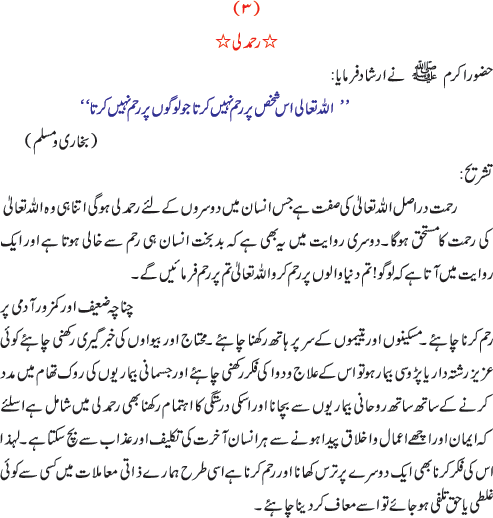
Rahamdili