
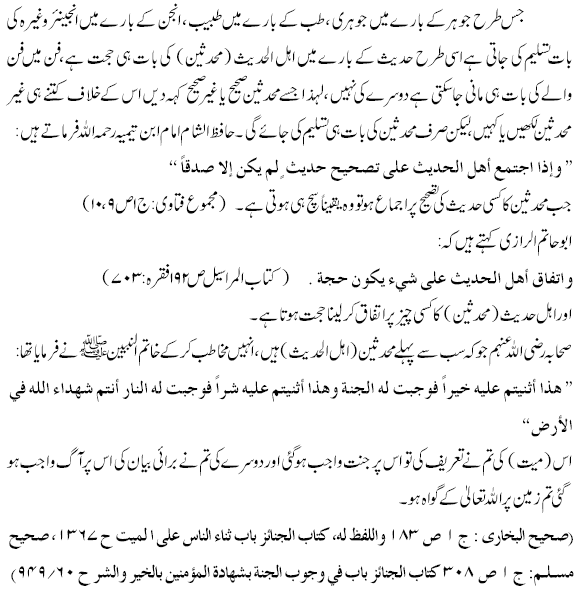
Muhaddiseen
Do You Really Want Paradise?
‘I want to go to Jannah (Paradise)’ should be our goal in life. It should be written in bold letters on our foreheads so that it serves a constant reminder for us. The Prophet (peace be upon him) has left with us a very small key to Jannah, which we Muslims today have become oblivious of. Just like you need a key to open your car’s door, or house door, or office door; similarly you need a key to open Jannah to you. What is this key?
The Noble Prophet (peace be upon him) said, “Whoever goes down a path/road searching for knowledge, Allah will make it easy for him the road to Paradise.” (Sahih Muslim, Vol.3, Hadith no. 99)
Traveling on the path to knowledge refers both to walking or driving along an actual pathway, such as going to conferences or the local mosque whenever there is an Islamic lecture or seminar. Searching also entails, a metaphysical road, such as studying and memorizing the Qur’an and Hadith. Not just memorizing like a parrot, but understanding it and acting upon it.
For those who seek knowledge, Allah will make their learning easier, clearing the way for him, and smoothing his journey to Paradise. This is why some of our pious predecessors used to say, “Is there anyone seeking knowledge so that we can assist him in finding it?”
Brothers and sisters, be LOVERS of Knowledge, be seekers of Knowledge. “Yes, where is my Qur’an, where is my Hadith Bukhari!” Let’s get up every morning with a purpose: to seek Jannah by seeking Knowledge. Knowledge is also the shortest path to Allah. Whoever travels the road of knowledge reaches Allah and Paradise by the shortest route. Knowledge also clears the way out of darkness, ignorance, doubt, and skepticism. This is why Allah called His Book “Light.”
Knowledge is the ROAD to Paradise, and Islam is the vehicle that takes you to this destination of Paradise. Just like you get in a car to go from one destination to another, but how? By finding out the directions to get there, either by seeing a map or asking someone. Similarly, our Qur’an and Hadith are our maps, and our scholars are the people who give the directions from this map to get to our ultimate destination, Paradise.
Ask yourself, “Is Paradise easy?” Have you ever seen how easy it is for some brothers and sisters to memorize the whole Qur’an by heart? Have you ever seen how easy it is for some of us to study the Qur’an and Hadith for hours and hours, while others cannot even open the Qur’an or Hadith even once a year or month? Why?
Do Not Get Frustrated When There Is Delay In Accepting Your Supplications
Abu Hurairah (May Allah be pleased with him) reported: The Messenger of Allah (PBUH), “The supplication of every one of you will be granted if he does not get impatient and say (for example): `I supplicated my Rubb but my prayer has not been granted’.” [Al-Bukhari and Muslim].
The narration of Muslims is: “The supplication of a slave continues to be granted as long as he does not supplicate for a sinful thing or for something that would cut off the ties of kinship and he does not grow impatient.” It was said: “O Messenger of Allah! What does growing impatient mean?” He (PBUH) said, “It is one’s saying: `I supplicated again and again but I do not think that my prayer will be answered.’ Then he becomes frustrated (in such circumstances) and gives up supplication altogether.”
Abu Umamah (May Allah be pleased with him) reported: The Messenger of Allah (PBUH) was asked: “At what time does the supplication find the greatest response?” He (PBUH) replied, “A supplication made during the middle of the last part of the night and after the conclusion of the obligatory prayers.” [At-Tirmidhi].
`Ubadah bin As-Samit (May Allah be pleased with him) said: The Messenger of Allah (PBUH) said, “Whenever a Muslim supplicates Allah, He accepts his supplication or averts any similar kind of trouble from him until he prays for something sinful or something that may break the ties of kinship.” Upon this, someone of the Companions said: “Then we shall supplicate plenty.” The Messenger of Allah (PBUH) said, “Allah is more plentiful (in responding).”
[At-Tirmidhi].
Commentary: We learn from this Hadith that prayer (supplication) is beneficial to us in any case, because Almighty Allah either grants the prayer we make, or if the supplication is not being accepted, He removes some future trouble that was destined for us, or He grants us in full in the Hereafter.
A Muslim should never feel shy of praying to Allah. In fact, he should persistently pray because there is no end to His Treasures.
Ibn `Abbas (May Allah be pleased with them) said: The Messenger of Allah (PBUH) used to say when he was in distress: “La ilaha illallahul-Azimul-Halim. La ilaha illallahu Rabbul-`Arshil-`Azim. La ilaha illallahu Rabbus-samawati, wa Rabbul-ardi, wa Rabbul-`Arshil-Karim. (None has the right to be worshiped but Allah the Incomparably Great, the Compassionate. None has the right to be worshiped but Allah the Rubb of the Mighty Throne. None has the right to be worshiped but Allah the Rubb of the heavens, the Rubb of the earth, and the Rubb of the Honorable Throne).”
[Al-Bukhari and Muslim].
Commentary: The only medicine in a time of distress is the remembrance of Allah Whose Help alone should be sought. This Du`a contains words that glorify Allah and exalt Him far above all else. It is desirable to recite these words when one is in distress as this is exactly what the Prophet (PBUH) used to recite in such situations
Paradise – Sexual Haven For Men?
First, we human beings have to remember that we have limited knowledge and perceptions. The things of the hereafter are beyond our understanding. That does not mean that Paradise and Hell are not physical. It is wrong to think that our next life will be only spiritual. We are told that we will be resurrected and re-created, but life in Paradise will be unlike life here. We will eat and drink but there will be no filth or dirt. Our bodies will not excrete wastes nor will they grow old.
Not only our physical bodies but also our psychology (or nature) will be different. The Qur’an tells us that there will be no vanities or hard feelings in Paradise. Those who are blessed enough to enter will have all they desire and there will be no jealousy.
Second, it is not important to understand exactly what Paradise and Hell will be like. It is important to know how to develop our relationship with God so that He will reward us with Paradise.
If we learn all the details of what life in Paradise will be like but fail to worship and serve God, then our knowledge is useless.
If a man in this world is allowed to have up to four wives (if he treats them equally), what is so wrong with him having more than that in the next life? Remember, our bodies and psychologies will be different and we cannot compare our life here with our life in the hereafter.
There is another Hadith that believes women in Paradise will have a higher status than even the houris. The believing women will say, “We shall have eternal life and will never die; we are the gentle ones who will never despair; we have settled down and shall never depart; we are contented and shall never be dissatisfied; blessed are we and blessed are our spouses…” (At-Tabarani, summarized in A Thematic Commentary on the Qur’an by Sheikh Muhammad Al-Ghazali).
From that, we can judge that the believing women will not be dissatisfied if their husbands also have houris. Why should we judge life in Paradise by the standards of our lives here?
The Qur’an does tell us that we will be greeted with the word “Peace!” when we enter Paradise. We should not question God’s wisdom in making us in the nature we are now or in re-creating us in the nature we will have. We know that He is the Most Generous and Most Merciful, and we have no right to question what He chooses to give us in Paradise. Our focus should be on worshiping and serving Him, developing our relationship with Him so that we may hope for His generous reward of Paradise.
Fakhar-O-Guroor Aur Khud Pasandi Haraam Hay
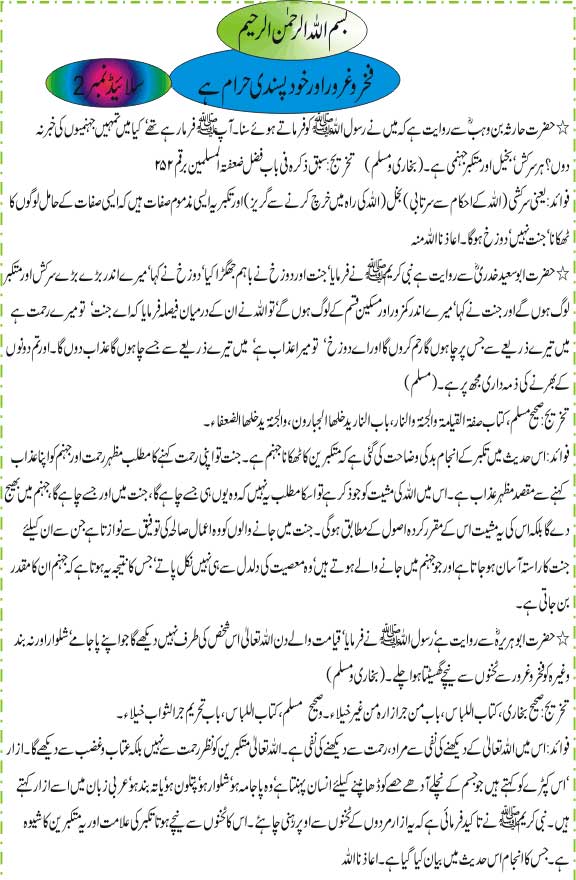
Fakhar-O-Guroor Aur Khud Pasandi Haraam Hay
How To Achieve Inner Peace
It is important to remember that inner peace comes from Allah. It does not come from material things. It does not come from drugs or painkillers. It does not come from a sinful lifestyle. Unless our relations with Allah are good, we can never have real inner peace. In order to have inner peace, we must :
Have strong faith and trust in Allah. Make Dhikr of Allah as much as we can. Dhikr brings comfort. We must follow the right path of Islam. Neither misfortune nor prosperity should turn you away from Islam.
Be with good people and be good to others. We must always say good words and do good deeds. Deeds of charity bring real inner peace.
What we do not like others to do to us, we should not do to others.
Be most forgiving. Forgiveness is the best healer and it first heals the person who forgives.
Of Malls And Mus’ab Bin ‘Umair
Big city, with bright lights. Cars flash in fast lanes. Young Muslims are getting ready to hit the “night scene”. Branded shoes and designer clothes in place, clutching the latest mobile gizmos and sporting the trendiest watches, their perfume smells of – more than anything else – money.
You can see them “hanging out” in groups, lolling in the bright lights of a megamall, lingering aimlessly in hyper shops, watching people go by, sharing a joke, and laughing raucously.
You can see them racing cars dangerously late into the night, music blasting from the stereos, startling passersby while they laugh in their faces. A standard sight.
Each time you see this all-too-familiar scene, just think of someone. Someone who lies buried in the blood-wet earth of ‘Uhud, feet covered by scented grass and his body covered only by a square woolen sheet that was not even sufficient to cover him completely. Someone who was his mother’s pampered son, he wore the best clothes his rich mother’s money could buy, and his perfume scented the streets he walked through. The talk of Makkan matrons and maidens in their plush salons, the toast of his peers in the city’s clubs, the most flamboyant young man of the Quraish, who left a life of pleasuring the Self to gain the pleasure of Allah: Mus’ab Bin Umair Bin Hashim Bin Abd Munaf who was also known as Mus’ab Al-Khair.
Mus’ab was only a youth when he heard of the new Prophet who had arisen among the Quraish and his message of monotheism. Makkah talked of very little else in those days. His curiosity piqued by all the talk, Mus’ab decided to approach the Prophet (peace be upon him) on his own to determine the truth of his Message.
One night, instead of joining his friends in their customary revelry, Mus’ab made his way to the house of Al-Arqaam Ibn Al-Arqaam which came to be known as Dar Al-Arqaam among the Muslims. It was here that the Prophet met with the growing band of Muslims, away from the eyes of the Quraish. It was here that the companions talked over the future of their faith, heard and recited newly revealed portions of the Qur’an, and prayed behind the Prophet (peace be upon him) to Allah.
That night, Mus’ab sat down among the gathering of the faithful and heard the Prophet (peace be upon him) recite verses of the Qur’an. From that moment on he forgot forever his life of luxury and indolence while discovering the key to eternal life.
Concept Of Hereafter
Many people wonder how a person with a scientific and logical temperament, can lend any credence to the belief in life after death. People assume that anyone believing in the hereafter is doing so on the basis of blind belief.
This concept has been given to mankind by God in his book “Qur’an Kareem” which has more than a thousand verses containing scientific facts. Some have been discovered by science and others will be discovered as science advances.
The concept of peace, human values, and good or bad are useless without the concept of the hereafter. One thing or act can be bad in the eyes of a person but could be good or beneficial for another one.
Every human being wants justice: Does human law provide justice to all humankind?
The people who do injustice should be punished: Can we punish a murderer of 100 people as compared to a murderer of a single person?
This life is a test for the hereafter: If it is not, then why few people are wealthy and enjoying the luxuries of life, and why few are poor and don’t even have enough food to eat? Life is a test for both of them.
Final justice on the day of judgment. No human law can provide 100% justice to all humankind. There will be definitely a day of judgment for final justice. We all are in the examination hall and we will be given results on the day of judgment.
When it is dead sure that there will be a day of judgment and life after death, one should follow the religion instead of passing life in his own style.
All religions basically exhort mankind to be righteous and eschew evil. but Islam goes beyond that. It guides us toward practical ways of achieving righteousness and eliminating evil from our individual ad collective lives. Islam takes into account human nature and the complexities of human society. Islam is Guidance from the creator himself. Therefore, Islam is also called The “Deen-ul-Fitrah” (the natural religion).
According to Muslims the only true religion on earth is ISLAM. Everyone has their own choice to find out the truth but one must not decide anything just by seeing the followers only. Rather one must study sacred scripture to find out the truth. ISLAM is for the whole of mankind so whoever accepts it and follows it will get successful. Accepting is not enough till we follow it in true spirit.
We should hurry to ask Allah (SWT) for forgiveness and start following true religion before the end of our life. Life is too short(who knows tomorrow we will get up from sleep or not!).
Makaram-e-Ekhlaq
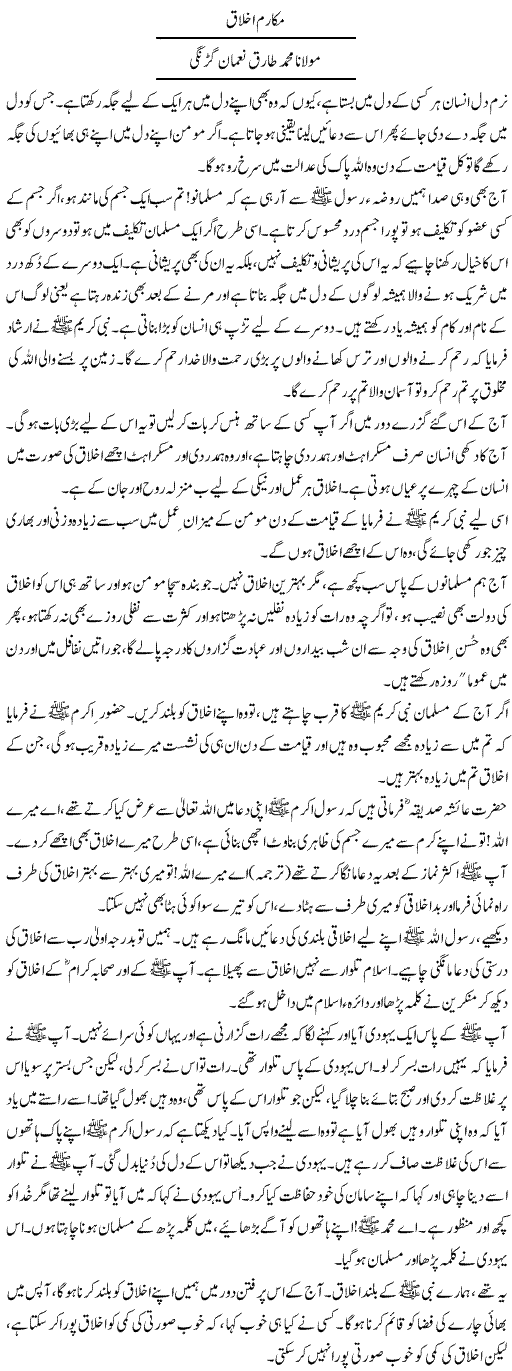
Makaram-e-Ekhlaq
Am I Not Your Lord ?
And recall (O Prophet) when your Lord brought forth descendants from the loins of the sons of Adam, and made them witnesses against their own selves, asking them: ‘Am I not your Lord?’ They said: ‘Yes, we do testify.’ We did so lest you claim on the Day of Resurrection: ‘We were unaware of this.‘ (Qur’an, 7:172)
Allah made the Israelites enter into a covenant with their Lord. A covenant with God is not the exclusive privilege of the Children of Israel. In fact, all human beings are bound in a covenant with Allah and a Day will come when they will be made to answer how well they were able to observe that covenant.
This event, according to several traditions, took place at the time of the creation of Adam. Apart from the prostration of the angels before Adam and the proclamation that man would be Allah’s vicegerent on earth, all the future progeny of Adam were gathered and endowed with both existence and consciousness in order to bear witness to Allah’s lordship.
The best interpretation of this event is found in a statement by Ubayy Bin Ka’b, who has probably given the substance of what he had heard from the Prophet (peace be upon him):
Allah gathered all human beings, divided them into different groups, granted them human form and the faculty of speech, made them enter into a covenant, and then making them witnesses against themselves He asked them: ‘Am I not you Lord?’ They replied: ‘Assuredly you are our Lord.’ Then Allah told them: ‘I call upon the sky and the earth and your own progenitor, Adam, to be witness against you lest you should say on the Day of Judgment that you were ignorant of this. Know well that no one other than Me deserves to be worshipped and no other than Me is your Lord. So do not ascribe any partner to Me.
I shall send to you My Messengers who will remind you of this covenant which you made with Me. I shall send down to you My Books.’ In reply, all said: ‘We witness that You are Our Lord and our Deity. We have no lord or deity other than You.’