

- Start off each day with the waking-up supplications, thanking Allah for waking up in good shape.
- Put Allah first in your life.
- Broaden your horizons – learn 5 new verses from the Holy Qur’an every day, take up a booklet having supplications, and read them.
- If someone says something mean to you, just shrug it off and dismiss it in a friendly, laid-back manner, and pray that Allah shall forgive him.
- When you get angry, remember Allah, and think how short and worthless life is to waste in being angry.
- Remember that you can never have too many friends, but you can have a few quality friends that help you fulfill the purpose of your creation (i.e. live for Allah).
- When you’re happy, try to share your happiness with others. Thank Allah for that, and pray for its continuation.
- When something bad or embarrassing happens to you, just think that it could always be worse, remember the reward of patience, and thank Allah that it’s not worse than it is.
- Do something extra of goodness once in a while, like feeding a poor person, or caressing an orphan’s head.
- Never stop believing that you can win Allah’s love and thus work for it. Then you can win the love of Allah’s slaves.
- Spend some time thinking of Allah’s amazing creation.
- Always love those who love Allah unconditionally. This way you will ensure that you live for Him, love for Him, and hate for Him (those who are enemies of Him).
- Find the righteous ways to express yourself, and if you think that what you are about to say shall cause no benefit, maintain silence.
- Every now and then, give yourself a break. Give time to your family and friends, but always remember Allah and watch that He is watching you.
- Pray for the blessing to come to those who are lost, and pray to Allah to guide them to the true path.
- Hug your parents, kiss their hands and heads, and always obey them except when they order you to disobey Allah.
- Smile to everyone, for your smile makes a big difference to him or she, and you are rewarded.
- Forgive, forget, and smile.
- Tears are not for women only… tears are for all human beings with feelings remaining in them. Don’t restrain your tears when remembering Allah.
- When people criticize your actions and effort, revise your actions and see if they please Allah or not. If they do; then ignore and remember how the Noble Prophet (peace be upon him) and the Sahabah (Allah be pleased with them) were criticized, made fun of, and even physically harmed, so have patience.
- Read the Holy Qur’an daily and try to have a schedule for completing it as much as you could. As you open the Holy Qur’an daily, read with attention not just pass your eyes through the words.
- Don’t let popularity go to your head, for it never lasts and you may lose from it more than gain.
- Never look down on anybody, for, to Allah, they may be better than you.
- Convey this to all Muslims with the intention of having a healthy society living for Allah and pray: “Invite all to the way of your Lord with wisdom and beautiful preaching, and argue with them in ways that are best and most gracious.” (Qur’an, 16:125)
A Blessed Month Of A Special Nature
Fasting in the month of Ramadan is one of the five pillars upon which the structure of Islam is built. The other four are the declaration of one’s belief in God’s oneness and in the message of Muhammad (peace be upon him), regular attendance to prayer, payment of zakah (i.e. obligatory charity), and the pilgrimage.
If we examine these five pillars, taking into account the fact that Islam aims at improving the quality of human life at both the individual and social levels, we find that the first of these five pillars is concerned with beliefs that influence man’s conduct. The second, i.e. prayer, provides a constant reminder of man’s bond with God. Zakah, the third pillar, is a social obligation that reduces the gap between the rich and the poor, while the fifth, i.e. the pilgrimage, has a universal aspect that unites the Muslim community throughout the world.
Fasting in Ramadan, which is the fourth of these pillars, has a particularly high importance, derived from its very personal nature as an act of worship. Although in a Muslim country, it is extremely difficult for anyone to defy public feelings by showing that one is not fasting, there is nothing to stop anyone from privately violating God’s commandment of fasting if one chooses to do so. This means that although fasting is obligatory, its observance is purely voluntary. The fact is that fasting cannot be used by a hypocrite in order to persuade others of one’s devotion to God. If a person claims to be a Muslim, he is expected to fast in Ramadan. On the other hand, a person fasting voluntarily at any other time should not tell others of the fact. If he does, he detracts from his reward for his voluntary worship. In fact, people will find his declaration to be fasting very strange and will feel that there is something wrong with it.
This explains why the reward God gives for proper fasting is so generous. In a sacred, or Qudsi hadith, the Prophet quotes God as saying: “All actions done by a human being are his own except fasting, which belongs to Me and I reward it accordingly.” This is a mark of special generosity since God gives for every good action a reward equivalent to at least ten times its value. Sometimes He multiplies this reward to seven hundred times the value of the action concerned, and even more. We are also told by the Prophet that the reward for proper fasting is admittance into heaven.
5 Things About Battle Of Badr
The Battle of Badr took place on the seventeenth of Ramadan, two years after Prophet Muhammad’s (peace be upon him) Hijrah (emigration) to Madina. Here’s more information about the battle, which was the first armed conflict that the Muslims were ever engaged in.
- The Muslims went out of Madina to investigate a caravan that was returning to Makkah from Syria, not intending to engage in battle. The caravan escaped, but its leader Abu Sufyan managed to send word to Makkah, asking for forces to come and protect the caravan.
- The Makkan tribes marched with an enormous army of 1,000 men, 100 horses, 700 camels, and luxurious provisions to last for several days, while the Muslims numbered 313 ill-equipped men on 70 camels and a few horses.
- Led by the Prophet (PBUH), the Muslims marched forward and at the suggestion of a companion, Hubab Bin Mundhir, encamped south on the nearest water well, restricting the Makkans’ access to water.
- The Battle of Badr is one of the few battles explicitly mentioned in the Qur’an: “And Allah has already made you victorious at Badr when you were a weak little force. So fear Allah much that you may be grateful.” Qur’an: 3:123
- Many important Makkan leaders were killed or taken prisoner in this battle, the most noteworthy of whom was Abu Jahl, the archenemy of Islam. The Battle of Badr strengthened the Muslims’ status in Arabia as a strong force and consolidated the Muslims’ faith.
Taraweeh Ki Fazeelat
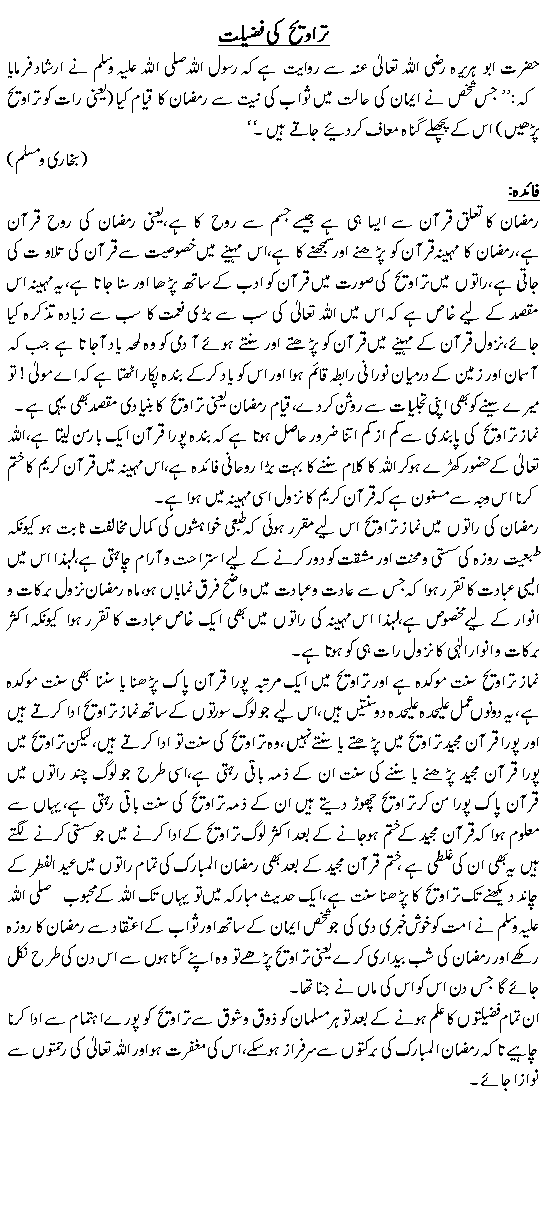
Taraweeh Ki Fazeelat
Which Fasting Deserves The Best Reward?
A hadith that includes the following statement: “They abstain from their food, drink, and sexual desire for My sake. Fasting is undertaken for Me and I will grant its reward.” This is a statement by God as quoted by the Prophet (peace be upon him). What this means is that fasting is rewarded at the highest rates and the greatest value, because it is an act of worship that admits no hypocrisy or showing off. It is an abstention from what people need most to preserve their own lives and their kind, i.e. food, drink, and sex. Normally, a good deed is rewarded by ten times its value, but God may increase this to 700 times and even more. For fasting, however, the rate is not specified. We are left to expect what is greater than all this, because it is a reward by God, the Most Generous, for an act of worship that seeks to gain His pleasure.
To gain such a great reward we need to do more than mere abstention from what we desire most. Scholars agree that the fasting that deserves such a reward is that which remains untainted by any sinful action, whether verbal or physical. They say that the minimum type of fasting is when a person refrains from doing anything that invalidates fasting, i.e. eating, drinking, and sex. A middle grade of fasting is achieved by refraining from doing anything that Islam forbids. The highest type adds banishing any thoughts of indulging in what is prohibited. When one achieves this, one is certainly happy and contented. This is sufficient for a reward in this life, but what God grants us in the life to come is much greater.
The question arises here whether committing a sinful action during the day of fasting invalidates one’s worship. The answer is summed up in the following hadith in which Abu Hurayrah quotes the Prophet as saying: “Whoever does not refrain from saying what is false or acting on it need not abstain from eating and drinking, for God is in no need of that.” (Related by Al-Bukhari). This hadith means that fasting is incompatible with saying what is false. The Arabic term, zoor, which the Prophet uses for ‘false’ is primarily used to express perjury, but in this hadith, it is much wider than this. It includes any false statement a person may say, including lying, backbiting, or telling tales of which one is uncertain.
The Prophet says that if a person does not wish to abstain from such verbal sins, then God has no need for his fasting. Such a person actually does not fast, because he indulges in what God has forbidden. Scholars debate at length whether committing a deliberate sin invalidates fasting or not. Some say that any deliberate sin makes fasting invalid. Others say that backbiting and deliberate lying in particular invalidates fasting. Another group of scholars maintains that fasting remains valid in spite of these sins, but its reward is wasted because these sins incur a greater punishment than the reward of fasting. This is how they explain this statement by the Prophet: “Whoever does not refrain from saying what is false or acting on it need not abstain from eating and drinking, for God is in no need of that.”
– Adil Salahi
Fear Allah Alone
KHAWF (fear) is one of the acts of worship and should be for Allah alone. This has a tremendous position and lofty status in the fields of worship. It can be divided into two categories:
Shirk of ‘secret fear’
It is to fear someone about affairs over which only Allah has power. For example: To fear that a creature could prevent you from completing your life span, or to fear that someone would stop your sustenance, or to fear that someone (has the power) to prevent you from entering Paradise.
Such fear that a person harbors toward a created being with the belief that he has the ability to do these things when only Allah Alone has the power and ability to do them, is secret fear and is considered Shirk (associating partners with Allah).
Disobedience
If a person doesn’t say the truth, or enjoin good and forbid wrong, because of fear of another person, then this is an act of disobedience.
Fear is an act of worship and should be entertained for Allah alone. Allah says in the Qur’an:
“…so fear them not, but fear Me, if you are (true) believers…” (Qur’an, 3:175)
Allah also said:
“…Therefore fear not men but fear Me (O Jews) and sell not My Verses for a miserable price…“ (Qur’an, 5:44)
The Prophet (peace be upon him) said: “Seven people shall receive shade from Allah when there is no shade except His shade… (one of them is) a man who is called by a charming lady of noble birth and he says ‘I fear Allah.'” (Al-Bukhari)
Extract from the Sheikh’s lecture “Enter into Islam wholeheartedly”
Benefits Of Night Worship
The special character, which distinguishes the month of Ramadan from the rest of the year is derived from the type of action we do during this month, be they obligatory or voluntary. We have spoken about fasting and the reasons for making it obligatory, as well as the role it plays in the building of the special character, which the nation of Islam has. We have pointed out that fasting has much to do with the preparation of Muslims for the task assigned to them by God, namely, conveying the divine message of Islam to mankind. Although fasting is the main thing, we do in Ramadan, it is only the obligatory part. There are other aspects of worship, which we associate with Ramadan in one way or another and which contribute to its distinctive characteristics.
Every Muslim knows that emulating the Prophet (peace be upon him) in any action he did during the 23 years of his mission is strongly recommended. It goes without saying that some of these actions we must do since they are Islamic duties. What is not obligatory and has been done by the Prophet constitutes a recommended practice, which earns a reward if done by any Muslim. When we look at what the Prophet did in Ramadan, we find that he was exceptionally charitable in this blessed month. In order to appreciate his generosity, we need to remember that the Prophet was the most generous of people at all times. He never hesitated to give away whatever he had, trusting always that God will give him more for his charity. In Ramadan, however, he was exceedingly charitable, with no limits to his generosity.
Moreover, prayer, which is the mainstay of Islamic worship, and indeed the Islamic faith, receive even stronger emphasis during Ramadan. When you go anywhere in the Muslim world during Ramadan, you find that mosques witness some unusual activity during this month. Worshippers gather for a late congregational prayer, which is offered after Isha, the night prayer, and takes much longer than any of the five obligatory prayers offered daily. Nevertheless, this worship exercise is not obligatory. We do it, following the guidance of the Prophet. It is authentically reported that he came out into the mosque one night during Ramadan and a group of his companions joined him in a congregational prayer. He did the same on the following two nights with the congregation increasing every night. On the fourth night, the mosque was overcrowded, but the Prophet did not come out. In the morning, when he came out for the obligatory dawn prayer, Fajr, said to his companions that he was aware of their presence. He simply did not want to come out because he feared that this worship might become obligatory to them. He wanted to keep it voluntary. However, the indication is clear that congregational night worship during Ramadan is strongly recommended.
Hadrat Imam Hussain (Radi Allahu Anhu) Ki Fazeelat
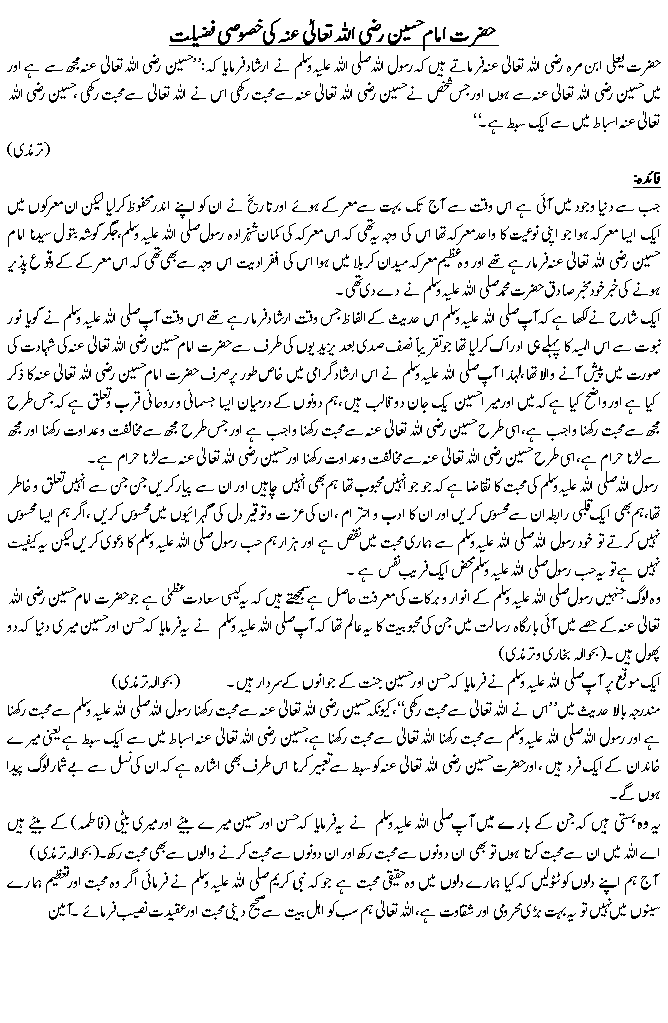
Hadrat Imam Hussain (Radi Allahu Anhu) Ki Fazeelat
How To Strengthen Our Faith
Recite and ponder on the meanings of the Qur’an. Tranquility then descends and our hearts become soft. To get optimum benefit, remind yourself that Allah is addressing you. People are described in different categories in the Qur’an; think of which one you find yourself in.
Realize the greatness of Allah. There are signs in everything we see that points us to His greatness. Everything happens according to His permission. Allah keeps track and looks after everything, even a black ant on a black rock on a black moonless night.
Make an effort to gain Islamic knowledge. Learn at least the basic things we need to know in daily life, e.g. how to make Wudhu properly. Know the meanings of Allah’s names and attributes. Only those who have knowledge truly fear Allah (Refer Qur’an, 35:28).
Attend gatherings where Allah is remembered and His religion is taught.
Do more good deeds. One good deed leads to another good deed. Good deeds must be done continuously, not in spurts.
Remember death, the destroyer of pleasures, frequently.
Ponder over the different stages of the Hereafter. From graves to being raised on the Day of Judgment to one’s final destination in paradise or hell-fire.
Make Du’a. Realize that we need Allah. Be humble. Don’t covet material things in this life.
Every night, before going to sleep, think about the good deeds and the sins we did during that day.
Realize the effects of sins and disobedience. Eemaan (faith) increases with good deeds and decreases with sins.
Hope In Allah
RAJAA’ (hope) is an aspect of worship. This is the type of hope a person has for Allah’s pleasure and reward along with having Iman (correct belief) and doing righteous deeds. It is waiting for Allah’s reward and seeking His pleasure. Hope is the opposite of despair. Being despaired of Allah’s Mercy is one of the major sins. Hope, however, is an act of worship beloved to Allah. Allah said in the Qur’an:
“Verily, those who have believed, and those who have emigrated (for Allah’s religion) and have striven hard in the way of Allah, all these hope for Allah’s Mercy…” (Qur’an, 2:218)
The opposite of hope is despair and hopelessness in the Mercy of Allah. Allah said:
“…Certainly no one despairs of Allah’s Mercy, except the people who disbelieve.” (Qur’an, 12:87)
And in another verse:
“…And who despairs of the Mercy of his Lord except those who are astray?” (Qur’an, 15:56)
So hope is a quality or an aspect of Tawheed, whereas despair, its opposite, is not. It is (rather) an act of disobedience. Allah mentioned in the above verses that despair is a characteristic of those who are astray and who do not believe in Him.
Extract from the Sheikh’s lecture “Enter into Islam wholeheartedly”