

Fazail Hifz Quran
AHKAM AL-HAKIMEEN
AHKAM AL-HAKIMEEN
The Most Just Judge
Is Allah not the Most Just Judge? (Surat at-Tin, 95:8)
Allah passes judgment on each matter and concludes them. All events evolve and develop upon His command and wish. Each of His judgments contains many hidden divine purposes. However, most people do not really understand His commands, for, given their limited intelligence, their ability to do so is also limited.
Furthermore, Allah is infinitely wise, exalted above time and space, and the One Who created and bound humanity to these concepts. A person can never know what will happen the next day or even in an hour. When Allah gives a command, however, He has total knowledge of all of its consequences, regardless of time or place. Consequently, Allah creates everything in compliance with His plan and for a divine purpose.
But unbelievers can never understand Allah’s purposes, for they base their worldview on certain causes and then think that everything evolves randomly and coincidentally. Therefore, they fail to understand that Allah controls everything. Believers, however, strive to grasp the divine purposes in Allah’s judgments and comprehend that He gives the best judgments. In the Qur’an, Allah commands the following:
Follow what has been revealed to you, and be steadfast until Allah’s judgment comes. He is the Best of Judges. (Surah Yunus, 10:109)
Nuh (Noah – peace be upon him) called out to his Lord and said: “My Lord, my son is one of my family. Your promise is surely the truth, and You are the Most Just Judge.” (Surah Hud, 11:45)
Why We Follow the Sunnah?
As Allah has revealed in this verse (Today I have perfected your religion for you and completed My blessing upon you, and I am pleased with Islam as a religion for you) Al-Ma’idah 5:3, Islam is the final divine religion. Prophet Muhammad (Peace be upon him) is (the Messenger of Allah and the Seal of the Prophets) Al-Ahzab 33:40. The faithful learn the kind of moral values they need to display in order to attain the approval, compassion, and Paradise of Allah; what they must avoid and what they must abide by; what is lawful and what is forbidden; in short, all the details regarding the kind of life that will be pleasing to Allah from the Qur’an. Another mercy and blessing of our Lord for believers is the Sunnah of the Prophet (Peace be upon him).
The Prophet is a blessed individual, whom Allah has sent as a role model for all people with his moral values:
(You have an excellent model in the Messenger of Allah for all who put their hope in Allah and the Last Day and remember Allah much) Al-Ahzab 33:21.
The Prophet is a role model for everyone embracing his faith, knowledge, and superior moral values. With his patience, trust in Allah, courage, devotion, closeness to Allah, justice, compassion, love, affection for believers, and foresight, he possessed moral values that are greatly admired by the faithful. All believers strongly desire and strive to possess these qualities to attain the moral model required by the Qur’an. For all these reasons, all his words, decisions, recommendations, advice, and life -the Sunnah – represent a most valuable guide for all those who wish to understand and live by the Qur’an.
Many verses of the Qur’an emphasize the importance of obeying the Prophet and adhering to his path in. One of these reads:
(Whoever obeys the Messenger has obeyed Allah. If anyone turns away, We did not send you [Muhammad] to them as their keeper.) An-Nisaa’ 4:80.
What devout believers must do is adhere to the path of the Prophet and take his Sunnah as their guide, knowing that he has called them to a path that will give them a pleasant eternal life. Those who wish to attain the mercy and Paradise of Allah must metaphorically speaking, build their house on solid foundations right from the outset.
Anyone who acts out of fear of Allah and strives to gain His approval is a loyal follower of the Prophet and seeks to resemble him in faith and moral values. This, however, is only possible through adhering to the Qur’an and never departing from the Sunnah.
Al-Hafeedh One Of Allah’s Beautiful Names
From among Allah’s beautiful and excellent Names is Al-Hafeedh (the All-Heedful and All-Protecting). It encompasses two matters. First, He is Heedful of all the actions that humans perform by His Knowledge. By His order, His noble writers (angels) record all that humans do.
Second, He protects His slaves from all kinds of hardship and evil. He has special protection for those slaves who abide by His commandments. Allah protects them and guards them against slipping into a mistake. He protects their religion and worldly life. Allah’s Messenger (peace be upon him) said: “Guard Allah(‘s Commands) and He will guard and protect you.” (Musnad Ahmad and Al-Tirmidhi, authenticated by Al-Albani)
That means, guard His Commands by fulfilling them, guard His prohibitions by avoiding what He has prohibited, and guard the limits He has set by not exceeding them, then Allah will guard and protect you in your religion and worldly affairs.
– By Sheikh Abdur Rahman Nasir Al-Sa’di
– Taudeeh Al-Kafiyah Ash-Shafiyah
Abu Bakr (Allah be pleased with him) The Man For All Ages
ABDULLAH Bin Uthman Bin Amir Bin Amr was from a branch of the Quraish tribe. His father, Uthman, was known as Abu Quhafa. His mother, Salma, was also known as Umm Al-Khayr.
From his early years, Abu Bakr (Allah be pleased with him) was known for his good and upright nature. He was honest and truthful and came from a noble family. These things won him respect among the people.
His goodness also won him the friendship of young Muhammad (peace be upon him). The two became fast friends in early boyhood. The friendship was to prove lifelong and history-making.
When he grew up, Abu Bakr (Allah be pleased with him) became a rich merchant, but he remained very kindhearted. When he saw someone in trouble, his heart melted and he did his best to help him. If his money could remove suffering, he did not care how much he had to spend. Once he gave away 35,000 dirhams out of his total fortune of 40,000 dirhams. He was so honest in his dealings that people kept their money with him. But above all, Abu Bakr (Allah be pleased with him) had a sincere heart and a firm will. Nothing could stop him from doing what he thought was the right thing to do.
When the Makkans were intent on putting out, once and for all, the light of Islam, Allah commanded the Prophet (peace be upon him) to move to Madina. In the burning heat of the midday sun, there was a knock at Abu Bakr’s door. The Messenger of Allah (peace be upon him) sought permission to enter, and after everyone else had left the room, he told Abu Bakr, “I must leave for Madina tonight.”
“Will I also have the honor of going with you?” asked Abu Bakr eagerly. “Of course,” came the reply. “Get things ready.”
Abu Bakr (Allah be pleased with him) was beside himself with joy. “I have been looking forward to this day for months,” he exclaimed. “I have kept two camels specifically to carry us to Madina.”
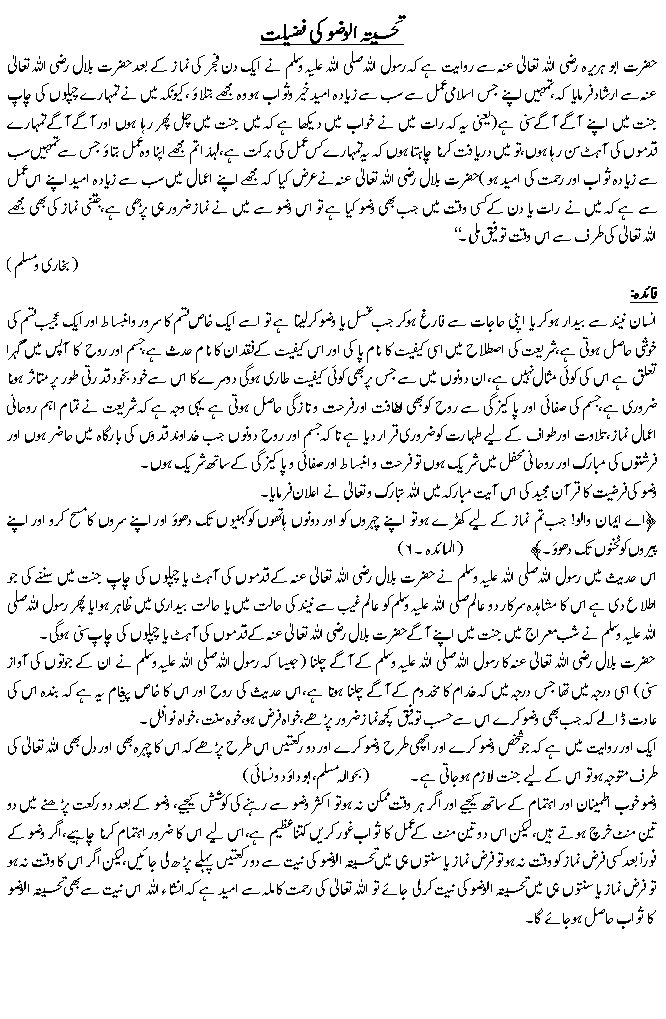
Tahiyatul-Wudu Ki Fazeelat
Tahiyatul-Wudu Ki Fazeelat
Easy But Few People Practice
Abdullah Bin Amr Bin Al-Aas (may Allah be pleased with him) narrated that the Prophet (peace be upon him) said, “There are two characteristics that whenever the Muslim maintains them will enter Jannah. These two traits are easy to possess. However, only a few people acquire them.
“Say Subhan Allah 10 times, Alhamduillah 10 times, and Allahu Akbar 10 times at the end of each Salah. By practicing this deed you earn 150 rewards for your tongue and 1,500 for the scale (of good deeds).
“And before you go to sleep say Subhan Allah 33 times, Alhamdulilah 33 times, and Allahu Akbar 34 times. By saying these words before you sleep you gain 100 good deeds for your tongue and 1,000 deeds for the scale.”
The companions (Allah be pleased with them) asked, “O Messenger (of Allah), how is it that these deeds are easy, yet few people do them?”
The Prophet (peace be upon him) replied, “Right after a person finishes praying, Shaitan comes to him and reminds him of something that he has to do. Therefore this person gets up and leaves without saying these words.
“Further, when he lies down on his bed, Shaitan comes to him and causes him to fall asleep before he mentions these words.” Abdullah Bin Amr (may Allah be pleased with him) said, “I saw the Messenger of Allah (peace be upon him) say these words using his hand to count them.” (Abu Dawood, no. 5065, Al-Tirmidhi, no. 3410, An-Nisa’i, no. 926 and Ahmad, 2/205)
Mother’s Day Special – Father’s Day Special
For us, Every Year and Month and Day and Hour and Minute and Second is Mother’s Day and Father’s Day
Parents are a Great Gift from Allah
When we were young, we loved to play with our Mum and Dad. When we grow up, many of us leave them and only come to them when we need something or when we are in trouble. No matter what, parents are always there and give everything they could just to make us happy. Below is what Allah mentioned in the Quran.
And We have enjoined on the man doing of good to his parents; with trouble did his mother bear him and with trouble did she bring him forth; and the bearing of him and the weaning of him was thirty months; until when he attains his maturity and reaches forty years, he says My Lord! grant me that I may give thanks for Thy favor which Thou hast bestowed on me and on my parents and that I may do good which pleases Thee and do good to me in respect of my offspring; surely I turn to Thee, and surely I am of those who submit. (Al_Quraan_046: 015)
Be Kind to your Parents:
And your Lord has commanded that you shall not serve (any) but Him, and goodness to your parents. If either or both of them reach old age with you, say not to them (so much as) “Ugh” nor chide them, and speak to them a generous word. And make yourself submissively gentle to them with compassion, and say: O my Lord! have compassion on them, as they brought me up (when I was) little. (Al_Quraan_017: 023-024)
And We have enjoined on man goodness to his parents, and if they contend with you that you should associate (others) with Me, of which you have no knowledge, do not obey them, to Me is your return, so I will inform you of what you did. (Al_Quraan_029: 008)
And We have enjoined man in respect of his parents– his mother bears him with faintings upon faintings and his weaning takes two years– saying: Be grateful to Me and to both your parents; to Me is the eventual coming. And if they contend with you that you should associate with Me what you have no knowledge of, do not obey them, and keep company with them in this world kindly, and follow the way of him who turns to Me, then to Me is your return, then will I inform you of what you did. (Al_Quraan_031: 014-015)
Hadeeth regarding Parents:
The Prophet Muhammad said, may Allah’s peace and blessings be upon him: Your Heaven lies under the feet of your mother (Ahmad, Nasai).
Etiquettes of Reading The Qur’an
THE Qur’an which we recite contains the actual words of Allah revealed to Muhammad (peace be upon him). Therefore, we should observe the following when reciting it :
- Seek refuge in Allah before reading it (“A’oothu billaahi minash – shaytaanir-rajeem)”
- Have the intention that the recitation is purely to seek the pleasure of Allah alone.
- Recite with an alert heart that you may comprehend its meaning, considering while reciting it that Allah is speaking to you through the Qur’an.
- Make sure you are clean before touching the Qur’an. Do not read it when you are in a state of impurity.
- Do not read the Qur’an in lavatories or similar places.
- Read it slowly with pleasant sounds and rhythm.
- Prostrate wherever a verse requires prostration.
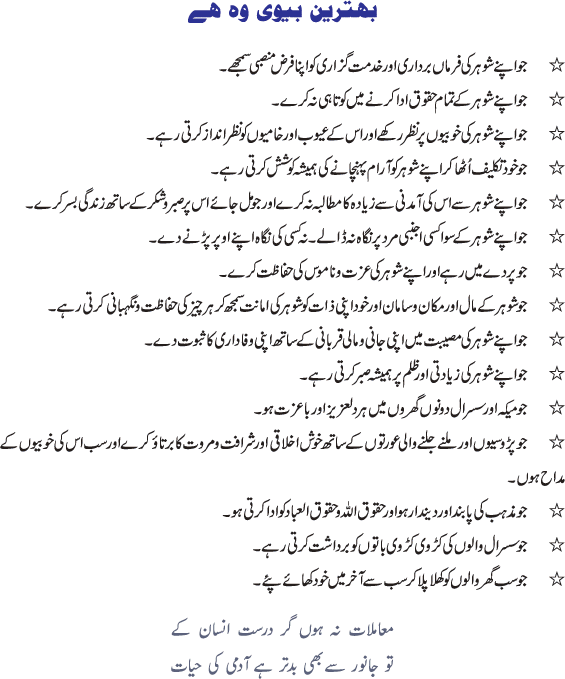
Behtreen Biwi
Behtreen Biwi