Hadiths
Sayyiduna Jundub ibne-Abdullah Al-Azdi (RadhiAllaho anho) a sahabi of Nabi Sallallahu alaihi wasallam narrates
that Rasulullah (Sallallahu Alaihi Wasallam) said: The example of the person who teaches people well and neglects himself (does not practice himself), is like a lamp which is a source of illumination for people and burns itself.
{ Tabarani, Targhib }
Narrated ‘Ali (Radi’Allahu anhu): The Prophet (sall’Allahu alaihi wa sallam) said, “Do not tell a lie against me for whoever tells a lie against me (intentionally) then he will surely enter the Hell-fire.”
{ Sahih Bukhari } (Book # 3, Hadith # 106)
Narrated Salama bin Al-Akwa (radi’Allahu anhu) : I heard the Prophet (sall’Allahu alaihi wa sallam) saying, “Whoever (intentionally) ascribes to me what I have not said then (surely) let him occupy his seat in Hell-fire.”
{ Sahih Bukhari } (Book # 3, Hadith # 109)
Narrated Abu Huraira (Radi’Allahu anhu): The Prophet (Sall’Allahu alaihi wa sallam) said, “…Whoever tells a lie against me (intentionally), then (surely) let him occupy his seat in hell-fire.”
{ Sahih Bukhari } (Book # 3, Hadith # 110)
Narrated Abu Huraira (Radi’Allahu anhu): The Prophet (Sall’Allahu alaihi wa sallam) said, “Name yourselves after me (by my name), but do not call yourselves by my kuniya, and whoever sees me in a dream, he surely sees me, for Satan cannot impersonate me (appear in my figure). And whoever intentionally ascribes something to me falsely, he will surely take his place in the (hell) Fire.
{ Sahih Bukhari } (Book # 73, Hadith # 217)
The True Meaning of Life is to Plant Trees under whose shade you do not expect to sit.
Salam
Virtue Of Fasting The Day Of Ashura
Indeed, fasting on the day of `Ashura’ – the 10th of Muharram- is of great merit in Islam. The Prophet (peace and blessings be upon him) said, “Fasting the day of `Ashura’ (is of great merits), I hope that Allah will accept it as an expiation for (the sins committed to) the previous year” (Muslim).
Also, fasting on the 9th of Muharram is highly recommended by the Sunnah. Imam At-Tirmidhi reported that Ibn `Abbas (may Allah be pleased with them both) used to say: We should fast on two days: the 9th and 10th of Muharram to distinguish ourselves from the Jewish community. (At-Tirmidhi)
Explaining the virtue of fasting on the 9th and the 10th of Muharram, Dr. Muzammil H. Siddiqi, former President of the Islamic Society of North America, states:
It is the Sunnah of the Prophet (peace and blessings be upon him) to fast on the 9th and 10th of Muharram. The Prophet (peace and blessings be upon him used to fast on the day of ‘Ashura’. When he came to Madinah, he found out that the Jews of Madinah were also fasting on this day remembering Prophet Musa (peace and blessings be upon him). The Prophet (peace and blessings be upon him) admired this tradition and said to the Jews, “I am closer to Musa than you are.” He fasted and he also told his Companions to fast on this day.
Later, before the end of his life, the Prophet (peace and blessings be upon him) told Muslims to add the 9th day also. Thus, it is recommended to fast on both the 9th and 10th of Muharram.
Moreover, in his well-known book, Fiqh As-Sunnah, the late Sheikh Sayyed Sabiq states:
Abu Hurayrah (may Allah be pleased with him) reported: “I asked the Prophet (peace and blessings be upon him): ‘Which Prayer is the best after the obligatory Prayers?’ He (peace and blessings be upon him) said: ‘Prayer during the mid of the night.’ I asked: ‘Which fasting is the best after Ramadan?’ He (peace and blessings be upon him) said, ‘The month of Allah that you call Muharram” (Ahmad, Muslim, and Abu Dawud).
Mu`awiyyah ibn Abi Sufyan (may Allah be pleased with him) reported that he heard the Messenger of Allah (peace and blessings be upon him) say: “Concerning the day of ‘Ashura’, it is not obligatory upon you to fast on it as I do. Whoever wishes may fast and whoever does not wish to is not obliged to do so” (Al-Bukhari and Muslim).
It is noteworthy that Muslim scholars have stated that fasting of ‘Ashura’ is of three levels as follows:
- fasting for three days, i.e., on the 9th, 10th, and 11th of Muharram,
- fasting the 9th and 10th of Muharram, and
- fasting only on the 10th of Muharram.
There is a great reward in fasting on the day of ‘Ashura’. There are many hadiths that mention their blessings and virtues. It is good to fast on this day, although it is not obligatory.
Allah Almighty knows best.
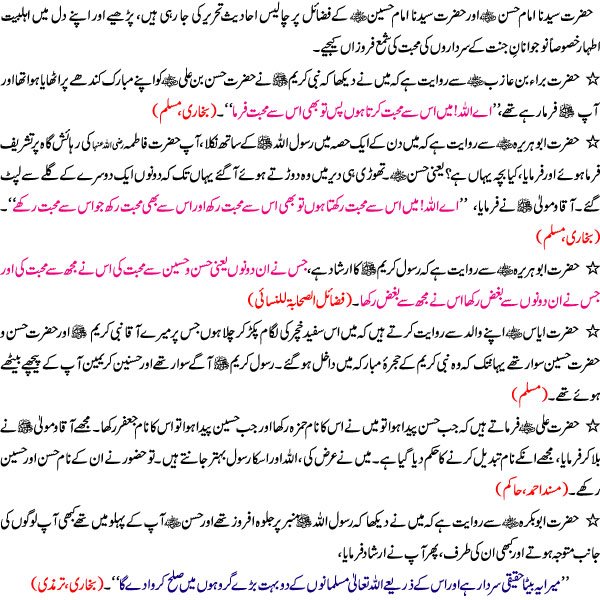
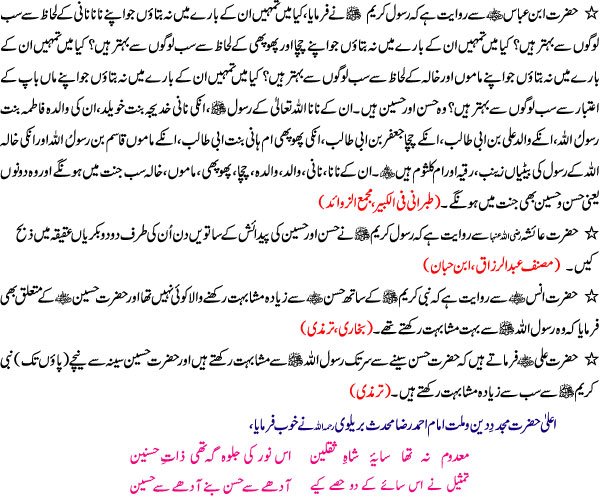
Hasanain al-Kareemain Radi Allahu Ta’ala Anhuma – 40 Ahadith
The Day Of Aashura (10th Muharam ) And Historical Events
Although the month of Muharram is a sacred month as a whole, the 10th of Muharram is the most sacred of all its days.
The day is named ‘aashurah’. it is one of the most important and blessed days of allah ta’ala in the Islamic calendar. This day has been accepted as having deep significance. evidence of its significance has been clearly found in authentic traditions.
There are many prophetic events of great historical importance and also events that happened after the beloved and final messenger of Allah (peace be upon him) had left this world, such as the battle of Karbala, that have taken place on this day.
The importance of the month of Muharram has been mentioned in the Qur’an in surah taubah verse 36. This day of Ashura derives its importance from prophetic traditions. in the ahadeeth (sayings of rasulullah sallallaho alaihe wassallam) the following have been mentioned :
Fasting
The prophet Muhammad(sallallahu-alaihe wasallam) has exhorted and encouraged his ummah to fast on this day. He said: ” This fast is a compensation for the (minor) sins of the past year ” ( hadith: Muslim )
The prophet Muhammad (PBUH), when migrated to Madinah, found that the Jews of Madinah used to fast on the 10th day of Muharram. They said that it was the day on which the prophet Musa (Moses), alaihe salam, and his followers crossed the red sea miraculously and the pharaoh was drowned in its waters. On hearing this from the Jews, the prophet, sallallahu alaihi wassallam, said, “We are more closely rotated to Musa, alaihi salam, than you, and directed the Muslims to fast on the day of “Ashura”. ( hadith-abu Dawood)
“Observe the fast of Ashura and oppose the Jews. Fast a day before it or a day after.” (hadith: baihaqi)
Hence, it is important to either fast on the ninth and the tenth or the tenth and the eleventh of Muharram.
Being Generous
One should be generous with one’s family and dependents and spend more on them than what is normally spent.
Rasulullah ( sallallahu-alayhi-wasallam) said:” One who generously spends on his family on the day of Aashora, Allah will increase (his provision) for the whole year.” ( hadith: baihaqi )
Historical Events
There is no doubt about the blessedness of the day of Ashura. Many historical events of deep significance have also been recorded on this day.
Hazrat Musa (as) and his people, the Bani Israel, were saved from the Egyptian pharaoh by the miracle of the parting of the sea on the day of Ashura. it was for this reason that the Jews used to fast on this day.
The tragic battle of Karbala was also fought on this day. This event has many important lessons for the ummah (Muslim nation), especially at this point in time when the ummah is being maliciously targeted and persecuted just because of their attachment to and love for Islam.
Beparda Khawateen Kya Gunah Kamati Hein
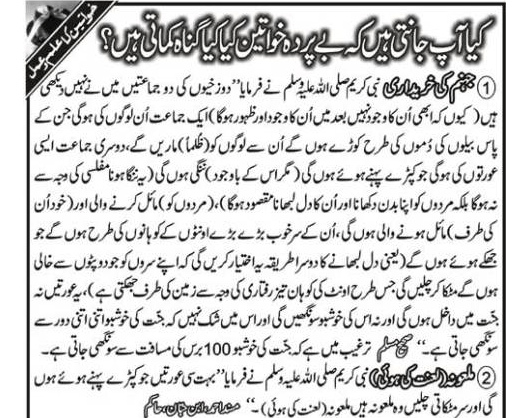


Beparda Khawateen Kya Gunah Kamati Hein
Responsibilities Of A Muslim
The long-standing political and moral decline of the Muslim Ummah has resulted, among other things, in a serious distortion of our very concept of Islam itself. We have grown accustomed to viewing Islam as a mere “religion,” instead of using the original Qur’anic term “Deen.” This apparently minor change in semantics is actually a huge leap backward. This is because the word religion is commonly used in a rather narrow sense, its scope is limited to a set of dogmas, some rituals for worship, and a number of social customs to celebrate important life events. Deen, on the other hand, is a system of life in which human beings consciously surrender to the sovereignty of a higher authority, and live a life of total obedience to that higher authority. In this sense, the term Deen can be applied to monarchy, where the king is accepted as the final authority, or to democracy, where the people as a whole act as sovereign. Thus, when the term Deen is used for Islam, it obviously means a system of life where the Almighty God is worshipped and obeyed, not just in the narrow religious sense, but in a manner that includes all aspects of human of life.
A well-integrated set of beliefs describing the nature of existence as it really is (Iman), modes of worship including Salat, Zakat, Saum, and Hajj, as well as social customs and ceremonies all comprise indispensable and integral parts of Islam. However, in addition to these “religious” features, we are also provided by the Almighty God with all the relevant instructions regarding our social, economic, and political existence (generally considered to be the “secular” elements of life), and this is what really distinguishes Islam from other religions, say, Christianity or Buddhism. Unfortunately, the majority of our masses are simply, and perhaps blissfully, unaware of what it really means to be a Muslim; thus, their concept of religious duties is usually very narrow and limited. But, as Allama Iqbal has so correctly observed, you begin to shudder with the fear of accountability once you realize the tremendous responsibilities that come with being a Muslim.
When Islam loses its political authority, it is relegated and dethroned to the status of a mere religion — a private affair of the individual; and if any particular generation is to revive the teachings of Islam in the social, economic, and political spheres, then this is impossible without adopting the same methodology as was adopted by Prophet Muhammad (SAW). After the independence of the Muslim lands from direct subjugation by Western Imperialism, it was naively believed that since political authority now belongs to the Muslims, the next step, that of implementing Islamic values, won’t be all that difficult. However, it has been proved during the last half century or so that the ideal Islamic State is still very much a dream, and since no shortcuts are available, we have no alternative except to start at the very beginning. We must remind the Muslims of their responsibilities. The significance of this subject is quite clear: We cannot hope to achieve salvation in the Hereafter without fulfilling all our obligations. Moreover, we cannot even think about the revival of the Muslim Ummah and the Renaissance of Islam without first inculcating the true concept of our Divinely ordained obligations in a significant portion of the Ummah.
OUR FIRST OBLIGATION as Muslims is to develop real faith and true conviction (or Iman) in the teachings of the Qur’an as explained to us by Prophet Muhammad (SAW). Faith must not be a mere dogma that has little or nothing to do with the practical aspects of one’s life, but it must be a deeply-felt certitude that changes the whole system of values, ambitions, and behavior in favor of Islam. Iman can be gained by reading, comprehending, and pondering over the meaning of the Holy Qur’an with a genuine search for truth. Knowledge of the Arabic language is indispensable for this purpose.
Hajj Sharait, Ahmeat Aur Fazeelat

Hajj Sharait, Ahmeat Aur Fazeelat
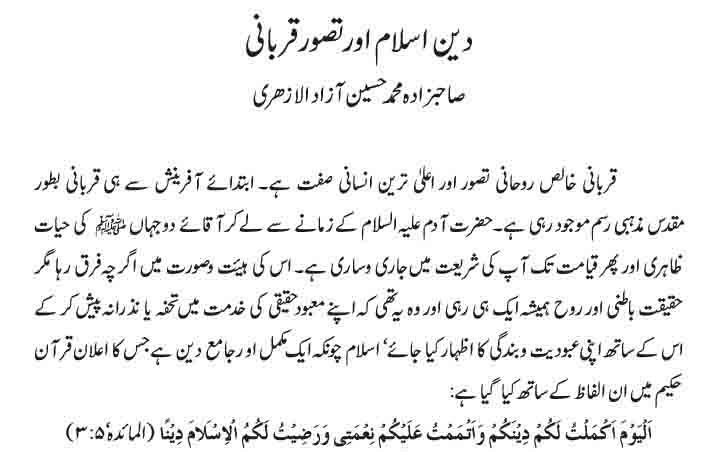
Deen-e-Islam Aur Tasawur Qurbani