

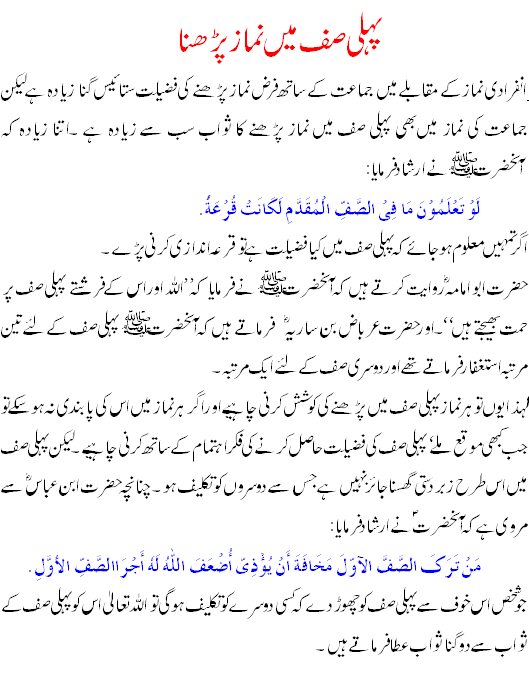
Pehli Saf Main Namaz Perhna
The Power of Imaan
The famous general of Islam, Taariq Bin Ziyaad on receiving the command of the Khalifah, set off with a naval force of 7,000 Mujahideen to attack Spain. In the year 92 A.H., he landed at a place that now bears his name, viz. Jablut Taaariq or Gibral-ter.
During the voyage to Spain, he saw in a dream Rasulullah (sallallahu alayhi wasallam) giving him the glad tidings of him being the Conqueror of Spain. The first act executed by Taariq was to issue an order to set alight all the ships which had brought them to the shores of Spain. After having burnt out all the ships, he addressed his men: “In front of you is the enemy and behind you is the see.” In view of the glad tidings he had received from Rasulullah (sallallahu alayhi wasallam), he was confident of victory over the Christians. The Christian king Roderick confronted Taariq’s relatively small band of Mujahideen with a powerful army of 100,000.
The two armies – the army of Islam vastly outnumbered — met on the banks of the Guadalete River. The ferocity with which Taariq and his men fought routed the enemy resulting in a magnificent victory for the Muslims.
The act of setting ablaze the naval ships will undoubtedly be viewed as an act of insanity. Be it as it may. The power of Imaan is inexplicable to the people of the world. It was this power that drove Taariq to bum the ships and push on to victory.
The state of Taariq’s Yaqeen in Allah Ta’ala can be gauged from this episode which no one can ever accomplish. The state of the obedience of his troops also testifies to their degree of Taqwa. The troops readily submitted to the command. There was no fear and no mutiny. It was such states of Yaqeen and Taqwa that resulted in victory upon victory against overwhelming odds.
[By Hazrat Maulana Ahmad Sadeq Desai]
Jawahir Paare
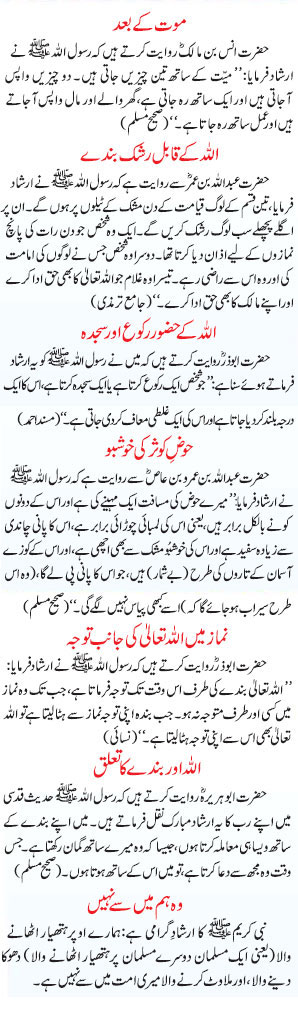
Jawahir Paare
Did You Know – Hazrat Umar Farooq May Allah Be Pleased With Him
Allah Almighty we begin with His Name.
Choicest and countless Blessings and Salutations upon our beloved, the final Prophet Muhammad – may Allah Almighty send Peace and Blessings be upon him – and upon his noble offspring and illustrious companions.
Did You Know – Hazrat Umar Farooq may Allah be pleased with him
Q: What is the name of the second rightly guided Caliph of Islam?
A: Hazrat ‘Umar Ibn Khattaab – may Allah be pleased with him.
Q: What was his title?
A: Farooq Al-A’zam
Q: Which Caliph used to be awake at night to look after his people?
A: Hazrat Umar Farooq – may Allah be pleased with him.
Q: Which Caliph’s era is known as the era of victories?
A: None other than his.
Q: What was the duration of his Caliphate?
A: 10 years, 6 months.
Q: When did he become a Caliph?
A: Jumaad Al-Ukhra 13 A.H.
Q: Who was the first to make the Masjids bright with lamps?
A: Hazrat Umar – may Allah be pleased with him.
Q: In whose Caliphate was the Taraweeh Salah of 20 Rak’ats commenced?
A: In his Caliphate.
Islami Tareekh Kay Jharooko Sey
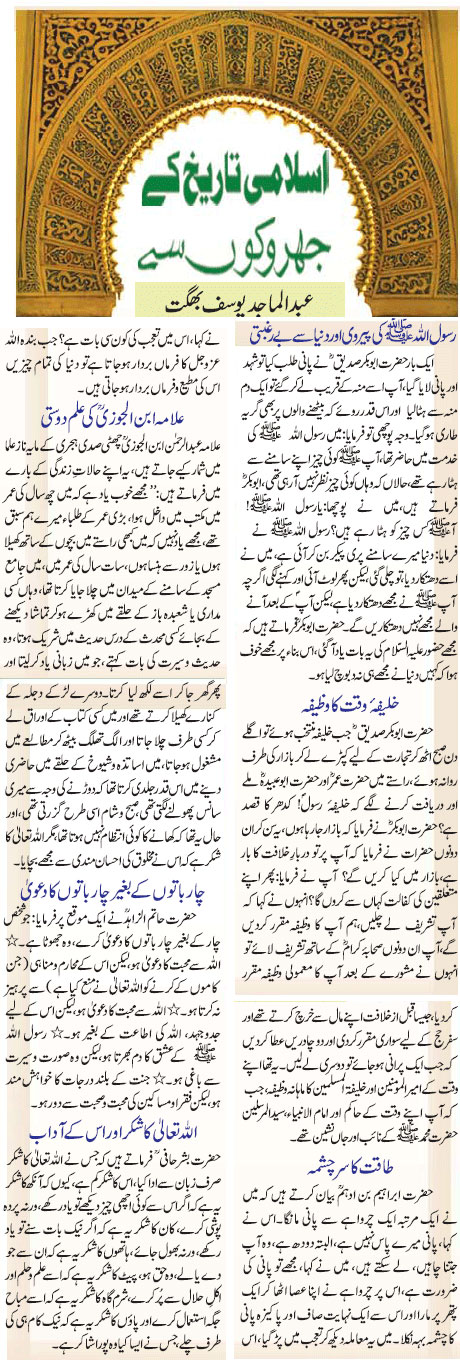
Islami Tareekh Kay Jharooko Sey
Anger Management According To Qur’an And Sunnah
How To Control Anger?
1 – Seeking refuge with Allaah from the accursed Shaytaan when feeling angry.
Al-Bukhaari (3282) and Muslim (2610) narrated that Sulaymaan ibn Surad said: I was sitting with the Prophet (peace and blessings of Allaah be upon him) and two men were trading insults, One of them was red in the face and his veins were standing out. The Prophet (peace and blessings of Allaah be upon him) said:
“I know a word which, if he said it, what he is feeling would go away. If he said, ‘I seek refuge with Allaah from the Shaytaan,’ what he is feeling would go away.”
2 – Changing one’s posture when feeling angry.
Abu Dawood (4782) narrated that Abu Dharr (may Allaah be pleased with him) said: The Messenger of Allaah (peace and blessings of Allaah be upon him) said to us:
“If one of you gets angry when he is standing, let him sit down; if his anger disappears, all well and good, otherwise let him lie down.”
Classed as saheeh by al-Albaani in Saheeh Abi Dawood.
3 – Bring to mind the reward for patience, forbearance, and restraining your anger,
for that is the characteristic of the pious who are promised Paradise,
as Allaah says (interpretation of the meaning):
133. Be quick in the race for forgiveness from your Lord, and for a Garden whose width is that (of the whole) of the heavens and of the earth, prepared for the righteous,–
134. Those who spend (freely), whether in prosperity, or in adversity; who restrain anger, and pardon (all) men;- for Allah loves those who do good;–
[Aal ‘Imraan 3:133-134]
The Prophet (peace and blessings of Allaah be upon him) said:
“Whoever restrains his anger when he is able to act upon it, Allaah will fill his heart with pleasure on the Day of Resurrection. ”
Narrated by Ibn Abi’l-Dunya; classed as hasan by al-Albaani in Saheeh al-Targheeb, 2623.
Cures for Anger
When talking about cures for anger, it’s important to think about why we get angry in the first place.
A lot of the time, people get angry because they lose control of a situation. Anger is their attempt to regain control, but in actuality, does not help at all. It actually makes it worse because when a person is angry, he has shown weakness. He puts himself at a disadvantage both in dealing with people (in a debate, for example), and also in dealing with shaitan. He becomes a much weaker prey for shaitan.
This is why our beloved Prophet saws said,
“The strong is not the one who is physically powerful, but indeed, the one who controls himself when angry.”
If anger is a problem for you, it may be helpful for you to write down all the times that you can remember that you got angry…then look for a common factor that made you angry, or rather made you act on your anger.
Feeling anger is normal, and the act of being angry is not in and of itself necessarily sinful. It’s what you do with that anger that makes it a problem.
And while we’re on the subject, there’s an amazing lecture (As always mA) by brother Nouman about the characteristics of the people of Jannah, as taken from verses in Surah aal Imraan.
One of them is that they swallow their anger. Brother Nouman analyzes why the word ’swallow’ is used, and not ‘control’, etc.
When we are eating something, and let’s say someone is coming, and we don’t want them to know we were eating, so we quickly swallow the food.. will the person know we were eating? No, right? If there are no signs, like chewing, etc, the person will not even suspect that we were eating.
So in the same way, Allah SWT tells us that the people who shall enter Jannah swallow their anger, or make it completely go away…to the point where the people around them do not even suspect that the person is angry. Subhan Allah.
Usually, when someone is angry, and they’re trying to control themselves, you’ll see them shaking, or turning red, or holding themselves back. And then someone will go and ask them if they’re ok.
So the best thing to do is when you feel anger coming up from inside you, quickly swallow it and make it disappear. Of course, it won’t be that easy, but if you make it your habit, it will become easier and easier to do. And it’s important to note that Allah SWT tells us that the people of Jannah swallow their anger, not that they don’t have anger.
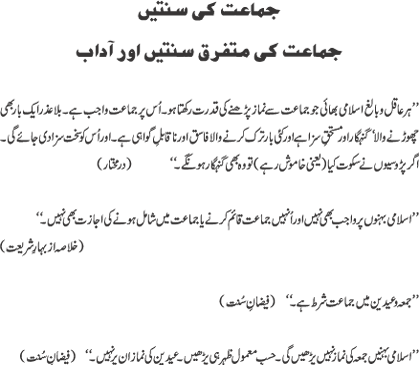
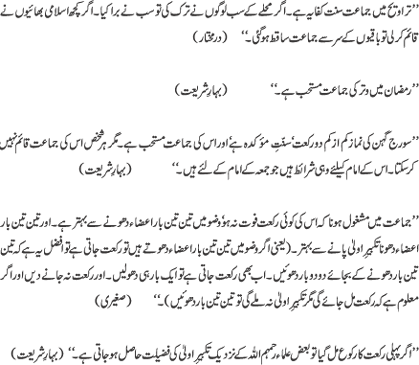
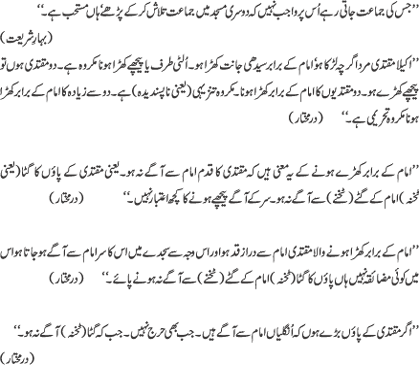
Jamaat ki Sunnatain
10 Ways Of Honoring Servants
Most Muslims in Eastern countries employ domestic staff as a norm. For some, domestic helpers are a priceless resource who significantly ease our day-to-day chores. Conversely, for others, they can be a source of distress and chagrin.
Many women complain to each other about the trouble they face from the incompetence, treachery, and intentional misdemeanor of their servants. However, we need to remind ourselves that it is in managing our helpers according to Islamic injunctions that the secret lies to get the best out of them.
- Think of their pay as Sadaqah
We need to change the way we view our servants’ wages. By considering it an “expense,” we tend to extract the “full value” of the money. For instance, even if a maid is sick, her employer might say, “I pay her to work, so she must work.” But if we consider the salary a “Sadaqah” that helps fill their bellies, we will In Sha Allah be more tolerant of their shortcomings as human beings.
- Counsel them when they need it
You might notice that your domestic helpers are disturbed on some days. They are human beings who have problems and worries just like us. Ask them what is troubling them; then advise them to have patience and hope in Allah’s mercy. Keep the counsel short, but show them that you care.
- Forgive and forget their mistakes
Just like other human relationships, it is not pleasant to have your past mistakes and wrongs thrown in your face repeatedly. Forgive them for the sake of Allah if they wrong you, and do not be harsh when scolding them.
- Do not accuse them of stealing, cheating, or lying on mere suspicion
Many employers are guilty of this unfair action – as soon as something in the house is missing due to their own absentmindedness, the domestic helper is squarely accused of theft or negligence.
“O you who believe! Avoid suspicion as much (as possible): for suspicion in some cases is a sin.” (Qur’an, 49:12)
Ask them normally if they have seen the missing object, but do not accuse them of theft or misplacement. In most cases, the object is eventually found after the maid has been fired, causing guilt and embarrassment to the employer for life.
- Informally teach them Islamic manners and knowledge
One of the rights of our domestic helpers upon us is that they are taught about Islam, or given its message if they are non-Muslims. Without being overtly ‘preachy’, give them small doses of the truth. The best way is to act upon Islam yourself. This will eventually make them love and respect you for the sake of Allah – which results in a sincere relationship devoid of mistrust and treachery.
- Eat with them occasionally without separating utensils
Domestic helpers are not animals. Some people treat them as if they are unhygienic beings from another planet. Allow them to use the utensils from which you and your family eat. If they have dirty habits, teach them hygiene. But do not separate their utensils as if they are untouchables. This will make them feel insulted. They will never return an insult with loyalty or obedience.
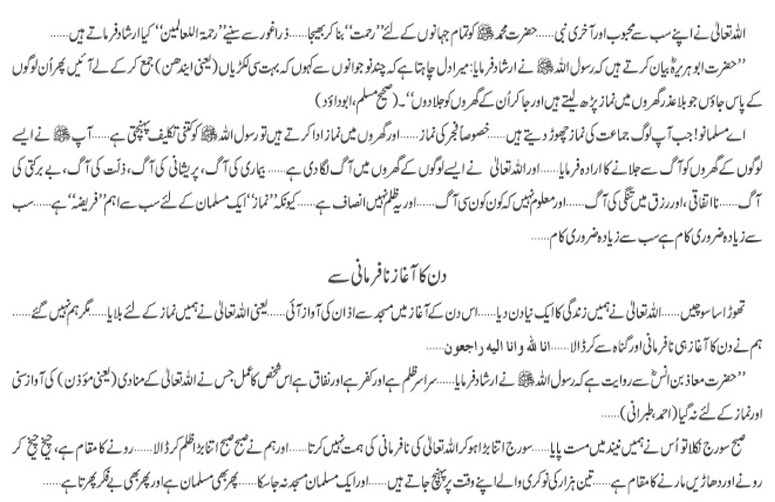
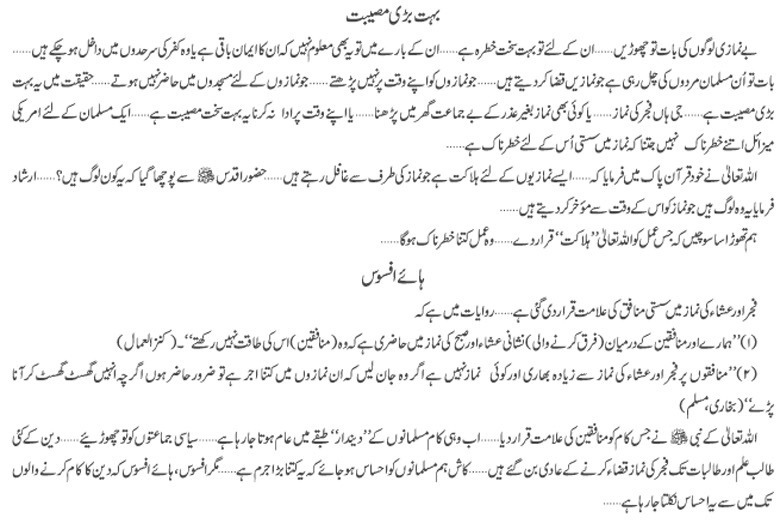
Namaz Ki Ahmiyat
Click Images to enlarge and read.
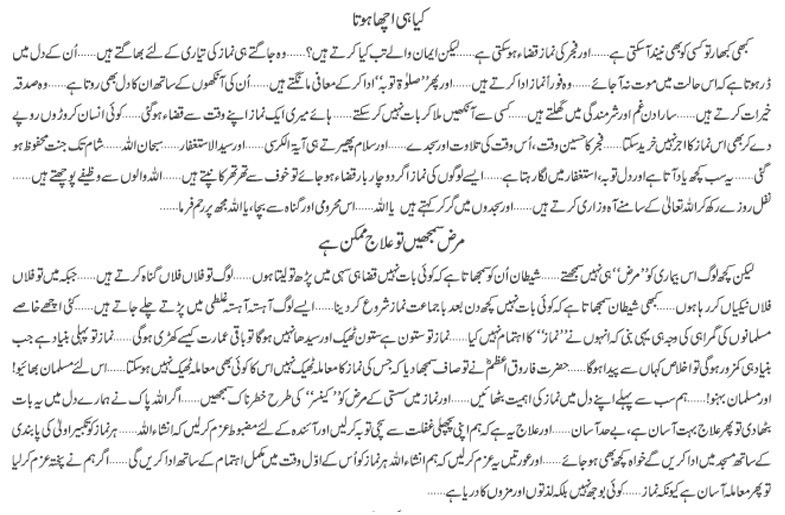
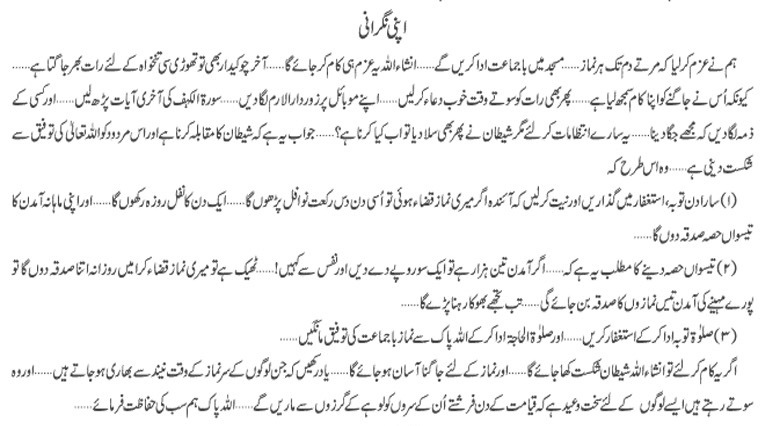
Namaz Ki Ahmiyat
I’tikaf – The Spiritual Retreat
The Messenger of Allah (blessings of Allah be upon him and his family) is reported to have said:
“The persons who seclude himself (for I’tikaf) in true faith and hope (of reward from Allah), all of his previous sins shall be forgiven.” (Kanzul Ummal, Hadith 24007)
The meaning of Itikaf is to seclude oneself in the Masjid with the express niyyah (intention) of Itikaf.
Allah has indeed in his perfect wisdom created humanity in a unique way. He has made it such that from time to time His creation needs a rest. We rest at night to give our bodies time to recover. Birds retire to their nests, horses to their stables, bees to their hives, etc. However, there comes a time when more intensive rest or retreat is required. Sometimes due to a person’s physical condition, he is admitted into the hospital’s intensive care unit allowing his or her body time to recover.
Likewise, the soul also needs to recover from the hustle and bustle of the world, the spiritual pollution caused by evil elements of society, the rat race of wanting, desiring, and acquiring more of this world, and the distractions that have diverted our mind, heart, and soul from the remembrance of Allah Ta’ala and His Beloved Messenger Muhammad (peace be upon him).
The Intensive Care Unit(ICU) for the soul is the Musjid and Itikaf is the facility within this ICU to allow the soul to not only recover but be spiritually rejuvenated!
Itikaf is indeed a Spiritual Retreat!
Inside each and every human being, a constant battle rages. It is like a battle between two wolves. One of the wolves is evil. It is full of hate, lust, and greed. His fangs drip with bitterness and strife. The other wolf is a good one. He is full of love, compassion, and honesty. He never betrays his brother.
These two wolves are constantly at war. Which wolf is going to win the battle?
The answer is quite obvious…. Whichever one you feed.
Our soul is being bombarded by forces of good and evil. We need to feed it good so that it overpowers the evil….and Itikaf is indeed an excellent opportunity to achieve this.
Since the life of the transient world keeps us busy for the whole year with studies, work, social functions, business, traveling, and other such things that cause us to be negligent of our souls and the next life, we may sometimes think that these things are the sole purpose in life and thus, we end up forgetting our true goal – Allah (Glory and Greatness be to Him). Thus, it is for this reason that I’tikaf is referred to as “The spring of life in a world struck with the drought of the negligence of Allah (Glory and Greatness be to Him).”
The period of I’tikaf is the best time to force one’s self to sit and think and reflect on the self and the world around; the period of the I’tikaf is the best time to forget the worries of the transient world and to return to nurturing the soul and linking oneself with the Creator of the soul; the period of the I’tikaf is the best time to return back to Allah (Glory and Greatness be to Him) in true repentance for our sins committed through the year and to give our souls the spiritual strength desperately needed to live a spiritual and pure life in this challenging world.