
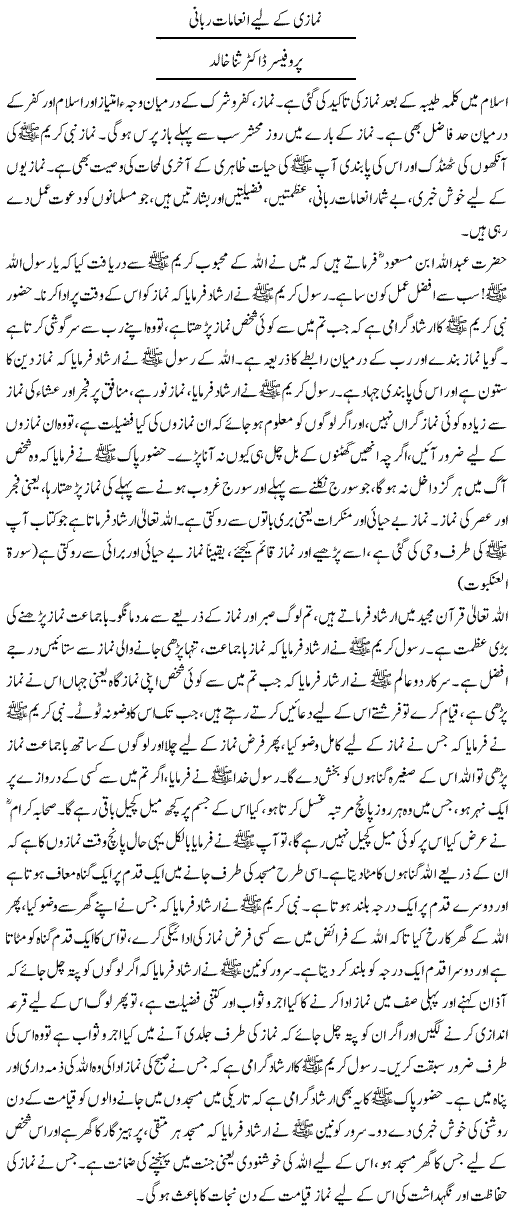
Namazi Ke Liye Inamat e Rabbani
Prayer Is Better Than Sleep
When young Muslims meet others for the first time and find out that they are Muslim, often one of the very first questions they ask each other is, “Do you pray?” It’s as if this is their touchstone to see if the person they have met is a real Muslim or not. Calling yourself Muslim is one thing, being a Muslim is something else.
Praying five times a day is at the heart of Islam. It is one of the things that distinguishes a Muslim from everyone else in the world; that all the activities of life can be made significant by the cycle of prayer and praise which we offer to Almighty Allah. So why, then, do we have such a problem being faithful to prayer?
My first Umrah was one of the most important experiences of my life and it had its effects on me. Being so close to the Kaaba was a deeply moving experience. Being at the very place where our beloved Prophet (peace be upon him), like all the prophets before him, had walked and prayed, was amazing.
One of the things that hit me most about being in Makkah, among so many others, was when the call to prayer sounded for Fajr, the Dawn prayer. Thousands of people appeared from every direction and headed toward the Kaaba for prayer.
Getting up in the middle of the night wasn’t difficult at all, because the experience of praying at the Kaaba was so moving. At the time, moving with the vast crowd, I couldn’t help thinking about what it is usually like back home.
Those getting up and going to the mosque for the dawn prayer are certainly a minority, aren’t they? Away from Makkah, it is all too easy to ignore the Adhan completely and stay in the comfort of one’s bed.
At special times like Ramadan, or when we go on pilgrimage, it seems so much easier to be faithful to prayer and to take Islam so much more seriously. How many of us, for example, attended Tarawih Prayers in the mosque during Ramadan, even though we might occasionally miss one or two of the obligatory prayers?
It’s one of life’s paradoxes that we want so much to be good, and yet we find ourselves falling into the same old traps and doing things we later regret. How odd we are as human beings! We can quite happily sit in front of the television for hours or sit idly chatting on the Internet to no one in particular, yet we can’t manage to set aside 10 minutes to pray.
Hurmat And Tazeem Muharram

Hurmat And Tazeem Muharram
Muharram – One Of The Four Sacred Months
Muharram’ is the first {1st} month of the Hijri calendar and is one of the Four [4] sacred months concerning which Allah {Aza wa Jall } says in the Quran:- ‘Surely the number of months with Allah is twelve {12} months in Allah’s ordinance since the day when He created the heavens and the earth, of these four being sacred; that is the right reckoning; therefore be not unjust to yourselves regarding them. [Source:-Quran ~Surah 9 At-Taubah, Verse # 36]
‘Muharram’ is one of the four{4} sacred Months out of twelve. The others are… Zul-Qa’dah, Zul-Hijjah, and Rajab. These four { 4 }months have been sacred since the creation of the universe.
Allah {Aza wa Jall } says in the Quran:- Muharram is a sacred month because Allah made it sacred along with three{3} other months and told us about it in the Quran. Prophet Muhammad {may peace be upon him} informed us about the Four {4}sacred months in the following narration:-
‘The year is of twelve {12}months, out of which four{4} months are sacred:
Three{3} are in succession …
#1/ ~Dhul-Qa’ da.
#2/~ Dhul-Hijja.
#3/~Muharram.
#4/ ~ Rajab.
[Source:- Bukhari Vol 004, Book 054, Hadith # 419]
‘Ashura’~ [meaning tenth [10th ] in Arabic] {The 10th of Muharram}
Fasting on the 10th of Muharram Ashura was obligatory for Muslims before the fasts of Ramadan were obligatory.
Narrated by the Mother of the Believers Aisha (Allah be pleased with her):- The people used to fast on ‘Ashura’ {the tenth (10th)day of the month of Muharram} before the fasting of Ramadan was made obligatory. And on that day the Kaaba used to be covered with a cover. When Allah made the fasting of the month of Ramadan compulsory…
Allah’s Apostle {may peace be upon him} said:- ‘Whoever wishes to fast (on the day of Ashura) may do so, and whoever wishes to leave it can do so. [Source:-‘Bukhari’ Vol 02, Book 026, Hadith # 662]
The Fast of Ashura expiates the sins of the previous year and the coming year.
Abu Qatada al-Ansari (Allah be pleased with him) reported that….. The Messenger of Allah {may peace be upon him} was asked about fasting on the day of Ashura {10th of Muharram} at which point he said:- It expiates the sins of the preceding year. {Source:-Muslim: Book 06: Hadith # 2603}
Syedna Usman e Ghani (Razi Allah Tala Anho)

Syedna Usman e Ghani (Razi Allah Tala Anho)
Janwaroon Se Husn-e-Salook
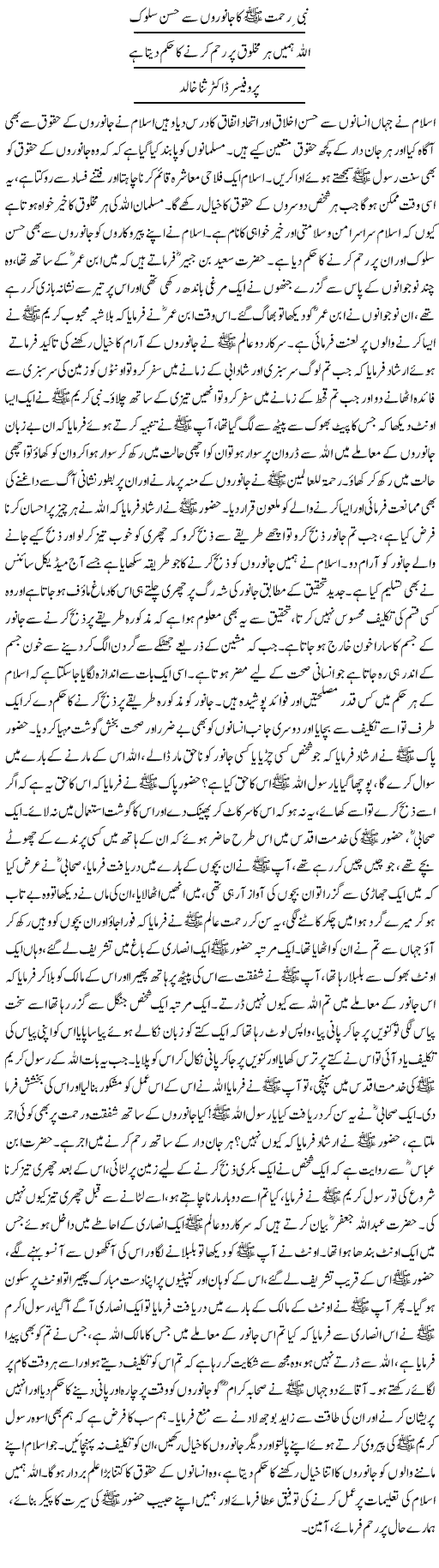
Janwaroon Se Husn-e-Salook
Importance Of Prayer
The importance of prayer in Islam cannot be understated. It is the first pillar of Islam that the Prophet, may Allah praise him, mentioned after mentioning the Testimony of Faith, by which one becomes a Muslim. It was made obligatory upon all the prophets and for all peoples. Allah has declared its obligatory status under majestic circumstances. For example, when Allah spoke directly to Prophet Moses, He said,
“And I have chosen you, so listen to that which is inspired to you. Verily, I am God! There is none worthy of worship but I, so worship Me and offer prayer perfectly for My remembrance.” (Quran 20:13-14)
Similarly, the prayers were made obligatory upon the Prophet Muhammad during his ascension to heaven. Furthermore, when Allah praises the believers, such as at the beginning of the chapter entitled ‘al-Muminoon’ (The Believers), one of the first descriptions He states is their adherence to the prayers.
Once a man asked the Prophet about the most virtuous deed. The Prophet stated that the most virtuous deed is prayer. The man asked again and again and for the first three times, the Prophet answered, “The prayer,” then on the fourth occasion he stated, “Jihad in the way of Allah.”
The importance of prayer is demonstrated in many of the Prophet’s statements. For example, the Prophet (peace be upon him) said,
“The first matter that the slave will be brought to account for on the Day of Judgment is the prayer. If it is sound, then the rest of his deeds will be sound. And if it is incomplete, then the rest of his deeds will be incomplete.”
The importance of the prayers lies in the fact that no matter what actions one performs in his life, the most important aspect is one’s relationship to Allah, that is, one’s faith (Imaan), Allah-consciousness (taqwa), sincerity (ikhlas) and worship of Allah (ibaadah). This relationship with Allah is both demonstrated and put into practice, as well as improved and increased, by prayer. Therefore, if the prayers are sound and proper, the rest of the deeds will be sound and proper; and if the prayers are not sound and proper, then the rest of the deeds will not be sound and proper, as the Prophet himself stated.
Haqooq-e-Niswan in Islam
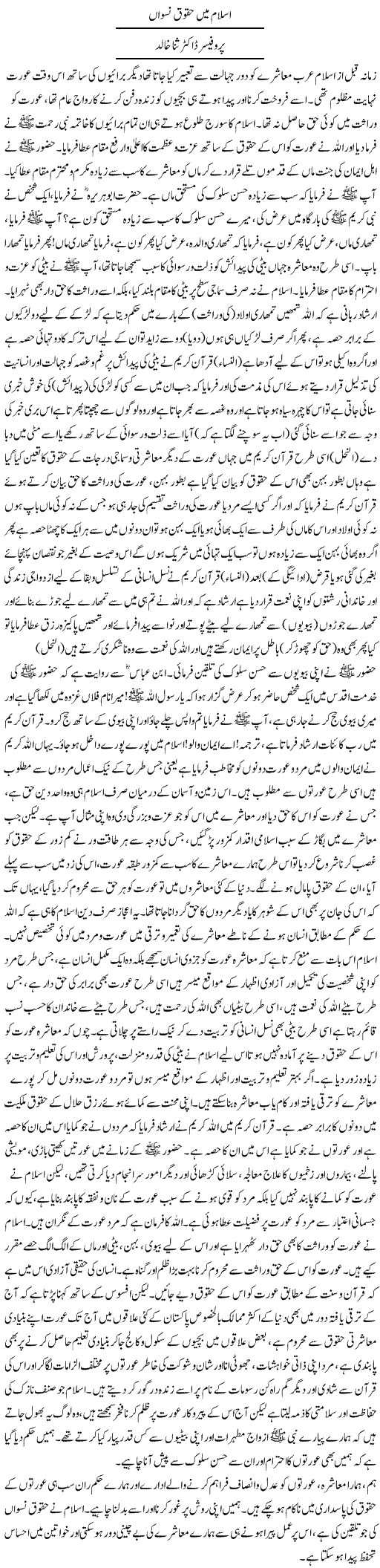
Haqooq-e-Niswan in Islam
The Greatest Gift Which We Received Because of Miraaj
When Miraaj took place, our Prophet (PBUH) received the greatest gift one can ever imagine.
He (PBUH) got to meet our Creator, our Sustainer, Allah SWT himself.
What more can one ask?
But what gift did we (the prophet’s ummah / meaning us) receive?
Did we get flowers/food/fruits/gold/clothes / etc?
No.
Those are materialistic things and we also have them back on our earth.
When the Prophet (PBUH) came back and told his sahabah, they all were very happy on receiving their gift sent by Allah SWT himself.
What gift did the sahaba receive?
The gift to pray compulsory Salah five times a day at fixed hours.
Five times a day…Oh my God.
But consider this, at first Allah SWT first gave His order of offering 50 salah’s a day.
As the Prophet was going back, he (PBUH) was asked by Prophet Moosa (PBUH): What gift did Allah SWT give your ummah?
To which our Prophet (PBUH) replied: Allah SWT has ordered to pray 50 salahs per day.
Gusse Ki Tabah Karian
Gusse Ki Tabah Karian