

Sunnahs Of Prophet Muhammad [PBUH]
Sunnahs of Prophet Muhammad [PBUH]
A Quick Refresher – Sunnahs of Our Beloved Prophet Muhammad [PBUH]
Sunnahs of Eating:
- Sit and eat on the floor.
- Spread out a cloth on the floor first before eating.
- Wash both hands up to the wrists.
- Recite ‘Bismillah wa’la barakatillah’ aloud.
- Eat with the right hand.
- Eat from the side that is in front of you.
- If a morsel of food falls down, pick it up, clean it and eat it.
- Do not lean and eat.
- Do not find fault with the food.
- Remove your shoes before eating.
- When eating, sit with either both knees on the ground or one knee raised or both knees raised.
- Clean the plate and other utensils thoroughly after eating.
- By doing this, the utensils make dua for one’s forgiveness.
- Recite dua after eating.
- First, remove the food then get up.
- After meals wash both hands.
- Thereafter gargle the mouth.
- Whilst eating one should not remain completely silent.
- Eat with three fingers if possible.
- One should not eat very hot food.
- Do not blow on the food.
- After eating one should lick his fingers.
Sunnahs of drinking:
- A Muslim should drink with the right hand. Shaytaan Drinks with the left hand.
- Sit and drink.
- Recite ‘Bismillah’ before drinking.
- After drinking say ‘ Alhamdullilah’.
- Drink in 3 breaths removing the utensil from the mouth after each sip.
- Do not drink directly from the jug or bottle. One should pour the contents into a glass first and then drink.
Allah Sai Achi Umeed Rakhna
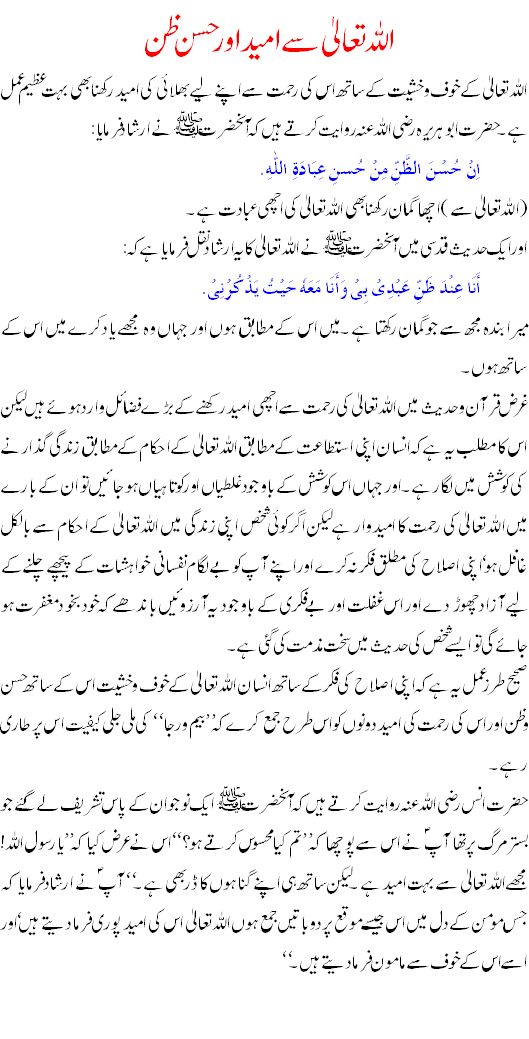
Ten Things We Waste
1. –Our Knowledge– Wasted by not taking action with it.
2. –Our Actions– Wasted by committing them without sincerity.
3. –Our Wealth– Wasted by using on things that will not bring us ajr. We waste our money, our status, and our authority, on things that have no benefit in this life or in akhirah.
4. –Our Hearts– Wasted because they are empty from the love of Allah, the feeling of longing to go to Him, and a feeling of peace and contentment. In its place, our hearts are filled with something or someone else.
5. –Our Bodies– Wasted because we don’t use them in ibadah and service of Allah
6. –Our Love– Our emotional love is misdirected, not towards Allah, but towards something/someone else.
7. –Our Time– Wasted, not used properly, to compensate for that which has passed, by doing what is righteous to make up for past deeds
8. –Our Intellect– Wasted on things that are not beneficial, that is detrimental to society and the individual, not in contemplation or reflection.
9. –Our Service– Wasted in service of someone who will not bring us closer to Allah, or benefit in Dunya
10. –Our Dhikr– Wasted, because it does not affect us or our hearts.
Avoid The Seven Noxious Things
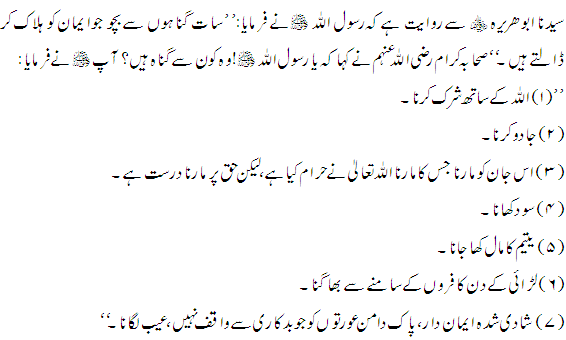
[Sahih Muslim: Book 1, Number 0161]
It is reported on the authority of Abu Huraira (Radi Allah Anhu) that the Messenger of Allah (sal-allahu- alleihi-wasallam ) observed: Avoid the seven noxious things. It was said (by the hearers): What are they, Messenger of Allah (sal-allahu- alleihi-wasallam)? He (the Holy Prophet (sal-allahu- alleihi-wasallam ) ) replied:
1. Associating anything with Allah,
2. Magic,
3. Killing of one whom God has declared inviolate without a just cause,
4. Consuming the property of an orphan,
5. And consuming of usury,
6. Turning back when the army advances,
7. And slandering chaste women who are believers, but unwary.
No Injustice From Allah
[ALLAH’S Quran – 4:40 ] “Indeed, Allah does not do injustice, [even] as much as an atom’s weight; while if there is a good deed, He multiplies it and gives from Himself a great reward.”
The Prophet (Peace Be Upon Him) has said:
[Bukhari, Book #2, Hadith #40] “Narrated Abu Huraira: Allah’s Apostle said, “If any one of you improve (follows strictly) his Islamic religion then his good deeds will be rewarded ten times to seven hundred times for each good deed and a bad deed will be recorded as it is.”
[Bukhari, Book #93, Hadith #592] “Narrated Abu Huraira: Allah’s Apostle said, “Allah says, “If My slave intends to do a bad deed then (O Angels) do not write it unless he does it; if he does it, then write it as it is, but if he refrains from doing it for My Sake, then write it as a good deed (in his account). (On the other hand) if he intends to do a good deed but does not do it, then write a good deed (in his account), and if he does it, then write it for him (in his account) as ten good deeds up to seven-hundred times.”
[Muslim, Book #001, Hadith #0234] “It is narrated on the authority of Abu Huraira that the Messenger of Allah (may peace be upon him) observed: Allah, the Great and Glorious, said: Whenever my bondsman intends to do good but does not do it, I write one good act for him, but if he puts it into practice I wrote from ten to seven hundred good deeds in favor of him. When he intends to commit an evil but does not actually do it, do not record it. But if he does it, I write only one evil.”
[Muslim, Book #041, Hadith #7039] “Abu Huraira reported Allah’s Messenger (may peace be upon him) having said: Hasten to do good deeds before six things happen: the rising of the sun from the west, the smoke, the Dajjal, the beast and (the death) of one of you or the general turmoil.”
[Abudawud, Book #41, Hadith #5059] “Narrated Abu Ayyash: The Apostle of Allah (peace be upon him) said: If anyone says in the morning: “There is no god but Allah alone Who has no partner; to Him belong the dominions, to Him praise is due, and He is Omnipotent,” he will have a reward equivalent to that for setting free a slave from among the descendants of Isma’il. He will have ten good deeds recorded for him, ten evil deeds deducted from him, he will be advanced ten degrees, and will be guarded against the Devil till the evening. If he says them in the evening, he will have a similar recompense till the morning. The version of Hammad says: A man saw the Apostle of Allah (peace be upon him) in a dream and said: Apostle of Allah! Abu Ayyash is relating such and such on your authority. He said: Abu Ayyash has spoken the truth.”

La Haula Wala Quwata Illa Billah

Narrated Abu Musa (Radi Allah Anhu): While we were with Allah’s Apostle (sal-allahu-alleihi-wasallam) in a holy battle, we never went up a hill or reached its peak or went down a valley but raised our voices with Takbir. Allah’s Apostle (sal-allahu-alleihi-wasallam) came close to us and said, “O people! Don’t exert yourselves, for you do not call a deaf or an absent one, but you call the All-Listener, the All-Seer.” The Prophet (sal-allahu-alleihi-wasallam) then said, “O ‘Abdullah bin Qais! Shall I teach you a sentence that is from the treasures of Paradise? ( It is): ‘La haula wala quwata illa billah. (There is neither might nor power except with Allah).” [Sahih Bukhari: Volume 8, Book 77 ‘Al-Qadar’, Number 607]
Witnesses To The Truth
[ALLAH’S Quran – 57:19] “And those who believe in Allah and His messengers- they are the Sincere (lovers of Truth), and the witnesses (who testify), in the eyes of their Lord: They shall have their Reward and their Light. But those who reject Allah and deny Our Signs,- they are the Companions of Hell-Fire.”
The Prophet (Peace Be Upon Him) has said:
[Muslim, Book #001, Hadith #0043] “It is narrated on the authority of Ubadah b. Samit that the Messenger of Allah (may peace be upon him) observed: He who said:” There is no god but Allah, He is One and There is no associate with Him, that Muhammad is his servant and His Messenger, that Christ is servant and the son of His slave-girl and he (Christ) His word which He communicated to Mary and is His Spirit, that Paradise is a fact and Hell is a fact,”Allah would make him (he who affirms these truths enter Paradise through any one of its eight doors which he would like.”
[Muslim, Book #001, Hadith #0045] “It is narrated on the authority of Sunabihi……………. I heard the Messenger of Allah (may peace be upon him) say: He who testifies that there is no god but Allah and that Muhammad is the messenger of Allah, Allah would prohibit the fire of hell for him.”
[Muslim, Book #001, Hadith #0051] “It is reported on the authority of Anas b. Malik that the Prophet of Allah (may peace and blessings be upon him) addressed Mu’adh b. Jabal as he was riding behind him to which he replied: At thy beck and call, and at thy pleasure, Messenger of Allah. He again called out: Mu’adh, to which he (again) replied: At thy beck and call, and at thy pleasure. He (the Holy Prophet) addressed him (again): Mu’adh, to which he replied: At thy beck and call, and at thy pleasure, Messenger of Allah. Upon this, he (the Holy Prophet) observed: If anyone testifies (sincerely from his heart) that There is no god but Allah, and that Muhammad is His bondsman and His Messenger, Allah immuned him from Hell.”
Namaz kay Fazail
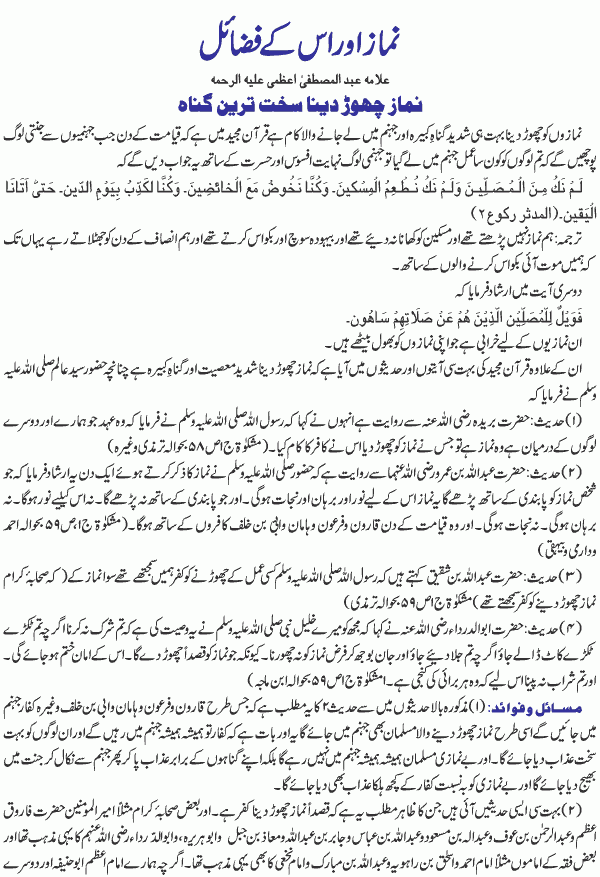
Virtues Of Salaah
1. Abu Hurayra Radiyallahu ‘anhu said, “I heard the Messenger of Allah, may Allah bless him and grant him peace, say, ‘What do you think would happen if there was a river by someone’s door in which he washed five times every day? Do you think that any dirt would remain on him?’ They said, ‘Not a scrap of dirt would remain on him.’ He said, ‘That is a metaphor of the five prayers by which Allah wipes out wrong actions.'”
2. Jabir ibne-’Abdullah Radiyallahu ‘anhuma narrates that Nabi Sallallahu alaihi wasallam said: ‘The key to Paradise is Salat and the key to Salat is Wuzu’. (Musnad Ahmad)
3. Anas Radiyallahu ‘anhu narrates that Rasulullah Sallallahu ‘alaihi wasallam said: ‘The comfort and delight of my eyes has been placed in Salat.’ (Nasai).
4. Hanzalah Al Usaidi Radiyallahu ‘anhu narrates that Rasulullah Sallallahu ‘alaihi wasallam said: ‘The person who guards the five times Salat, its Wuzu, its prescribed time, its proper Ruku’ and Sujud, while perceiving it to be the Right of Allah on him, he is forbidden upon Fire.’ (Musnad Ahmad)
5. Abu Qatadah ibne-Rib’i Radiyallahu ‘anhu reported that Rasulullah Sallallahu ‘alaihi wasallam narrates in a Hadith Qudsi that Allah ‘Azza wa Jall has said:’ Verily, I have enjoined upon your Ummah five times Salat, and I have taken upon myself an oath that anyone who observes them at their appointed time, I shall admit him into Paradise; if anyone does not offer them regularly, there is no such guarantee from Me for him (I may punish him or forgive him).'(Abu Dawud)