
Virtues Of Reciting Darood Sharif
The Virtues and Blessings of Reciting Durood upon Nabi (Sallallahu Alaihi Wasallam)
All praise is due to Allah Ta’ala. May the choicest durood (salutations) and salaam (peace) descend upon the noblest of Ambiyaa and Rasuls, our master and leader Hadhrat Muhammad (Sallallahu Alaihi Wasallam) and upon his blessed household and all his illustrious companions.
It is the belief of every believer that those who enjoy the highest rank after Allah Ta’ala are the Ambiyaa (may Allah Ta’ala’s choicest blessings rain upon them), and from among the galaxy of Ambiyaa, the highest in rank and status is Hadhrat Rasulullah (Sallallahu Alaihi Wasallam). Not only was Rasulullah (Sallallahu Alaihi Wasallam) sent to this ummah as the final messenger of Allah Ta’ala and the seal of prophet-hood, but he was also the leader of all the Ambiyaa and Rasuls of the past. The nubuwwat of every Rasul and Nabi of the past was subject to accepting Muhammad (Sallallahu Alaihi Wasallam) as his leader and pledging to support his cause if Rasulullah (Sallallahu Alaihi Wasallam) appeared in his era.
The love that Allah Ta’ala expressed for Rasulullah (Sallallahu Alaihi Wasallam), which can be easily gauged from the style of address in the Holy Qur’an, is unique and exclusive to Rasulullah (Sallallahu Alaihi Wasallam). The honor conferred to Rasulullah (Sallallahu Alaihi Wasallam) by Allah Ta’ala on the occasion of Me’raj was an honor not enjoyed by any other Messenger of the past. Furthermore, when Rasulullah (Sallallahu Alaihi Wasallam) will be ushered into the court of Allah Ta’ala on the day of Qiyaamah to the esteemed pedestal of maqaam mahmood to intercede for the entire humanity, his distinct position will be envied by all the Ambiyaa and Rasuls and their nations.
Rasulullah (Sallallahu Alaihi Wasallam)’s blessings and virtues are so immense and incredible that it is impossible for anyone to enumerate them. Suffice it to say that he will be the leader of the entire creation of Allah Ta’ala on the day of Qiyaamah.
Zikr-e-Elahi

Muharram And Aashura
Every year, when the blessed month of Muharram enters, we are reminded of certain incidents: The Hijrah, The Day of Aashura, and The Martyrdom of Sayyidina Husain (R.A). These are generally the topics of discussion in the month of Muharram and Insha-Allah, something will be said with respect to each one.
The Hijrah
During the Khilafat of Hazrat Umar (R.A), Islam had spread far and wide and there was a need to have some kind of date for the correspondence that was being sent out. Hazrat Umar (R.A) thus consulted with the Sahaaba-e-Kiraam (R.A) as to when the calendar should begin. Different views were presented before Hazrat Umar (R.A) wisely declared that the calendar begin with the Hijrah.
Many lessons are taken from this decision :
In this month of Muharram, we are reminded of the great sacrifices made for the Deen of Islam. Rasulullah and his companions had to leave their beloved Makkah Mukarramah, their homes, and even their families, and that too after a long and trying period of immense persecution, torture, and trials. The month of Muharram delivers us to the days of Rasulullah and we see the many trials and difficulties that the Beloved of Allah Ta’ala underwent. As we turn the pages of history, we see the three solid years of ostracism that were so patiently endured, despite the extreme and severe conditions, where food and drink and other necessities of life were cut off from the Muslims.
We take a glimpse at the grief and sorrow that burdened the heart of Rasulullah when his beloved wife, Hazrat Khadija (R.A) passed away; his support and his companion through those trying times. Then followed the loss of his uncle, Abu Talib, who had also been a means of support and protection. The year was thus called ‘The year of grief.
We turn another page and we behold the cruel experiences that Nabi endured in Taif: The rejection, the scorn, the mockery, and the stoning. …Of whom? The greatest after Allah Ta’ala. And as we turn more pages of history, we read of the culmination of all the evil plans and plots, with the decision to assassinate Rasulullah. This was the setting that opened the door to the Hijrah. Family, property, land …everything was sacrificed on the instruction of Allah Ta’ala to migrate from Makkah Mukarramah to Madina Munawwarah.
Life was a constant struggle: Overcoming one obstacle meant being confronted by another and yet another – but there was no losing hope, no despondency. Just absolute trust and unwavering faith in Allah Ta’ala. On every occasion, there was the assurance that Allah Ta’ala was with us. …How beautiful and comforting the words of Rasulullah to Hazrat Abu Bakr (R.A) during their perilous stay in the cave of Thaur… “Don’t be sad. Verily Allah is with us.”
So these incidents – which run into thousands – are lessons for mankind till the Day of Qiyaamah, more especially, we who are Muslims.
Reflecting over that period of struggle and we learn that if we say that we believe and that we have submitted, then we too will face different challenges, tests and trials, toil and struggle, and sacrifices will have to be rendered for this Imaan and for this beautiful Deen of Islam.
At the same time, each incident offers consolation to us all: If Rasulullah and his faithful companions could have undergone such severe trials, then what are our trials in comparison?
Life in this world will never be smooth sailing. There will always be some tests and some kind of sacrifices. For many of us, it is the small test of getting up for Fajr or giving up sins. What great sacrifice is there in this? Compare it to the sacrifices of the Sahaaba-e-Kiraam.
In today’s time, a little difficulty comes the person’s way and the person gives up his Deen; a little test and the person accepts another religion.
Our lives will offer us a share of struggle: The tests we face are sometimes in our home life, sometimes with family or neighbors, sometimes in business, and sometimes at the schools, colleges, and universities … but we should keep before us these exceptional incidents from the life of Rasulullah and the lives of his noble companions, of sacrifice and endurance against all odds.
Miswak

Punishments For Not Paying Zakah
Narrated Abu Huraira (radi’Allahu anhu) : Allah’s Apostle (sall’Allahu alaihi wa sallam) said, “Anyone whom Allah has given wealth but he does not pay its zakat, then, on the Day of Resurrection, his wealth will be presented to him in the shape of a bald-headed poisonous male snake with two poisonous glands in its mouth and with two black spots over the eyes. it will encircle itself around his neck and bite him over his cheeks and say, “I am your wealth; I am your treasure.”
Then the Prophet (sall’Allahu alaihi wa sallam) recited this Divine Verse:–
“And let not those who covetously withhold of that which Allah has bestowed upon them of His Bounty.”
(3.180)
{Sahih Bukhari}
(Book #60, Hadith #88) (Book #24, Hadith #486)
Narrated Abu Dhar (radi’Allahu anhu) : Once I went to him (the Prophet ) and he (sall’Allahu alaihi wa sallam) said, “By Allah in Whose Hands my life is (or probably said, ‘By Allah, except Whom none has the right to be worshipped) whoever had camels or cows or sheep and did not pay their zakat, those animals will be brought on the Day of Resurrection far bigger and fatter than before and they will tread him under their hooves and will butt him with their horns, and (those animals will come in a circle): When the last does its turn, the first will start again,
and this punishment will go on till Allah has finished the judgments amongst the people.”
{Sahih Bukhari}
(Book #24, Hadith #539)
Abu Huraira (radi’Allahu anhu) reported
Allah’s Messenger (sall’Allahu alaihi wa sallam) as saying: “If any owner of gold or silver does not pay what is due on him when the Day of Resurrection would come, plates of fire would be beaten out for him; these would then be heated in the fire of Hell and his sides, his forehead, and his back would be cauterized with them. Whenever these cool down, (the process is) repeated during a day the extent of which would be fifty thousand years, until judgment is pronounced among servants, and he sees whether his path is to take him to Paradise or to Hell.
It was said: Messenger of Allah, what about the camel? He (sall’Allahu alaihi wa sallam) said: If any owner of the camel does not pay what is due on him, and of his due in that (camel) is (also) to milk it on the day when it comes down to the water. When the Day of Resurrection comes
a soft sandy plain will be set for him, as extensive as possible, (he will find) that not a single young one is missing, and they will trample him with their hoofs and bite him with their mouths. As often as the first of them passes him, the last of them would be made to return during a day
the extent of which would be fifty thousand years, until judgment is pronounced among servants and he sees whether his path is to take him to Paradise or to Hell. It was (again) said:
Messenger of Allah, what about cows (cattle) and sheep? He (sall’Allahu alaihi wa sallam) said: If any owner of the cattle and sheep does not pay
what is due on them, when the Day of Resurrection comes a soft sandy plain would be spread for them, he will find none of them missing, with twisted horns, without horns or with a broken horn, and they will gore him with their horns and trample him with their hoofs. As often as the first of them passes him the last of them would be made to return to him during a day the extent of which would be fifty thousand years until judgment would be pronounced among the servants. And he would be shown his path leading him to Paradise or to Hell…”
Sahih Muslim (Book #005, Hadith #2161)
Nijaat Ka Zariya
Important Islamic Jurisprudence Terminology
Fard – Obligatory:
An act commanded by Allah in the Holy Qur’an is known as Fard. The following explains a Fard in detail:
a. An act that is obligatory to be executed
b. It has been proven by rigorously authenticated texts
c. The denial of any Fard renders one to come out of the folds of Islam.
d. If one omits to perform any Fard without any valid shari’i reason, then such a person becomes a fasiq (transgressor) and the person is regarded as a major sinner. [Fatawa Ridawiyyah – Vol. 2, Page 194]
Wajib – Necessary:
An act that is almost as compulsory as a Fard. The Messenger of Allah SallAllaho Alaihi wa Aalihi wa Sallam never omitted it. It is a graded second, below a Fard in its necessity.
a. An act that is compulsory to do.
b. It is proven by religious arguments through ijtihad.
c. One who denies a Wajib is misguided.
d. If one omits a Wajib without any valid shari’i reason, then he is a transgressor and liable for the punishment of Hell.
e. To miss a Wajib once (deliberately, without any valid reason) is a minor sin (Gunah-e-Saghira). However, persistently omitting a Wajib shall turn it into a major sin (Gunah-e-Kabira).
Sunnat-e-Mu’akkadah:
“Sunnat” generally means: an act done or liked by the Messenger of Allah SallAllaho Alaihi wa Aalihi wa Sallam in relation to worship. One shall gain a reward for performing a Sunnah, but there is no sin if one omits it. However, to continually omit it is a sin, and if one shows dissatisfaction with a Sunnah, then this is kufr (disbelief).
a. Sunnat-e-Mu’akkada is an act necessary to perform.
b. An act that was always performed by the Messenger of Allah SallAllaho Alaihi wa Aalihi wa Sallam, but occasionally omitted so as to differentiate from something that is Wajib.
c. One gains the displeasure of Allah Most High and His Beloved Prophet SallAllaho Alaihi wa Aalihi wa Sallam if a Sunnat-e-Mu’akkadah is omitted even if it is occasionally. Thus, making it a habit to omit a Sunnat-e-Mu’akkadah is an act of earning even more displeasure of Allah and His Beloved and inevitably, one becomes liable for punishment.
d. The status of a Sunnat-e-Mu’akkadah is near a Wajib.
e. Sunnat-e-Mu’akkadah is sometimes known as Sunnat-e-Huda.
Gheebat Aur Bad Kalami
If Allah Wants To Do Good To Somebody, He Afflicts Him With Trials
[Sahih Bukhari: Volume 7, Book 70, Number 548]
Narrated Abu Huraira (Radi Allah Anhu): Allah’s Apostle (sal-allahu- alleihi-wasallam ) said, “If Allah wants to do good to somebody, He afflicts him with trials.

[Sahih Bukhari: Volume 7, Book 70, Number 545]
Narrated Abu Sa’id Al-Khudri and Abu Huraira (Radi Allah Anhu): The Prophet Muhammad (sal-allahu- alleihi-wasallam ) said, “No fatigue, nor disease, nor sorrow, nor sadness, nor hurt, nor distress befalls a Muslim, even if it were the prick he receives from a thorn, but that Allah expiates some of his sins for that.”

[Sahih Bukhari: Volume 7, Book 70, Number 547]
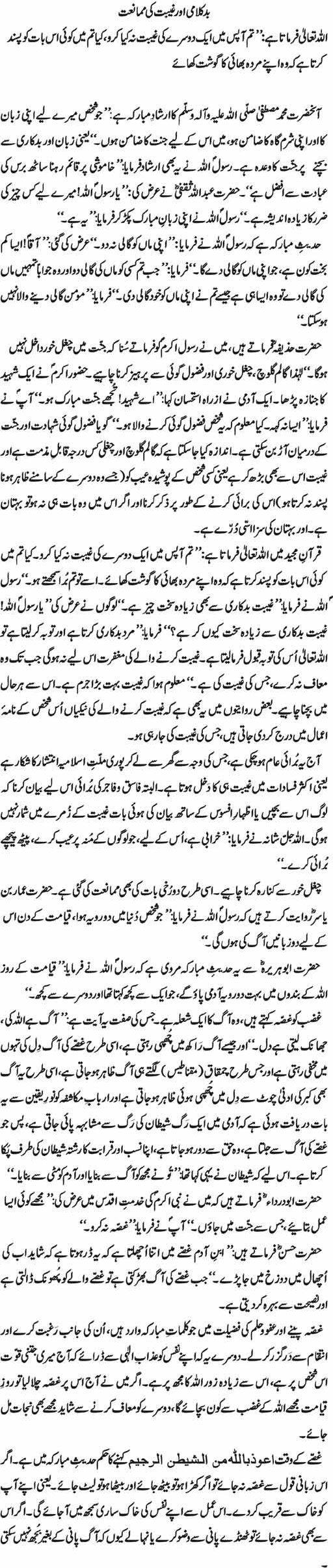
Narrated by Abu Huraira (Radi Allah Anhu): Allah’s Apostle (sal-allahu- alleihi-wasallam ) said, “The example of a believer is that of a fresh tender plant; from whatever direction the wind comes, it bends it, but when the wind becomes quiet, it becomes straight again. Similarly, a believer is afflicted with calamities (but he remains patient till Allah removes his difficulties. ) And an impious wicked person is like a pine tree which keeps hard and straight till Allah cuts (breaks) it down when He wishes.”