

The Power Of Forgiveness
God has granted intellect to human beings. The intellect entails responsibility. The more intellect a person has, the more he/she is responsible.
When the intellect is missing, the responsibility is also not there. Little children are not held responsible, because their intellect has not yet developed. The insane are not responsible, because they have lost their intellectual capacity. However, part of our being human is also that we make mistakes. Sometimes we make mistakes without deliberation and intention. But sometimes we knowingly and deliberately sin and do wrong to others.
It is said: To err is human and to forgive is divine. Both parts of this statement are very true. As human beings we are responsible, but we do also make mistakes and we are constantly in need of forgiveness. Islam speaks about two elements of forgiveness: a) God’s forgiveness; b) Human forgiveness. We need both because we do wrong in our relations to God as well as in our relations to each other.
There are many names of God given in the Quran. They are called the most beautiful names and they indicate many different and diverse attributes and qualities of God. Some of these names are related to His mercy and forgiveness. Let us look at some of these names:
*1. Al-Ghafoor (The Most Forgiving):* This name occurs in the Quran more than 70 times. There are other names from the same root, such as Ghafir and Ghaffar. The meaning of the Arabic word Ghaffar is to cover, to hide and from it comes the meaning to excuse, to pardon, to remit, and to forgive. God does all these things. In the Quran, it is mentioned that God does not forgive the Shirk (without repentance) but He may forgive every other sin for whomsoever He wills. (4:116) We must turn to God to seek His forgiveness.
*2. Al-Afuw:* This has another part of forgiveness. This name occurs in the Quran five times. Literally, the word Afw means to release, to heal, to restore, to remit. Thus in relation to God it means “to release us from the burden of punishment due to our sins and mistakes; to restore our honor after we have dishonored ourselves by committing sins and making mistakes. Sometimes in the Quran, both names, Afuw and Ghafoor, come together.
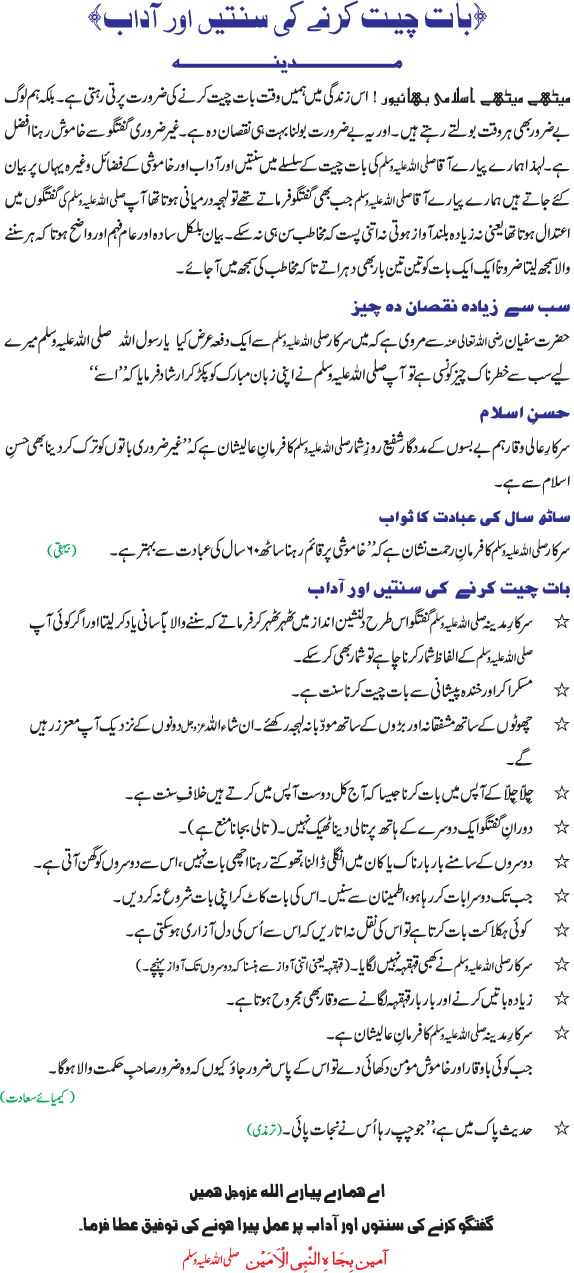
Sunnahs Of Talking
The Poor On The Day Of Judgement
Who are the Poor on Judgement Day
Abu Huraira. reported Allah’s Messenger (may peace be upon him) as saying: Do you know who is poor? They (the Companions of the Holy Prophet) said: A poor man amongst us is one who has neither dirham with him nor wealth. He (the Holy Prophet) said: The poor of my Ummah would be he who would come on the Day of Resurrection with prayers and fasts and Zakat but (he would find himself bankrupt on that day as he would have exhausted his funds of virtues) since he hurled abuses upon others, brought calumny against others and unlawfully consumed the wealth of others and shed the blood of others and beat others, and his virtues would be credited to the account of one (who suffered at his hand). And if his good deeds fall short to clear the account, then his sins would be entered in (his account) and he would be thrown in the Hell-Fire.
Sahih Muslim Book 32, Number 6251:
May Allah guard us against Oppressing others, May Allah strengthen our Moral Character
Oppression is the darkness on the Day of Resurrection.
Jabir b. Abdullah reported that Allah’s Messenger (may peace be upon him) said: Be on your guard against committing oppression, for oppression is a darkness on the Day of Resurrection, and be on your guard against petty mindedness for petty mindedness destroyed those who were before you, as it incited them to shed blood and make lawful what was unlawful for them.
Sahih Muslim Book 32, Number 6248:
Ibu ‘Umar reported Allah’s Messenger (may peace be upon him) as saying: Oppression is the darkness on the Day of Resurrection.
Sahih Muslim Book 32, Number 6249:
Saving others from Oppression
Salim reported on the authority of his father that Allah’s Messenger (may peace be upon him) said: A Muslim is the brother of a fellow Muslim. He should neither commit oppression upon him nor ruin him, and he who meets the need of a brother, Allah would meet his needs, and he who relieved a Muslim from hardship Allah would relieve him from the hardships to which he would be put on the Day of Resurrection, and he who did not expose (the follies of a Muslim) Allah would conceal his follies on the Day of Resurrection.
Sahih Muslim Book 32, Number 6250:
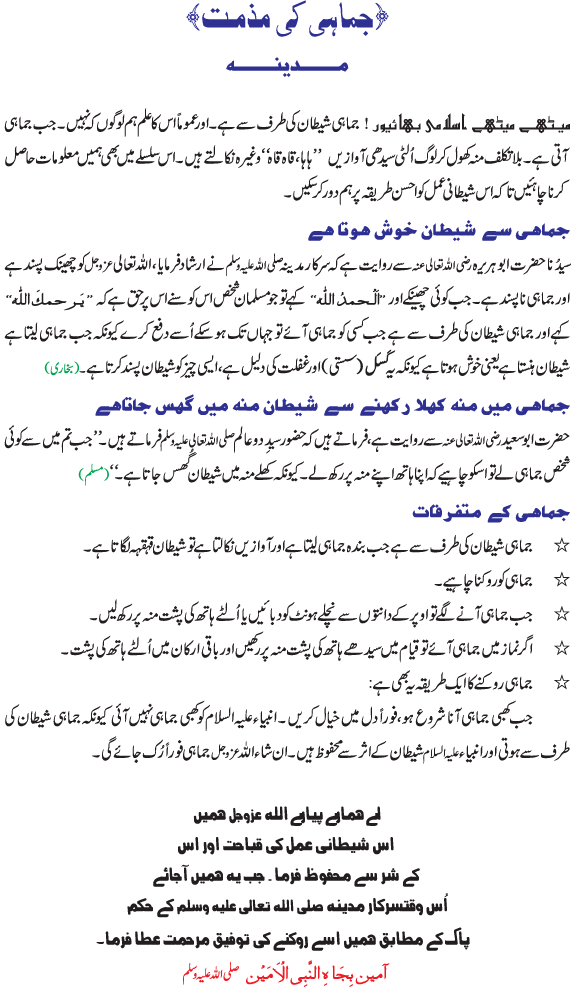
Yawning Is Bad
Bed Time Sunnahs
Revive a Sunnah
Say, If you (really) love Allah, then follow me (Sall-Allahu alayhe wasallam), [so] Allah will love you and forgive you your sins. And Allah is Forgiving and Merciful.
(Noble Quran 3:31)
Bed Time Sunnahs
1- Recite the bedtime Du’as from the Masnun Du’as such as Allah-humma bismka amutu wa ahya (Oh Allah, with your name I die and live)
2- Recite the 3 Quls 3 times: One should put his hands together, then, blow into them and recite Surah Ikhlas, Surah Falaq, and Surah Naas then, saying that, wipes as much as he can of his body, starting with his head, his face and the front of his body. He should do this three times. [Narrated by Al-Bukhari]
3- Recite Ayat-ul-Kursi (the verse of the Throne): The fruit (reward) of reciting this ayah is that who recites it, the protection from Allah remains over him, so that no devil can approach him. [narrated by Al-Bukhari]
4- Reciting the last two verses of Surat Al-Baqarah Aamanar-Rasulu: This who recites them at night, they suffice him. [narrated by Al-Bukhari and Muslim]
· Scholars have different views about the meaning of (they suffice him): it has been said: they are sufficient for him, as it is equal to praying Tahajjud of that night. Also, it has been said that they protect him against every evil and adversity. Imam Nawawi said, it may mean both things.
5- Recite Tasbeeh Fatimah: Subhan Allah thirty-three times, Al-Hamdulillah thirty-three times, and Allahu Akbar thirty-four times. [Narrated by Al-Bukhari and Muslim]
6- Reciting Surah Kafirun: as one of its fruits is that it is a protection from polytheism.
7- Make wudhu: One should be pure, for the hadith says if you go to bed, have an ablution.
8- Sleep on the right side then lie on your right side ). [Narrated by Al-Bukhari and Muslim]
9- One should put the right hand under his cheek: when he (Sallallahu alayhi wasallam) lay down, he used to put his right hand under his cheek. [Narrated by Abu-Dawoud]
Rights Of Wife In Islam
Signs Of Weak Faith
- Committing Sins And Not Feeling Any Guilt.
- Having A Hard Heart (no sign of mercy and petty when it comes to own benefit/loss).
- Being Materialistic.
- Feeling Too Lazy To Do Good Deeds, e.g. Being Late For Salat
- No Desire To Read The Quran.
- Neglecting The Sunnah.
- Having Mood Swings, For instance, Being Upset about petty things and bothered and irritated most of the time.
- Not feeling anything when hearing verses from the Quran, for example when Allah warns us of punishments and His
- promise of glad tidings.
- Finding difficulty in remembering Allah and making dhikr.
- Not feeling bad when things are done against the Shariah.
- Desiring status and wealth.
- Being mean and miserly, i.e. not wanting to part with wealth.
- Feeling pleased when things are not progressing for others.
- Not concerned with whether something is haram or halal.
- Making fun of people who do simple good deeds, like cleaning the mosque.
- Not feeling concerned about the situation of Muslims.
- Not feeling the responsibility to do something to promote Islam.
- Becoming engrossed and very involved with Dunya, worldly things, i.e. feeling bad only when losing something in terms of material wealth.
- Becoming engrossed and obsessive about ourselves.
Tilawat-e-Quran – Har Mushkil Asaan

The Essence Of Qurbani
History of Qurbani
Qurbani (Sacrifice) is an ancient form of worship that is prevalent since the time of Hazrat Adam (Alaihis Salaam). The first sacrifice to be offered was that of Haabil and Qaabil, the two sons of Hazrat Adam (Alaihis Salaam). Hazrat Bibi Hawa (Radiallahu Ta’ala Anha) used to give birth to twins and Haabil was born with Leewa while Qaabil was born with Aqleemah. In terms of the Shariah during that time, Aqleemah was unlawful for Qaabil but Leewa was lawful for him. But because Aqleemah was prettier Qaabil tried to marry her. He argued with Hazrat Adam (Alaihis Salaam) who eventually told both his sons to offer a sacrifice, and the one whose sacrifice is burned by a heavenly fire would be true and sincere. Thus Qaabil brought a heap of wheat and Haabil slaughtered a sheep and placed it on a mountain. A fire from an unknown source appeared and burnt the meat, leaving the wheat untouched. At this miraculous happening Qaabil became jealous and made a firm intention to kill Haabil. [Tafseer Noorul Irfaan]
Referring to this incident, Allah Ta’ala states in the Glorious Qur’an And narrates to them the true story about the two sons of Adam, when each of them offered a sacrifice (to Allah). It was accepted by one but rejected by the other. He (Qaabil) said I swear that I shall kill
you. The other (Haabil) said Allah accepts (the offering) only from the God-fearing. [Surah 5, Verse 27]
From this verse, we learn that the eating of sacrificial meat was not permissible for the previous Ummahs. Their accepted sacrifice would be burnt by fire from Almighty Allah, while the rejected sacrifice would be left to rot. The eating of sacrificial meat is a distinctive privilege of the Ummah of Rasoolullah (Sallallahu Alaihi Wasallam). [Tafseer Noorul Irfaan] We can therefore see how Allah Ta’ala has bestowed His special favor upon us just because we are the Ummatis of His Beloved Rasool (Sallallahu Alaihi Wasallam). Subhaanallah!
The month of Hajj and the day of Eid-ul-Adha remind us of the sacrifices of Hazrat Ibrahim Khaleelullah (Alaihis Salaam). Allah Ta’ala loved his act of devotion and sacrifice so much that He has made it incumbent on us to follow this beautiful Sunnah of Hazrat Ibrahim (Alaihis Salaam) till the Day of Qiyaamah. In fact, sacrifices have been made for Allah Ta’ala since the time of Hazrat Adam (Alaihis Salaam) yet it was that of Hazrat Ibrahim (Alaihis Salaam) that Allah Ta’ala made incumbent on us to follow, further emphasizing how much Allah Ta’ala loved that act. From this, we also learn that true devotion to Almighty Allah demands that one must be willing to sacrifice everything in the name of Allah, whether it be wealth, family, or life.
Qurbani instills in us selflessness, sharing, and sacrifice and removes from us the carnal desire to hoard money. The intention of Qurbani is not to feed or eat the meat of Qurbani, but to fulfill a command of Allah Ta’ala and to renew the Sunnah of Hazrat Ibrahim (Alaihis Salaam). The Holy
Qur’an bears testament to this in the following verse, “Neither their flesh reaches to Allah nor their blood, but your piety reaches Him.” [Surah 22, Verse 37]
Significance of Qurbani
Rasoolullah (Sallallahu Alaihi Wasallam) once said to his beloved daughter Hazrat Bibi Fatima (Radiallahu Ta’ala Anha), “You must stand in the presence of your animal sacrifice, and bear witness to it, for then you will be granted forgiveness, with the first drop of blood that drips from it, for every sin you have committed. (As you stand there) you must say “Inna Salaati wa Nusuki wa Mahyaaya wa Mamaati Lillaahi Rabbil Aalameen”” [Ghunyalit Taalibi Tareeqal Haq, Vol. 3]
What Rasoolullah (Sallallahu Alaihi Wasallam) told Hazrat Bibi Fatima (Radiallahu Ta’ala Anha) to recite in the above Hadith is a verse of the Holy Qur’an, the translation of which is, Undoubtedly, my prayer, and my sacrifices, and my living and my dying are all for Allah Who is
the Lord of all the worlds. [Surah 6, Verse 162]