

Click Image to enlarge

Improve Your Relationship With The Quran
7 Tips for Improving your Relationship with the Quran….!!!
1. Before you touch it, check your heart.
The key to really benefiting from the Quran is to check your heart first before you even touch Allah’s book. Ask yourself, honestly, why you are reading it. Is it to just get some information and to let it drift away from you later? Remember that the Prophet Muhammad (peace and blessings be upon him) was described by his wife as a “walking Quran”: in other words, he didn’t just read and recite the Quran, he lived it.
2. Do your Wudu (ablution).
Doing your Wudu is good physical and mental preparation to remind you you’re not reading just another book. You are about to interact with ALLAH, so being clean should be a priority when communicating with Him.
3. Start with reading for only 5 minutes every day.
Too often, we think we should read Quran for at least one whole hour. If you aren’t in the habit of reading regularly, this is too much. Start off with just five minutes daily. If you took care of step one, Insha Allah (ALLAH willing), you will notice that those five minutes will become ten, then half an hour, then an hour, and maybe even more!
4. Make sure you understand what you’ve read.
Five minutes of reading the Quran in Arabic is good, but you need to understand what you’re reading. Make sure you have a good translation of the Quran in the language you understand best. Always try to read the translation of what you’ve read that day.
Hardships Benefit The Believer
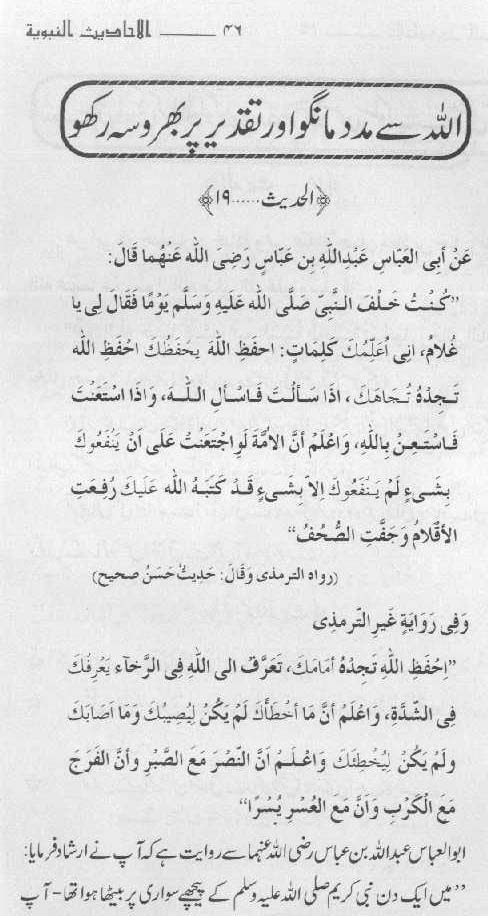
Hardships Benefit the Believer
Allah has decreed that, in this life, hardships and disasters strike both believers and non-believers. For a non-believer, they are inconveniences that hinder him from proceeding with his normal involvement in worldly life. For a believer, on the other hand, they are instances of rest and remembrance, tests that promise great rewards, and indications of atonement and expiation of sins.
Regardless of how little the harm that strikes a believer, it carries with it good news of forgiveness and elevated rank ( in Jannah ). The Righteous Predecessors used to be pleased when hardship afflicted them, seeing it as a token of Allah’s forgiveness and benevolence.
Expiation of Sins
Abu Hurayrah (RA) reported that the Prophet said: ” Hardships continue to befall a believing man and woman in their body, family, and property until they meet Allah (S) burdened with no sins. ” [Tirmithee]
Sign of Allah’s Love
Abu Hurayrah (RA) reported that the Prophet (SAW) said: “Whenever Allah wills good for a person, He subjects him to adversity” [Bukharee and others]
Sign of Emaan
Abu Hurayrah (RA) and Kab Bin Maalik (RA) reported that the Prophet (SAW) said: “The parable of a believer is that of a fresh and moist plant; the wind tilts it this way and that way, and so is the believer; he continues to be subject to affliction. And the parable of a hypocrite is that of a firm cedar tree; it does not shake – until it is uprooted all at once.”
[Bukhari and Muslim]
Guldasta-e-Ahadith (Part 2)
What Quran Says Regarding Parents?

And whoever obeys Allah and the Apostle, these are with those upon whom Allah has bestowed favors from among the prophets and the truthful and the martyrs and the good, and a goodly company is they.
 |
|
What does Quran say regarding Parents?
[4.Surah An-Nisaa : Ayah 36]
“And serve Allah and do not associate anything with Him and be good to the parents and to the near of kin and the orphans and the needy and the neighbor of (your) kin and the alien neighbor, and the companion in a journey and the wayfarer and those whom your right hands possess; surely Allah does not love him who is proud, boastful.”

Excellence Of Giving Adhan
1. Abu Hurairah (May Allah be pleased with him) reported: The Messenger of Allah (sallallaahu alayhi wa sallam) said:
“Were people to know the blessing of pronouncing Adhan and standing in the first row, they would even draw lots to secure these privileges. And were they to realize the reward of performing Salat early, they would race for it; and were they to know the merits of Salat after nightfall (`Isha’) and the dawn (Fajr) Salat, they would come to them even if they had to crawl.”
[Al-Bukhari and Muslim].
COMMENTARY: This expression ‘to crawl’ is used to illustrate the high merit of praying `Isha and Fajr in the congregation in the mosque. This Hadith also urges to make best to occupy the first rows, as the `Angels of Mercy’ pray for the Imam first, then for those who pray immediately behind him in the first row, then those behind them, and so on. The Hadith also points out the excellence of Adhan and the great reward of the person who pronounces it.
2. Mu`awiyah (May Allah be pleased with him) reported: I heard the Messenger of Allah (sallallaahu alayhi wa sallam) saying:
“The Mu’adhdhinun (callers to prayer) will have the longest necks on the Day of Resurrection.”
[Muslim].
COMMENTARY: The phrase “will have the longest necks” has been given different interpretations. One of them is that they are those who long for the Mercy of Allah more than anyone else. Another interpretation is that their necks will grow longer on the Day of Requital and so sweat will not reach them, for everyone will sweat on that day depending on his deeds: sweat will reach up to one’s ankles or knees or waists. In the case of some people, sweat will reach up to their mouths. Another interpretation is that those who call Adhan will have an honorable and great status on the Day of Requital.
Allah Knows Better.

Guldasta-e-Ahadith (Part 1)
The Excellence Of Dua
Dua is the most powerful weapon of a believer. It can change fate, while no action of ours ever does. It is the brain of ‘Ibadah or worship. With it we can never fail; without it, we can never succeed. With all the suffering and disasters Muslims are facing in various parts of the world, the question of Dua can be directed to all of us today. It is not that we have forgotten Dua completely; we refer to it regularly. But, our ideas and practice regarding Dua have become distorted. Often it is reduced to the level of a ritual. It is belittled through actions and sometimes even with words. Almighty Allah says:
And your Lord said: Invoke Me, I will respond to your (invocation). Verily, those who scorn My worship they will surely enter Hell in humiliation.[Surah al-Ghafir, Verse 60]
The Almighty Allah states:
When the suffering reached them from Us, why then did they not learn humility? On the contrary, their hearts became hardened (with arrogance), and Satan made their (sinful) acts seem alluring to them. [Surah al-An’am, Verse 43]
THE EXCELLENCE OF DUA
There are numerous Ahadith relating to the excellence of Dua.
HADITH NO. 1
Sayyiduna Rasoolullah SallAllaho Alaihi wa Sallam states that Almighty Allah says:
I am with the supposition of My servant. [Recorded in Bukhari (Hadith 7239), Muslim, Tirmidhi, Nisaa’i, and Ibn Maja on the authority of Sayyiduna Abu Hurayrah]
This means that as a servant imagines or has an opinion concerning Allah, the Merciful Lord accordingly reacts with him. Knowledge and Qudrat is with everything but there is special proximity of mercy with those who make Dua to Him. What bigger mercy can a servant ask for than being blessed with the Divine Proximity of the Sublime Lord? Thousands of acceptances and millions of desires and intentions may be sacrificed in such Divine Proximity!
HADITH NO. 2
There is nothing nobler to Allah than Dua. [Recorded in Tirmidhi, Ibn Maja, Ibn Habban, and Hakim narrated by Sayyiduna Abu Hurayrah. Also cited in Tahzib al-Kamil, Vol. 4, Page 309]
Hazrat Abu Bakr Siddique (RadiAllahuAnh)
Hazrat Abu Bakr Siddique was the first caliph and one of the closest companions of the Holy Prophet Muhammad (PBUH). His real name was Abdullah and he belonged to the sub-tribe of Quraish. He was the best companion of Muhammad (PBUH) and stood with him through thick and thin. He remained with Holy Prophet Muhammad (PBUH) during the migration of Muslims from Makkah to Madina. One of his daughters- Hazrat Ayesha(RA) married Hazrat Muhammad (PBUH). He was declared as Ameer-e-Haj (Leader of Pilgrimage) by Hazrat Muhammad (PBUH) in the 9th hijrah. After the demise of the Holy Prophet, he was chosen as the first caliph of the Muslim Ummah. He continued his services for Islam during his caliphhood which started in 632 A.D and ended in 634 A.D. During his era of caliphhood the Muslims won a lot of battles, especially in Iraq and Syria. He died on the 24th of August 634 A.D and he was buried on the left side of Hazrat Muhammad PBUH.

Instruction f Prayer In Quran
Who believe in the Unseen, are steadfast in prayer, and spend out of what We have provided for them; (2:3)
And be steadfast in prayer; practice regular charity; and bow down your heads with those who bow down (in worship).(2:43)
Nay, seek (Allah’s) help with patient perseverance and prayer: It is indeed hard, except to those who bring a lowly spirit, (2:45)
And be steadfast in prayer and regular in charity: And whatever good ye send forth for your souls before you, ye shall find it with Allah: for Allah sees Well all that ye do.(2:110)
O ye who believe! seek help with patient perseverance and prayer; for Allah is with those who patiently persevere. (2:153)
Guard strictly your (habit of) prayers, especially the Middle Prayer; and stand before Allah in a devout (frame of mind). (2:238)