


Islam Aur Mahol Ka Tahafuz
Achieving High Aims
Achieving high aims depends upon having a firm intention and a strong will. Whoever loses them will never attain one’s goals, because when one’s intention is firm, it adheres to the plan, and if one’s will is strong, the servant will walk along the right way that leads to that aim. Having a strong will opens the way and a resolute intention focuses one on the aim. If one’s aim coincides with the way that one reaches it, one will be successful.
If one’s intention is weak, one will not have a high aim. If one’s will is not strong, it will (also) not lead one to the aim. The whole matter depends upon the will and the intention of the servant, and they will never be achieved without the following:
First: Neglecting innovations that people make.
Second: Abandoning worldly benefits and vain pleasures, which hinder one from one’s way and aim.
Third: Purification of one’s heart from any vain desires that will distract one’s intention. – Al-Fawa’id
- By Ibn Qayyim Al-Jawziyyah (d. 751H) – a famous Islamic scholar commonly referred to as the doctor of the heart given his extensive works about human behavior and ethics.
Musalman Hukmran Kay Haqooq
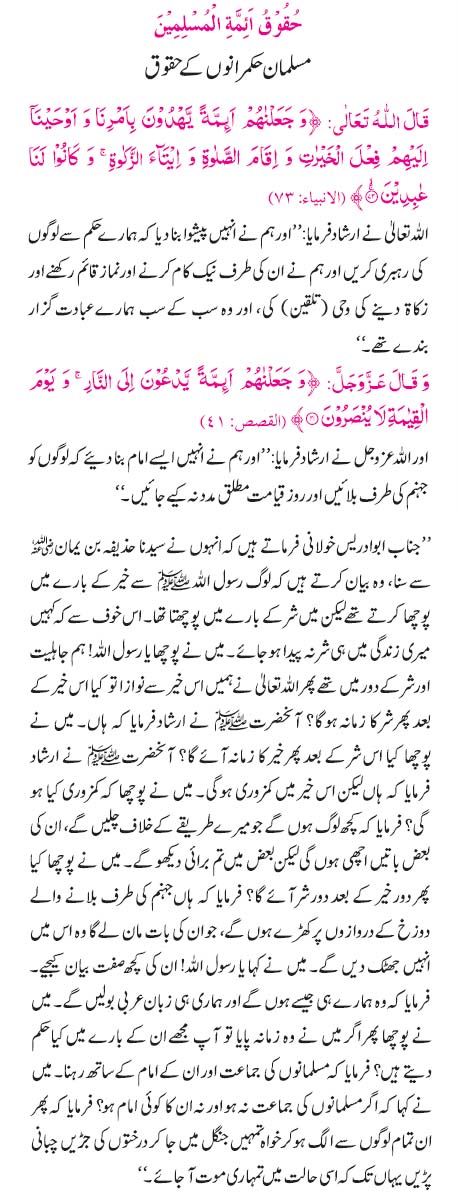
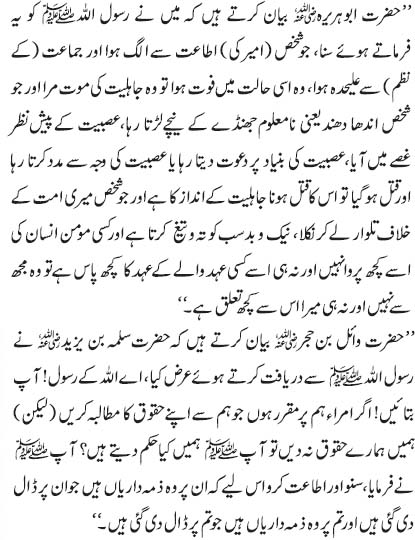
Musalman Hukmran Kay Haqooq
Allah Looks To Your Heart And Deeds (Not Your Faces And Wealth)
[94. Surah Al-Sharh: Ayah 7-8] “So when you are free, nominate. And make your Lord your exclusive object.”
( Sahih Muslim: Book 32, Number 6219) Abu Huraira (Radi Allah Anhu) reported Allah’s Messenger (sal-allahu-alleihi-wasallam) as saying: “Don’t nurse a grudge and don’t bid him out for raising the price and don’t nurse aversion or enmity and don’t enter into a transaction when the others have entered into that transaction and be as fellow-brothers and servants of Allah.
A Muslim is the brother of a Muslim. He neither oppresses him nor humiliates him nor looks down upon him. The piety is here, (and while saying so) he pointed towards his chest thrice. It is a serious evil for a Muslim that he should look down upon his brother Muslim.
All things of a Muslim are inviolable for his brother in faith: his blood, his wealth, and his honor.”
(Sahih Muslim: Book 32, Number 6220) This hadith has been transmitted on the authority of Abu Huraira (Radi Allah Anhu) with some addition (and it is this): “Verily Allah does not look to your bodies nor your faces but He looks to your hearts,”
And he pointed toward the heart with his fingers.
( Sahih Muslim: Book 32, Number 6221) Abu Huraira (Radi Allah Anhu) reported Allah’s Messenger (sal-allahu-alleihi-wasallam) as saying: “Verily Allah does not look to your faces and your wealth but He looks to your heart and your deeds.” |
Meethi Zaban Khushboo

Meethi Zaban Khushboo
Hasad Shaves Faith
Tirmîdhî narrated from al-Zubayr Ibn al-Awam (Allah be pleased with them) that Prophet (sallallahu alaihi wa-sallam) said… ‘There has come to you the disease of the nations before you… Jealousy and Hatred. This is the Shaver (Destroyer) I do not say that it shaves hair, but that it shaves (destroys) Faith.
Source (Hasan) Jami at- Tirmidhi (2434)
‘Hasad’ can cause the person to indulge in disbelief because it causes the individual to feel that Allah has not been fair with him; he forgets all the Mercy and Blessings that Allah has bestowed upon him. The Messenger of Allah (Sallallahu Alaihi Wa-Sallam) said: They are enemies for Allah’s bounties. The companions asked: ‘Who are they? The Messenger of Allah(sallallahu alaihi wa-sallam) said: ‘Those who envy people for what Allah has given them of Bounty.” [Source at-Tabaranî]
It is reported that Muhammad Ibn. Sirin, [Allah have mercy on him] said: “I have never envied anyone over anything: if a person is going to be in the Fire …how could I envy him over some worldly matter when he is destined for the Fire? And if he is going to Paradise, how could I be envious of a man of Paradise with whom AllahTabaraka wa ta’ala is pleased.”
Muslim said: “We have never heard anything better than this from the words of Ibn Sirin.” [ Source: Abu Bakr Al-Daynuri, Al-Mujalasah wa Jawahir Al-‘Ilm article 2931.]
O Allah, I ask You for knowledge that is of benefit, a good provision, and deeds that will be accepted. Aameen.
Apnay Aamal Ka Muhasba Aur Ukhravi Hisab Ki Tayari
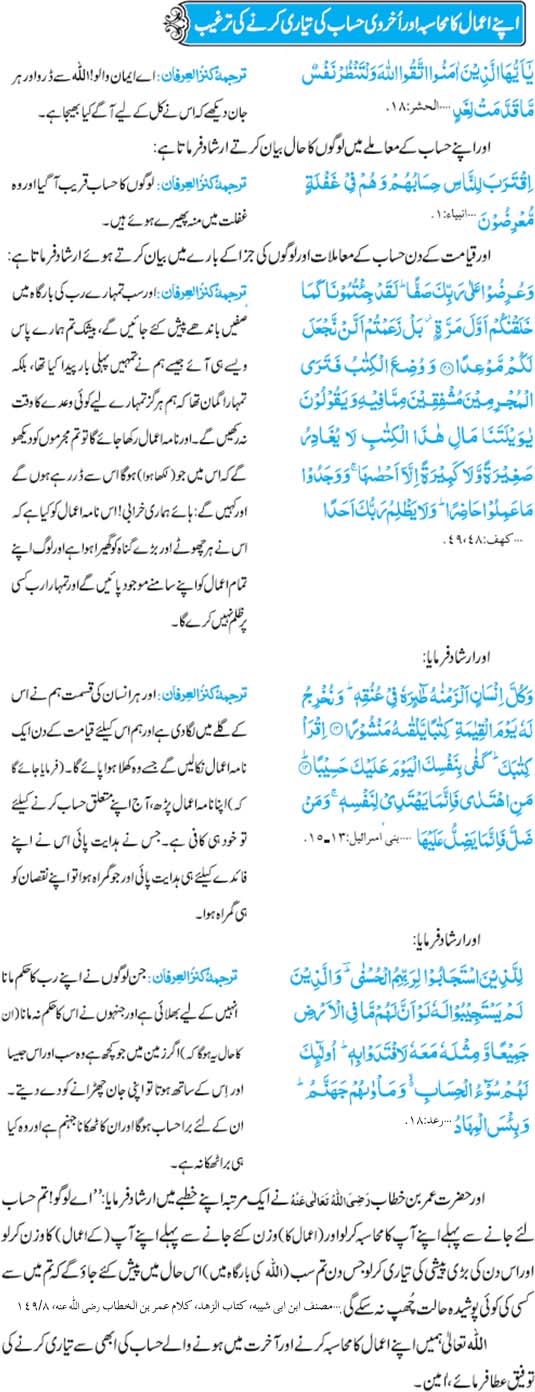
Apnay Aamal Ka Muhasba Aur Ukhravi Hisab Ki Tayari
The Healing Of Honey
More than 1,400 years ago, Allah All-Mighty told us through His Messenger sallallaahu `alayhi wa sallam (may Allah exalt his mention) that honey can heal a variety of medical problems. Honey is a remarkable viscous liquid, prepared by bees from nectars of various plants. It has occupied a prominent place in traditional medicine throughout history. The ancient Egyptians, Assyrians, Chinese, Greeks, and Romans employed honey for different diseases.
The Noble Quran and many Prophetic narrations refer to honey as a great healer of disease. Allah, Almighty, Says (what means): “And your Lord inspired the bee, saying: “Take you habitations in the mountains and in the trees and in what they erect. Then, eat of all fruits, and follow the ways of your Lord made easy (for you).” There comes forth from their bellies, a drink of varying colors wherein is healing for men. Verily, in this is indeed a sign for people who think.” [Quran; 16: 68-69]
Abu Saeed Al-Khudri may Allah be pleased with him related that a man came to the Prophet sallallaahu alayhi wa sallam ( may Allaah exalt his mention ) and said: “My brother has some abdominal trouble.” The Prophet sallallaahu alayhi wa sallam ( may Allaah exalt his mention ) said to him “Let him drink honey.” The man returned to the Prophet sallallaahu alayhi wa sallam (may Allah exalt his mention) and said: “O Messenger of Allah! I let him drink honey, but it caused him more pain.” The Prophet sallallaahu `alayhi wa sallam (may Allah exalt his mention) said to him: “Go and let him drink honey!” The man went and let his brother drink honey, then returned and said: “O Messenger of Allah, it did not cause him except more pains.” The Prophet sallallaahu alayhi wa sallam (may Allah exalt his mention) then said: “Allah has said the truth, but your brother’s abdomen has told a lie. Let him drink honey.” So he made him drink honey and he was cured. [Al-Bukhaari and Muslim]
The Prophet sallallaahu `alayhi wa sallam (may Allah exalt his mention) also said: “Make use of the two remedies: honey and the Quran.” [At-Tirmithi, Ibn Maajah, and Al-Bayhaqi] Modern medicine is only just learning of this fact.
Benefits of honey:
1. Alleviates inflammation of the cornea if used locally on the eye.
2. An antibiotic if used locally in situations of wounds and burns, and it is used for healing of wounds:
§ In the case of wounds, honey absorbs moisture from the air, facilitates the healing process, and prevents scarring. This is because honey stimulates the growth of epithelial cells that form the new skin cover. In this way, honey may eliminate the need for tissue transplantation.
§ Honey stimulates the re-growth of tissue involved in the healing process. It stimulates the formation of new blood capillaries and the growth of fibroblasts that replace the connective tissue of the deeper layer of the skin and produce the collagen fibers that give strength to the repair.
§ Honey has an anti-inflammatory action, which reduces the swelling around a wound. This improves circulation and thus hastens the healing process.
§ Honey does not stick to the underlying wound tissues, so there is no tearing away of newly formed tissue, and no pain when dressings are changed.
§ Thanks to its antimicrobial properties, honey provides a protective barrier to prevent wounds from becoming infected. It also rapidly clears any existing infection from wounds. It is fully effective, even with antibiotic-resistant strains of bacteria.
§ Some studies showed that honey is a good treatment against the hospital infection bacteria “superbugs” (MRSA.)
3. As honey does not accommodate bacteria, this bactericide (bacteria-killing) property of honey is named “the inhibition effect.” There are various reasons for this anti-microbial property of the honey. Some examples are the high sugar content that limits the amount of water microorganisms need for growth, its high acidity (low pH), and its composition which deprives bacteria from nitrogen necessary for reproduction. The existence of hydrogen peroxide as well as antioxidants in the honey prevents bacteria growth.
4. Antioxidant: Those are the components in cells that get rid of harmful byproducts of normal metabolic functions. These elements inhibit destructive chemical reactions that cause spoilage of food and many chronic illnesses. Researchers believe food products rich in antioxidants may prevent heart problems and cancer. Strong antioxidants are present in honey: Pinocembrin, pinobaxin, chrisin, and galagin. Pinocembrin is an antioxidant that merely exists in the honey.
5. A treatment for gastric and duodenal ulcers, as honey decreases the secretion of hydrochloric acid to a normal rate, thus helping to heal such ulcers alleviate the related pains, and reduce resultant cases of vomiting and colic. For the treatment to be effective, honey should be taken dissolved in warm water one or two hours before meals.
6. A treatment for involuntary urination at beds. So, if the child is given one small spoon of honey before sleeping, this will have a positive effect, as honey is a sedative for the nervous system, thus helping the cyst to relax and expand during sleep.
7. It supports blood formation: Honey provides an important part of the energy needed by the body for blood formation. It helps in cleansing the blood. It has some positive effects in regulating and facilitating blood circulation. It also functions as a protection against capillary problems and arteriosclerosis.
8. A treatment for colds, flu, and pharyngitis.
9. A treatment for cases of chronic hepatitis, as honey increases the liver stock of glycogen material through the increase of blood glucose, thus helping the liver function properly and relieve it from more burdens.
10. A treatment for insomnia and a sedative for nerves, as it contains some sedative and tonic substances as sodium and potassium at a reasonable rate such.
11. A treatment for alcoholic poisoning. Fructose and vitamin B group in the honey help oxidize the alcohol remaining in the body.
12. A treatment for cough.
13. In cosmetics, a mixture of honey with lemon and glycerin is considered the best old medical prescription for the treatment of skin cracking and roughness, inflammation, and wounds of lips, sunstroke, and dermal pigments.
14. A treatment for muscular spasms of sportive exercises or facial spasms and eyelid muscles, which disappear after having one big spoon of honey for three days after each meal.
15. Has a low calorie level. When it is compared with the same amount of sugar, it gives 40% fewer calories to the body. Although it gives great energy to the body, it does not add weight. Furthermore, the use of honey is safe and has no allergic or side effects.
The Prophet sallallaahu alayhi wa sallam ( may Allaah exalt his mention )was right in his prescription for the ailing man. When the fourth treatment of honey was given to the man, he got better. Such is part of the knowledge that the Almighty has revealed to His Prophet sallallaahu `alayhi wa sallam may Allah exalt his mention).
Sahaba Karam Ki Nazar Mein Sunnat
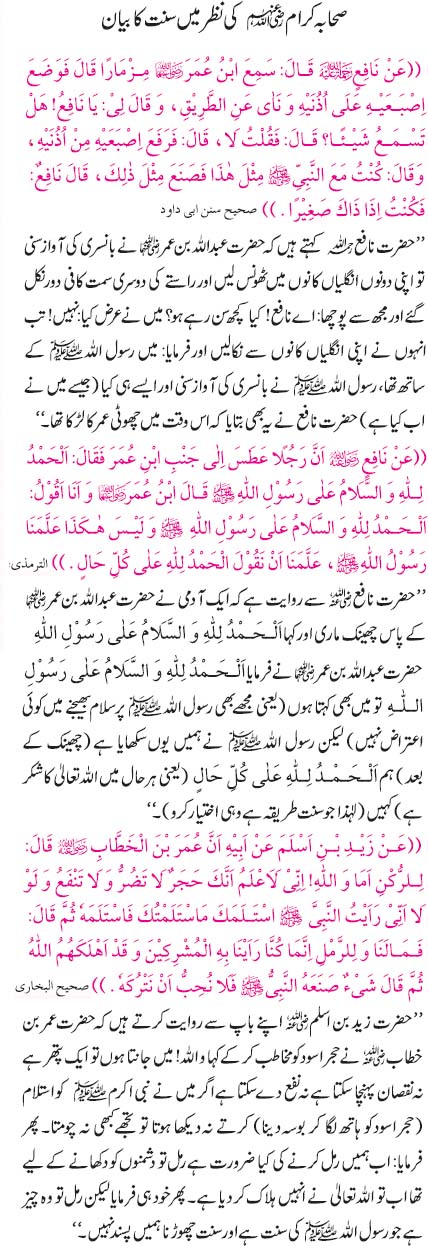
Sahaba Karam Ki Nazar Mein Sunnat
Fasting Six Days Of Shawwal After Ramadan
Sayyiduna Ayyub (Allah be pleased with him) relates that the Messenger of Allah (blessings and peace be upon him, his family, and companions) said, “Whoever fasts Ramadan and follows it with six days from Shawwal it is as if they fasted the entire year.” [Muslim, Abu Dawud, Tirmidhi, and Ibn Majah; Ahmad transmitted it from Jabir, Muntaqa]
Sayyiduna Thawban (Allah be pleased with him) relates that the Messenger of Allah (blessings and peace be upon him, his family, and companions) said, “Whoever fasts Ramadan, and then six days after Eid, it is an entire year. Whoever does a good deed shall have ten times its reward.” [Ibn Majah, Muntaqa]
Important Notes:
1. Based on this, the majority of the fuqaha, including the Hanafi, Shafi`i, and Hanbali school, have held that it is recommended to fast six days of the month of Shawwal. [Radd al-Muhtar; Mughni al-Muhtaj Shah al-Minhaj; Kashshaf al-Qina]
- It is permitted to fast these six days separately throughout the month, or consecutively, after Eid al-Fitr.
-
It is prohibitively disliked (makruh tahriman) and sinful to fast on Eid day itself. [Radd al-Muhtar]
-
The Shafi’is and Hanbalis state that it is superior to make the six fasts consecutive[Minhaj, Ghayat al-Muntaha]. Khatib al-Shirbini explains the reasoning as being,
“To hasten to do the good, and because of the problems inevitable in delaying,”
such as becoming lazy and not fulfilling this sunnah in the end, though he points out that the sunnah is fulfilled by both consecutive and non-consecutive fasting of six days in Shawwal. [Mughni al-Muhtaj]
The later Hanafi scholars differed as to which is better, fasting the six days consecutively or non-consecutively, though neither is disliked and both fulfill the sunnah. [Radd al-Muhtar]
However, it would be agreed that those who fear not fulfilling the recommendation due to laziness, forgetfulness, or other excuses, should hasten to fast the six days consecutively immediately after Eid al-Fitr.
- The reward is akin to having fasted obligatory fasts the entire year days, according to Buhuti, Shirbini, and others.
Sayyiduna Abu Hurayra (Allah be pleased with him) said that the Prophet (Allah bless him & give him peace) said, “The strong believer is better and more beloved to Allah than the weak believer, though there is good in both. Be avid for that which benefits you. Rely on Allah and do not deem yourself incapable…” [Muslim:4816, Ibn Majah:76, Ahmad:8436]
Imam Nawawi (Allah have mercy on him) explained that the ‘strength’ in this hadith refers to, “One’s determination and ability in matters of the next life.”
And Allah alone gives success!!
References:
Ibn Abidin, Radd al-Muhtar ala al-Durr al-Mukhtar, Vol. 2, Page 125
Shirbini, Mughni al-Muhtaj Sharh al-Minhaj, Vol. 2, Page 184-185
Buhuti, Kashshaf al-Qina, Vol. 2 Page 237-238