

Gawahi Chupanay Aur Jhooti Gawahi Ki Waeed
Muhammad-ur-Rasoolullah (sal-allahu-alleihi-wasallam)
[9. Surah Tauba: Ayah 128] Certainly an Apostle has come to you from among yourselves; grievous to him is your falling into distress, excessively solicitous respecting you; to the believers (he is) compassionate.
[3. Surah Aal-e-Imran: Ayah 144] And Muhammad (sal-allahu-alleihi-wasallam) is no more than an apostle; the apostles have already passed away before him; if then he dies or is killed will you turn back upon your heels? And whoever turns back upon his heels!s, he will by no means do harm to Allah in the least and Allah will reward the grateful.
[33. Surah Al-Ahzab: Ayah 40] Muhammad (sal-allahu-alleihi-wasallam) is not the father of any of your men, but he is the Apostle of Allah and the Last of the prophets; and Allah is cognizant of all things.
[21. Surah Al-Anbiyaa: Ayah 107] And We have not sent you but as a mercy to the worlds.
[18. Surah Al-Kahf: Ayah 110] Say: I am only a mortal like you; it is revealed to me that your god is one God, therefore whoever hopes to meet his Lord, he should do good deeds, and not join any one in the service of his Lord.
[21. Surah Al-Anbiyaa: Ayah 34] “And We did not ordain abiding for any mortal before you. What! Then if you die, will they abide?”
[48. Surah Fateh : Ayah 29] Muhammad (sal-allahu-alleihi-wasallam) is the Apostle of Allah, and those with him are firm of heart against the unbelievers, compassionate among themselves; you will see them bowing down, prostrating themselves, seeking grace from Allah and pleasure; their marks are in their faces because of the effect of prostration; that is their description in the Taurat and their description in the Injeel.
[Sahih Bukhari: Volume 5, Book 55 Prophets, Number 654] Narrated ‘Umar (Radi Allah Anhu): I heard the Prophet (sal-allahu-alleihi-wasallam) saying, “Do not exaggerate in praising me as the Christians praised the son of Mary, for I am only a Slave. So, call me the Slave of Allah and His Apostle.”
Our Lord! accept from us; surely Thou art the Hearing, the Knowing.
Hub-e-Rasool Kareem (PBUH)

Hub-e-Rasool Kareem (PBUH)
The Prayer Of A Believer
[Allah’s Quran 46:15] “O my Lord! Please Inspire me to be Grateful forever for thy Favours to me and to my Parents and Please Guide me so that I may do Righteous Deeds, well Pleasing To thee; Please Grant me Righteous Descendents; truly I have turned To thee repentant and Truly do I Submit To thee as a Believer”
[Comment – Ibn Kathir] “My Lord! Grant me the power and ability) meaning, ‘inspire me.’ (that I may be grateful for Your favors which You have bestowed upon me and my parents, and that I may do righteous good deeds, such as please You,) meaning, in the future. (and make my offspring good.) meaning, my offspring and descendants. Truly, I have turned to You in repentance, and truly, I am one of the Muslims.) This contains an instruction for anyone who reaches forty years of age to renew his repentance and turn to Allah with strong resolution.”
Salam Kehne Mein Musalman Ka Haq

Salam Kehne Mein Musalman Ka Haq
Most Surely Man Is Despairing, Ungrateful And Exulting, Boasting
[11. Surah Hud: Ayah 9] And if We make man taste mercy from Us, then take it off from him, most surely he is despairing, ungrateful.
[11. Surah Hud: Ayah 10] And if We make him taste a favor after distress has afflicted him, he will certainly say: The evils are gone away from me. Most surely he is exulting, boasting.
[11. Surah Hud: Ayah 11] Except those who are patient and do good, they shall have forgiveness and a great reward.
[70. Surah Al-Ma’arij: Ayah 19] Surely man is created of a hasty temperament.
[70. Surah Al-Ma’arij: Ayah 20] Being greatly grieved when evil afflicts him.
[70. Surah Al-Ma’arij: Ayah 21] And niggardly when good befalls him.
[70. Surah Al-Ma’arij: Ayah 22] Except those who pray.
[70. Surah Al-Ma’arij: Ayah 23] Those who are constant at their prayer.
[70. Surah Al-Ma’arij: Ayah 24] And those in whose wealth there is a fixed portion.
[70. Surah Al-Ma’arij: Ayah 25] For him who begs and for him who is denied (good).
Our Lord! grant us good in this world and good in the hereafter, and save us from the chastisement of the fire.
Khatma Bil Khair
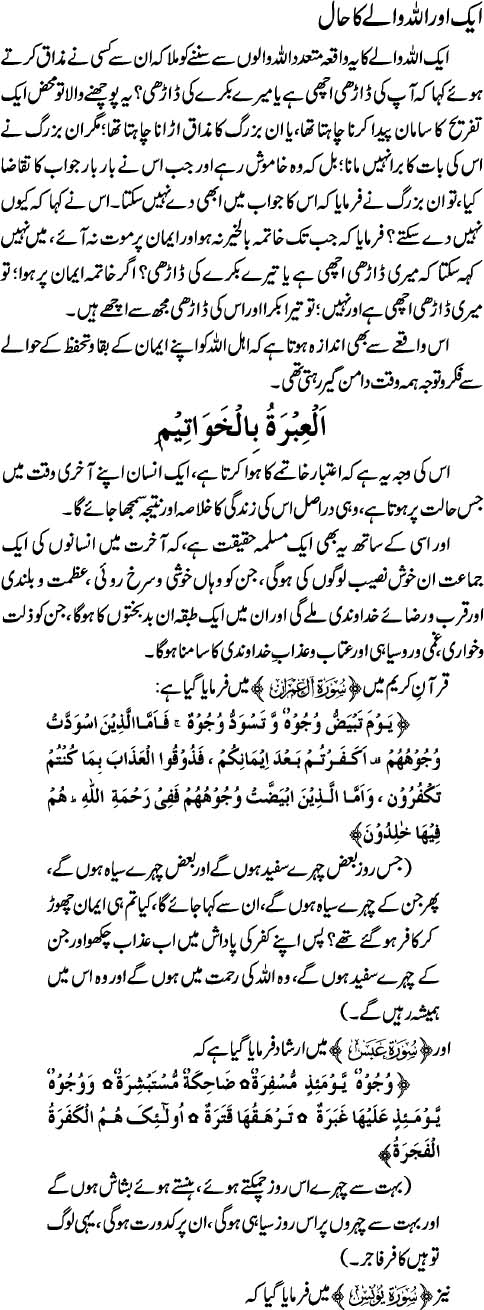
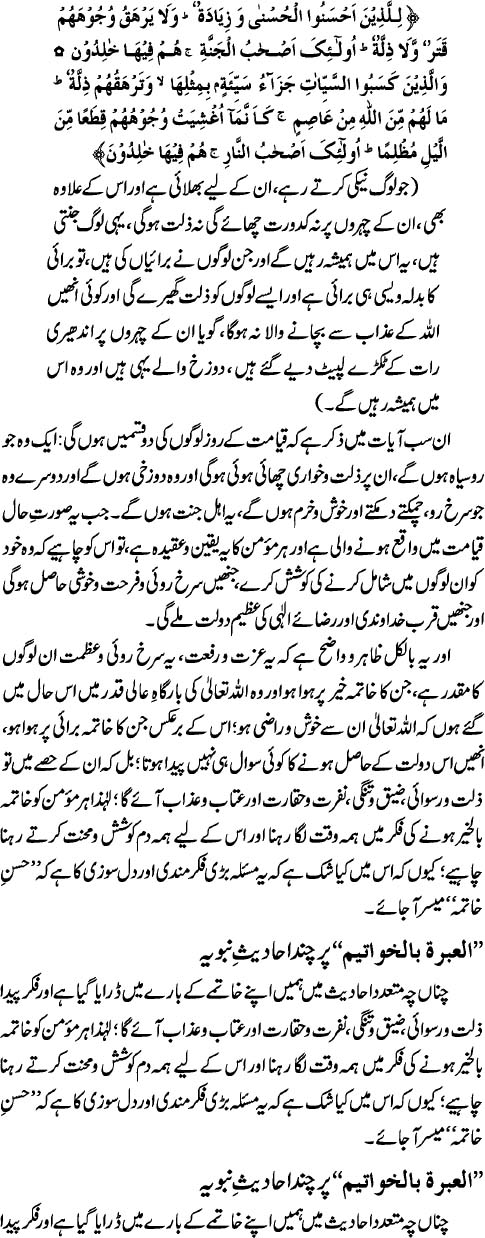
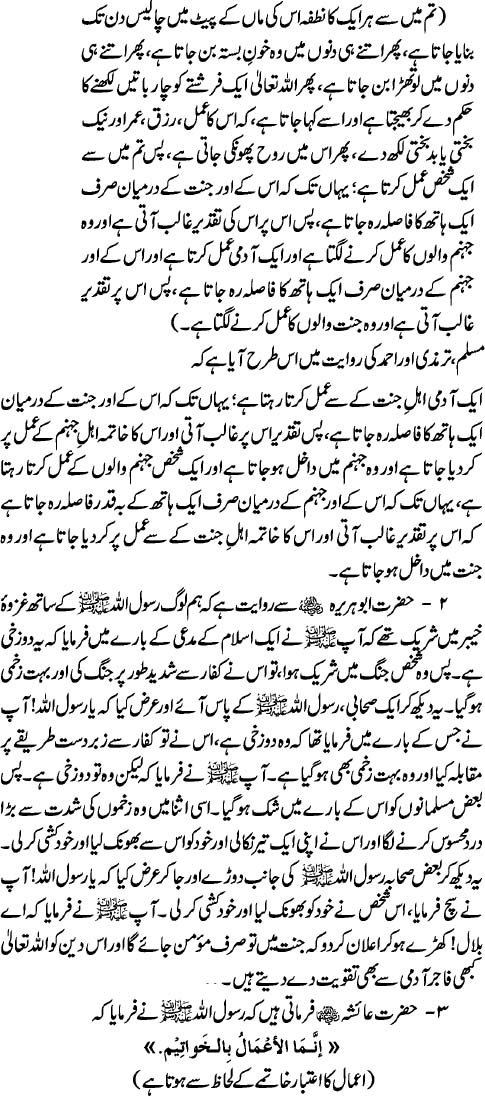
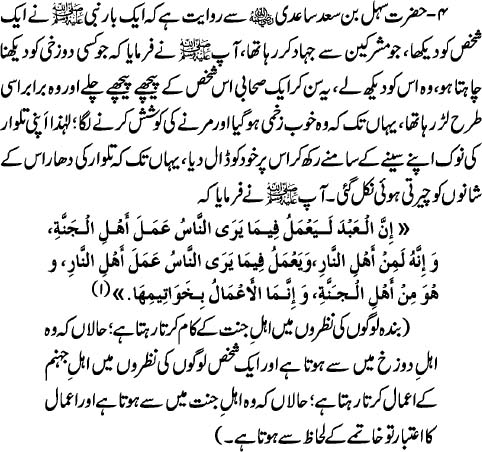
Khatma Bil Khair: Haqeeqi Kamyabi
The Virtue Of The Last Ten Days Of Ramadan And Laylat al-Qadr
Praise be to Allah, the Lord of the Worlds, and peace and blessings be upon the Trustworthy Prophet Muhammad and upon all his family and companions.
The Prophet (peace and blessings of Allah be upon him) used to strive hard (in worship) during the last ten days of Ramadan in a way that he did not strive at any other times. (Muslim, 1175, from Aa’ishah). Among the things he did were secluding himself in I’tikaaf and seeking Laylat al-Qadr during this time. (Al-Bukhaari, 1913; Muslim, 1169). In al-Saheehayn it is reported from the hadeeth of Aa’ishah (may Allah be pleased with her) that when the last ten days of Ramadan came, the Prophet (peace and blessings of Allah be upon him) would stay up at night, wake his family and gird his loins. (al-Bukhaari, 1920; Muslim, 1174). Muslim added: he strove hard and girded his loins.
Her phrase “girded his loins” is a metaphor for his preparing himself to worship and strive hard in worship, more than usual. It has the meaning of “rolling up one’s sleeves” to worship (i.e. getting ready to make a great deal of effort).
It was also said that it was a metaphor for keeping away from women and abstaining from sexual relations.
The phrase “stay up at night” means that he would stay awake, spending the night in prayer, etc. It was reported in another hadeeth that Aa’ishah (may Allah be pleased with her) said: “I never saw the Prophet (peace and blessings of Allah be upon him) recite the entire Quran in one night, or spend a whole night in prayer until the morning, or fast an entire month, except in Ramadan.” (Sunan al-Nasaa’i, 1641). The words “stay up at night” may mean that he spent most of the night in worship, or that he did not stay up for the entire night, but he did that at the times of Ishaa and Suhoor, and other times, in which case it would mean that he stayed up for most of the night.
The phrase “and wake his family” means that he would wake his wives to pray qiyaam. It is known that he (peace and blessings of Allah be upon him) used to wake his wives all year round, but he used to wake them to spend part of the night in qiyaam. In Saheeh al-Bukhaari it is reported that the Prophet (peace and blessings of Allah be upon him) woke up one night and said, “Subhan Allah! What tribulations have come down tonight! What treasure has come down tonight! Who will wake up the dwellers of the apartments There may be women who are clothed in this world and naked in the Hereafter”. (al-Bukhaari, 1074). It was also reported (in Saheeh al-Bukhaari) that he (peace and blessings of Allah be upon him) used to wake Aa’ishah (may Allah be pleased with her) when he wanted to pray Witr. (al-Bukhaari, 952). But when he woke his wives during the last ten nights of Ramadan, this was more persistent than at other times of the year.
The fact that he (peace and blessings of Allah be upon him) did this indicates the importance he attached to worshipping his Lord and making the most of this special time.
The Muslim should follow the example of the Prophet (peace and blessings of Allah be upon him), for he is the best example, and he should strive hard to worship Allah. He should not waste the hours of these days and nights. For we do not know, perhaps this time will never come again, for the spoiler of pleasures, i.e., death, which must come to all men, may come and snatch him and his life will end; then he will feel regret at the time when regret will be of no avail.
Among the unique virtues of these special nights is that Laylat al-Qadr is among them. Allah says (interpretation of the meaning):
Haa-Meem. [These letters are one of the miracles of the Quran and none but Allah (Alone) knows their meanings.]
The Manifest Book (this Quran) makes things clear.
Paroosi Kay Haqooq
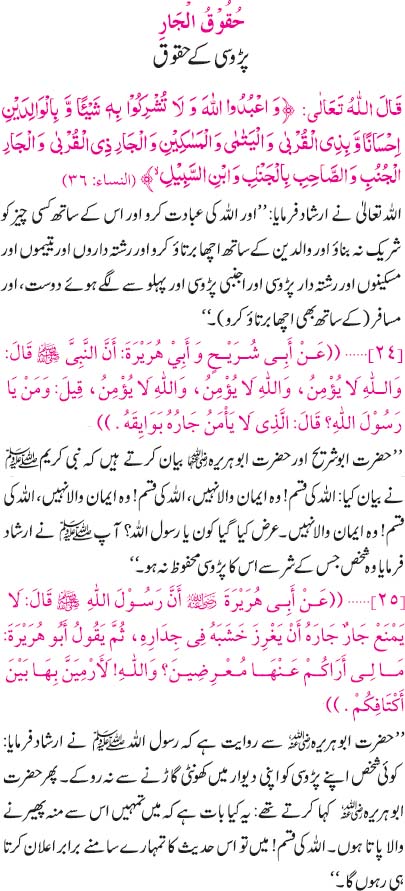
Paroosi Kay Haqooq
Better Than A Thousand Months
God has ordained that we fast during the month of Ramadan, every day from dawn to dusk, during which time we abstain from eating, drinking, and sex. The Prophet (peace be upon him) also recommended us to spend part of the time during the night in voluntary worship. This is done after we have prayed Isha, offering more prayer every night throughout the month. This is known as Taraweeh prayer, which consists of either eight or 20 rak’ahs, or any lesser number.
However, the Prophet used to spend more of the night in voluntary worship during the last 10 days of Ramadan. Ayesha reports: “When the last 10 days (of Ramadan) arrived, the Prophet would be more diligent, staying up the nights and waking up the people in his household.” (Related by Al-Bukhari).
Ayesha tells us that the Prophet did certain special things in the last ten days of Ramadan. These are the best nights of the year to spend in worship. One thing was to wake up his family members to encourage them to allocate time for night worship. He did not make this obligatory, but whereas on other nights he left them to decide whether they wanted to wake up for night worship, he did wake them up in the last third of Ramadan. Needless to say, he only woke up those who were willing and able to offer night worship. Since this is voluntary, he would not compel anyone to do anything unless it is their own choice.
Another thing that he did was to be more diligent. In the Arabic text of the Hadith, Ayesha uses a metaphor, saying that the Prophet would “tighten his robes.” Most scholars suggest that this means that he abstained from having sex with his wives during those 10 nights. There is no prohibition on that, but this was the Prophet’s choice.
Moreover, the Prophet “stayed up the nights” offering worship. According to most scholars, this means that he spent more time in worship during these 10 nights than on other nights. It does not mean that he would spend the whole night because that would be too exhausting. Moreover, it would mean that we sleep longer during the following day, which reduces the feelings of fasting.
What is special about the last 10 days of Ramadan is that they include the Night of Power. This is the night described in the Qur’an as “better than a thousand months,” which means that spending this night in worship earns a greater reward than worshipping at night for a thousand months. It is a special, blessed night because it witnessed the revelation of the Qur’an from on high to Prophet Muhammad. In other Hadiths, we are told that dedication to worship on that night ensures that our slate is wiped clean and we are free of all sins. They are all forgiven by God. Hence, we should be keen to spend that night in worship.
When is the Night of Power? It has not been mentioned specifically, either in the Qur’an or by the Prophet. However, the Prophet tells us to seek it on the odd nights of the last third of Ramadan. Thus, it could be any night on 21, 23, 25, 27 or 29 of Ramadan. In Islam, the night precedes the day, which means that it is the night that begins after sunset on 20, 22, etc. of Ramadan. If we dedicate several hours of that night to worship, we feel great relief and happiness for the effort making us keen to repeat the experience every year.
– By Adil Salahi