
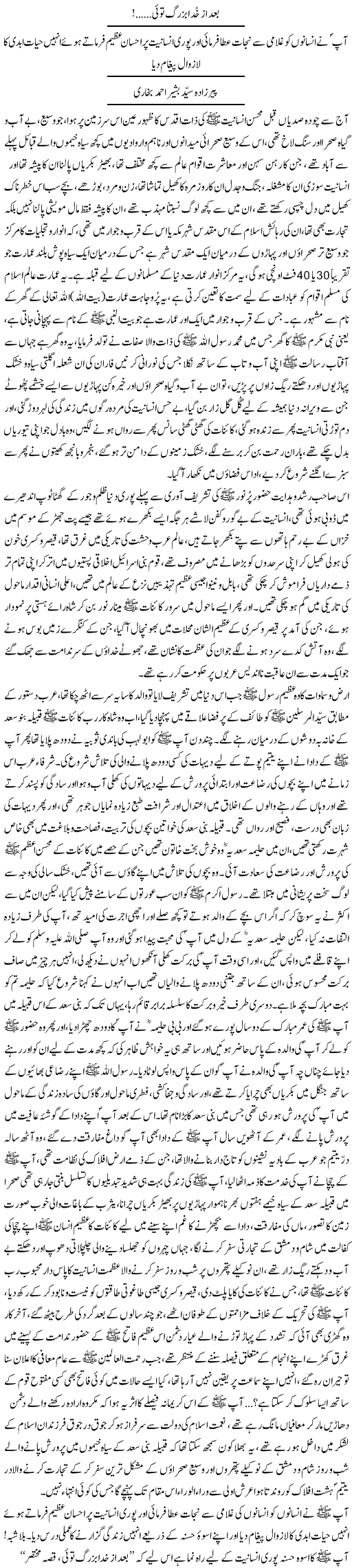
Baad Az Khuda Buzurg Tuee, Qissa Mukhtasar
Selecting A Muslim Name
[1:1] In the name of GOD, Most Gracious, Most Merciful
[7:71] He said, “You have incurred condemnation and wrath from your Lord. Do you argue with me in defense of innovations you have fabricated – you and your parents – which were never authorized by GOD? Therefore, wait and I will wait along with you.”
God Almighty creates all languages, not just Arabic! Any beautiful name can be derived from any language.
[30:22] Among His proofs are the creation of the heavens and the earth, and the variation in your languages and your colors. In these, there are signs for the knowledgeable.
[7:180] To GOD belongs the most beautiful names; call upon Him therewith, and disregard those who distort His names. They will be requited for their sins.
The reason God chose the Arabic language for an Arabian prophet is given below.
[43:2] And the enlightening scripture.
[43:3] We have rendered it an Arabic Quran, that you may understand.
[43:4] It is preserved with us in the original master, honorable and full of wisdom.
[26:198] If we revealed this to people who do not know Arabic.
[26:199] And had him recite it (in Arabic), they could not possibly believe in it.
Some of God’s beautiful English names can be derived from this English translation of the Quran.
[59:22] He is the One GOD; there is no other god besides Him. Knower of all secrets and declarations. He is the Most Gracious, Most Merciful.
[59:23] He is the One GOD; there is no other god besides Him. The King, the Most Sacred, the Peace, the Most Faithful, the Supreme, the Almighty, the Most Powerful, the Most Dignified. GOD be glorified; far above having partners.
[59:24] He is the One GOD; the Creator, the Initiator, the Designer. To Him belong the most beautiful names. Glorifying Him is everything in the heavens and the earth. He is the Almighty, Most Wise.
The Islamic scholars invent all sorts of ridiculous issues (hadith, tafsir,, fatwas, etc,) and successfully divert millions of Muslims from the very important Quranic issues to unimportant unQuranic issues. One of their ridiculous inventions is the “Islamic names” for Muslim boys and Muslim girls.
The word Muslim is an Arabic word that simply means Submitter to God Alone. Anyone who submits to the will of God is Muslim in the Quranic context. According to the Quran, a righteous Jew, a righteous Christian, a righteous Muslim or any righteous person is Muslim in the eye of God(2:62, 5:69).
[2:62] Surely, those who believe, those who are Jewish, the Christians, and the converts; anyone who (1) believes in GOD, and (2) believes in the Last Day, and (3) leads a righteous life, will receive their recompense from their Lord. They have nothing to fear, nor will they grieve.
The Arabic word Islam simply means Submission (to the will of God). So, anyone who follows the religion of Islam is Muslim. The concept of Islam can easily be derived from this verse of the Quran (42:13)
[42:13] He decreed for you the same religion decreed for Noah, and what we inspired to you (Mohammad), and what we decreed for Abraham, Moses, and Jesus: “You shall uphold this one religion, and do not divide it.” The idol worshipers will greatly resent what you invite them to do. GOD redeems to Himself whomever He wills; He guides to Himself only those who totally submit.
The above Quranic verses, along with numerous other verses, confirm the truth that as far as God is concerned, there has always been one religion Islam, which was decreed for Noah, Abraham, Moses, Jesus, and Mohammad. All the scriptures revealed to mankind from God advocate one and the same religion. In this religion God calls Submission or in Arabic Islam.
It is a mistaken concept among Muslim and non-Muslims alike that Islam was founded by Mohammad, who was happened to be an Arab. Satan successfully duped the majority of people on earth including the majority of ignorant Muslims by making them believe that Islam is an Arabian religion or a religion of Mohammad!
Why “Mary” cannot be a good Islamic name for girls!? God Almighty chose her among all the women.
[3:42] The angels said, “O Mary, GOD has chosen you and purified you. He has chosen you from all the women.
[3:36] When she gave birth to her, she said, “My Lord, I have given birth to a girl” – GOD was fully aware of what she bore – “The male is not the same as the female. I have named her Mary, and I invoke Your protection for her and her descendants from the rejected devil.”
Why “Jesus” or “Zachariah” or “Moses” cannot be good Islamic name for boys? The name of Moses is mentioned so many times in the Quran! Jesus was one of those closest to God.
[3:45] The angels said, “O Mary, GOD gives you good news: a Word from Him whose name is `The Messiah, Jesus the son of Mary. He will be prominent in this life and in the Hereafter, and one of those closest to Me.’
[19:7] “O Zachariah, we give you good news; a boy whose name shall be John (Yahya). We never created anyone like him before.”
God and His messenger condemn innovation. God and His messenger condemn division.
[7:71] He said, “You have incurred condemnation and wrath from your Lord. Do you argue with me in defense of innovations you have fabricated – you and your parents – which were never authorized by GOD? Therefore, wait and I will wait along with you.”
[6:159] Those who divide themselves into sects do not belong with you. Their judgment rests with GOD, then He will inform them of everything they have done.
[30:32] (Do not fall in idol worship,) like those who divide their religion into sects; each party rejoicing with what they have.
[42:14] Ironically, they broke up into sects only after the knowledge had come to them, due to jealousy and resentment among themselves. If it were not for a predetermined decision from your Lord to respite them for a definite interim, they would have been judged immediately. Indeed, the later generations who inherited the scripture are full of doubts.
Musalman Ka Haq: Hasad Na Karo
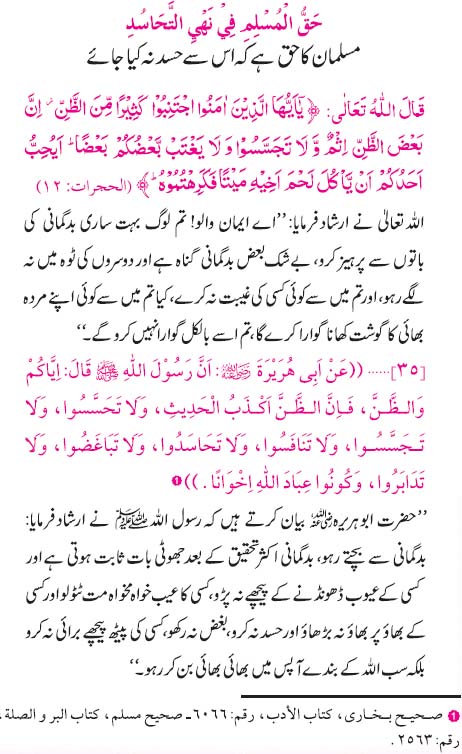
Musalman Ka Haq: Hasad Na Karo
The Moon-Splitting Miracle
The moon splitting was a miracle with which Allah The Almighty supported the Prophet, sallallaahu ‘alayhi wa sallam. The moon split into two parts, and some Companions saw the mountain of Hiraa’ between them. This miracle took place before the prophetic emigration when the Makkan disbelievers asked the Prophet, sallallaahu ‘alayhi wa sallam, to provide them with evidence of the truthfulness of his Da‘wah (call). The Hadeeth reads: “The people of Makkah asked the Prophet, sallallaahu ‘alayhi wa sallam, to provide them with a sign [that would prove the truthfulness of his message]. He consequently showed them the moon divided into two parts until they saw the mountain of Hiraa’ between them.” [Al-Bukhaari and Muslim]
Ibn Mas‘ood, may Allah be pleased with him, said, “During the lifetime of the Prophet, sallallaahu ‘alayhi wa sallam, the moon split into two parts – one of them was above the mountain and the other at the bottom of it. The Prophet, sallallaahu ‘alayhi wa sallam, then said:‘Bear witness [to that]’” [Al-Bukhaari and Muslim]
Ibn Mas‘ood, may Allah be pleased with him, also said, “I saw the mountain of Hiraa’ between the two split halves of the moon.”
The moon splitting is one of the signs of the hour that have, of course, already taken place. It was narrated that the Prophet, sallallaahu ‘alayhi wa sallam, said: “Five [signs of the Hour] have occurred: the smoke, the moon splitting, [the defeat of] the Romans, Al-Batshah, and Al-Lizaam.” [Al-Bukhaari and Muslim]
Al-Lizaam refers to either aridity or the sticking of corpses to one another at the battle of Badr. Al-Batshah (the mighty grasp) refers to the killing that occurred at the battle of Badr.
The moon splitting is mentioned in the Quran coupled with the approach of the Hour. Allah The Almighty Says (what means): {The Hour has come near, and the moon has split [in two]} [Quran 54:1]
However, because of their natural belying and obstinacy, the Qurayshis turned away and described the incident as magic. Allah The Almighty Says (what means): {And if they see a miracle, they turn away and say, ‘Passing magic’} [Quran 54:2]
Their argument, of course, is no more than a refutable malicious allegation that was even refuted in the past. Abu Is’haaq Az-Zajjaaj, may Allah have mercy upon him, said, “Some of the religious innovators agreed with the non-Muslims in negating the incident of the moon splitting. Reason should not deny this in any way, for the moon is created by Allah The Almighty who does whatever He wills as He will wrap it up in darkness and destroy it on the Day of Resurrection.”
Some have argued that if the moon had truly split, it would have been consecutively narrated by a huge number of narrators and all the people on earth would have known it – and knowing it would not have been exclusive to the Makkans. This, however, is refuted by the fact that the incident took place during the night, while most people were asleep, doors were shut and there were very few people who examined the sky. There may be a lunar eclipse and great stars appear at night while none witnesses this except a few people. Also, the moon splitting was a miracle that took place at night for obstinate people who asked for it, so none but them needed to witness it. The moon that night might have been in a place in the sky that allowed it to be seen only in some places, just as the solar eclipse appears in some places and disappears in others.
Al-Khattaabi, may Allah have mercy upon him, was quoted as saying, “The moon splitting is a great miracle which is hardly comparable to any other of the miracles of the prophets. This is due to its occurrence in the kingdom of heaven away from the norms of this complex [earthly] world – so none longs for reaching it by any means, and, therefore, taking it as a proof is even more binding.”
Some modern studies, which are interested in studying the surface of the moon, proved the existence of traces of ruptures and splitting. This motivated some people to embrace Islam when they knew that the Quran mentioned this incident centuries ago. Exalted is Allah who showed evidence of His Divinity and great creation. Allah The Almighty Says (what means): {We will show them Our signs in the horizons and within themselves until it becomes clear to them that it is the truth. But is it not sufficient concerning your Lord that He is, over all things, a Witness?} [Quran 41:53]
Iman Sab Say Bari Naimat
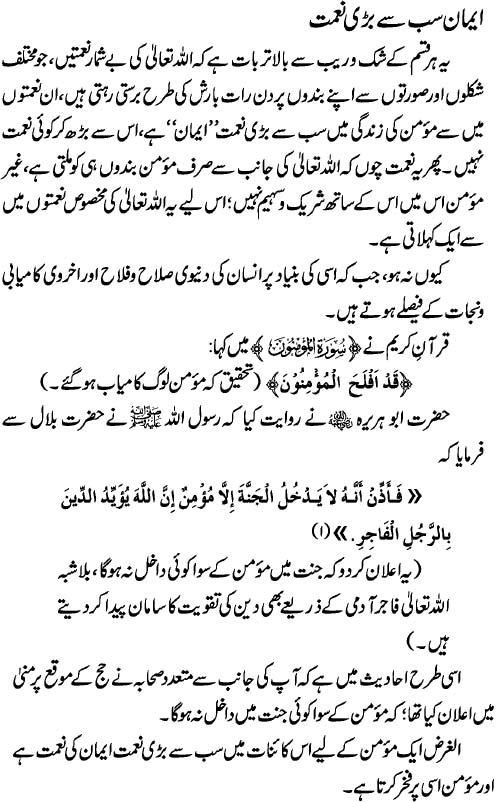
Iman Sab Say Bari Naimat
Keep Up Prayer And Enjoin The Good And Forbid The Evil
Luqman (alaihi salaam) instructions to his Son: “O My Son! Keep up Prayer And Enjoin The Good And Forbid The Evil, And Bear Patiently That Which Befalls You; Surely These Acts Require Courage”. 31. Surah Luqman: Ayah 17
Narrated by Abu Huraira (Radi Allah Anhu) Allah’s Apostle (sal-allahu-alleihi-wasallam) Said: “The Congregational Prayer Of Anyone Amongst You is More Than Twenty (five or twenty-seven) times in reward Than His Prayer in The market or in his House, for if he performs ablution completely and then goes to the mosque with the sole intention of performing the prayer, and nothing urges him to proceed to the mosque except the prayer, then, on every step which he takes towards the mosque, he will be raised one degree or one of his sins will be forgiven. The angels will keep on asking Allah’s forgiveness and blessings for every one of you so long as he keeps sitting at his praying place. The angels will say, ‘O Allah, bless him! O Allah, be merciful to him!’ as long as he does not do Hadath or a thing which gives trouble to the other.” The Prophet further said, “One is regarded in prayer so long as one is waiting for the prayer.” Sahih Al-Bukhari: Volume 3, Book 34 Sales and Trade , Number 330
Qualities of those who keep Prayers
Surely man is created of a hasty temperament. 70. Surah Al-Ma’arij : Ayah 19
Being greatly grieved when evil afflicts him. 70. Surah Al-Ma’arij : Ayah 20
And niggardly when good befalls him. 70. Surah Al-Ma’arij : Ayah 21
Except Those Who Pray. 70. Surah Al-Ma’arij : Ayah 22
Those Who Are Constant At Their Prayer. 70. Surah Al-Ma’arij : Ayah 23
And Those in Whose Wealth There is A Fixed Portion. 70. Surah Al-Ma’arij : Ayah 24
For Him Who Begs And For Him Who is Denied (good). 70. Surah Al-Ma’arij : Ayah 25
Call Upon Me, I Will Answer You; Surely Those Who Are Too Proud For My Service Shall Soon Enter Hell Abased.40. Surah Momin: Ayah 60
It is Narrated On The Authority Of Abu Huraira (Radi Allah Anhu) That:” When The Son Of Adam Recites The Ayat Of Sajdah (Prostration) And Then Falls Down in Prostration, The Satan Goes into Seclusion And Weeps And Says: Alas, And in The Narration Of Abu Kuraib The Words Are: Woe Unto Me, The Son Of Adam Was Commanded To Prostrate, And He Prostrated And Paradise Was Entitled To Him And I Was Commanded To Prostrate, But I Refused And Am Doomed To Hell.” Sahih Muslim : Book 1 Kitab Al-Iman, Number 144
It is Narrated On The Authority Of Jabir (Radi Allah Anhu) That He Heard The Apostle (may peace and blessings be upon him) Saying ” Verily Between Man And Between Polytheism And Unbelief is The Negligence Of Prayer.” Sahih Muslim : Book 1 Kitab Al-Iman, Number 146
Best Deed
It is Narrated On The Authority Of ‘Abdullah b. Mas’ud (Radi Allah Anhu) That He Observed. I Asked The Messenger Of Allah (Sallalahu Allaihi wasallam) Which Deed Was The Best. He (the Holy Prophet) Replied: Prayer At its Appointed Hour.
I (again) said: Then what?
He (the Holy Prophet) Replied: Kindness to the parents.
I (again) said: Then what?
He replied: Earnest endeavor (Jihad) in the cause of Allah.
And I would have not ceased asking more questions but out of regard (for his feelings). Sahih Muslim : Book 1 Kitab Al-Iman, Number 151
It is reported on the authority of ‘Abdullah (Radi Allah Anhu) that the Apostle of Allah (sal-allahu-alleihi-wasallam) observed: “The best of’ the deeds or deed is the (observance of) prayer at its proper time and kindness to the parents.” Sahih Muslim : Book 1 Kitab Al-Iman, Number 155
Cheenk Ka Jawab Denay Wale Ko Dua Ka Haq
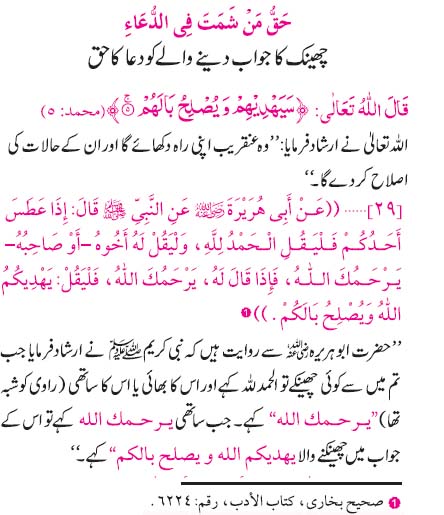
Cheenk Ka Jawab Denay Wale Ko Dua Ka Haq
Visiting The Prophet’s Mosque
Located 275 miles north of Makkah, in this historic city is the Prophet’s Mosque. The Messenger of Allah (peace be upon him), said: “A Muslim should only set out (i.e. traveling with the intention of worship) for three mosques: The Holy Mosque (in Makkah), this Mosque of Mine and AI-Aqsa Mosque (in Jerusalem).”
Visiting Madina Al-Munawwarah and the Prophet’s Mosque is a Sunnah and may be performed before or after Haj.
Having been reassured about his place of residence and belongings, it is advisable for the visitor to wash his body, use perfumes, put on his best clothes, and proceed to the Prophet’s Mosque, entering with his right foot first while uttering:
“In the Name of Allah and peace be upon the Messenger of Allah. I seek refuge in Allah Almighty and in His noble countenance and His eternal power from Satan the Rejected.” “O Allah, open to me the doors of Your Mercy.”
The visitor then heads to the sanctified Rawdah (Garden) of the Prophet, situated between the Prophet’s grave and pulpit. He performs the two Raka’hs of “Tahiyyat AI-Masjid,” i.e. greeting to the Mosque. He then offers whatever supplications he wishes. The Messenger of Allah, (peace be upon him) said: “There is a garden in paradise situated between my grave and my pulpit.”
The visitor then proceeds towards the Prophet’s grave stopping three to four cubits away. He should not touch, kiss, or circle the apartment containing the Prophet’s grave.
The visitor should utter in a low voice: “Greetings be to Allah’s Messenger, Allah’s Mercy, and blessings be upon you.” Greetings be to Allah’s Prophet. Prayers and peace be on thee the best of Allah’s creation. Prayers and peace be on the leader of Messengers and Imam of the pious. I bear witness that you communicated the message, fulfilled the mission entrusted to you, sincerely advised the Ummah (Islamic nation) and you truly struggled in the way of Allah.”
Then he moves about one cubit to his right side to face the grave of Abu Bakr Al Siddeeq (may Allah be pleased with him) and says:
“Greetings and peace be upon you, successor of the Messenger of Allah. Greetings to you, the companion of the Messenger of Allah in the cave (Al-Ghar).” “Greetings to you the companion of his travels. Peace be upon you his confidant. May Allah Grant you the best reward granted to a leader for the services he has rendered for the Ummah of His Prophet.”
Then he moves about one cubit towards the grave of Umar Ibn Al-Khattab (may Allah be pleased with him) and says: “Greetings be to you Emir of the Faithful. Greetings be to you who demolished the idols. May Allah grant you the best reward for the great services you have rendered to us (Muslims).”
Then he turns toward Qiblah and prays for himself, his parents, and all those who asked to be remembered there.
– From the book “At the Service of Allah’s Guests” by the Ministry of Information, Saudi Arabia.
Ilm Aur Amal Dono Aitbaar Say Kamil Aur Jamia Shakhsiyat
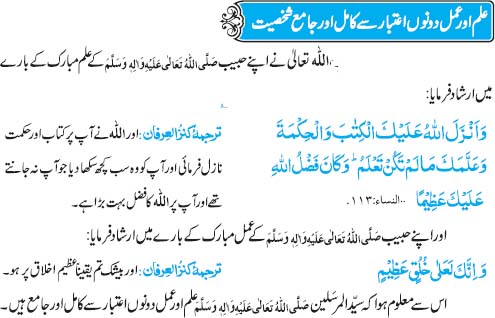
Ilm Aur Amal Dono Aitbaar Say Kamil Aur Jamia Shakhsiyat
Argument About Jesus
In the name of God, the Lord of Grace, the Ever Merciful
Whenever the son of Mary is cited as an example, your people raise an outcry, saying: ‘Who is better: Our deities or he?’ They cite him only to challenge you. They are contentious people. He was but a servant of Ours whom We had favored and made an example to the Children of Israel. (Gold; Al-Zukhruf: 43: 57-59)
These verses begin the final passage of this surah, which picks up the legends the pagan Arabs weaved around their worship of angels. It refers to one of the arguments they used to defend their absurd beliefs. It was a futile argument that reflected no attempt to arrive at the truth; it was more an exercise in polemics. They had been told that both they and what they worshipped were bound for hell. The reference here is to their idols that were first intended as representations of angels, but which were later worshipped as deities. They were told that whoever worshipped anything other than God would be in hell together with the thing worshipped. In response, some of them cited the example of Jesus (peace be upon him), who was worshipped by some of those who deviated from true Christianity. They asked whether Jesus would also be in hell? This was nothing but an idle argument. They also claimed that they were better guided than the Christians who worshipped Jesus, a human being, while they worshipped the angels, God’s daughters. All this was no more than compounded falsehood. In connection with this, the surah gives an account of Jesus, explaining the truth about him and his message, and the differences that gripped his people both before and after him.
Addressing all those who deviate from their true faith, the surah warns them against the sudden coming of the Last Hour. It moves on to portray a long scene of the Day of Judgment, giving an image of lasting happiness for the God-fearing and one of painful suffering for the guilty. Furthermore, the surah negates their legends concerning the angels, makes it clear that God is free of all that they allege concerning Him, and outlines some of His attributes, including His complete ownership of both this life and the life to come. The surah concludes with a directive to the Prophet (peace be upon him) to be forbearing and to turn away from the unbelievers. They will come to know what is there to be known. This is an implicit warning to those who continue to argue after things have been made very clear.
In his biography of the Prophet (peace be upon him), Ibn Ishaq gives the following report: The Prophet sat with Al-Waleed ibn Al-Mugheerah in the Sacred Mosque, and they were joined by Al-Nadr ibn Al-Harith. There were a few other men from the Quraysh. The Prophet spoke to them, but Al-Nadr interrupted him. The Prophet argued with him until he silenced him. He then read to them a passage of the Qur’an that included the verse that says: “You and all that you were wont to worship instead of God are but the fuel of hell: that is what you are destined for.” (21: 98) The Prophet then left.
Then came Abdullah ibn Al-Zibaari of the Tameem tribe who sat with them. Al-Waleed said to him: Al-Nadr was no match for Muhammad. Indeed Muhammad said that both we and the deities we worship will be the fuel of hell. Ibn Al-Zibaari said: “Had I been the one who argued with him I would have won. Ask Muhammad whether everyone worshipped other than God will be in hell together with those worshipping him. Well, we worship the angels, and the Jews worship Ezra, while the Christians worship Jesus, son of Mary.” Al-Waleed and those who were in the Mosque admired what Ibn Al-Zibaari had said and felt that he had put forward a winning argument. When this was mentioned to the Prophet, he said: “Anyone who likes to be worshipped in place of God will be joined to those who worship him. These people only worship Satan and whoever Satan orders them to worship.” God then revealed the verse that says: “But those for whom (the decree of) ultimate good has already gone forth from Us will be kept far away from that hell.” (21: 101) This means that Jesus, Ezra, and other rabbis and priests who were sincere in their faith but were then worshipped as deities by later people will be safe from hell. Furthermore, concerning the argument about Jesus being worshipped and the admiration of the argument by Al-Waleed ibn Al-Mughirah and others, God revealed the verse that says: “Whenever the son of Mary is cited as an example, your people raise an outcry.”
In Al-Kashshaf, a commentary on the Qur’an, Al-Zamkhshari gives a largely similar report, without mentioning its source. Both reports show clearly how argumentative the pagan Arabs were. They were exactly as the Qur’an describes them: “They are contentious people.” They were certainly skillful in dispute. They realized what the Qur’an and the Prophet meant, but they tried hard to twist its meaning, indulged in polemics, exploiting the fact that the Qur’anic statement was general in its implication. This is characteristic of everyone who is devoid of sincerity, seeking to manipulate words and phrases in order to twist what was a clear meaning. Therefore, the Prophet strictly prohibited contentious arguments. Abu Umamah, a companion of the Prophet, reports: “The Prophet came out once only to find some people involved in an argument concerning the Qur’an. He was so angry that he looked as though vinegar had been poured over his face. He then said to them: ‘Do not argue about God’s book citing parts of it against other parts. No community strays into error unless they are given to contentious argument.’ He then quoted the Qur’anic verse that says: ‘They cite him only to challenge you. They are contentious people.’