
Ikhlaq e Hasna Ki Taleem
The Meaning Of Islam
I. The Meaning of Islam
Islam is derived from the Arabic root “Salema”: peace, purity, submission, and obedience. In the religious sense, Islam means submission to the will of God and obedience to His law.
Everything and every phenomenon in the world other than man are administered totally by God-made laws, i.e. they are obedient to God and submissive to his laws, they are in the State of Islam. Man possesses the qualities of intelligence and choice, thus he is invited to submit to the goodwill of God and obey His law, ie, become a Muslim.
Submission to the good will of God, together with obedience to His beneficial Law, ie, becoming a Muslim, is the best safeguard for man’s peace and harmony.
Islam dates back to the age of Adam and its message has been conveyed to man by God’s prophets and messengers, including Abraham, Moses, Jesus, and Muhammad (PBUH).
Islam’s message has been restored and enforced in the last stage of the religious evolution by God’s last prophet and messenger, Muhammad.
The word Allah in the Arabic language means God, or more accurately, The One and Only Eternal God, Creator of the Universe, Lord of all lords, King of all kings, Most Compassionate, Most Merciful. The word Allah to mean God is also used by Arabic-speaking Jews and Christians.
II. Articles of Faith
A Muslim believes in One God, Supreme, and Eternal, Infinite and Mighty, Merciful and Compassionate, Creator and Provider.
God has no father nor mother, no sons nor daughters. He has not fathered anyone nor was He fathered. None equal to Him. He is the God of all mankind, not of a special tribe or race.
God is High and Supreme but He is very near to the pious thoughtful believers; He answers their prayers and helps them. He loves the people who love Him and forgives their sins. He gives them peace, happiness, knowledge, and success.
God is the Loving and the Provider, the Generous and the Benevolent, the Rich and the Independent, the Forgiving and the Clement, the Patient and the Appreciative, the Unique and the Protector, the Judge and the Peace. God’s attributes are mentioned in the Quran.
God creates in man the mind to understand, the soul and conscience to be good and righteous, and the feelings and sentiments to be kind and humane. If we try to count His favors upon us, we cannot, because they are countless.
In return for all the great favors and mercy, God does not need anything from us, because he is Needless and Independent.
God asks us to know Him, to love Him, and to enforce His Law for our own benefit and our own good.
A Muslim believes in all the Messengers and Prophets of God without any discrimination.
All messengers were mortals, human beings, endowed with Divine revelations and appointed by God to teach mankind. The Holy Quran mentions the names of 25 messengers and prophets and states that there are others. These include Noah, Abraham, Ishmael, Isaac, Moses, Jesus, and Muhammad (PBUH). Their message is the same and it is Islam and it came from One and the Same Source; God, and it is to submit to His will and to obey his law, ie, to become a Muslim.
A Muslim believes in all scriptures and revelations of God, as they were complete and in their original versions.
Revelations were given to guide the people to the right path of God. The Quran refers to the books revealed to Abraham, Moses, David, Jesus, and Muhammad (PBUH).
Today, the books before the Quran do not exist in their original form. They are lost corrupted or concealed. Weakness in the early period of Judaism and Christianity are partly responsible.
Today the Quran is the only authentic and complete book of God. No scholar has questioned the fact that the Quran today is the same as it was more than 1400 years ago. Muslims till today memorize the Quran word by word as a whole or in part.
God who revealed the Quran is protecting it from being lost, corrupted, or concealed.
A Muslim believes in the angels of God.
They are purely spiritual and splendid beings created by God. They require no food drink or sleep. They have no physical desires or material needs.
Angels spend their time in the service of God. Each is charged with a certain duty. Angels cannot be seen by the naked eye. Knowledge and truth are not entirely confined to sensory knowledge or sensory perception alone.
A Muslim believes in the day of Judgement.
This world as we know it will come to an end and the dead will rise to stand for their final and fair trial. Everything we do, say, make, intend, and think are accounted for and kept in accurate records. They are brought up on the day of judgment.
People with good records will be generously rewarded and warmly welcomed to God’s Heaven. People with bad records will be fairly punished and cast into Hell.
The real nature of Heaven and Hell are known to God only, but they are described by God in man’s familiar terms in the Quran.
If some good deeds are seen not to get full appreciation and credit in this life, they will receive full compensation and be widely acknowledged on the Day of Judgement.
If some people who commit sins, neglect God, and indulge in immoral activities seem superficially successful and prosperous in this life, absolute justice will be done to them on the Day of Judgement.
The time of the Day of Judgement is only known to God and God alone.
A Muslim believes in “Qadaa” and “Qadar”.
“Qadaa” and “Qadar” mean the Timeless Knowledge of God and His power to plan and execute His plans. God is not indifferent to this world nor is He neutral to it.
God is Wise, Just, and Loving and whatever He does must have a good motive, although we may fail sometimes to understand it fully.
We should have strong faith in God and accept whatever He does because our knowledge is limited and our thinking is based on individual consideration, whereas His knowledge is limitless and He plans on a universal basis.
Man should think, plan, and make sound choices, but if things do not happen the way he wants, he should not lose faith and surrender himself to mental strains or shattering worries.
A Muslim believes that the purpose of life is to worship God.
Worshipping God does not mean we spend our entire lives in constant seclusion and absolute meditation. To worship God is to live life according to His commands, not to run away from it.
To worship God is to know Him, to love Him, to obey His commands, to enforce His laws in every aspect of life, to serve His cause by doing right and shunning evil, and to be just to Him, to ourselves, and to our fellow human beings.
A Muslim believes that man enjoys an especially high-ranking status in the hierarchy of all known creatures.
Man occupies this distinguished position because he alone is gifted with rational faculties and spiritual aspirations as well as powers of action.
Man is not a condemned race from birth to death, but a dignified being potentially capable of good and noble achievements.
A Muslim believes that every person is born a “Muslim”.
Every person is endowed by God with spiritual potential and intellectual inclination that can make him a good Muslim.
Every person’s birth takes place according to the will of God in the realization of His plans and in submission to His commands.
A Muslim believes that every person is born free from sin.
When the person reaches the age of maturity and if he is sane, he becomes accountable for all his deeds and intentions. Man is free from sin until he commits sin.
There is no inherited sin, no original sin. Adam committed the first sin, he prayed to God for pardon, and God granted Adam pardon.
A Muslim believes that man must work out his salvation through the guidance of God.
No one can act on behalf of another or intercede between him and God.
In order, to obtain salvation a person must combine faith and action, belief and practice. Faith without doing good deeds is as insufficient as doing good deeds without faith.
A Muslim believes that God does not hold any person responsible until he has shown him the Right Way.
If people do not know and have no way of knowing about Islam, they will not be responsible for failing to be Muslim. Every Muslim must preach Islam words and in action.
A Muslim believes that faith is not complete when it is followed blindly or accepted unquestioningly.
Man must build his faith on well-grounded convictions beyond any reasonable doubt and above uncertainty.
Islam ensures freedom to believe and forbids compulsion in religion. (one of the oldest synagogues and one of the oldest churches in the world are in Muslim countries).
A Muslim believes that the Quran is the word of God revealed to the prophet Muhammad (PBUH) through the Angel Gabriel.
The Quran was revealed from God on various occasions to answer questions, solve problems, settle disputes, and to be man’s best guide to the truth.
The Quran was revealed in Arabic and it is still in its original and complete Arabic version until today. Millions memorize it.
A Muslim believes in a clear distinction between the Quran and the Traditions of the Prophet Muhammad.
Whereas the Quran is the word of God, the Traditions of Prophet Muhammad (his teachings, sayings, and actions) are the practical interpretations of the Quran.
Both the Quran and the Traditions of the Prophet Muhammad are the primary sources of knowledge in Islam.
III. Application of Faith
God has laid down for a Muslim four major exercises of faith, some are daily, some weekly, some monthly, some annually, and some are required as a minimum of once in a lifetime.
These exercises of faith are to serve man’s spiritual purposes, satisfy his human needs, and mark his whole life with a Divine touch.
These major exercises of faith are:
- Prayer (Salah)
- Fasting (Seyam)
- Charity Giving (Zakah)
- Pilgrimage (Hajj)
1. Prayer
Praying, to the Creator on a daily basis, is the best way to cultivate in man a sound personality and to actualize his aspirations.
God does not need man’s prayer because He is free of all needs. Islamic prayers are for our benefit. The benefits are immeasurable and the blessings are beyond imagination.
In Islamic prayer, every muscle of the body joins the soul and the mind in the worship and glory of God. Islamic prayer is an act of worship.
It is a matchless and unprecedented formula of intellectual meditation and spiritual devotion, moral elevation, and physical exercise, all combined.
Offering of prayers is obligatory upon every Muslim male and female who is sane, mature, and in the case of women, free from menstruation and confinement due to childbirth.
Requirements of prayers: performing of ablution (Wudu), purity of the whole body, clothes, and ground used for prayer, dressing properly, and declaring the intention and facing the Qiblah; the direction of the Ka’bah at Mecca.
Obligatory prayers- five daily prayers, the Friday’s noon congregation prayer, and the funeral prayer.
Highly recommended prayers- Those accompanying the obligatory prayers and the two great festival prayers.
Optional prayers- Voluntary prayers during the day and night.
Times of Obligatory Prayers
Early morning: after dawn and before sunrise.
Noon: after the sun begins to decline from its zenith until it is about midway on its course to setting.
Mid-Afternoon: after the expiration of the noon prayer until sunset.
Sunset: immediately after sunset until the red glow in the western horizon disappears.
Evening: after the expiration of the sunset prayer until dawn.
Prayers should be offered in their due times unless there is a reasonable excuse. Delayed obligatory prayers must be made up.
Prayers involve prescribed physical motions, accompanied by saying mainly some parts of the Quran.
In addition to the prescribed prayers, a Muslim expresses gratitude to God and appreciation for His favors and asks for His mercy all the time. Especially at times of, for example: Childbirth, marriage, going to or rising from bed, leaving and returning to his home, starting a journey or entering a city, riding or driving, before or after eating or drinking, harvesting, visiting graveyards and at time of distress and sickness.
2. Fasting
Fasting is abstaining completely from eating, drinking, intimate sexual contact, and smoking from the break of dawn until sunset.
It is a matchless Islamic institution that teaches man the principle of sincere love for God.
Fasting teaches man a creative sense of hope, devotion, patience, unselfishness, moderation, willpower, wise savings, sound budgeting, mature adaptability, healthy survival, discipline, the spirit of social belonging, unity, and brotherhood.
Obligatory Fasting is done once a year for the period of the month of Ramadan; the ninth month of the Islamic year.
Recommended Fasting every Monday and Thursday of every week, three days in the middle of each Islamic month, six days after Ramadan following the Feast Day, and a few days of the two months before Ramadan.
Fasting of Ramadan is a worship act that is obligatory on every adult Muslim, male or female if he/she is mentally and physically fit and not on a journey. Exceptions: women during their period of menstruation and while nursing a child and also in cases of travel and illness.
3. Charity Giving (Zakah)
It is an act of worship and spiritual investment. The literal meaning of Zakah is purity and it refers to the annual amount in kind or coin which a Muslim with means must distribute among the rightful beneficiaries.
Zakah does not only purify the property of the contributor but also purifies his heart from selfishness and greed.
It also purifies the heart of the recipient from envy and jealousy, from hatred and uneasiness and it fosters instead good-will and warm wishes for the contributors.
Zakah has a deep humanitarian and social-political value; for example, it frees society from class warfare, from ill feelings and distrust, and from corruption.
Although Islam does not hinder private enterprise or condemn private possessions, it does not tolerate selfish and greedy capitalism.
Islam adopts a moderate but positive and effective course between individual and society, between the citizen and the state, between capitalism and socialism, and between materialism and spiritualism.
Every Muslim, male or female, who at the end of the year is in possession of the equivalent of (85 gm) of gold or more in cash or articles of trade, must give Zakah at the minimum rate of 2.5%
Zakah is paid on the net balance after paying personal expenses, family expenses, due credits, taxes, etc.
The recipients of Zakah are the poor, the needy, the new Muslim converts, the Muslim prisoners of war (to liberate them), Muslims in debt, employees appointed to collect Zakah, Muslims in service of research or study or propagation of Islam, wayfarers who are foreigners in need of help.
Taxes paid to the government do not substitute for this religious duty. Contributors should not seek pride or fame, but if disclosing their name and their contribution is likely to encourage others, it is acceptable to do so.
4. The Pilgrimage (Hajj)
It is a pilgrimage to Mecca, at least once in a lifetime and it is obligatory upon every Muslim male and female who is mentally, physically and financially fit.
It is the largest annual convention of faith on earth.
Peace is the dominant theme. Peace with God, with one’s soul, with one another, with all living creatures. To disturb the peace of anyone or any creature in any shape or form is strictly prohibited.
Muslims from all walks of life, from every corner of the globe assemble in Mecca in response to the call of God. There is no royalty but loyalty of all to God, the creator.
It is to commemorate the Divine rituals observed by Prophet Abraham and his son, Ishmael, who are the first pilgrims to the first house of God on earth; the Ka’bah.
It is to remember the grand assembly of the Day of Judgement when people will stand equal before God.
Muslims go to Mecca in the glory of God, not to worship a man.
The visit to the tomb of the Prophet Muhammad at Madena is highly recommended but not essential in making the Hajj valid and complete.
Surah Al-Asr: Akhrat Ki Nijaat Kay Liay Char Lazmi Sharait
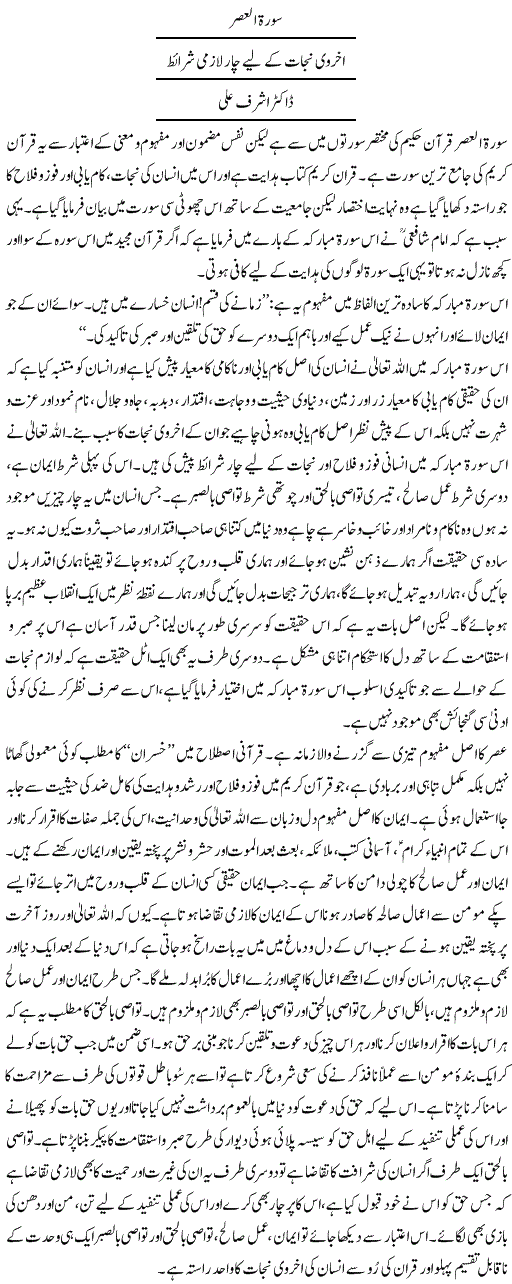
Surah Al-Asr: Akhrat Ki Nijaat Kay Liay Char Lazmi Sharait
Do Not Be Fooled By The One Who Recites
The Prophet (PBUH) has said: Malik said, “I heard that al-Qasim ibn Muhammad used to say, ‘I have seen the people, (i.e. the companions), and they were not impressed by speech.’ ” Malik said, “He meant that only action and deed would be looked at, not words.” [Malik’s Muwatta, Book #56, Hadith #56.10.25)
‘Umar bin Al-Khattaab said: “Do not be fooled by the one who recites the Qur’an for that is only words we utter. Rather, look at the one who acts upon it.”
Al-Hasan said: “Verily, this Qur’an is learned by servants and young children who do not approach it from its front side, nor do they have knowledge of the interpretation of its meanings. Allah, the Most High, says: ‘This is a Book (which) We have sent down to you, full of blessings, that they may ponder over its verses.’ [Soorah Saad: 29] What does pondering over its verses mean? It means following it through actions. And verily, the people with the most right to this Qur’an are those who follow it even if they don’t recite it. One of them says: ‘O so and so, come here, I will teach you how to recite! When did the reciters ever do this? They are not the reciters, nor are they the forbearing, nor the wise. May Allah not increase their likes amongst the people!”
Bakr bin Khunais said: “Verily, in the Hellfire there is a valley, which the Hellfire seeks refuge from seven times every day. And verily, in this valley there is a pit, which the valley and the Hellfire seek refuge from seven times every day. And verily, in this pit, there is a snake, which the pit, the valley, and the Hellfire seek refuge from seven times every day. It will begin first with the wicked bearers of the Qur’an. So they will say: ‘O Lord! Will you start with (punishing) us before the idol worshippers? It will be said to them: ‘The one who knows is not like the one who doesn’t know.’”
Allah Ta’ala Kay Azab Say Bay Khof Na Hua Jaye
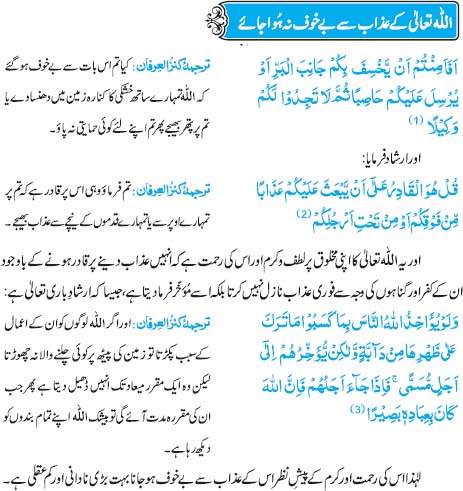
Allah Ta’ala Kay Azab Say Bay Khof Na Hua Jaye
Wise Sayings From Hadith And Sunnah
1) Narrated `Ali (RA): The Prophet (PBUH) said, “Do not tell a lie against me for whoever tells a lie against me (intentionally) then he will surely enter the Hell−fire.” [Bukhari 1/106]
2) Narrated Abu Huraira(RA): The Prophet(PBUH) said, “Religion is very easy and whoever overburdens himself in his religion will not be able to continue in that way. So you should not be extremists, but try to be near to perfection and receive the good tidings that you will be rewarded; and gain strength by worshipping in the mornings, the nights.” [Bukhari 1/38]
3) Narrated Al−Mughira(RA): The Prophet (PBUH) said, “Allah has forbidden you
(1) to be undutiful to your mothers
(2) to withhold (what you should give) or
(3) demand (what you do not deserve), and
(4) to bury your daughters alive. And Allah has disliked that
(A) you talk too much about others
(B), ask too many questions (in religion), or
(C) waste your property.”
[Bukhari 8/6]
4) “He who does not thank people does not thank Allah.” Hadith – Tirmidhi 1877, Saheeh: Related by and at-Tirmidhee (no. 1877) and Aboo Daawood (no. 4177). It was declared authentic by Imam al-Albaanee in as-Saheehah (no. 417)
5) Narrated `Adi bin Hatim heard the Prophet(PBUH) saying: “Save yourself from Hell−fire even by giving half a date fruit in charity.” [Bukhari 2/498]
6) Narrated Abu Huraira(RA): The Prophet(PBUH) said, “Whoever established prayers on the night of Qadr out of sincere faith and hoping for a reward from Allah, then all his previous sins will be forgiven; and whoever fasts in the month of Ramadan out of sincere faith, and hoping for a reward from Allah, then all his previous sins will be forgiven.” [Bukhari 3/125]
7) Narrated Abu Huraira(RA): The Prophet(PBUH) said, “Whoever believes in Allah and the Last Day should not hurt (trouble) his neighbor. And I advise you to take care of the women, for they are created from a rib and the most crooked portion of the rib is its upper part; if you try to straighten it, it will break, and if you leave it, it will remain crooked, so I urge you to take care of the women.” [Bukhari 7/114]
8) Narrated Abu Huraira(RA): Allah’s Apostle(PBUH) said, “Anybody who believes in Allah and the Last Day should not harm his neighbor, and anybody who believes in Allah and the Last Day should entertain his guest generously and anybody who believes in Allah and the Last Day should talk what is good or keep quiet. (i.e. abstain from all kinds of evil and dirty talk). [Bukhari 8/47]
9) Abu Huraira(RA) reported Allah’s Messenger (may peace be upon him)as saying: The world is a prison−house for a believer and Paradise for a non−believer. [Muslim 42/7058]
10) Abu Huraira(RA) reported Allah’s Messenger(PBUH) said: There is a bone in the human being which the earth would never consume and it is from this that new bodies would be reconstituted (on the Day of Resurrection). They said: Allah’s Messenger, which bone is that? Thereupon he said: It is the spinal bone. [Muslim 41/705]
11) The son of Abu Said al−Khudri reported on the authority of his father that Allah’s Messenger (may peace be upon him) said: When one of you yawns, he should keep his mouth shut with the help of his hand, for it is the devil that enters therein. [Muslim 42/710]
Zaban Ki Afat

Zaban Ki Afat by Muhammad Tahir-ul-Qadri
Purifying Ourselves, Physically And Spiritually
WUDU is a pre-condition for Salah. It shows Islam’s stress on purifying ourselves, physically and spiritually.
Prophet Muhammad (peace be upon him) said about the virtue of Wudhu: “When a slave makes ablution and rinses his mouth, his wrong deeds fall from it. As he rinses his nose, his wrong deeds fall from it. When he washes his face, his wrong deeds fall from it until they fall beneath his eyelashes. When he washes his hands, his wrong deeds fall from them until they fall from beneath his fingernails. When he wipes his head, his wrong deeds fall from it until they fall from his ears. When he washes his feet, his wrong deeds fall from them until they fall from beneath his toenails. Then his walking to the mosque and his prayer fetch him an extra reward.” (Malik, An-Nasa’i, Ibn Majah and Al-Hakim)
After we complete our Wudhu, one of the Du’as our Prophet (peace be upon him) taught us to say is: “Ash-hadhu An Laa ilaaha illAllahu wahdahu Laa Shareeka Lahu wa Ash-hadu Anna Muhammadan Abduhu wa Rasuluhu” (I bear witness that none has the right to be worshipped except Allah, alone, without any partner, and I bear witness that Muhammad is His slave and Messenger).
Sheikh Salih Al-Fowzan explained: “The reason behind reciting Dhikr and invocation following ablution is to combine both physical and spiritual purity.
Ablution is a means of attaining physical purity, whereas Dhikr and invocation (implying declaring monotheism and repentance for sins) are signs of spiritual purity.
In this way, one gets into the perfect state of purity (combining both physical and spiritual purity) and becomes pure enough to be admitted to stand before Allah in prayer, imploring Him humbly and submissively. (Mulakhkhas Al-Fiqh, Eng. version, vol. 1, ch. 7, p. 43)
Baat Baat Par Kasmein Uthane Waley Naseehat Hasil Kerin
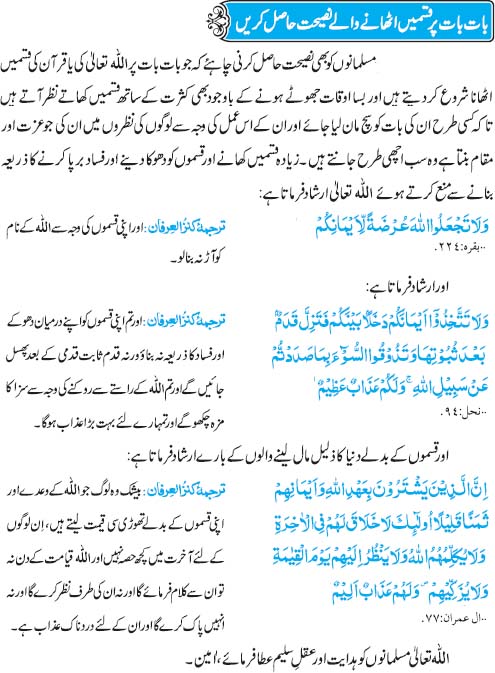
Baat Baat Par Kasmein Uthane Waley Naseehat Hasil Kerin
Hazrat Abu Huraira (Radi Allah Anhu)
[Sahih Bukhari: Volume 1, Book 3, Number 118] Narrated Abu Huraira (Radi Allah Anhu): People say that I have narrated many Hadiths (The Prophet’s (sal-allahu- alleihi-wasallam ) narrations). Had it not been for two verses in the Qur’an, I would not have narrated a single Hadith, and the verses are: “Verily those who conceal the clear sign and the guidance which We have sent down . . . (up to) Most Merciful.” (2:159-160). And no doubt our Muhajir (emigrant) brothers used to be busy in the market with their business (bargains) and our Ansari brothers used to be busy with their property (agriculture). But I (Abu Huraira) used to stick to Allah’s Apostle (sal-allahu- alleihi-wasallam ) contented with what will fill my stomach and I used to attend that which they used not to attend and I used to memorize that which they used not to memorize.
[Sahih Bukhari: Volume 1, Book 3, Number 119] Narrated Abu Huraira (Radi Allah Anhu): I said to Allah’s Apostle (sal-allahu- alleihi-wasallam ) “I hear many narrations (Hadiths) from you but I forget them.” Allah’s Apostle (sal-allahu- alleihi-wasallam ) said, “Spread your Rida’ (garment).” I did accordingly and then He moved his hands as if filling them with something (and emptied them in my Rida’) and then said, “Take and wrap this sheet over your body.” I did it and after that, I never forgot anything.
[Sahih Bukhari: Volume 1, Book 3, Number 121] Narrated Abu Huraira (Radi Allah Anhu): I have memorized two kinds of knowledge from Allah’s Apostle (sal-allahu- alleihi-wasallam ). I have propagated one of them to you and if I propagated the second, then my pharynx (throat) would be cut (i.e. killed).