
TAG: Ablution
Do Miswak As Much Possible
Narrated by Hazrat Aisha Ummul Mu’minin, Transmitted by Abu Dawud
Allah’s Messenger (Sal-allahu-aleihi-wassallam) said “Ablution water and tooth-stick were placed by the side of the Prophet (Sal-allahu-aleihi-wassallam). When he got up during the night (for prayer), he relieved himself, then he used the tooth-stick”.
Narrated by Abu Huraira, Transmitted by Sahih Bukhari
Hazrat Aisha said, “The Prophet said, ‘It (i.e. Miswak) is a purification for the mouth and it is a way of seeking Allah’s pleasures.’ [Vol 3:#154]
Narrated by Zayd ibn Khalid al-Juhani’, Transmitted by Tirmidhi, Abu Dawud. (Mishkat)
I heard Allah’s Messenger (Sal-allahu-aleihi-wassallam) saying: If it were not burdensome upon my Ummah I would have commanded them to use miswak at every prayer and to delay the night prayer till the third part of the night is over. [390]
Narrated by Hazrat Anas, Transmitted by Sahih Bukhari
Allah’s Apostle I said, “I have told you repeatedly to (use) the Miswak. (The Prophet put emphasis on the use of the Miswak). [Vol 2:#13]
Narrated by Hazrat Aisha Ummul Mu’minin, Abu Dawud transmitted it.
The Prophet (Sal-allahu-aleihi-wassallam) did not get up after sleeping by night or by day without using the tooth-stick before performing ablution.
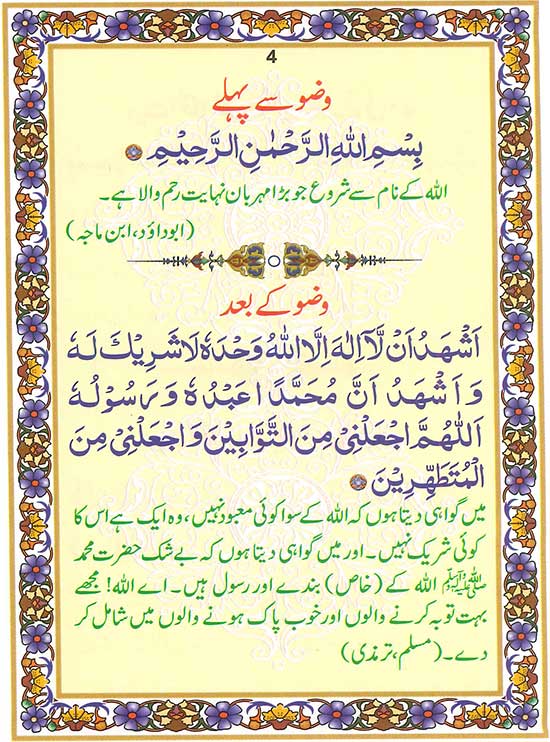
Wudu Ki Dua
What’s On Your Mind?
Our lives are usually so preoccupied with materialism today that we hardly find time to think about the eternal life to come. Our quest to conquer every desirable thing in this temporary world has left little energy in us to work for eternal happiness. ‘Aaidh Bin Abdullah Al-Qarni mentions in his book ‘Don’t Be Sad’ some telling narrations of people who lived otherwise.
A RIGHTEOUS person was once thrown into a lion’s cage, and Allah then saved him from its claws. He was later asked, “What were you thinking about at the time.” He said, “I was considering the saliva of a lion – whether it is considered by scholars to be pure or impure (i.e. whether, when I die, I will be in a state of purity or not).”
Allah described those who were with the Prophet (peace be upon him) according to their intentions:?“Among you are some that desire this world and some that desire the Hereafter.” (Qur’an, 3:152)
Ibn Al-Qayyim mentioned that a person’s value is measured according to his determination and his goals. A wise person once said words to the same effect: “Inform me of a man’s determination and I will tell you what kind of man he is.”
A vessel capsized at sea. A pious man among others was hurled into the water. He began to make ablution, one limb at a time. Later, he managed to get to shore and was saved. He was asked about why he made the ablution. The man replied, “I wanted to make ablution so that I would die in a state of purity.”
Imam Ahmad, during the pangs of death, was pointing to his beard while others were making his ablution for him, reminding them not to miss a spot.
“So Allah gave them the reward of this world, and the excellent reward of the Hereafter.” (Qur’an 3:148)
The Real Significance Of Prayer
If a person really believes in Allah (God), how will he show it? And how will it affect his life? For a Muslim, his faith is first demonstrated by the five daily ritual prayers called Salah. These prayers are so important that they are the second pillar of Islam after the Testimony of Faith (There is no god but Allah and Muhammad is His Messenger), obligatory for all, and they are the first thing the Muslim will be asked about on Judgment Day.
Five times a day a Muslim is asked to stop whatever he is doing — be it sleep, work, or play — and make a ritual ablution before facing his Lord in Prayer.
No matter what his actions, the most important thing to a Muslim is his relationship with Allah. This relationship is demonstrated and put into practice, as well as improved and increased, by the ritual prayers.
Only if the prayers are sound and proper will the deeds be sound and proper.
In the Prayer, the Muslim faces toward the Ka’bah in Makkah, the symbol of the Oneness of Allah and the unity of Muslims. He stands, bows, and prostrates to his Lord while praising Him, reciting some of the words He revealed in the Qur’an, and asking for His forgiveness and mercy. In doing so, the Muslim reminds himself of his position in the universe as a humble servant of Allah and of his total dependence on his Creator, Cherisher and Sustainer.
When the prayer is performed properly — with due humility and remembrance of Allah — it has a lasting effect on the person. It fills his heart with the remembrance of Allah, and with fear of and hope in Him. He will not want to move from that lofty position by disobeying Allah.
The Prophet compared this experience of making ablution and praying five times a day to having a river running in front of one’s house.
If one bathed in that river five times a day, would any filth remain on his body? Likewise, the ablution and prayer five times a day removes one’s sins and also prevents him from sinning.
Prayers also affect the life of the Muslim by encouraging him to schedule his activities around their fixed times.
There is some flexibility, for each time is actually a span of one hour or more.
But the Muslim who is conscious of Allah will strive to schedule his life in such a way that he does not miss any of the prayers — for example, by postponing a shopping trip until after a Prayer, or by taking a break from work, or by sleeping earlier so as to be able to rise for the dawn prayer.
Therefore, if one really believes in Allah, he will show it by his commitment to the five daily Prayers, and these, in turn, will help him to live righteously.
Brushing Teeth Before Prayers
Islam takes much care of personal cleanliness and hygiene. We are required to perform ablutions before we start our prayers.
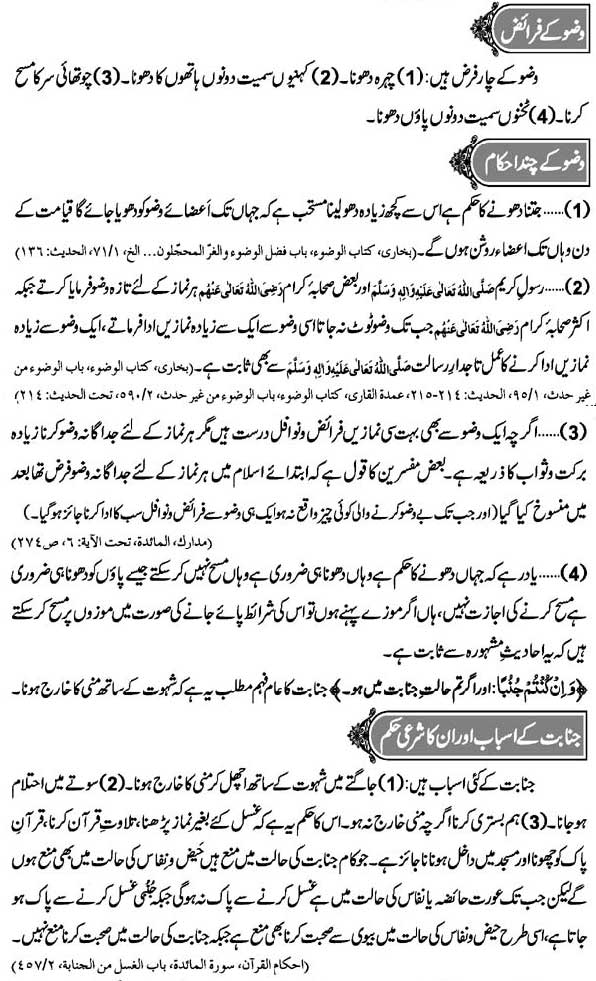
It is not enough that one should have such ablution once a day. There are several things or actions that invalidate ablution. Once it is invalidated, we cannot offer our prayers unless we have a fresh ablution. The ritual ablution for prayer consists of an obligatory part and a recommended one. The obligatory is to wash one’s face, hands up to the elbows, wiping one’s head with one’s wet hand and washing one’s feet up to the ankles. It is also obligatory to formulate at the start the intention to perform the ablution for worship. The recommended part includes rinsing one’s mouth, cleaning one’s nose and ears, as well as repeating the wash of every part three times, rather than once only. No prayer is valid unless it is preceded by an ablution that has not been invalidated. It is perfectly appropriate to perform more than one obligatory prayer with one ablution, as long as it has not been invalidated. Since we offer five obligatory prayers every day, and as these are spread throughout the day, everyone needs to perform the ablution at least three times a day.
One of the recommended practices in ablution is to clean one’s mouth. This is performed in two actions:
1 rinsing one’s mouth and
2 brushing one’s teeth.
It is generally the case that people rinse their mouths when they have ablution, but they often omit to brush their teeth, mainly because they forget or may not have a toothbrush handy. Hence, the Prophet (peace be upon him) emphasized this aspect of ablution in various ways. Abu Hurayrah quotes the Prophet as saying: “If it were not for fear that I would place hardship on my community, or on people, I would have ordered them to use the tooth stick at every prayer.” (Related by Al-Bukhari).
The tooth stick is taken from a tree called Arak. When the outer layer is removed, it reveals fibers that are very similar to a toothbrush. It can also be taken from the olive tree. There is nothing special about having a tooth stick from such trees. A toothbrush is just as good.
What gives us the proper understanding of this Hadith is its other version, also related by Al-Bukhari on the authority of Abu Hurayrah. It reads: “If it were not for fear that I would place hardship on my community, or on people, I would have ordered them to use the tooth stick every time they perform ablution”.
The Hadith also tells us that the Prophet was always keen to make things easier for us. It was his preference that everyone should clean their teeth before coming to prayer, or when they perform the ablution. Yet he realized that this may be difficult for some. Therefore, he put it in the way that makes it strongly recommended but not obligatory.
Saying Bismillah In The Hadith
Saying Bismillah Is Recommended Before Eating:
The Prophet (saw) said,
“Say Bismillah, eat with your right hand and eat what is in front of you.”
[Bukhari 7/88, Muslim 2/207, Ahmad 17/92, Muwatta Malik 10/32 and Ibn Majah 1/557]
Saying Bismillah Is Recommended When Drinking Water:
Ibn Abbas (ra) reported that the Messenger of Allah (saw) said,
“Do not drink in one gulp like a camel, but in two or three [Gulps]. Mention the Name of Allah when you start drinking and praise Him after you have finished Drinking.”
[Fath al-Bari 12/197 and Al-Trimidhi]
Saying Bismillah Is Recommended At The Beginning Of Ablution:
The Prophet (saw) said,
“Make Wudu [Ablution] in the name of Allah”
[An-Nasai 1/11 and Ibn Khuzaimah 1/84]
Saying Bismillah Is Recommended When Entering The House:
Jabir (ra) said: I heard the Messenger of Allah (saw) saying,
“If a person mentions the Name of Allah upon entering his house or eating, Satan says, addressing his followers: `You will find no where to spend the night and no dinner.’ But if he enters without mentioning the Name of Allah, Satan says [To his followers]; `You have found [A place] to spend the night in, and if he does not mention the Name of Allah at the time of eating, Satan says: `You have found [A place] to spend the night in as well as food.”
[Sahih Muslim 2/206]
Saying Bismillah Is Recommended When Leaving The House:
The Messenger Of Allah (saw) said,
“If anyone of you when leaving the house says In the name of Allah, I trust in Allah, there is no power and might except from Allah. Your needs shall be fulfilled, you shall be saved from difficulties and hardships. Shaitaan hearing these words leaves him.”
[Al-Trimidhi 2/493]
Fajr Prayer
The fajr (dawn) prayer is amongst the most important acts of worship, being one of the five obligatory prayers. Unfortunately many of us have become so used to missing it at its prescribed time, which ends at sunrise – that we have forgotten its position in our religion, and barely feel anything is wrong when we wake up in the morning for work or school without having performed the fajr prayer. On the other hand, if one of us was to miss a job interview or a flight, we all know how disappointed he or she would feel. Therefore I thought I’d prepare this article as a reminder to myself first, then to all my brothers and sisters.
Muslims should know the great status of fajr in the sight of Allah. Allah (SWT) says (interpretation of the meaning) “Establish regular prayers at the sun’s decline till the darkness of the night, and the recital of the Qur’an in the fajr prayer, for the recital of the fajr is witnessed” (Al-Israa 17:78) In addition, the Prophet (PBUH) said: “Whoever prays the fajr prayer in congregation, it is as if he (or she) had prayed the whole night long.” [Muslim & Tirmidhi].
Now, to show the seriousness of missing this prayer, we present the Hadeeth of the Prophet (PBUH) “The most burdensome prayers for the hypocrites are ishaa and fajr, but if they only knew what they contain, they would come even if they had to crawl.” [Ahmad]
The practical aspect of dealing with the problem includes a number of steps which we can take in order to get used to praying fajr regularly in congregation:
Having a sincere intention and being determined, when going to sleep, that you will get up for fajr
Remembering Allah as soon as you wake up. Allah’s Apostle (PBUH) said, “During your sleep, Satan knots three knots at the back of the head of each of you, and he breathes the following words at each knot, ‘The night is long, so keep on sleeping.’ If that person wakes up and remembers Allah, then one knot is undone. When he (or she) performs ablution (wudu) the second knot is undone. And when he (she) prays, all the knots are undone, and he (she) gets up in the morning lively and in a good mood, otherwise he (she) gets up dull and gloomy.” [Bukhary]
Sleeping early. According to an authentic Hadeeth, the Prophet (PBUH) used to dislike sleeping before ishaa and talking after it. The kind of talk that is discouraged in this case, as the commentators explain, is that in which there is no clear benefit. However, if it is for good reason, such as studying, speaking to a guest, or spending time with one’s family, then there is nothing wrong with it. This has no connection with the reasons for which many people stay up late nowadays, to do wrong and commit sins.
Family members should encourage one another, and likewise roommates sharing the same apartment.
If you know a friend who normally wakes up on time, ask him or her to give you a call at prayer time. I have been using this technique on and off for quite some time now, and have found it to be extremely effective.
If you find that you switch off the alarm clock then go back to sleep, you might want to place it a few feet from your bed. This way you will actually have to get up and walk to the clock in order to turn it off.
Try using an alarm clock with the snooze feature.
Avoid eating too much before going to bed. Overeating makes you fall into a deep, heavy sleep.
Finally, true devotion to Allah is the best thing to motivate a person to get up for prayer, because Allah alone controls all means of help. I ask Allah Almighty to facilitate this prayer for us, and to guide us to what pleases Him.
Contributed by : Hany Omar
“Our Lord! Pour forth on us patience and make us victorious over the disbelieving people.” – Surah Al-Baqarah (2) Ayah 250
The Spirit Of Prayer In Islam
Ibadah (act of worship) is an Arabic word derived from `abd (a slave) and it means submission. It portrays that God is your Master and you are His slave and whatever a slave does in obedience to and for the pleasure of his Master is `ibadah. The Islamic concept of `ibadah is very wide.
If you free your speech from filth, falsehood, malice, and abuse and speak the truth and talk goodly things and do all these only because God has so ordained to do, they constitute `ibadah, however secular they may look in semblance. If you obey the law of God in letter and spirit in your commercial and economic affairs and abide by it in your dealings with your parents, relatives, friends, and all those who come in contact with you, verily all these activities of yours are `ibadah. If you help the poor and the destitute, give food to the hungry, and serve the ailing and the afflicted persons, and do all this not for any personal gain of yours but only to seek the pleasure of God, they are nothing short of `ibadah.
Salah (Prayer) is the most primary and the most important of these obligations. And what is salah? It is the prescribed daily Prayers which consist in repeating and refreshing five times a day the belief in which you repose your faith. You get up early in the morning, cleanse yourself and present yourself before your Lord for Prayer. The various poses that you assume during your Prayers are the very embodiment of the spirit of submission; the various recitals remind you of your commitments to your God. You seek His guidance and ask Him again and again to enable you to avoid His wrath and follow His chosen path. You read out from the Book of the Lord and express witness to the truth of the Prophet (peace be upon him) and also refresh your belief in the Day of Judgment and enliven in your memory the fact that you have to appear before your Lord and give an account of your entire life. This is how your day starts.
Then, after a few hours the muezzin calls you to Prayer, and you again submit to your God and renew your covenant with Him. You dissociate yourself from your worldly engagements for a few moments and seek audience with God. This once again brings to the fore of your mind your real role in life. After this rededication you revert to your occupations and again present yourself to the Lord after a few hours. This again acts as a reminder to you, and you once more refocus your attention on the stipulations of your faith. When the sun sets and the darkness of the night begins to shroud you, you again submit yourself to God in Prayer so that you may not forget your duties and obligations in the midst of the approaching shadows of the night. And then after a few hours you again appear before your Lord, and this is your last Prayer of the day. Thus before going to bed you once again renew your faith and prostrate before your God. And this is how you complete your day. The frequency and timings of the Prayers never let the object and mission of life be lost sight of in the maze of worldly activities.
Who Is More Shy?
It is well known that the Prophet (peace be upon him) was extremely resolute in defending Islam and the Muslim community. He would not accept any compromise in matters of faith and would stand firm in resisting any injustice that may be aimed at even the weaker elements in the community. In fact he would defend the rights of non-Muslim people, provided that they did not participate in war against Islam and Muslims. Yet with all this firmness and courage, the Prophet was a very shy person when it came to his own personal matters or when the discussion involved some intimate matters such as body discharges.
Ayesha reports: “A woman asked the Prophet about the form of taking a bath after she has finished her period. ‘How do I conduct my bath,’ she said. He replied: ‘Take a piece of cotton, perfumed with musk, and use it to purify yourself.’ She asked: ‘How do I purify myself with it?’ He said: ‘Well, use it and purify yourself.’ She said: ‘How?’ He said: ‘All glory be to God! Do purify yourself.’ I pulled her toward me and said to her: ‘Use it to remove any traces of blood.’” (Related by Al-Bukhari).
Muslims used to ask the Prophet about every little detail. They realized that Islam meant much more than a belief or a conviction that certain principles are true. It is a complete way of life, which required them to conduct all their life affairs in accordance with its principles. Purification is an essential part of Islamic worship. A Muslim always keeps himself clean, washing off all impurity. Muslims are required to perform ablutions before they stand up in prayer. Likewise, they are required to wash all their bodies and their heads when they are in the state of ceremonial impurity. The Prophet told them this and they knew what is required. Hence, the woman’s question was not seeking this elementary information. She was asking for more intimate information concerning the cleanliness of the place where menses is discharged.
The Prophet understood what she meant. He, however, was too shy to speak to a woman explicitly about this. He had already told women how to take a purification bath. As he explained, a woman who has finished her period should bring enough water and whatever else she needs for cleanliness, washing her private parts. Then she performs the ordinary ablutions normally needed for prayer. Then she pours some water over her head and rubs her scalp, pushing her fingers through her hair. Then she pours water over all her body. After that, she uses a piece of cotton or wool and wet it with some perfume or musk and use it for purification. As the woman in this case, Asma bint Shakal, felt that purification meant ablution, in its two forms, she wondered how could she do the ablution with a piece of cotton or wool. The Prophet tried his best to make her understand what was beyond his words, but she was persistent, asking for more details. Here Ayesha realized the difficulty of the situation, pulled the woman aside and explained to her what the Prophet meant.
There is nothing embarrassing in all this. We only note that the Prophet was too shy to discuss such matters with a woman, even in the presence of his wife. However, Ayesha praised the woman and her people generally. She said: “Blessed be the Ansari women. Shyness has not stopped them from seeking better knowledge of their religion.”
– By Adil Salahi