Hazrat Umar Ka Hazoor Kay Wisal Par Ranj
TAG: Abu Bakr
Hazrat Abu Bakr Ka Ailan-e-Islam Aur Takleef
Hazrat Abu Bakr (radi Allahu anhu) Ka Ailan-e-Islam Aur Takleef
Superiority Of Sayyiduna Abu Bakr as-Siddiq Radi Allahu Ta’ala Anhu
The Ahl-e-Sunnat wa Jama’at has reached the consensus (Ijma’) that after the Prophets (Alaihim as-Salam), the best of creation are the four rightly guided Khalifas (Khulafa-e-Arba’a i.e., Hadrat Abu Bakr, Hadrat Umar, Hadrat Uthman, and Hadrat Ali Radi Allahu Ta’ala Anhum Ajma’een).
Their sequence of excellence is that Sayyiduna Abu Bakr as-Siddique is the most excellent, then Sayyiduna Umar, thereafter followed by the excellence of Sayyiduna Uthman and Sayyiduna Ali (Ridwanullahi Ta’ala Alaihim Ajma’een). Here, I present a few proclamations of the Classical Scholars and Jurists in this regard.
Proclamations of the Classical Scholars and Jurists
1. Imam al-Aazam Abu Hanifa gave one of the pithiest definitions of Sunnism in Islam:
“The doctrine of Ahl al-Sunna wal-Jama’a consists in preferring the Two Shaykhs (tafdil al-shaykhayn) [i.e., Abu Bakr and ‘Umar over the rest], loving the Two Sons-in-law (hubb al-khatanayn) [i.e., ‘Ali and ‘Uthman], and wiping on leather socks (al-mas-h ‘alal-khuffayn) [i.e., all three contrary to Shi’is].” [Khulasat al-Fatawa, Vol. 2, Page 381]
Narrated by Ibn ‘Abd al-Barr in al-Intiqa’ bi-Manaqib al-A’immat al-Thalathati al-Fuqaha’ through several different chains. The same is also related by Sufyan al-Thawri by al-La’laka’i in his I’tiqad Ahl al-Sunna, Vol. 1, Page
152.
2. Imam al-Aazam Abu Hanifah in Fiqh Al-Akbar:
“The most superior and the best of all men after prophets – blessings and peace upon them – is Abu Bakr as-Siddiq. And then, Umar ibn al-Khattab al-Faruq. And then Uthman ibn Affan Dhu’n Nurayn. And then Ali ibn Abu Talib al-Murtada. May Allah be well pleased with them all; they were worshippers and steadfast on Truth and sided with Truth. We love all of them.” [Fiqh Al-Akbar]
3. Imam al-Nawawi said in his Fatawa:
“Know that each of Abu Bakr and ‘Umar is better than ‘Ali according to the Consensus (ijma’) of Ahl al-Sunna. The proofs for this in well-known sound hadiths are too famous and countless to be listed.” [Fatawa Imam Nawawi, Page 264]
The Dream Of Hadrat Abu Bakr Siddique Radi Allahu Ta’ala Anhu
Hadrat Abu Bakr Siddique Radi Allahu Ta’ala Anhu was a merchant before the advent of Islam and once traveled to Syria on business. While there, he had a dream in which he saw the sun and the moon descend from the sky and fall onto his lap. He took hold of them, placed them against his chest, and then stored them in a sheet. In the morning, he met with a Christian priest and sought an interpretation of the dream.
The priest asked him, “Who are you?”
“I am Abu Bakr, a resident of Makkah.”
“Which tribe are you from?”
“The Banu Hashim.”
“And what’s your means of livelihood?”
“Business.”
The priest then said,
“So listen carefully: The Final Prophet, Muhammad (Peace and Blessings of Allah be Upon Him), has arrived, and he is from your tribe. If it weren’t for him, Allah wouldn’t have created the Earth, the Heavens, or even another prophet. He’s the leader of whatever came first and whatever comes last. O Abu Bakr! Soon you’ll join this deen and become both a minister and a viceroy of it. This is the dream’s interpretation. Listen too, that I’ve read the praise of this Prophet in the Torah and in the Bible, and I’ve already brought Iman upon him and accepted Islam – only I haven’t revealed this yet to the Christians out of fear.”
Hearing this, the love for the Holy Prophet began to grow within Hadrat Abu Bakr Siddique Radi Allahu Ta’ala Anhu, and he immediately headed back to Makkah, looked for the Holy Prophet (Peace and Blessings of Allah be Upon Him), and cooled his eyes with his blessed sight.
The Prophet SallAllaho Alaihi wa Sallam saw him and said, “Abu Bakr! You’ve come. Now quickly enter the religion of truth.”
Hadrat Abu Bakr respectfully replied, “Fine, but I’d like to see a miracle.”
The Prophet SallAllaho Alaihi wa Sallam said, “Whatever you saw in Syria, and its interpretation by the priest, was solely my miracle.”
Hearing this, Hadrat Abu Bakr replied,
صدقت يارسول الله انا اشهد انك محمد رسول الله
You’ve spoken the truth, and I testify that Muhammad is the Messenger of Allah.” [Jami’ul Mu’jizat, Page 14]
Lesson: We see that Hadrat Abu Bakr Siddique Radi Allahu Ta’ala Anhu is a true Khalifa of Islam, and also that nothing of the happenings of the world is unknown to the Beloved Prophet (Peace and Blessings of Allah be Upon Him). We also come to know that had it not been for our Beloved Prophet (Peace and Blessings of Allah be Upon Him), nothing else in this world would have been created!!
Hazrat Abu Bakr (radi Allahu anhu) Ka Hijrat Kay Waqt Maal Lay Jana
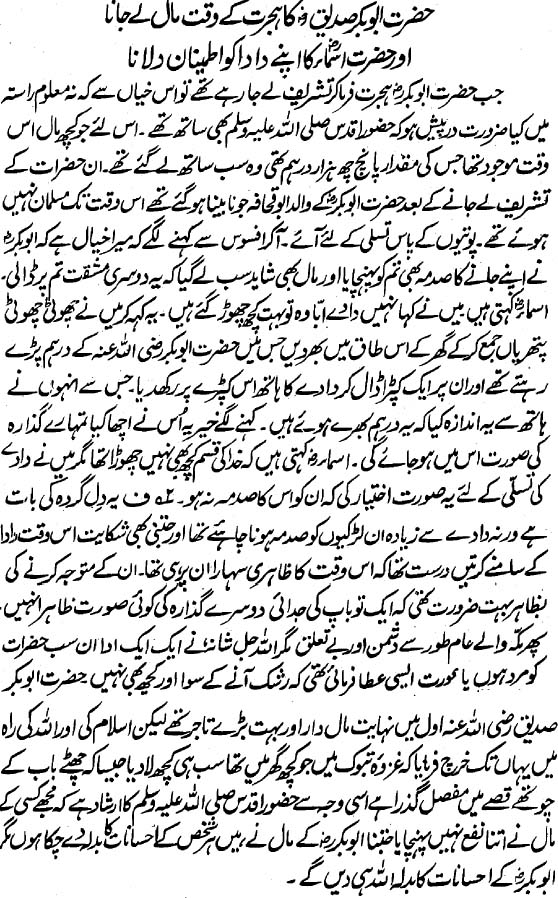
Hazrat Abu Bakr (radi Allahu anhu) Ka Hijrat Kay Waqt Maal Lay Jana Aur Hazrst Asma (radi Allahu anha) Ka Apnay Dada Ko Itmenan Dilana
Khalifa e Awwal: Janasheen Rasool Hazrat Abu Bakar (RA)
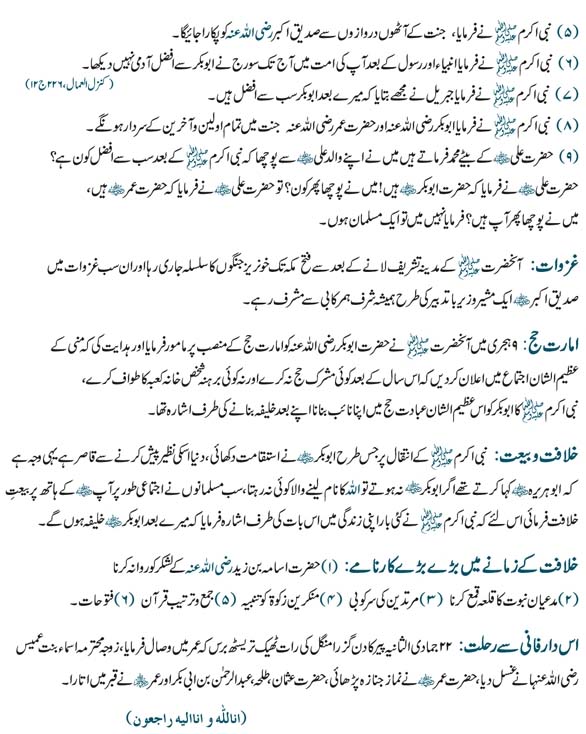
Khalifa e Awwal: Janasheen Rasool Hazrat Abu Bakar (RA)
Hazrat Abu Bakr RA Ka Majmua Ko Jala Dalna

Hazrat Abu Bakr RA Ka Majmua Ko Jala Dalna
The Leaders Of The People Of Paradise
(i) The Leaders of the Men
A number of the Sahabah, including ‘Ali ibn Abi Taalib, Anas ibn Maalik, Abu Hudhayfah, Jaabir ibn ‘Abdullaah, and Abu Sa’eed al-Khudri reported that the Messenger (saw) said, “Abu Bakr and ‘Umar will be the leaders of men of Paradise from the earlier and later generations.” [Silsilat al-Hadith as-Saheehah, 12/487, no. 824]
(ii) The Leaders of the Youth
at-Tirmidhi, al-Haakim, at-Tabaraani, Ahmad, and others reported that Abu Sa’eed al-Khudri said, that the Messenger of Allah (saw) said, “Hasan and Husayn are the leaders of the youth of Paradise”. This is proven by so many reports that reach the level of tawatur. [see also the narration from Hudhayfah and from ‘Abdullaah ibn ‘Umar in Ibn ‘Asaakir – Silsilat al-Hadith as-Saheehah, no. 797]
(iii) The Leaders of the Women
The true female leader is the one with whom her Rabb is pleased and whose deeds He accepts. The best women are those who attain the Paradise of delights. The women of Paradise are of different levels, and the Messenger (saw) told us about their leaders:
“The Messenger of Allah (saw) drew four lines and said, “Do you know what these are?” They said, “Allah and His Messenger know best.” He said, “The best women of Paradise are Khadeejah bint Khuwaylid, Faatimah bint Muhammad, Maryam bint ‘Imraan and Aasiyah bin Muzahim, the wife of Fir’awn” [Silsilat al-Hadith as-Saheehah, 4/13, no. 1508, from Ahmad at-Tahhaawi, al-Haakim from Ibn ‘Abbaas, saheeh]
Maryam and Khadeejah are the best of the four – “The best of its women is Maryam and the best of its women is Khadeejah” [from ‘Ali in al-Bukhaari, Kitaab Manaaqib al-Ansaar, Fath al-Baari, 7/133] – and Maryam is the “First Lady” – “The leaders of the women of Paradise, AFTER Maryam bint ‘Imraan will be..” [Silsilat al-Hadith as-Saheehah, 3/410, no. 1424, from Jaabir in at-Tabaraani, saheeh]. The reason why Maryam is considered the best of all women is clearly stated in the Qur’an:
“Behold! the angels said, “O Maryam! Allah has chosen you and purified you, chosen you above the women of all nations.” [3:42]
How could she not be the best of women when Allah has clearly stated that,
“..her Rabb accepted her with a goodly acceptance. He made her to grow in a good manner”. [3:37]
These four women are beautiful examples of perfect, righteous women. Maryam, the daughter of ‘Imran, is praised by Allah in the Qur’an:
“And Maryam, daughter of Imran, who guarded her chastity; and We breather into [the sleeve of her shirt/garment] through Our Ruh [i.e. Jibreel] and she testified to the truth of the Words of her Rabb, and [also believed in] His Scriptures and she was one of the Qaaniteen [obedient to Allah]” [66:12]
Khadeejah as-Siddeeqah believed in the Messenger (saw) without hesitation; she consoled and supported him in every way. Her Rabb gave her the good news, during her lifetime, of a place in Paradise in which there would be no noise or exhaustion [al-Bukhaari, Kitaab al-Manaaqib, Fath al-Baari, 7/133]
Aasiyah the wife of Fir’awn, despised the power and luxuries of this world and rejected Pharaoh and his false claims of divinity. Hence, her husband tortured her until her soul departed to her Creator:
“And Allah sets forth an example for those who believe, the wife of Pharaoh, when she said, “My Rabb! Build for me a home with You in Paradise, and save me from Pharaoh and his works, and save me from the Dhaalimoon [those that do wrong]” [66:11].
Faatimah az-Zahraa, the daughter of the Prophet (saw), was patient, forbearing, and feared Allah. She was a branch from the pure tree, brought up by the educator of humanity.
Bidding Final Farewell To The Most Beloved
When news of the death of the Prophet (peace be upon him) was known, people were stunned. The believers felt that the whole city of Madinah sank into total darkness. They were like young children losing their parents. They did not know what to do. Despite the repeated hints by the Prophet of his impending death and the fact that the Qur’an mentions that possibility clearly, to lose him was, for his companions, something they could not imagine or visualize. He lived among them as one who was dearer to them than their souls. He was the sun of their lives. His death meant that they had to live in absolute darkness. For the Prophet to be withdrawn from their lives meant to them a vacuum that could never be filled. It was an event, which they could not imagine or comprehend. Some of them were physically paralyzed, others were dumb, and others still made statements, that they could not have thought out properly.
Umar ibn Al-Khattab himself could not make a proper judgment. He stood up to address the people and said: “Some hypocrites are alleging that God’s Messenger has died. God’s Messenger has not died. He has gone to his Lord as Moses (peace be upon him) had done before and was away from his people for 40 nights. He then returned after people had said that he had died. I swear that God’s Messenger shall return and chop off the hands and legs of those who allege that he has died.”
As Umar was making his speech, Abu Bakr arrived. He paid no attention to anything going on around him until he went into the room of his daughter Lady Ayesha, the Prophet’s wife. Abu Bakr went straight to uncover the Prophet’s face, knelt down, and kissed him, saying: “My father and my mother may be sacrificed for your sake. The one death that God has decreed that you shall experience, you have now had. You shall never die again.”
He covered the Prophet’s face and went out to find Umar still speaking to the people. Abu Bakr said to him: “Listen to me.” Abu Bakr began by praising God and thanking Him for His grace. He then said: “People, if any of you has been worshipping Muhammad, let him know that Muhammad is dead. He who worships God knows that God is always alive; He never dies.” He then recited a verse of the Qur’an, which may be translated as follows: “Muhammad is but a messenger before whom other messengers have passed. Should he die or be slain, would you turn back on your heels? He who turns back on his heels shall do God no harm. God shall reward those who give thanks to Him.” (3: 144)
When people heard Abu Bakr reciting that verse of the Qur’an, they seemed as if they had never heard it before. They had indeed heard it repeatedly, and they repeated it then. Umar said: “When I heard Abu Bakr reciting that verse I was stunned and perplexed. I fell down to the ground, feeling that my legs could not support me. I realized, however, that God’s Messenger was dead.”
The next thing to be done was to prepare the Prophet’s body for burial. His body needed to be washed like every dead person. Ali ibn Abu Talib, the Prophet’s cousin, and Al-Abbas’ two sons, Al-Fadl and Qutham, as well as Usamah ibn Zaid and Shaqran, the Prophet’s servant, were given that task. Aws ibn Khawli, a man from the Ansar, appealed to Ali to let him also attend. Ali supported the Prophet’s body on his chest, Al-Abbas and his two sons helped him turn the Prophet’s body while Usamah and Shaqran poured the water and Ali washed him.
Ayesha reports that when they were about to start washing the Prophet’s body, they did not know whether to take off his clothes or to wash him with his clothes on. They were in disagreement when they were overtaken by sleep. All of them sat down and dozed off. They heard a voice telling them to wash the Prophet’s body with his clothes on, so this was how they did it. They poured the water over his shirt and rubbed his body holding his shirt. They did not insert their hands underneath his shirt.
When they had finished washing him, they wrapped him in three robes. There were several suggestions concerning where to bury the Prophet. Some people suggested that he should be buried in his mosque. Others suggested that he should be buried alongside his companions. Abu Bakr, however, told them that he heard the Prophet say: “Every Prophet was buried in the place where he died.” That settled the matter. The bed on which the Prophet died was removed and his grave was dug there.
After the Prophet was wrapped for burial, he was put on his bed. Abu Bakr and Umar entered the room and said: “Peace be upon you, Messenger of God, with God’s mercy and blessing.” A number of the Muhajirin and the Ansar went in with them, as many as the room could accommodate. They spoke the same greetings and stood up in rows to offer the prayer for the deceased, the Janazah prayer. No one led the prayer as an Imam. Abu Bakr and Umar, however, were in the first row next to the Prophet. They said: “Our Lord, we bear witness that he has conveyed to us what has been revealed to him, given good counsel to his nation, struggled for God’s cause until God has given triumph to His religion at his hands, and until God’s words were complete. People believed in Him alone without partners. Our Lord, place us with those who follow the word revealed to him and join us to him so that he recognizes us and You make us known to him. For he was compassionate and merciful to those who believed.
When they had finished they left the room to allow another group of the Muslims to go in and offer the Janazah prayer for the Prophet. They were followed by other groups as the room could accommodate. When all men had offered their prayers, women went in also in groups to do the same. Children then followed in groups. However, there was no congregational prayer for the deceased. Everyone prayed on his own. This took the whole of Tuesday and the Prophet was buried on Wednesday.
Most reports confirm that the Prophet was 63 when he died, although some suggest that he was 65. Normally, prophets start to receive their revelations at the age of 40. The Prophet lived after that for 13 years in Makkah and 10 years in Madinah. That he was 63 is perhaps more accurate.
Abu Bakr (RA) Par Allah Ka Dar