

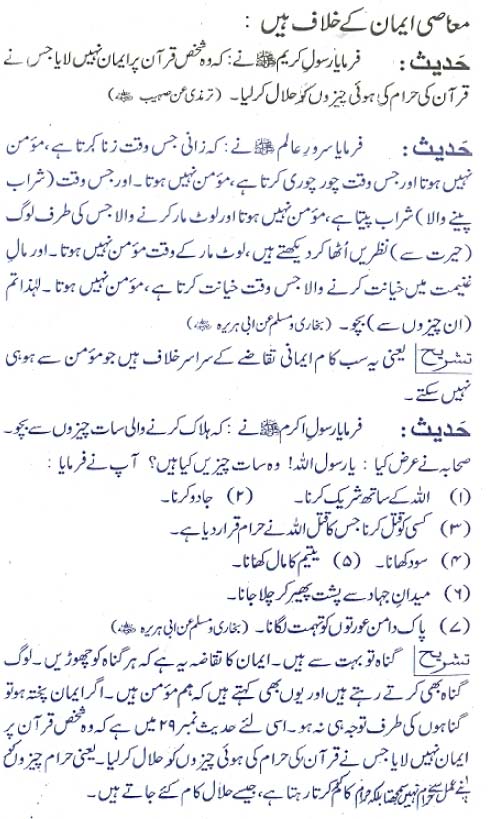
Nuasi (Gunnah, Allah Ki Nafarmani) Iman Kay Khilaf Hai
TAG: Ahadith
Jannat Ki Naimatien Bazuban Rasool e Akram (Sallallahu alaihi wasallam)
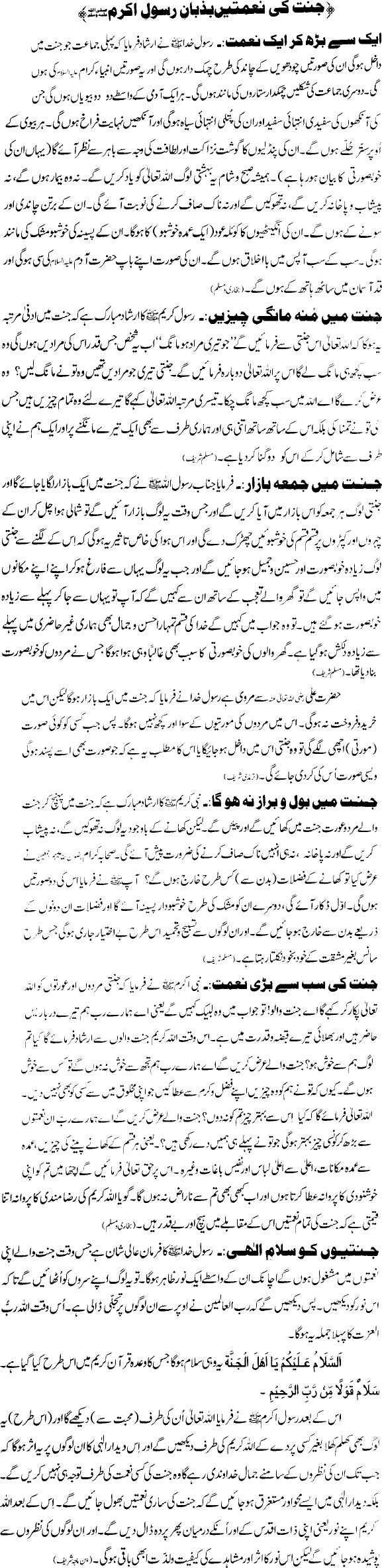
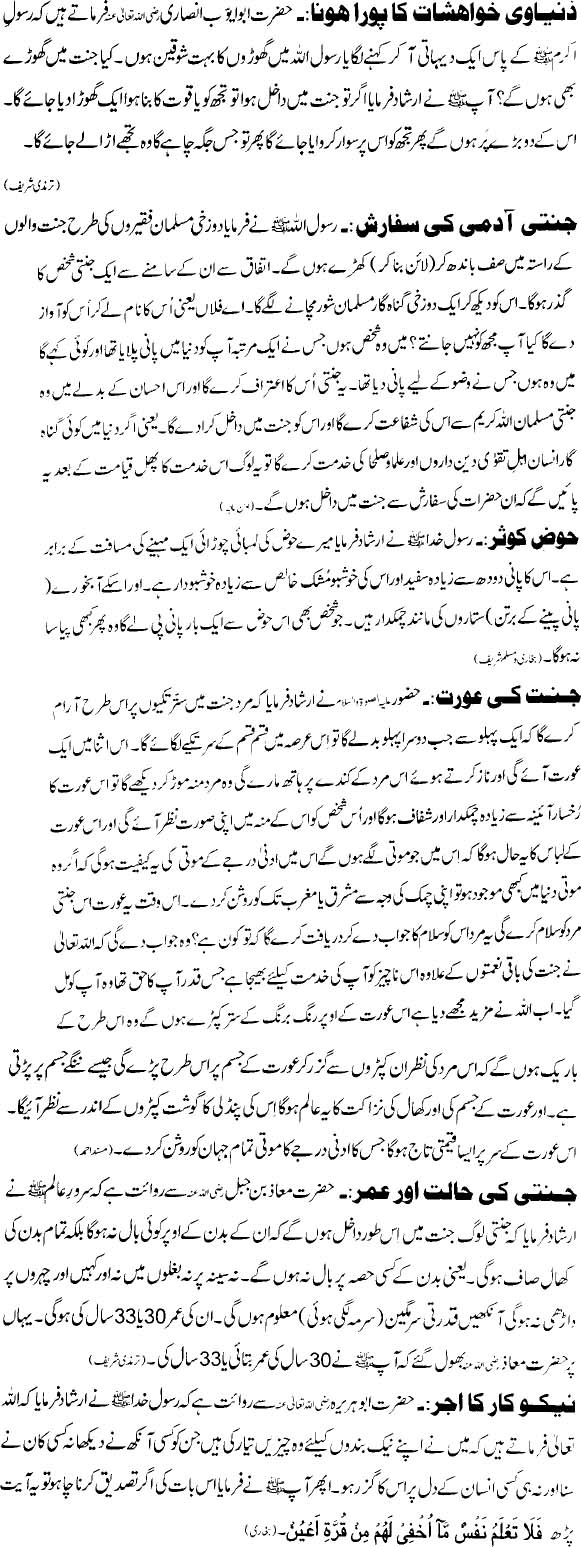
Ahdith: Jannat Ki Naimatien Bazuban Rasool e Akram (Sallallahu alaihi wasallam)
Hazrat Aisha (radi Allahu anha) Ki Ahadith Aur Ayat Ka Nuzool
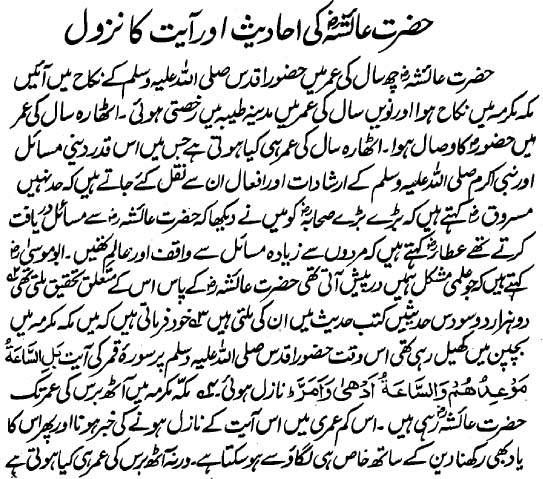
Hazrat Aisha (radi Allahu anha) Ki Ahadith Aur Ayat Ka Nuzool
Miscellaneous Ahadith Of The Day
Hadith – 1
Narrated Anas bin Malik (May Allah Subhanahu wa ta’ala be pleased with him). The Prophet (May Peace, blessings and mercy of Allah Subhanahu wa ta’ala be on him) said, “Take Suhur as there is a blessing in it.”
Sahih Bukhari: Volume 3, Book 31, Number 146
Hadith – 2
Narrated Aisha (May Allah Subhanahu wa ta’ala be pleased with her) (the wife of the Prophet(May Peace, blessings and mercy of Allah Subhanahu wa ta’ala be on her)), Hamza bin ‘Amr Al-Aslami asked the Prophet (May Peace, blessings and mercy of Allah Subhanahu wa ta’ala be on him), “Should I fast while traveling?” The Prophet replied, “You may fast if you wish, and you may not fast if you wish.”
Sahih Bukhari:Volume 3, Book 31, Number 164
Hadith -3
Narrated Jarir (May Allah Subhanahu wa ta’ala be pleased with him), When I gave the pledge of allegiance to Allah’s Apostle (May Peace, blessings and mercy of Allah Subhanahu wa ta’ala be on him) and he (May Peace, blessings and mercy of Allah Subhanahu wa ta’ala be on him) stipulated that I should give good advice to every Muslim.
Sahih Bukhari:Volume 3, Book 50, Number 875
Hadith -4
Narrated Sahl bin Sad (May Allah Subhanahu wa ta’ala be pleased with him), I used to take my Suhur meals with my family and then hurry up to present myself for the (Fajr) prayer with Allah’s Apostle (May Peace, blessings and mercy of Allah Subhanahu wa ta’ala be on him).
Sahih Bukhari:Volume 3, Book 31, Number 143
Hadith – 5
Narrated Abu Huraira (May Allah Subhanahu wa ta’ala be pleased with him), I heard Allah’s Apostle (May Peace, blessings and mercy of Allah Subhanahu wa ta’ala be on him) saying, “If there was a river at the door of anyone of you, and he took a bath in it five times a day, would you notice any dirt on him?” They said, “Not a trace of dirt would be left.” The Prophet (May Peace, blessings and mercy of Allah Subhanahu wa ta’ala be on him) added, “That is the example of the five prayers with which Allah blots out (annuls) evil deeds.”
Sahih Bukhari: Volume 1, Book 10, Number 506
Hadith – 6
Narrated Abu Huraira (May Allah Subhanahu wa ta’ala be pleased with him), Allah’s Apostle (May Peace, blessings and mercy of Allah Subhanahu wa ta’ala be on him) said, “For every prophet there is one (special invocation (that will not be rejected) with which he appeals (to Allah), and I want to keep such an invocation for interceding for my followers in the Hereafter.”
Sahih Bukhari: Volume 8, Book 75, Number 317
Hadith – 7
Narrated Abu Huraira (May Allah Subhanahu wa ta’ala be pleased with him), Allah’s Apostle (May Peace, blessings and mercy of Allah Subhanahu wa ta’ala be on him) said, “When Allah completed the creation, He wrote in His Book which is with Him on His Throne, “My Mercy overpowers My Anger
Sahih Bukhari:Volume 4, Book 54, Number 416
Quraysh Ka Taruf

Quraysh Ka Taruf. Quraysh Kay Bare Mein Ahadith
Surah Al-A’la Say Mutaliq Ahadith

Surah Al-A’la Say Mutaliq Ahadith
Kuch Sabaq Amoz Ahadith Aur Riwayaat

Chand Sabaq Amoz Ahadith Aur Riwayaat by Mufti Muneeb
Miscellaneous Ahadith
Hadith – 1
Narrated ‘Abdullah bin ‘Amr (May Allah Subhanahu wa ta’ala be pleased with him) The Prophet (May Peace, blessings, and mercy of Allah Subhanahu wa ta’ala be on him) said, “Whoever has the following four (characteristics) will be a pure hypocrite and whoever has one of the following four characteristics will have one characteristic of hypocrisy unless and until he gives it up.
- Whenever he is entrusted, he betrays.
- Whenever he speaks, he tells a lie.
- Whenever he makes a covenant, he proves treacherous.
- Whenever he quarrels, he behaves in a very imprudent, evil, and insulting manner.”
Sahih Bukhari:Volume 1, Book 2, Number 33
Hadith – 2
Narrated Ibn Mas’ud (May Allah Subhanahu wa ta’ala be pleased with him) A man said, “O Allah’s Apostle! Shall we be punished for what we did in the Prelslamic Period of ignorance?” The Prophet (May Peace, blessings, and mercy of Allah Subhanahu wa ta’ala be on him) said, “Whoever does well in Islam will not be punished for what he did in the Pre-Islamic Period of ignorance and whoever does evil in Islam will be punished for his former and later (bad deeds).” Sahih Bukhari:Volume 9, Book 84, Number 56
Hadith – 3
Narrated Sahl (May Allah Subhanahu wa ta’ala be pleased with him) The Prophet (May Peace, blessings, and mercy of Allah Subhanahu wa ta’ala be on him) said, “There is a gate in Paradise called Ar-Raiyan, and those who observe fasts will enter through it on the Day of Resurrection and none except them will enter through it. It will be said, ‘Where are those who used to observe fasts?’ They will get up, and none except them will enter through it. After their entry, the gate will be closed and nobody will enter through it.”
Sahih Bukhari:Volume 3, Book 31, Number 120
Chand Sabaq Amoz Ahadith Aur Riwayaat

Chand Sabaq Amoz Ahadith Aur Riwayaat by Mufti Muneeb-ur-Rehman
Hazrat Abu Bakr RA Ka Majmua Ko Jala Dalna

Hazrat Abu Bakr RA Ka Majmua Ko Jala Dalna