

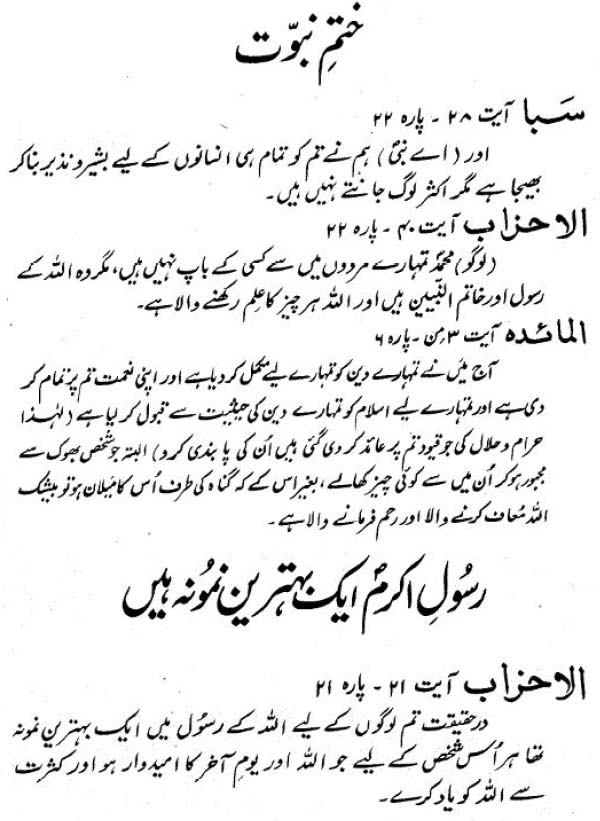
Khatam-e-Nabuwwat, Quran Ki Roshni Mein Aur Rasool Allah (Sallallahu alaihi wasallam) Ka Aswa-e-Husna
TAG: Aswa-e-Husna
The Messenger of Allah (Sal Allahu alaihi wa sallam)
Loving Allah and His messenger (salAllaahu alayhi wa salam) is a duty upon every Muslim. Loving the Prophet of Allah (salAllaahu alayhi wa salam) should be manifested in both our speech and actions. It is not sufficient to simply claim to love the Prophet Muhammad yet continue to disobey Allah and His Messenger. Loving the Prophet Muhammad (salAllaahu alayhi wa salam) means following his Sunnah and avoiding bid’ah.
As Muslims, we should love the Prophet (salAllaahu alahi wa salam) more than we love ourselves and our family. It was narrated that ‘Abd-Allah ibn Hishaam said: We were with the Prophet (salAllaahu alahi wa salam) when he was holding the hand of ‘Umar ibn al-Khattaab. ‘Umar said to him: “O Messenger of Allah, you are dearer to me than everything except my own self.” The Prophet (salAllaahu alahi wa salam) said: “No, by the One in Whose hand is my soul, not until I am dearer to you than your own self.” ‘Umar said to him: “Now, by Allah, you are dearer to me than my own self.” The Prophet (salAllaahu alahi wa salam) said: “Now (you are a true believer), O ‘Umar.” [al-Bukhaari, 6257]
Love of the messenger of Allah (salAllaahu alayhi wa salam) can be shown in various ways. A sign of love for him is to obey him (salAllaahu alayhi wa salam). Allah has commanded us to follow the Prophet (salAllaahu alahi wa salam). Allah says: “And obey Allah and the Messenger (Muhammad)…” [al-Maa’idah 5:92]. When you love someone, you follow them, imitate them and do what you can to please them. Allah has told us that obedience to the Prophet (salAllaahu alahi wa salam) is obedience to Allah. Allah says: “He who obeys the Messenger (Muhammad), has indeed obeyed Allah, but he who turns away, then we have not sent you (O Muhammad) as a watcher over them” [al-Nisa’ 4:80]
By refusing to obey the messenger of Allah (salAllaahu alayhi wa salam) we are, in reality, refusing to enter jannah. “All of my ummah will enter Paradise except those who refuse.” They said: “O Messenger of Allah, who would refuse?” He said, “Whoever obeys me will enter Paradise and whoever disobeys me has refused.” Everything that the Prophet (salAllaahu alayhi wa salam) said and did leads to paradise and eternal salvation, whereas everything he stayed away from and warned against leads to hellfire and eternal condemnation.
Our Lord, Allah, has given us a man as a mercy not only to humans but to the whole of creation. It is our duty to honor him and defend him when others attack him, even after his death. Allah says: “Verily, We have sent you (O Muhammad) as a witness, as a bearer of glad tidings, and as a Warner. In order that you (O mankind) may believe in Allah and His Messenger, and that you assist and honor him, and (that you) glorify (Allah’s) praises morning and afternoon” [al-Fath 48:8-9].
In Search Of The Prophet
I found my source of adoration for you in the love and respect that the Almighty has proclaimed for you; in the honor that He bestowed upon you; in His confirmation of you as “the ultimate exemplar”; “seal of Prophets” and “mercy unto all existence”.
O Prophet of Allah, where shall I find the source of my adoration for you? I have memorized hundreds of your sayings since my youth, taught your seerah (example) to numerous students, grown a beard, used the miswaak, sang, and proudly taught others odes (qasidahs) in praise of you. But I did not find you in these rituals nor did any of these make me anymore like you; rather they merely flung me into the fray of insignificant debates in the arena of so many of the sunnahless Muslims who see your Sunnah only as an endless array of harsh laws and practices or as some justification for their cultural tendencies. O Allah, save me from being of those who consider the Sunnah of Thy beloved as being expressed only through aimless imitations and who know Thy Prophet only as a conveyor of commands and warnings. O Prophet of Allah, I did not truly find you in the books of fatawa (religious edicts), nor in grand seminars and conferences throughout the world, and certainly not in the harsh arguments between groups proclaiming mutually exclusive rights over you. I found my source of adoration for you in the love and respect that the Almighty has proclaimed for you; in the honor that He bestowed upon you; in His confirmation of you as “the ultimate exemplar”; “seal of Prophets” and “mercy unto all existence”. Allah has elevated the very memory of you and has made His boundless love accessible through obedience to you. I catch but a dimension of you through the instances of compassion you extended to others; how you played with the poor orphaned boy when other children refused to play with him, how you prolonged your prostration out of consideration that your change in posture may inconvenience or hurt your beloved grandson who had climbed on your back; how you blessed with Paradise the sinful woman for saving the life of a cat by making the water of the well accessible with her shoes; how you intervened and prevented a man from abusing his wife by teaching him that “the best of men are those who treat their wives the best”; how you patched your clothes, mended your shoes and did your daily household chores; how you wrestled with your nephew and raced with your wife; how you joked with the kids and carried the baggage of the elderly; how you hosted the Christians of Najran in your mosque and stood up to honor the bier of a Jew. O Prophet of Allah, why is it that so many of us who claim to be of you refuse to be like you. We sing for you and dress like you, but do not come near fulfilling the expression of love, care, and beauty that is generated from yourself. Why is it that we see in you that which suits our cultural, organizational, and chauvinistic interests, yet ignore the essence of what is essential to your being. Others who are not of you proclaim the multidimensional and multi-faceted nature of your personality. “The personality of Muhammad is most difficult to get the whole truth of it. Only a glimpse of him I can catch. What dramatic succession of picturesque scenes? There is Muhammad (PBUH) the Prophet; there is Muhammad (PBUH) the General; Muhammad (PBUH) the King; Muhammad (PBUH) the Warrior; Muhammad (PBUH) the Businessman; Muhammad (PBUH) the Preacher; Muhammad (PBUH) the Philosopher; Muhammad (PBUH) the Statesman; Muhammad (PBUH) the Orator; Muhammad (PBUH) the Reformer; Muhammad (PBUH) the Refuge of Orphans; Muhammad (PBUH) the Protector of Slaves; Muhammad (PBUH) the Emancipator of Women; Muhammad (PBUH) the Judge; Muhammad (PBUH) the Saint… In all these magnificent roles and all these departments of human activities, he is equally a hero.” (Professor Ramakrishna Rao). O Prophet! Your life example is an integrated biography, history, and law; it is above all a model of excellence. O Prophet of Allah, you have certainly been adored by many much more worthy than I. Yet, neither the inability to capture my appreciation of you with the eloquence of poets nor my weakness as a believer debars me from qualifying as one who adores you; for in the commemoration of your being do I find the dignity and honor of my existence.
Sadullah Khan
Husn-e-Aqibat Ki Fikr Aswa-e-Ambiya Aur Auliya

Husn-e-Aqibat Ki Fikr Aswa-e-Ambiya Aur Auliya
Imam-ul-Ambiya Hazrat Muhammad SAW Ki Fikr-e-Akhirat
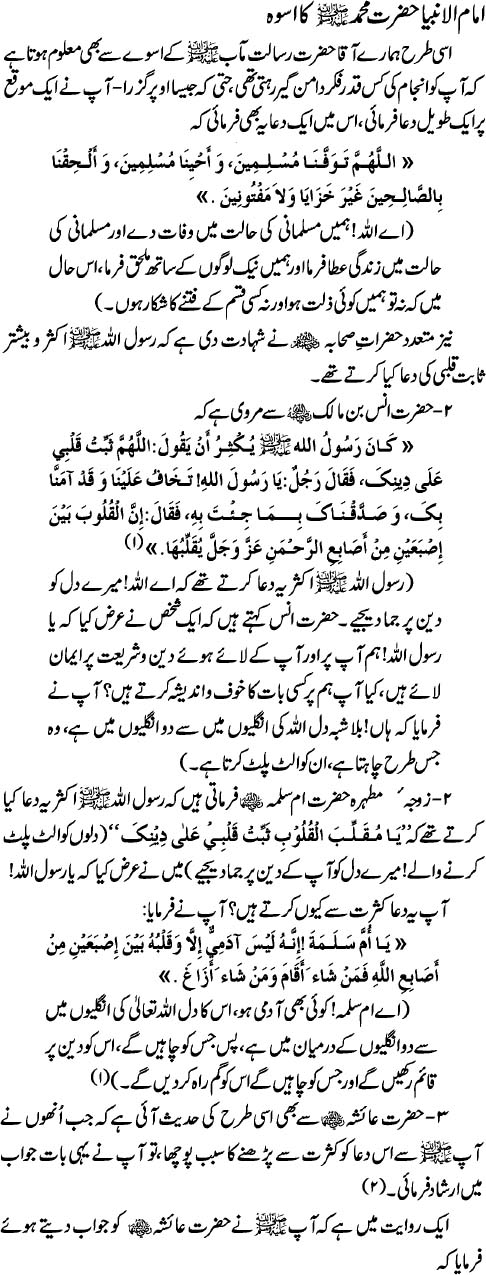
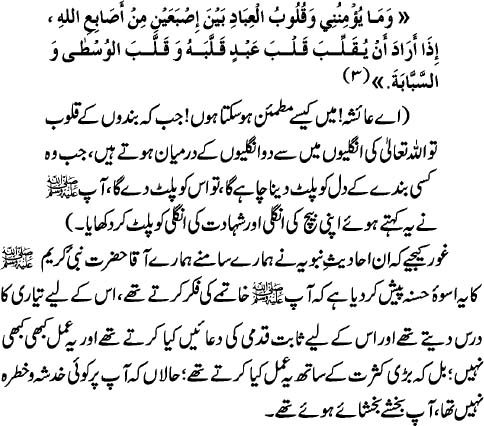
Imam-ul-Ambiya Hazrat Muhammad SAW Ki Fikr-e-Akhirat
Sahaba Karam Ki Nazar Mein Sunnat
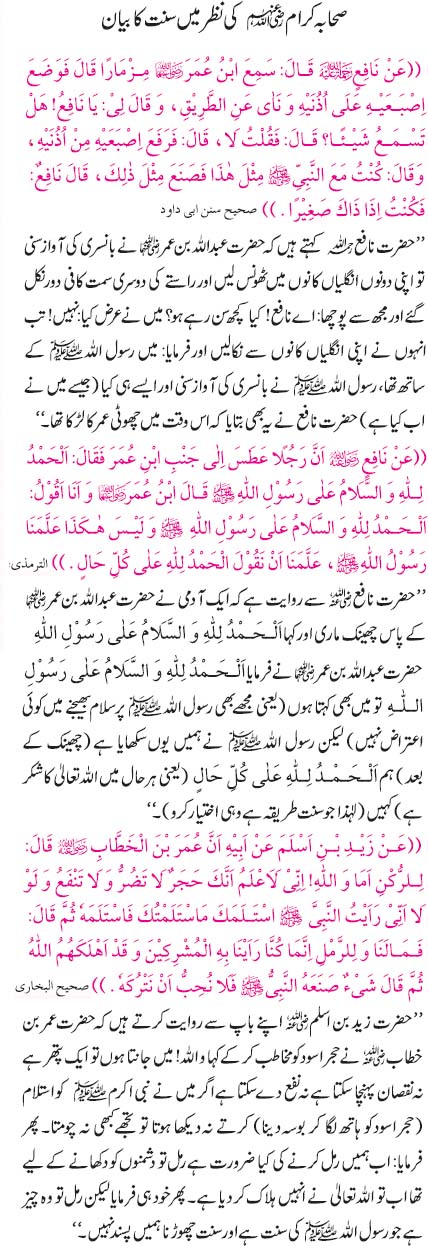
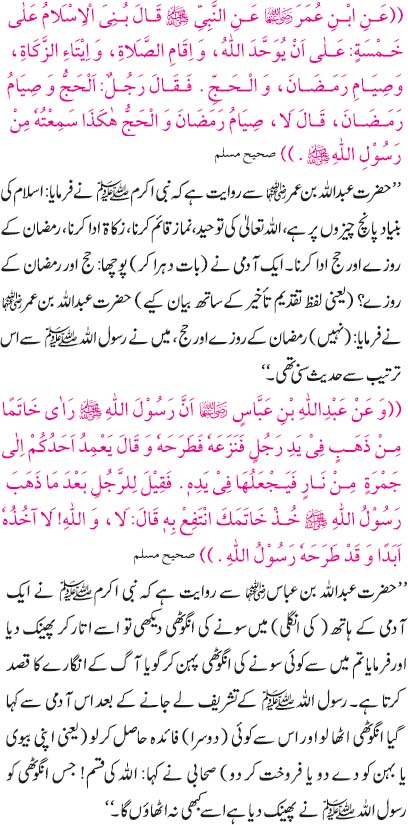
Sahaba Karam Ki Nazar Mein Sunnat
Baad Az Khuda Buzurg Tuee, Qissa Mukhtasar
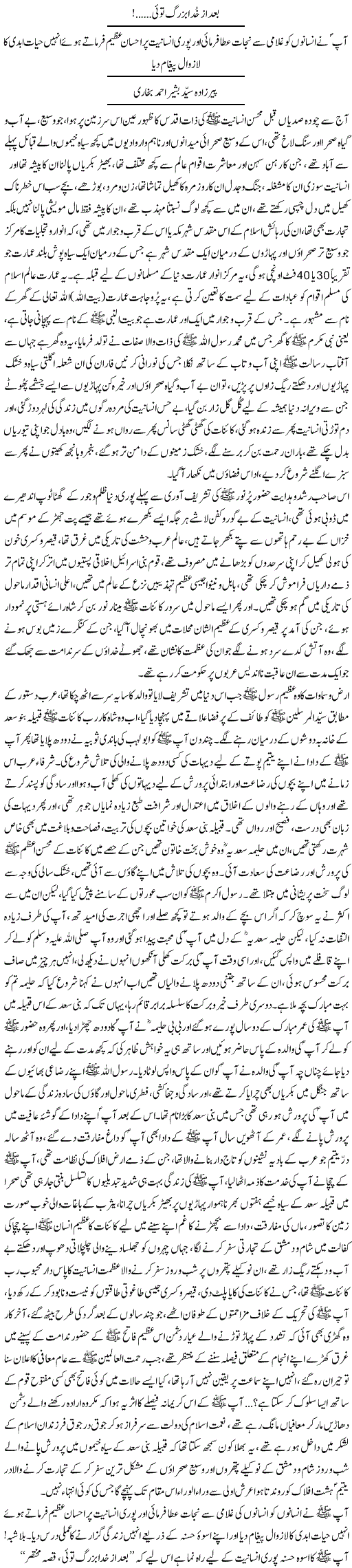
Baad Az Khuda Buzurg Tuee, Qissa Mukhtasar
Fard, Muashra Aur Akhlaq e Nabvi

Fard, Muashra Aur Akhlaq e Nabvi
Sunnat Ki Ahmiyat
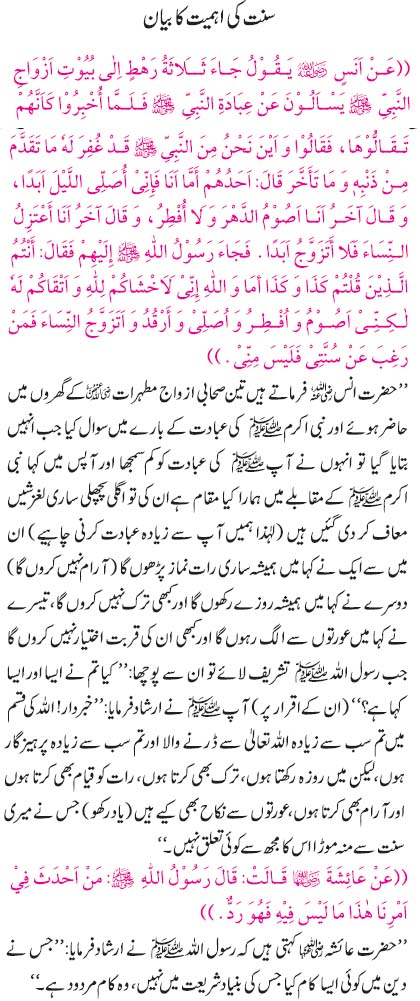
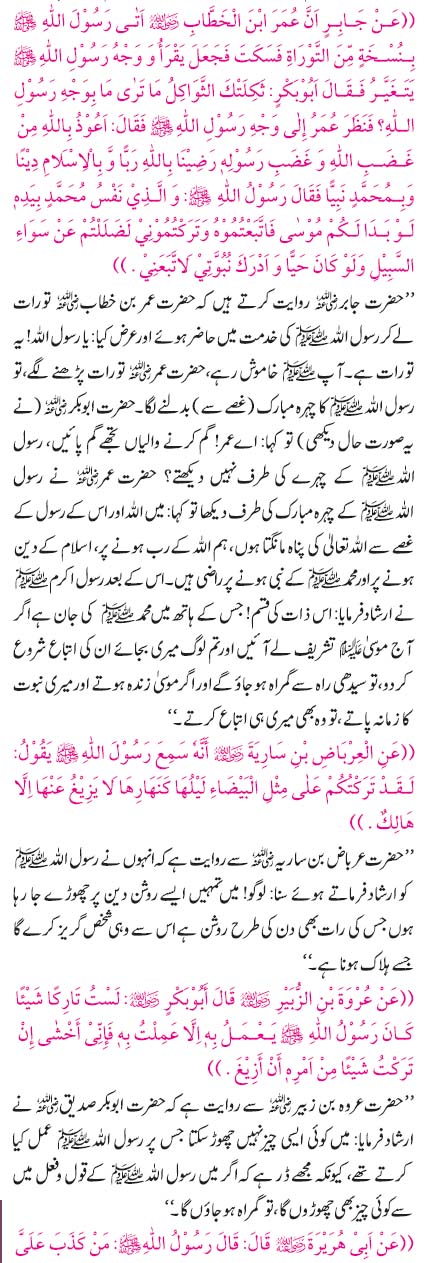
Sunnat Ki Ahmiyat
Nabi-e-Kareem (PBUH) Ki Sahaba Karam Par Rehmat Aur Shafqat

Nabi-e-Kareem (PBUH) Ki Sahaba Karam Par Rehmat Aur Shafqat by Molana Muhammad Tariq Noman Garangi